

Scientific Name : Mentzelia multicaulis
Author : (Osterhout) A. Nels. ex J. Darl. NatureServe Explorer
Common Name : Many- stem Stickleaf
 Current Research Activities


☰ Click link below for details.
Taxonomy
Loasaceae (blazingstar family)
Holmgren and Holmgren (2002) split Mentzelia multicaulis into four varieties of which M. multicaulis var. multicaulis and M. multicaulis var. uintahensis occur in Colorado. Flora of North America (2016) and Schenk and Hufford (2020) recognize these varieties as M. multicaulis and M. uintahensis. Eagle, Garfield, Grand and Summit county populations have been determined to be M. multicaulis and Rio Blanco, Moffat, and Mesa county populations in Colorado have been determined to be M. uintahensis (Ackerfield 2015). Weber and Wittmann (2012) refer to this taxon as Nuttallia multicaulis and do not recognize the varieties.
Ranks and Status
State Rank : S3
State Rank Reason : Mentzelia multicaulis is endemic to north-central Colorado, USA, where it is known from about 60 occurrences. Potential threats include off-road vehicle use, road construction and maintenance, and long-term drought and habitat shifting and alteration related to climate change.
U.S. Endangered Species Act : none
Colorado Threatened and Endangered List : none
Other Statuses : SWAP Tier 2
Description and Phenology
General Description:
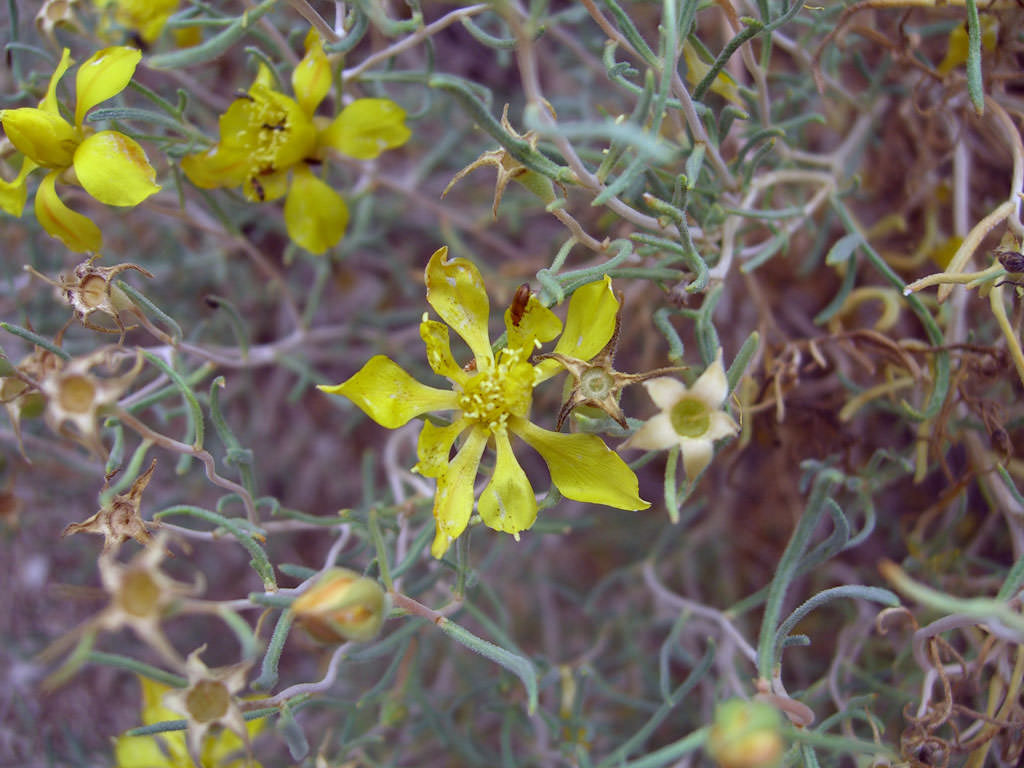
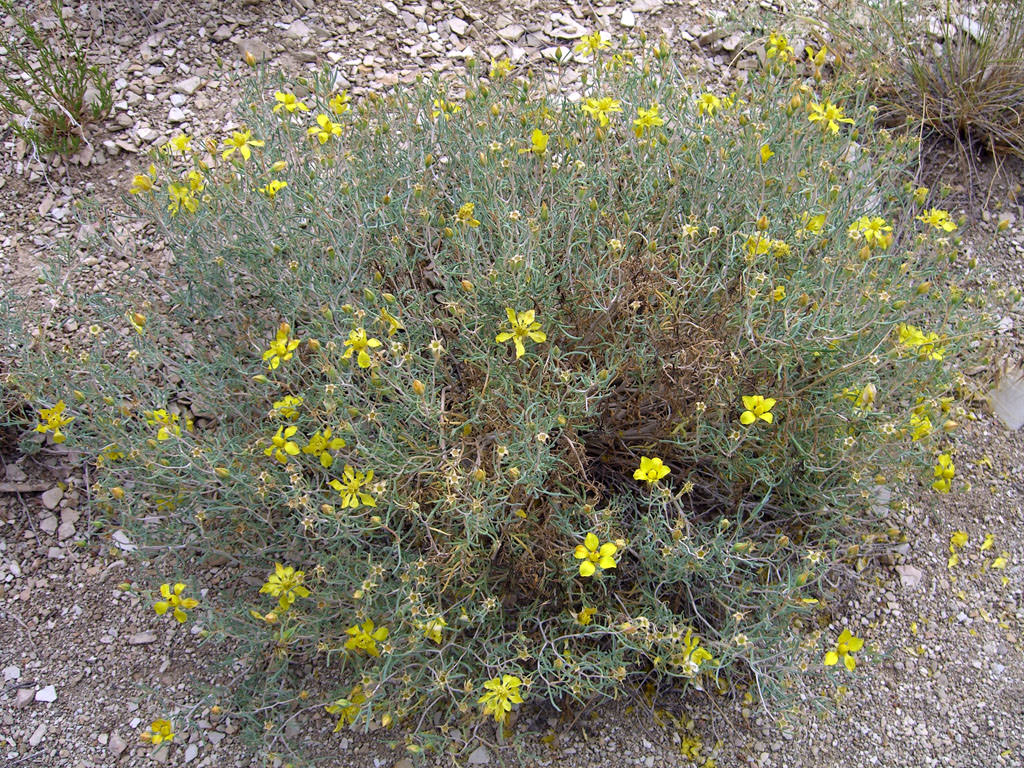
Plants are slender and much branched. Leaves are narrow, deeply pinnatisect. Flowers are glabrous, with 5 bright yellow petals and 5 petal-like staminodia. Petals and staminodia are broad, 6-9 mm wide and 9-10 mm long.
Look Alikes:
The plants are characterized by diffusely branched stems up to 3 dm tall, simple pinnatifid leaves with narrow lobes, and scarcely winged seeds (Thorne and Smith 1986).
Phenology:
Plants produce flowers and fruit June-August (Colorado Natural Heritage Program 2012).
Habitat
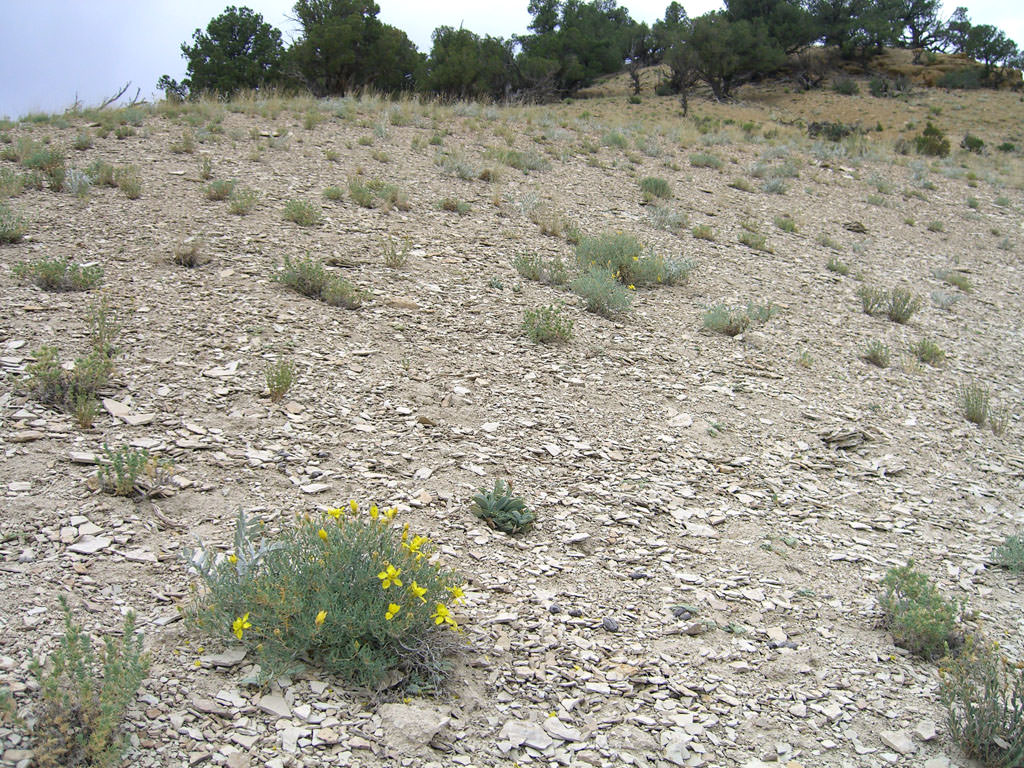
Found on sparsely vegetated, white, grey, or black shale slopes (Ackerfield 2012, CNHP 2012). Associated taxa include Chrysothamnus, Artemisia, Atriplex, Amelanchier, Eriogonum, Astragalus, Cirsium, Heterotheca, Tetraneuris, Machaeranthera, Gutierrezia, Penstemon, Hilaria jamesii, Pseudoroegneria spicata, and Achnatherum hymenoides. Also found in pinyon-juniper woodlands (CNHP 2012).
click on image to enlarge
 |
Elevation Range:
4,750 - 9,846 feet (1,448 - 3,001 meters)
Distribution
Colorado Endemic:
Yes
Range:
Mentzelia multicaulis is endemic to Colorado, USA, and is known from Eagle, Grand, and Summit counties. Estimated range extent in Colorado of 2,535 square kilometers was calculated in GeoCAT using occurrence data provided by the Colorado Natural Heritage Program (2024).
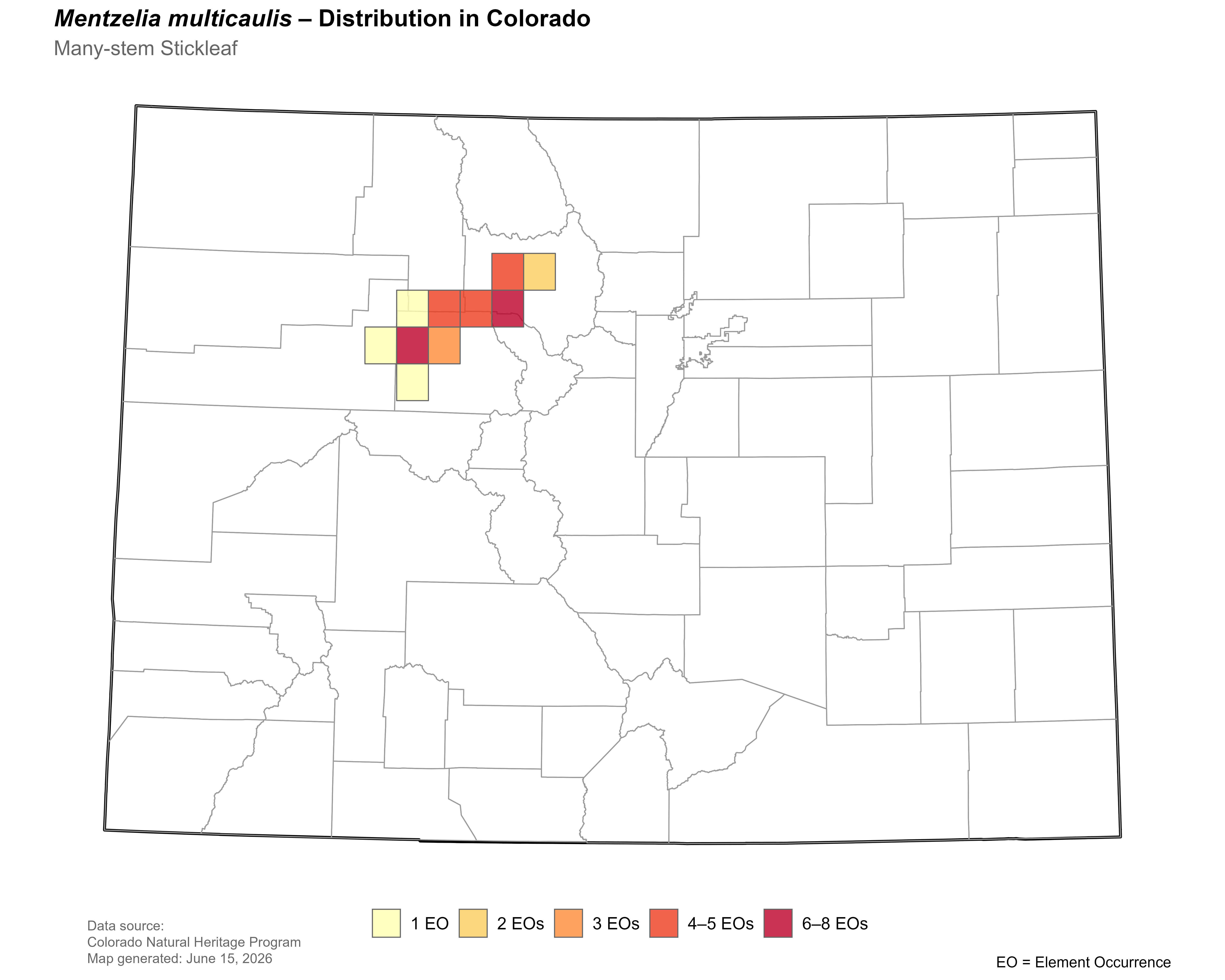
Click on map to enlarge |
Threats and Management Issues
Management concerns have been reported from 38% of the occurrences; potential threats include off-road vehicle use, road construction and maintenance, powerline maintenance, and competition from invasive species such as Bromus tectorum and Halogeton glomeratus. One site is bisected by a transmission line, and another is adjacent to Wolford Mountain Reservoir dam and spillway where they may be impacted by maintenance activities. This species is considered to have moderate adaptive capacity and is expected to be moderately vulnerable to climate change under both RCP 4.5 and 8.5 scenarios, as assessed for the 2025 Colorado State Wildlife Action Plan (CNHP 2025).
References
- Ackerfield, J. 2012. The Flora of Colorado. Colorado State University Herbarium. 433 pp.
- Colorado Natural Heritage Program (CNHP). 2024. Biodiversity Tracking and Conservation System (Biotics 5). Colorado Natural Heritage Program, Colorado State University, Fort Collins.
- Colorado Natural Heritage Program (CNHP). 2025. Climate Change Vulnerability Assessment of Colorado Tier 1 and Tier 2 Plant Species of Greatest Conservation Need (SCGN) for the 2025 Colorado State Wildlife Action Plan. Colorado Natural Heritage Program, Colorado State University, Fort Collins.
- Colorado Natural Heritage Program. 2012. Biodiversity Tracking and Conservation System. Colorado State University, Fort Collins, CO.
- Goodrich, S., and E. Neese. 1986. Uinta Basin flora. U.S. Forest Service, Intermountain Region, Ogden, Utah. 320 pp.
- Harrington, H.D. 1954. Manual of the plants of Colorado. Sage Press, Chicago. 666 pp.
- Holmgren., N. H. and P. K. Holmgren. 2002. New Mentzelias (Loasaceae) from the Intermountain region of western United States. Systematic Botany 27(4): 747-762.
- Kartesz, J.T. 1994. A synonymized checklist of the vascular flora of the United States, Canada, and Greenland. 2nd edition. 2 vols. Timber Press, Portland, OR.
- Lavender, A.E., M.M. Fink, S.E. Linn, D.M. Theobald. 2011. Colorado Ownership, Management, and Protection v9 Database. Colorado Natural Heritage Program and Geospatial Centroid, Colorado State University, Fort Collins, CO. (30 September).
- Thorne, K. H. and F. J. Smith. 1986. New variety of Mentzelia multicaulis (Loasaceae) from the Book Cliffs of Utah. Western North American Naturalist, Vol 46, No. 3.
- USDA, NRCS. 2022. The PLANTS Database. National Plant Data Team, Greensboro, NC 27401-4901 USA.
- Weber, W. A. and R. C. Wittmann. 2012. Colorado Flora, Western Slope, A Field Guide to the Vascular Plants, Fourth Edition. Boulder, Colorado. 532 pp.
- Welsh, S.L., N.D. Atwood, S. Goodrich, and L.C. Higgins (eds.) 1993. A Utah flora. 2nd edition. Brigham Young Univ., Provo, Utah. 986 pp.