

Scientific Name : Apios americana
Author : Medik. NatureServe Explorer
Common Name : American Groundnut
 Current Research Activities


☰ Click link below for details.
Taxonomy
Fabaceae (pea family)
Apios americana is the only representative of this genus in Colorado.
Ranks and Status
State Rank : S1
State Rank Reason : This species has only six documented extant occurrences in Colorado (USA), along the Front Range of the Rocky Mountains. The population size is very small (perhaps 100 individuals). Bank erosion, ditch cleaning, grazing, and exotic species threaten the populations of Apios americana. The effects of climate change on this species are unknown in Colorado.
U.S. Endangered Species Act : none
Colorado Threatened and Endangered List : none
Other Statuses : none
Description and Phenology
General Description:
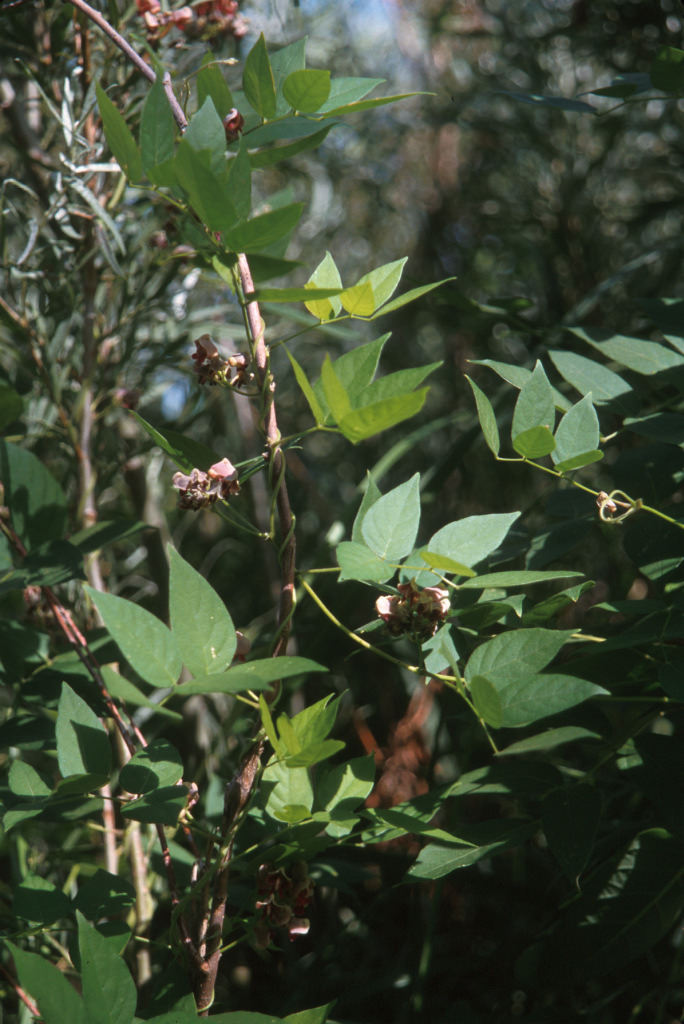
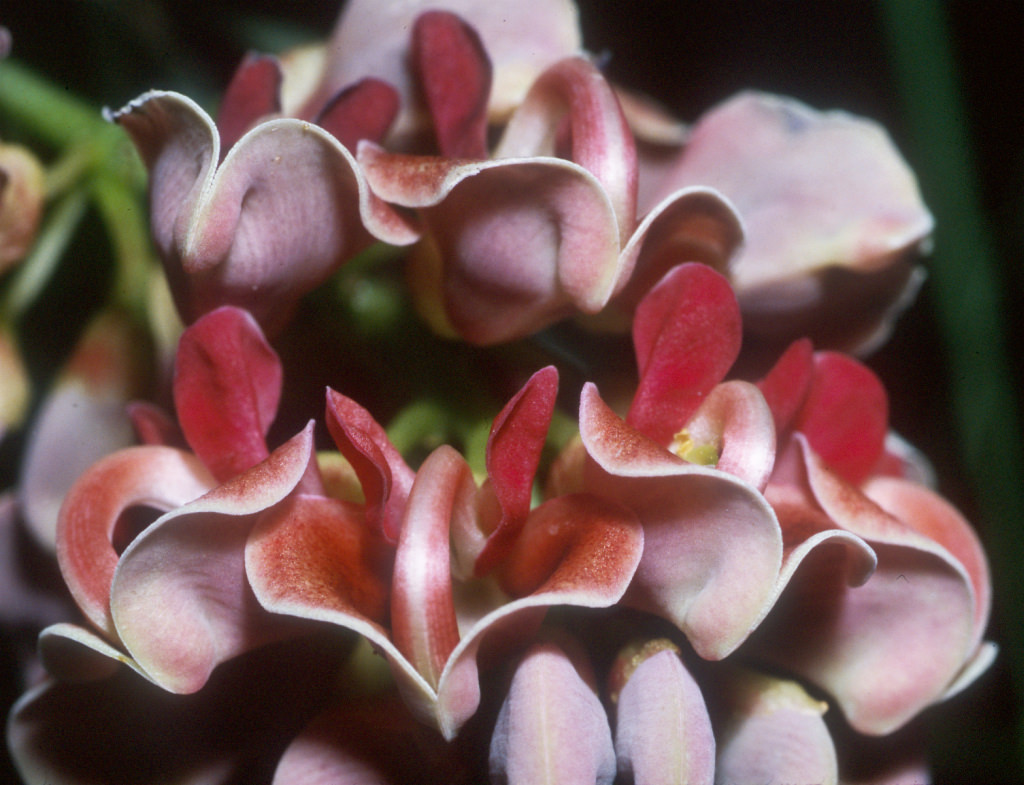
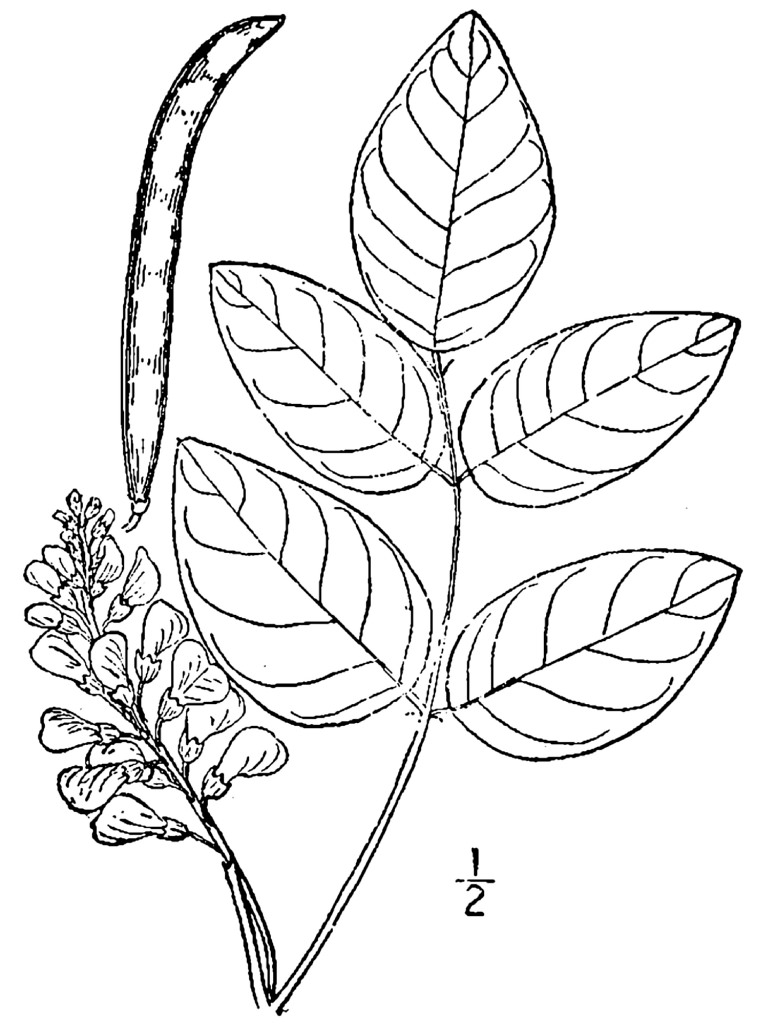
Apios americana is a perennial twining or trailing herbaceous vine, 1 to 5 meters long, with tuberous roots. Its alternate leaves have small stipules and 5 to 7 leaflets. The leaflets are ovate, acute, and 2 to 10 cm long. Plants can be glabrous to pubescent. The flowers are pedicellate and born in axillary racemes. The calyx is green or red tinted. Flowers are 8 to 10 millimeters long with five petals and a papilionaceous corolla. The banner is reflexed, whitish-pink dorsally and reddish-maroon ventrally with brown and green markings in the throat. The wings are pinkish-red and white around the distal edge. Five sepals are united, bilabiate, the upper four lobes very short or absent, the lower lobes longer. Fruits are straight or slightly curved, 5-10 mm long x 6-12 mm wide, usually with 1 seed (Anderson and Spackman 2001, Culver and Lemly 2013, Ackerfield 2015).
Look Alikes:
No other legume in Colorado has the combination of pinnate leaves, creeping habit and purple-brown flowers (Weber and Wittmann 2012, Culver and Lemly 2013).
Phenology:
Flowers July-September (Ackerfield 2015).
 |
Habitat
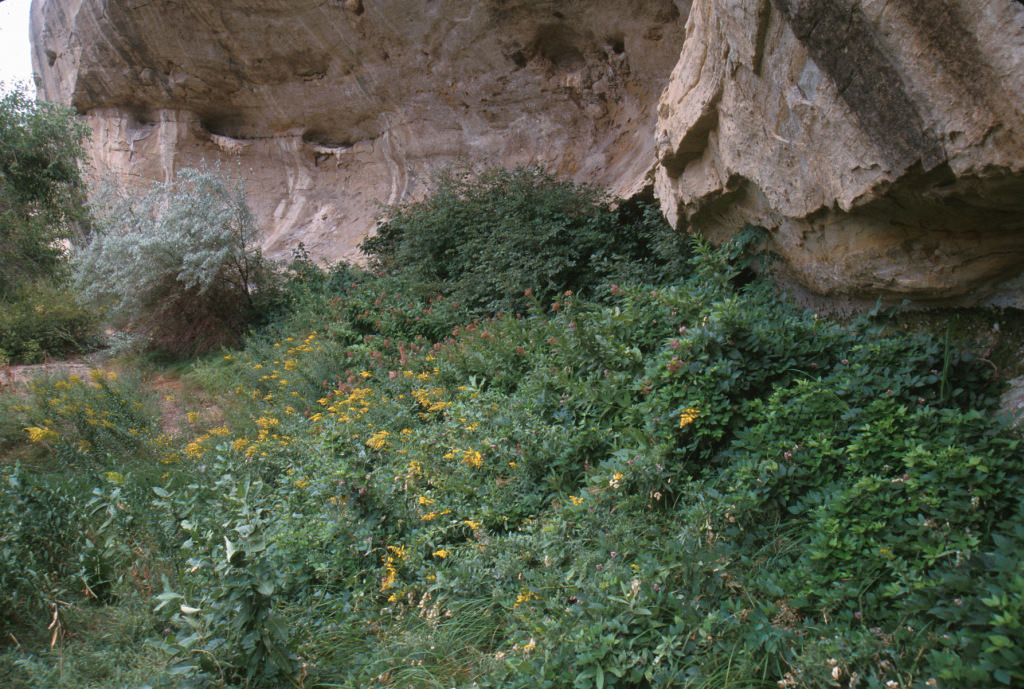
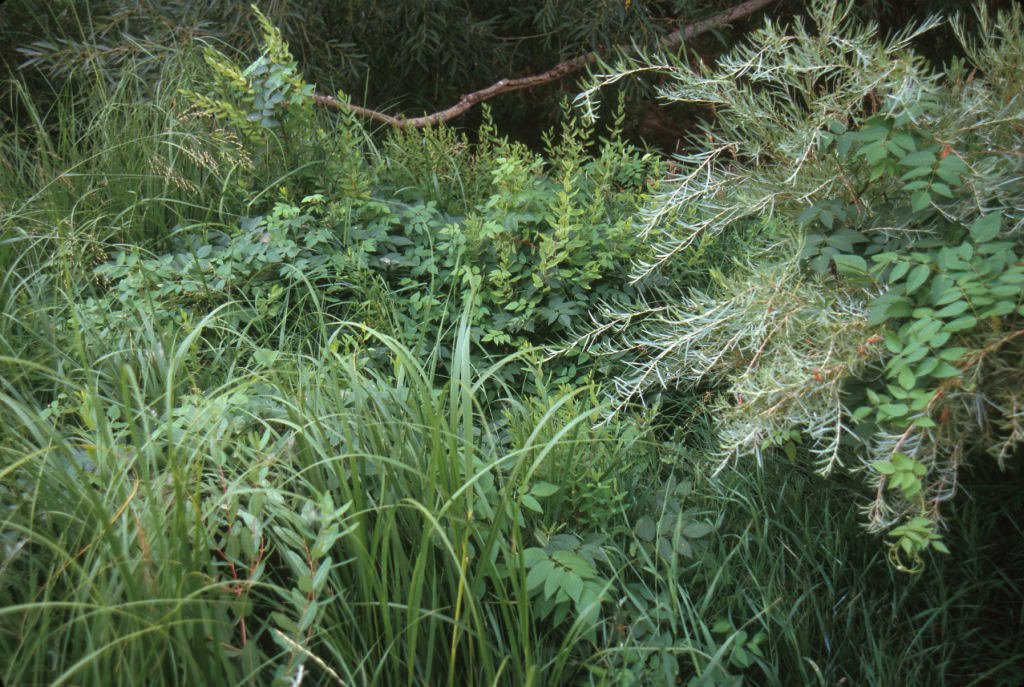
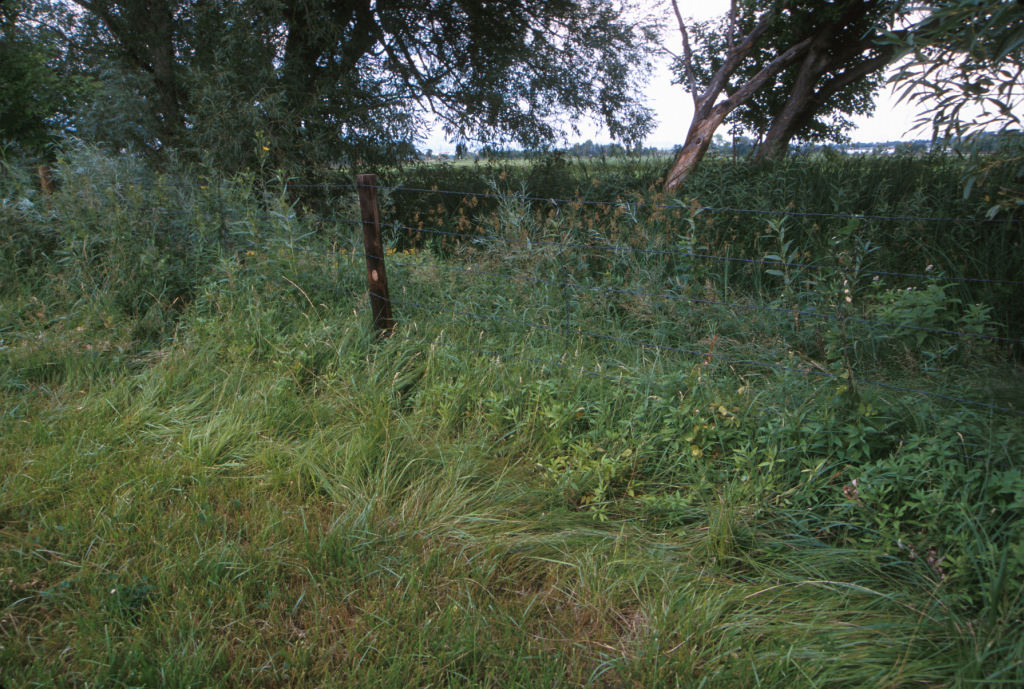
In Colorado, one of the known occurrences is located on a river bank, three are adjacent to irrigation ditches, and one is on a shaded, south-facing sandstone cliff on a seep (Anderson and Spackman 2001, Colorado Natural Heritage Program 2016). Moist, shady thickets and along streams (Ackerfield 2015, Culver and Lemly 2013).
click on image to enlarge
 |
 |
 |
Elevation Range:
5,097 - 5,920 feet (1,554 - 1,804 meters)
Distribution
Colorado Endemic:
No
Range:
There are extant occurrences of Apios americana in Boulder and Fremont counties, Colorado, USA. The species was collected in the Denver area by Alice Eastwood in 1890, and this occurrence is presumed to be extirpated. Dr. William Weber mentioned that it had been documented by unknown botanists in the 1870's in the vicinity of Wray, Colorado. Estimated range extent in Colorado of 592 square kilometers was calculated in GeoCAT using occurrence data provided by the Colorado Natural Heritage Program (2023). In the USA this species is known from Alabama, Arkansas, Delaware, Florida, Georgia, Illinois, Iowa, Kansas, Kentucky, Louisiana, Maine, Maryland, Massachusetts, Michigan, Minnesota, Mississippi, Missouri, Nebraska, New Hampshire, New Jersey, New York, North Carolina, North Dakota, Ohio, Oklahoma, Pennsylvania, Rhode Island, South Carolina, South Dakota, Tennessee, Texas, Vermont, Virginia, West Virginia, and Wisconsin; the Colorado populations are disjunct. Globally, this species can be found in New Brunswick, Nova Scotia, Ontario, Prince Edward Island, and Quebec, Canada (USDA NRCS 2017).
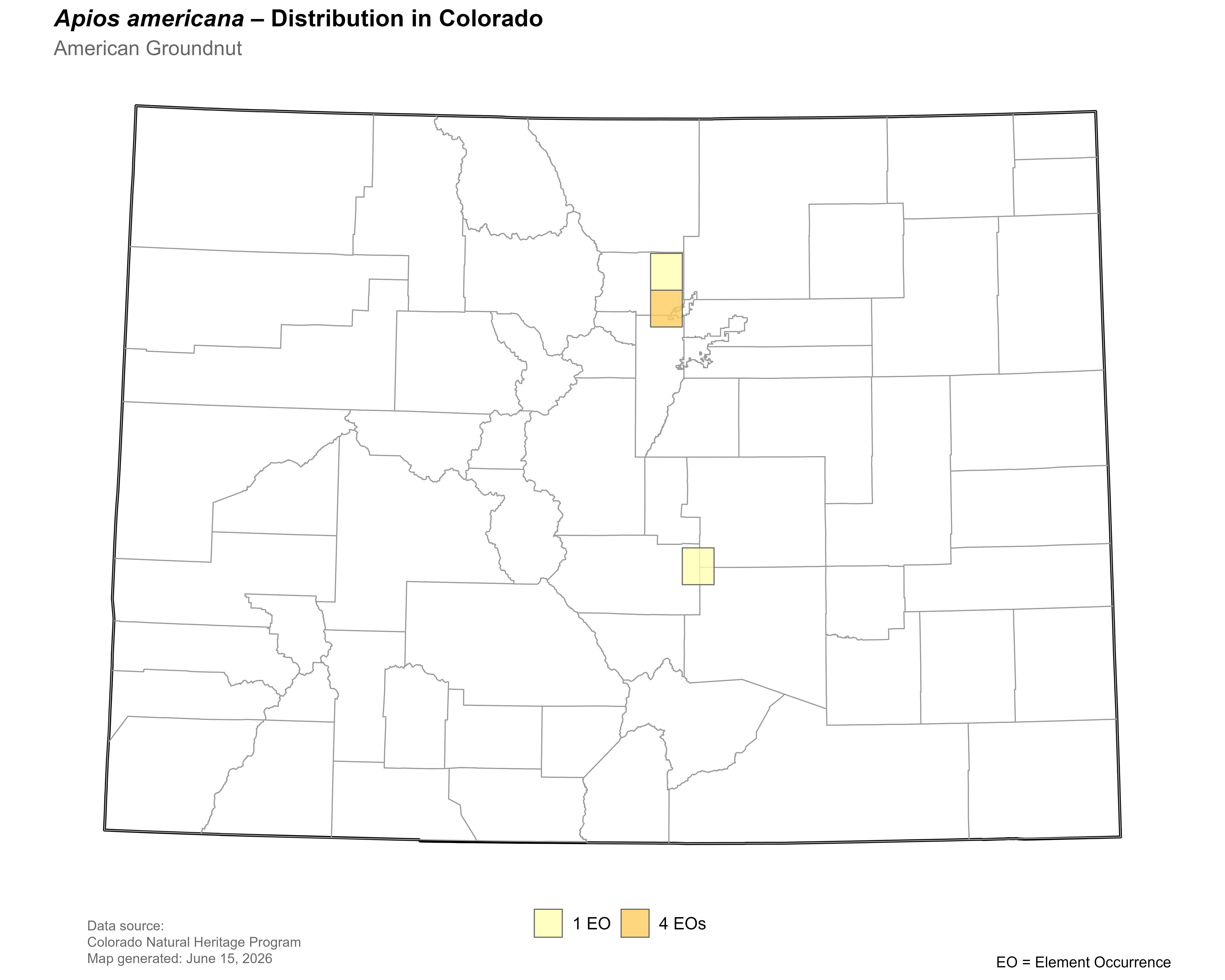
Click on map to enlarge |
Threats and Management Issues
Threats to the Colorado populations include ditch cleaning, bank erosion, invasion of exotic species, disturbed stream banks, mowing, haying, and grazing. Colorado climate scenarios for 2050 suggest temperature will increase by 3-7 F and precipitation may decrease or increase. The impact to any given rare plant habitat is likely to vary. Long-term monitoring that includes weather and soil moisture data is critical to understanding climate impacts.
References
- Ackerfield, J. 2015. Flora of Colorado. BRIT Press, Botanical Research Institute of Texas, Fort Worth, TX. 818 pp.
- Anderson, D. and S. Spackman. 2001. Inventory and Status Report for American Groundnut (Apios americana Medicus) in Colorado. Unpublished Report Prepared for the City of Boulder Open Space Department.
- Britton, N. L. and A. Brown. 1913. An Illustrated Flora of the Northern United States and Canada. 3 vol. Dover Publications, Inc., N. Y. 2052 pp.
- Colorado Natural Heritage Program (CNHP). 2023. Biodiversity Tracking and Conservation System (Biotics 5). Colorado Natural Heritage Program, Colorado State University, Fort Collins.
- Colorado Natural Heritage Program and the Geospatial Centroid. 2017. The Colorado Ownership and Protection Map (COMaP). Colorado State University, Ft. Collins, CO.
- Culver, D.R. and J.M. Lemly. 2013. Field Guide to Colorado's Wetland Plants; Identification, Ecology and Conservation. Colorado Natural Heritage Program, Colorado State University, Fort Collins, 694 pp.
- Great Plains Flora Association. 1986. Flora of the Great Plains. University Press of Kansas, Lawrence, KS. 1402 pp.
- Kartesz, J.T. 1994. A synonymized checklist of the vascular flora of the United States, Canada, and Greenland. 2nd edition. 2 vols. Timber Press, Portland, OR.
- USDA, Natural Resources Conservation Service, PLANTS Database [USDA PLANTS]. http://plants.usda.gov/. Accessed 2017.
- USDA, NRCS. 2022. The PLANTS Database. National Plant Data Team, Greensboro, NC 27401-4901 USA.
- Weber, W. A. and R. C. Wittmann. 2012. Colorado Flora, Eastern Slope, A Field Guide to the Vascular Plants, Fourth Edition. Boulder, Colorado. 555 pp.