

Scientific Name : Boechera crandallii
Author : (B.L. Robins.) W.A. Weber NatureServe Explorer
Common Name : Crandall's Rockcress
 Current Research Activities
☰ Click link below for details.
Taxonomy
Brassicaceae (mustard family)
=Arabis crandallii (USDA NRCS 2012). Windham et al. (2022) provide new combinations for B. kelseyana, B. thompsonii, and B. villosa as subspecies of B. crandallii which expands the range of B. crandallii to Arizona, New Mexico, and Utah [in addition to Colorado and Wyoming].
Ranks and Status
State Rank : S3S4
State Rank Reason : There are over 50 occurrences of B. crandallii, with rangewide low level threats from resource extraction, recreation, road development, and grazing. Prolonged drought throughout the species range is also a concern.
U.S. Endangered Species Act : none
Colorado Threatened and Endangered List : none
Other Statuses : USFS GMUG
Description and Phenology
General Description:
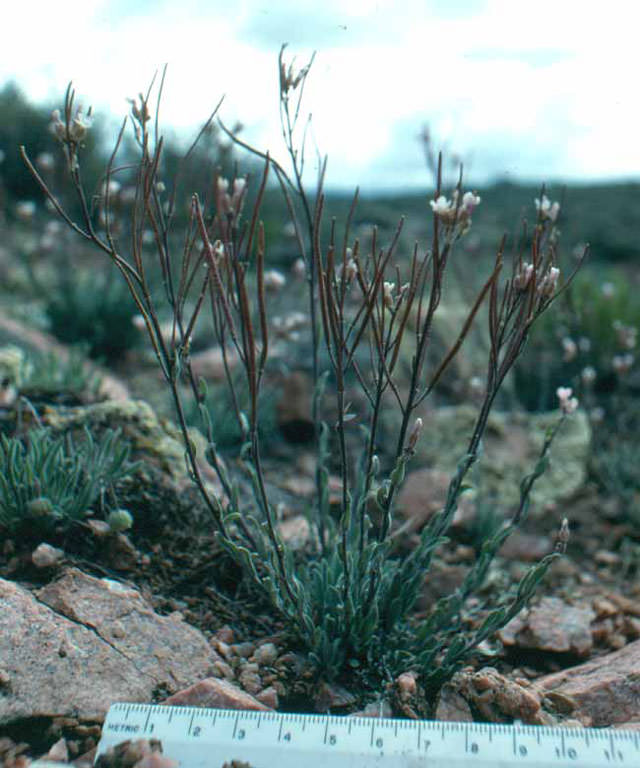
Perennial with a branched caudex, stems slender and numerous, erect, rarely branched, densely pubescent to sparsely so, 1.5-4 dm high. Basal leaves are numerous, entire, occassionally somewhat toothed, oblanceolate in shape and pubescent, 1.5-3 cm long. Upper leaves are oblong to lanceolate, hairy and 8-15 mm long. Flower petals are white-pinkish 5-7 mm long and 2-3 mm wide. Fruits (siliques) are smooth, slender pods 3-6 cm long, with constrictions between the seeds. Seeds are round to slightly oblong, wingless to very narrowly winged (Ladyman 2005, Rollins 1993).
Look Alikes:
Boechera pallidifolia has broader siliques, purplish flowers, and is more densely caespitose (B. crandallii is caespitose but with few stems; Ladyman 2005, Weber and Wittmann 2012).
Phenology:
Flowers from May through June (Rollins 1993, Colorado Natural Heritage Program 2012).
Habitat
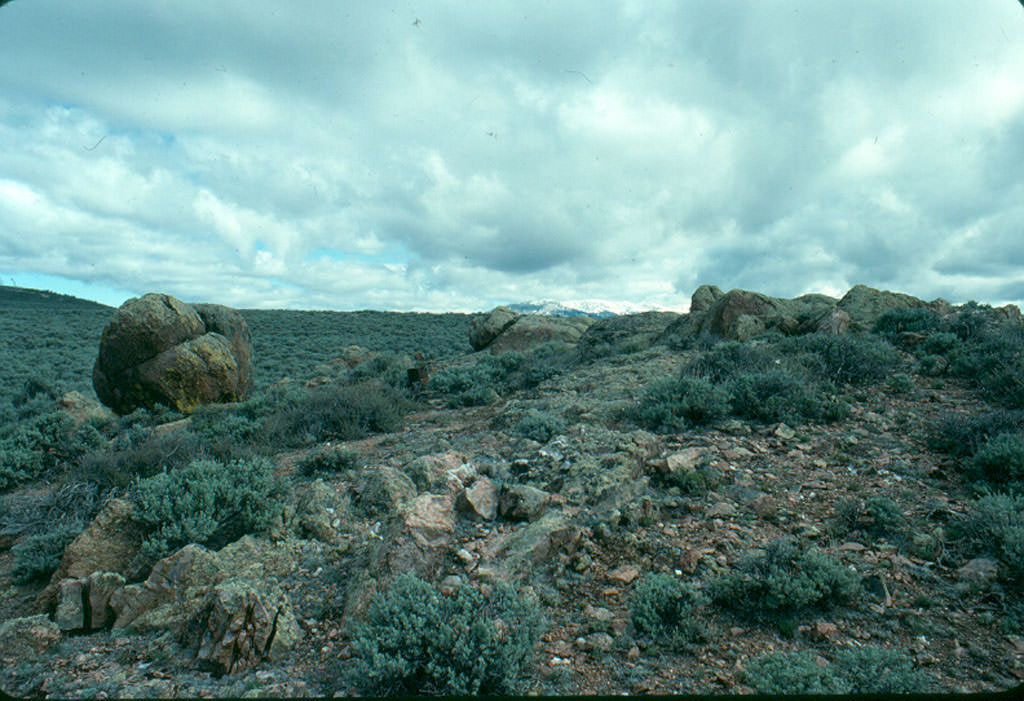
This plant grows in limestone chip-rock and stony areas, often among sagebrush, ridges, and steep hill slopes (Rollins 1993). It is commonly growing with Boechera pallidiflora (Weber and Wittmann 2012). According to Rollins (1993), Boechera crandallii and B. pallidifolia grow in the same area but colonize different habitats; B. crandallii grows in more open, sometimes windswept places whereas B. pallidifolia grows in relatively protected places frequently associated with sagebrush (Ladyman 2005). Associated species include Pinus ponderosa, Cercocarpus montanus, Ribes cereum, Artemisia vaseyana, Ribes cereum, and Purshia tridentata (Colorado Natural Heritage Program 2012).
click on image to enlarge
 |
Elevation Range:
6,509 - 11,146 feet (1,984 - 3,397 meters)
Distribution
Colorado Endemic:
No
Range:
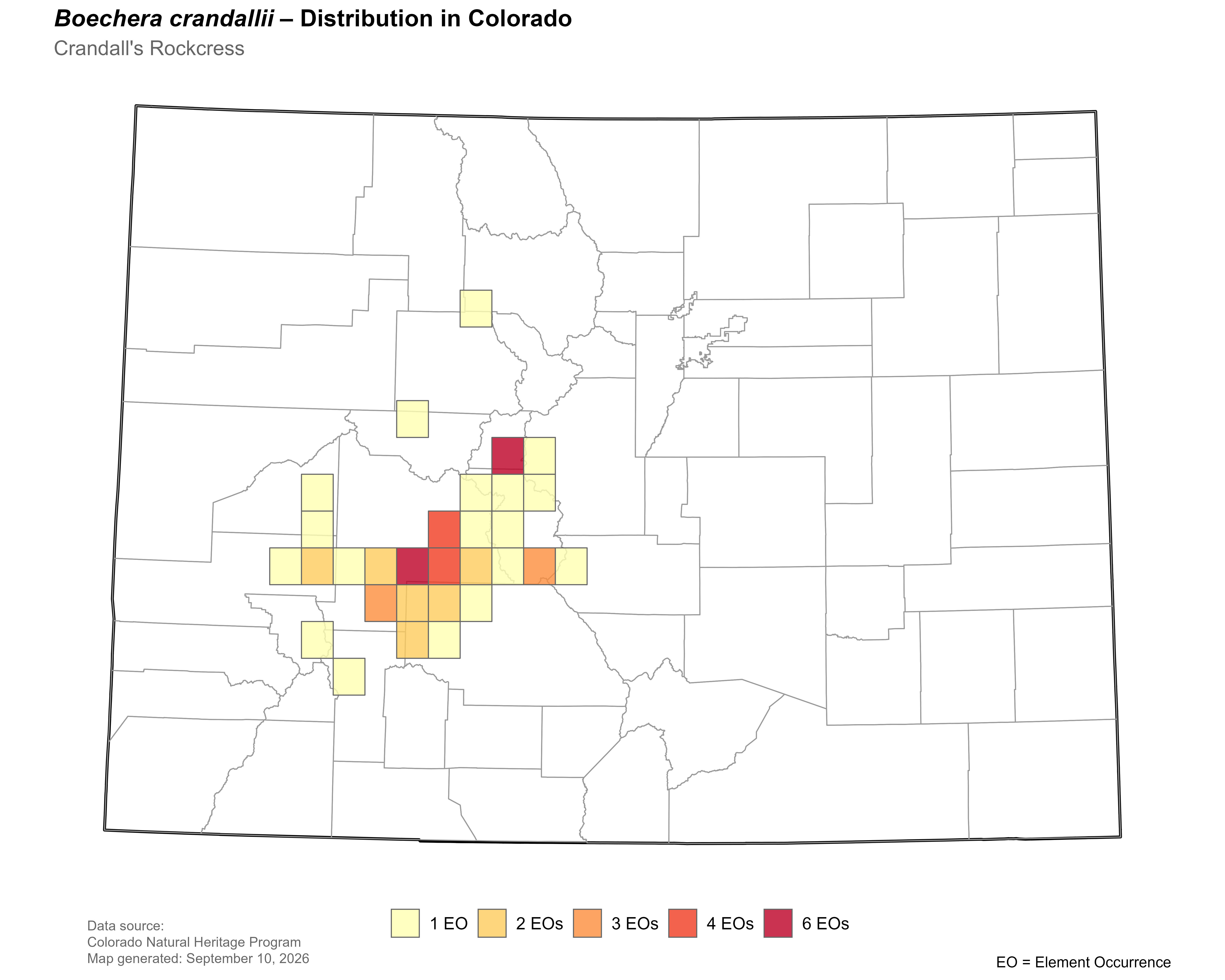
The species range in Colorado is 20,609 square kilometers calculated in GeoCAT in 2022. SEINet 2022 reports this species from eight counties in west-central Colorado (Chaffee, Delta, Eagle, Grand, Gunnison, Hinsdale, Lake, Montrose, Park, and Saguache counties). However, Alexander 2013 reports that the Grand and Park county specimens may be misidentified. Also known from southern Wyoming, USA.
Click on map to enlarge |
Threats and Management Issues
As of 2022, 62% of the occurrences are found in habitat with minimal to low levels of landscape disturbance, and the remainder in areas with moderate to high levels of landscape disturbance (CNHP 2021). At the local level logging, recreation, road development, grazing and prolonged drought are the primary threats to Arabis (Boechera) crandallii. Invasion of habitat by non-native species is also a source of concern. The species is likely only moderately competitive and may be out-competed by non-native plant species. Occurrences on land managed by the USDA Forest Service Region 2 are likely to be most vulnerable to invasive weeds encroaching in their habitat, activities associated with recreation, campground and road improvement, and livestock grazing. Details of imminent threats to specific occurrences are unavailable. Long-term population sustainability may be vulnerable to long term drought and declines in pollinator populations. Actions that substantially reduce the numbers of individuals within a population may exacerbate the potential for inbreeding depression that would reduce population viability (Ladyman 2005). This species is considered to be extremely vulnerable to climate change (Handwerk et al. 2015).
References
- Ackerfield, J. 2015. Flora of Colorado. BRIT Press, Botanical Research Institute of Texas, Fort Worth, TX. 818 pp.
- Colorado Natural Heritage Program. 2012. Biodiversity Tracking and Conservation System. Colorado State University, Fort Collins, CO.
- Colorado Natural Heritage Program. 2021. Landscape Disturbance Index Layer for Colorado. Edition 04_2021. Raster Digital Data Set. Colorado Natural Heritage Program, Fort Collins, CO. April 21, 2021.
- Dorn, R.D. 1992. Vascular plants of Wyoming, 2nd edition. Mountain West Publishing, Cheyenne, Wyoming.
- Fertig, W. 2000. August 18-last update. Arabis crandallii State Species Abstract. Online. Available: http://uwadmnweb.uwyo.edu/WYNDD/PDF_files/Plant_Summaries/B/Boechera%20crandallii.pdf. Accessed 2003, April 17.
- Flora of North America Editorial Committee, ed. (FNA). 1993+. Flora of North America North of Mexico. Oxford Univ. Press, New York, Oxford.
- Handwerk, J., L. Grunau, and S. Panjabi. 2015. Colorado Wildlife Action Plan: 2015 Rare Plant Addendum. Colorado Natural Heritage Program, Colorado State University, Fort Collins, Colorado, USA.
- Ladyman, J.A.R. (2005, May 25). Boechera crandallii (B.L. Robinson) W.A. Weber (Crandall’s rockcress): a technical conservation assessment. [Online]. USDA Forest Service, Rocky Mountain Region. Available: http://www.fs.fed.us/r2/projects/scp/assessments/boecheracrandallii.pdf [March 2006].
- Lavender, A.E., M.M. Fink, S.E. Linn, D.M. Theobald. 2011. Colorado Ownership, Management, and Protection v9 Database. Colorado Natural Heritage Program and Geospatial Centroid, Colorado State University, Fort Collins, CO. (30 September).
- Neely, B., S. Panjabi, E. Lane, P. Lewis, C. Dawson, A. Kratz, B. Kurzel, T. Hogan, J. Handwerk, S. Krishnan, J. Neale, and N. Ripley. 2009. Colorado Rare Plant Conservation Strategy, Developed by the Colorado Rare Plant conservation Initiative. The Nature Conservancy, Boulder, Colorado, 117 pp.
- Rollins, R.C. 1993a. The Cruciferae of continental North America: Systematics of the mustard family from the Arctic to Panama. Stanford Univ. Press, Stanford, California. 976 pp.
- Rondeau, R., K. Decker, J. Handwerk, J. Siemers, L. Grunau, and C. Pague. 2011. The state of Colorado's biodiversity 2011. Prepared for The Nature Conservancy. Colorado Natural Heritage Program, Colorado State University, Fort Collins, Colorado.
- SEINet. 2022. Southwest Environmental Information Network; Regional Herbaria Network Collections Database. http://swbiodiversity.org/seinet/collections/index.php?catid=2 (accessed 28 Feb., 2022).
- USDA, NRCS. 2022. The PLANTS Database. National Plant Data Team, Greensboro, NC 27401-4901 USA.
- Weber, W. A. and R. C. Wittmann. 2012. Colorado Flora, Western Slope, A Field Guide to the Vascular Plants, Fourth Edition. Boulder, Colorado. 532 pp.