

Scientific Name : Townsendia rothrockii
Author : Gray ex Rothrock NatureServe Explorer
Common Name : Rothrock Townsend- daisy
 Current Research Activities


☰ Click link below for details.
Taxonomy
Asteraceae (sunflower family)
Distinctions between Townsendia glabella and T. rothrockii are subtle. Types of the two names are probably better considered to be conspecific (Flora of North America 1993+).
Ranks and Status
State Rank : S3
State Rank Reason : Townsendia rothrockii is endemic to central and southwestern Colorado, USA. It is known from approximately about 60 occurrences, several are protected, and most are on USFS lands. Current threats are poorly documented but thought to be minimal, and include motorized and non-motorized recreation and the potential effects of climate change.
U.S. Endangered Species Act : none
Colorado Threatened and Endangered List : none
Other Statuses : SWAP Tier 2, USFS GMUG, USFS RGNF
Description and Phenology
General Description:
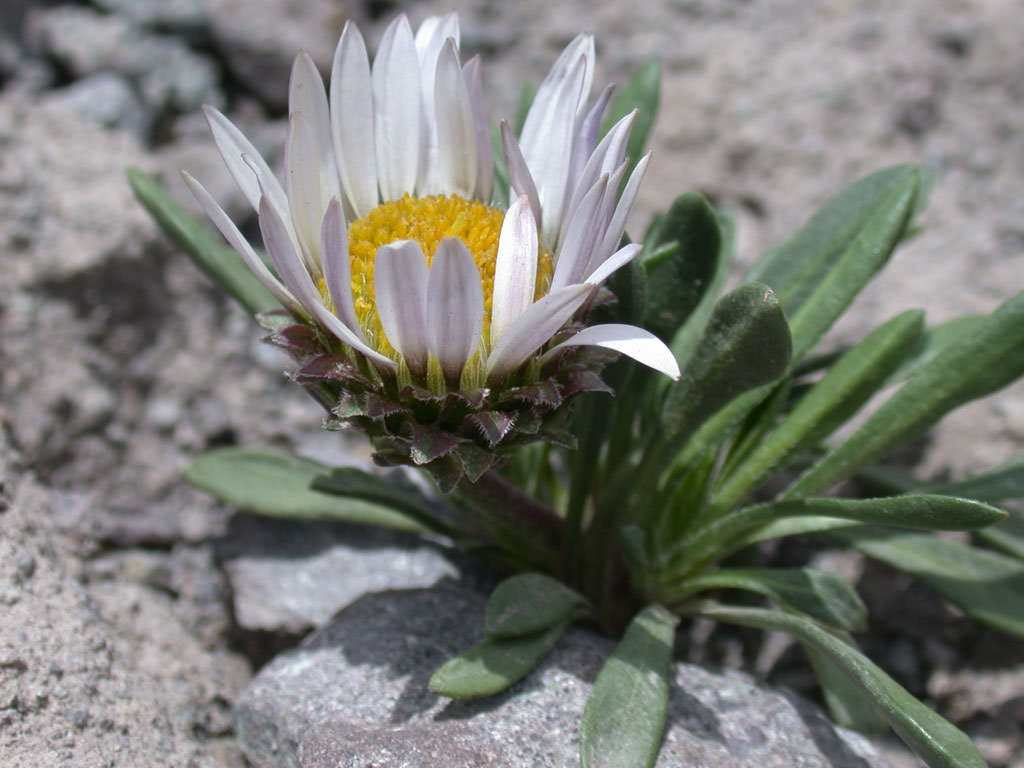
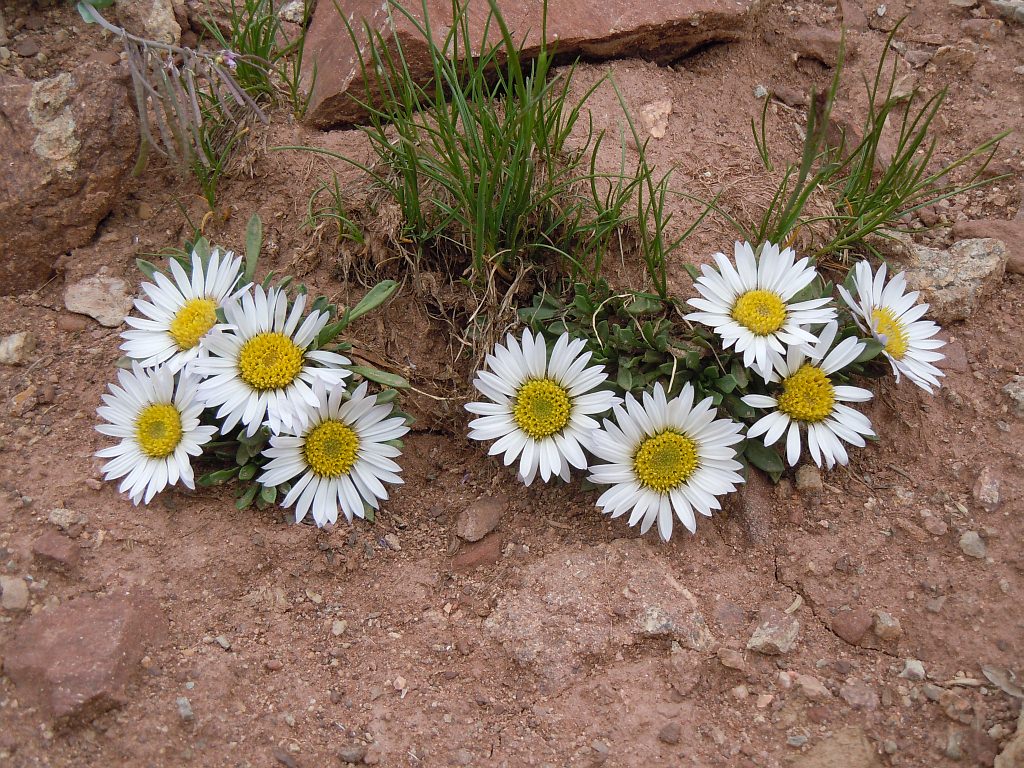
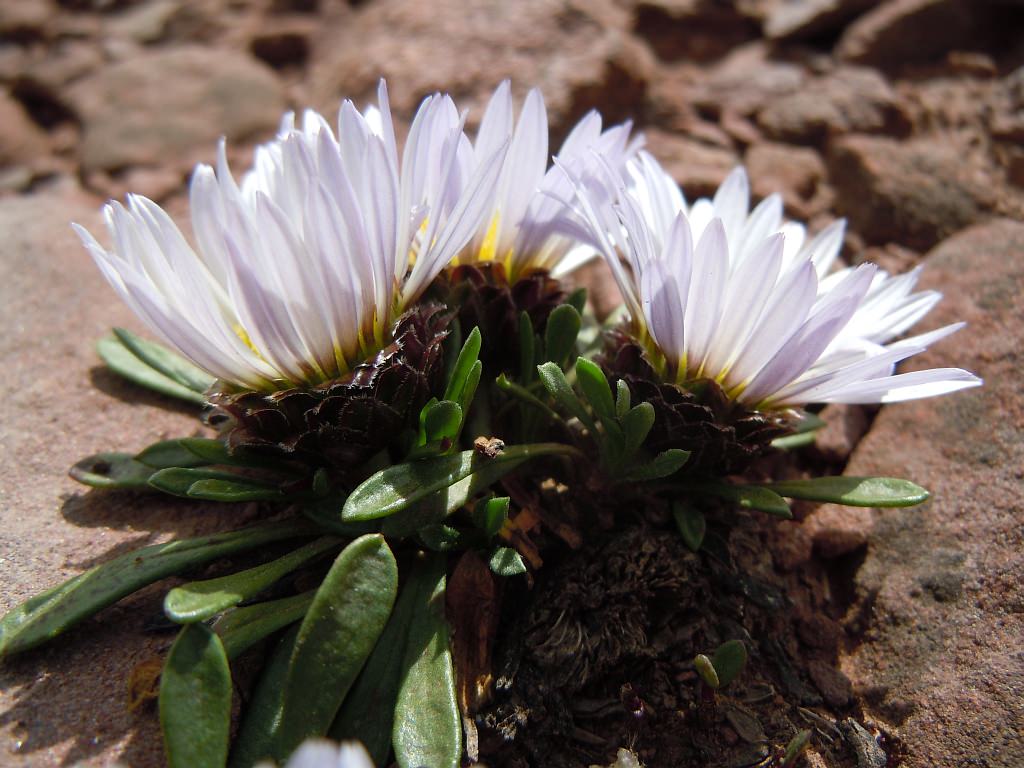
Townsendia rothrockii plants are perennials, with stems more or less erect, and 1-3 cm long. Plants are glabrous or somewhat strigose. Leaves are basal and cauline, spatulate to oblanceolate, 10-35 × 2-7 mm, and fleshy. Heads are sessile or on peduncles. Involucres are hemispheric, and 12-28+ mm in diameter. Phyllaries are 40-60+ in (3-)4-5+ series, obovate to oblanceolate, 7-9+ mm long, and the apices are obtuse to acute. Ray florets are 18-40; and are blue to purplish (Flora of North America 2006).
Look Alikes:
Townsendia rothrockii has succulent leaves, and phyllaries that are obovate, ovate, or broadly lanceolate. Townsendia glabella does not have succulent leaves and the phyllaries are lanceolate and acute (Weber and Wittmann 2012). Involucre bracts of T. rothrockii are usually reddish-purple and anthocyanic throughout (Ackerfield 2012).
Phenology:
Flowers June-August (Ackerfiled 2012, Colorado Natural Heritage Program 2012).
Habitat
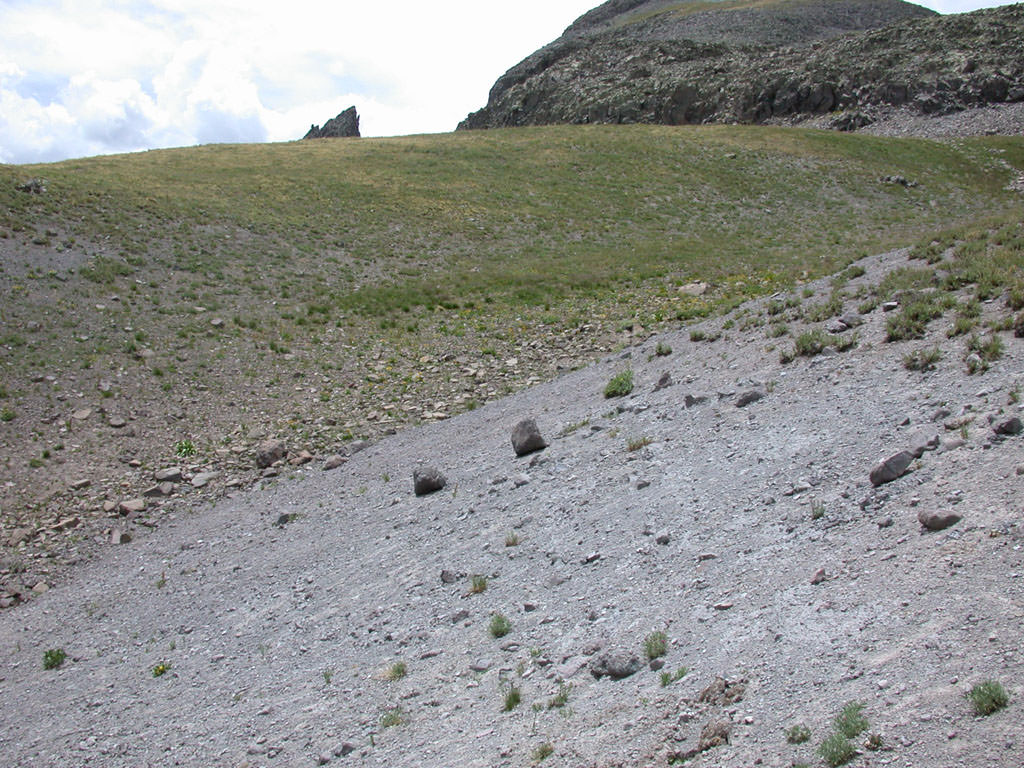
This species has been reported growing in alpine fellfields, krummholtz, subalpine meadows, oak brush, grasslands, shrub/herbaceous areas, talus slopes, forest openings, high plateau ridgetops, mountain passes, late-snow and cornice areas, limestone outcrops, rocky streamsides, disturbed mine and roadside areas, bare sandstone slopes, lava cliffs, and summit ridges (Beatty et al. 2004). Associated species include Abies lasiocarpa, Agrostis thurberiana, Anemone multifida, Draba nivalis var. exigua, Eritrichium aretioides, Festuca thurberi, Frageria spp., Frasera spp., Juniperus spp., Oreoxis alpina, Physaria spp., Pinus spp., Pinus ponderosa, Polemonium viscosum, Populus spp., Quercus spp., Rydbergia grandiflora, Shepherdia spp., Stipa spp., Trifolium dasyphyllum, Trifolium nanum, and Valeriana capitata (Beatty et al. 2004).
click on image to enlarge
 |
Elevation Range:
6,254 - 13,219 feet (1,906 - 4,029 meters)
Distribution
Colorado Endemic:
Yes
Range:
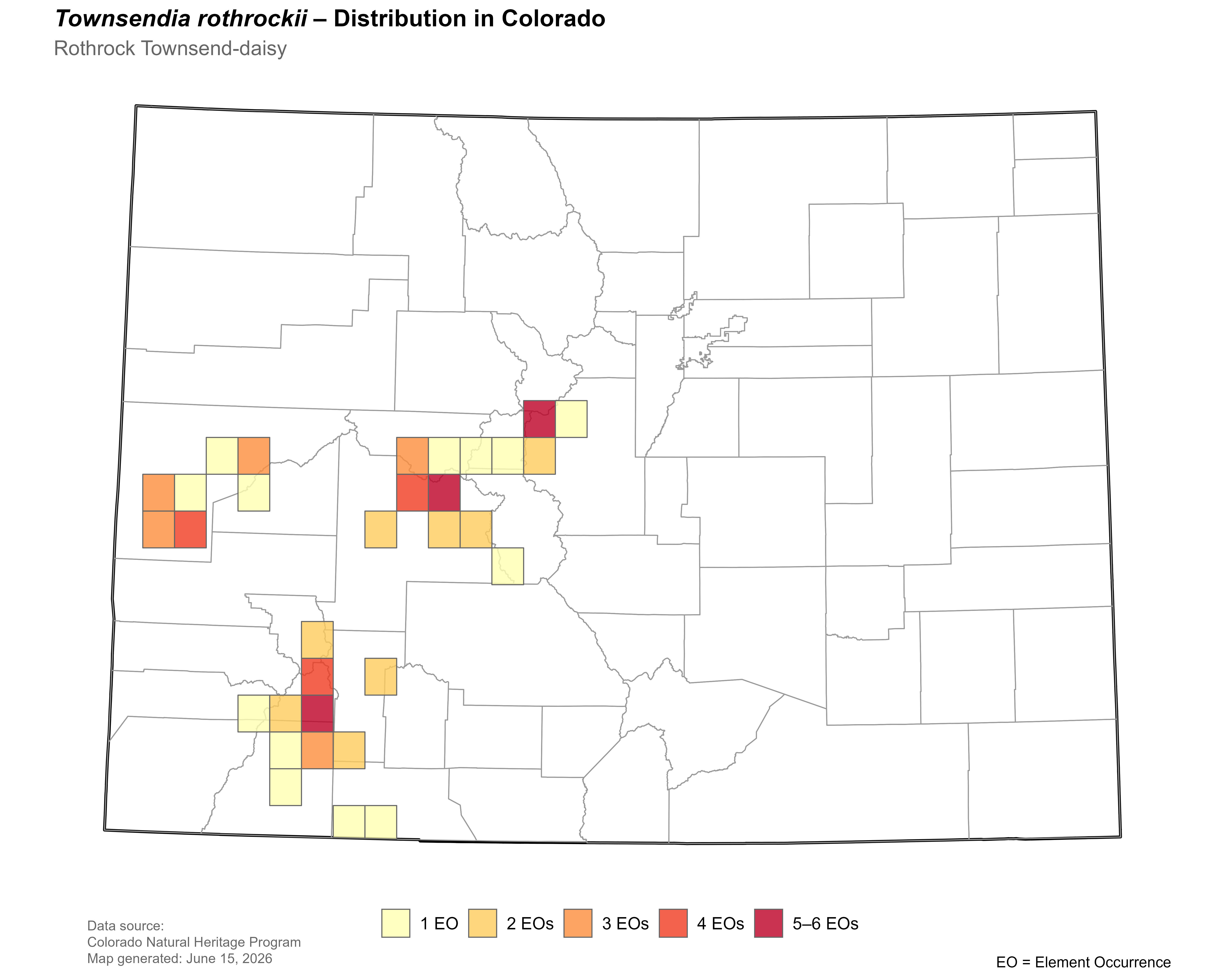
Townsendia rothrockii is endemic to central and southwestern Colorado (USA) where it is known from thirteen counties. Estimated range extent in Colorado of 33,495 square kilometers was calculated in GeoCAT using occurrence data provided by the Colorado Natural Heritage Program (2023). New Mexico reports are apparently false (Beatty et al. 2004).
Click on map to enlarge |
Threats and Management Issues
Motorized recreation was once thought to be the primary threat to the species (Rondeau et al. 2011) and remains a concern, however, additional threats have been reported since 2011 and include non-motorized recreation, road maintenance and the related erosion and sedimentation, browsing by mountain goats, livestock grazing activities, and competition from exotic species. Overall, these impacts have only been noted less at than 22% of the occurrences with 8% reporting no threats or management concerns, and the remaining 79% of occurrences having no information on threats. Nonetheless, hiking appears to be increasing within the species habitat, although the impacts are reported to be minimal. Competition from invasive plant species such as Bromus inermis, Bromus tectorum, Melilotus officinalis is now noted at several occurrences. Range wide the effects small-scale mining and of long-term drought remain a concern. Beatty et al. 2004 list the following possible human-related threats to T. rothrockii : succession, environmental fluctuations, herbivory, genetic isolation, inadequate pollination, global climate changes, and changes to the natural disturbance regime. This species is considered to have moderate adaptive capacity and is expected to be slightlyvulnerable to climate change under both RCP 4.5 and 8.5 scenarios, as assessed for the 2025 Colorado State Wildlife Action Plan (CNHP 2025).
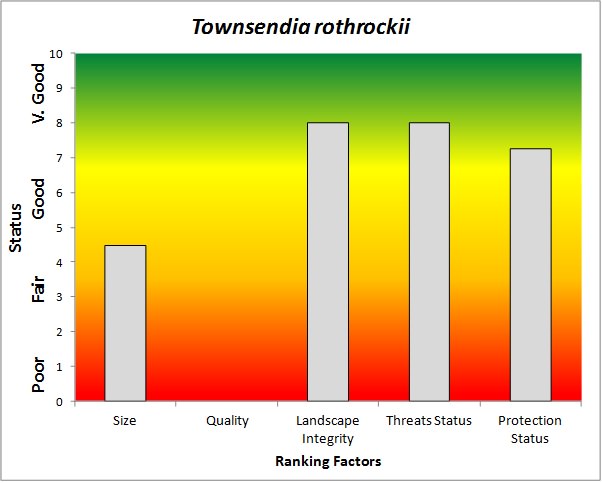
Summary results of an analysis of the status of Townsendia rothrockii based on several ranking factors. This species was concluded to be Effectively Conserved. From Rondeau et al. 2011. |
References
- Ackerfield, J. 2015. Flora of Colorado. BRIT Press, Botanical Research Institute of Texas, Fort Worth, TX. 818 pp.
- Beatty, B.L., W.F. Jennings, and R.C. Rawlinson. 2004. Townsendia rothrockii Gray ex Rothrock (Rothrock's Townsend daisy): a technical conservation assessment. [Online]. USDA Forest Service, Rocky Mountain Region. Available http://www.fs.fed.us/r2/projects/scp/assessments/townsendiarothrockii.pdf.
- Colorado Natural Heritage Program (CNHP). 2023. Biodiversity Tracking and Conservation System (Biotics 5). Colorado Natural Heritage Program, Colorado State University, Fort Collins.
- Colorado Natural Heritage Program (CNHP). 2025. Climate Change Vulnerability Assessment of Colorado Tier 1 and Tier 2 Plant Species of Greatest Conservation Need (SCGN) for the 2025 Colorado State Wildlife Action Plan. Colorado Natural Heritage Program, Colorado State University, Fort Collins.
- Colorado Natural Heritage Program. 2012. Biodiversity Tracking and Conservation System. Colorado State University, Fort Collins, CO.
- Flora of North America Editorial Committee, ed. (FNA). 1993+. Flora of North America North of Mexico. Oxford Univ. Press, New York, Oxford.
- Handwerk, J., L. Grunau, and S. Panjabi. 2015. Colorado Wildlife Action Plan: 2015 Rare Plant Addendum. Colorado Natural Heritage Program, Colorado State University, Fort Collins, Colorado, USA.
- Harrington, H.D. 1954. Manual of the plants of Colorado. Sage Press, Chicago. 666 pp.
- Heil, K.D., S.L. O'Kane Jr., L.M. Reeves, and A. Clifford, 2013. Flora of the Four Corners Region, Vascular Plants of the San Juan River Drainage; Arizona, Colorado, New Mexico, and Utah. Missouri Botanical Garden Press, St. Louis, Missouri. 1098 pp.
- Lavender, A.E., M.M. Fink, S.E. Linn, D.M. Theobald. 2011. Colorado Ownership, Management, and Protection v9 Database. Colorado Natural Heritage Program and Geospatial Centroid, Colorado State University, Fort Collins, CO. (30 September).
- Neely, B., S. Panjabi, E. Lane, P. Lewis, C. Dawson, A. Kratz, B. Kurzel, T. Hogan, J. Handwerk, S. Krishnan, J. Neale, and N. Ripley. 2009. Colorado Rare Plant Conservation Strategy, Developed by the Colorado Rare Plant conservation Initiative. The Nature Conservancy, Boulder, Colorado, 117 pp.
- Rickett, H. W. 1973. Wild flowers of the United States: Vol. 6 (3 parts). The central mountains and plains. McGraw-Hill Book Company, New York. 784 pp. + plates.
- Rondeau, R., K. Decker, J. Handwerk, J. Siemers, L. Grunau, and C. Pague. 2011. The state of Colorado's biodiversity 2011. Prepared for The Nature Conservancy. Colorado Natural Heritage Program, Colorado State University, Fort Collins, Colorado.
- Schneider, A. 2013. Wildflowers, Ferns, and Trees of the Four Corners Regions of Colorado, New Mexico, Arizona, and Utah. Accessed on-line at http://www.swcoloradowildflowers.com.
- USDA, NRCS. 2022. The PLANTS Database. National Plant Data Team, Greensboro, NC 27401-4901 USA.
- Weber, W. A. and R. C. Wittmann. 2012. Colorado Flora, Eastern Slope, A Field Guide to the Vascular Plants, Fourth Edition. Boulder, Colorado. 555 pp.
- Weber, W. A. and R. C. Wittmann. 2012. Colorado Flora, Western Slope, A Field Guide to the Vascular Plants, Fourth Edition. Boulder, Colorado. 532 pp.