

Scientific Name : Physaria rollinsii
Author : Mulligan NatureServe Explorer
Common Name : Rollins' Twinpod
 Current Research Activities


☰ Click link below for details.
Taxonomy
Brassicaceae (mustard family)
Ranks and Status
State Rank : S2
State Rank Reason : Physaria rollinsii is a Colorado (USA) endemic restricted to the Gunnison Basin. There are only 2 occurrences with good viability, the remainder are of fair to poor or unknown viability or are known only from historical observations. Potential observed threats to Physaria rollinsii include inappropriate livestock grazing, fragmentation of habitat by roads and utility lines, recreation within occupied habitat and competition from cheatgrass (Bromus tectorum). This species is also considered to be moderately to extremely vulnerable to the effects of climate change.
U.S. Endangered Species Act : none
Colorado Threatened and Endangered List : none
Other Statuses : BLM, SWAP Tier 1, USFS GMUG
Description and Phenology
General Description:
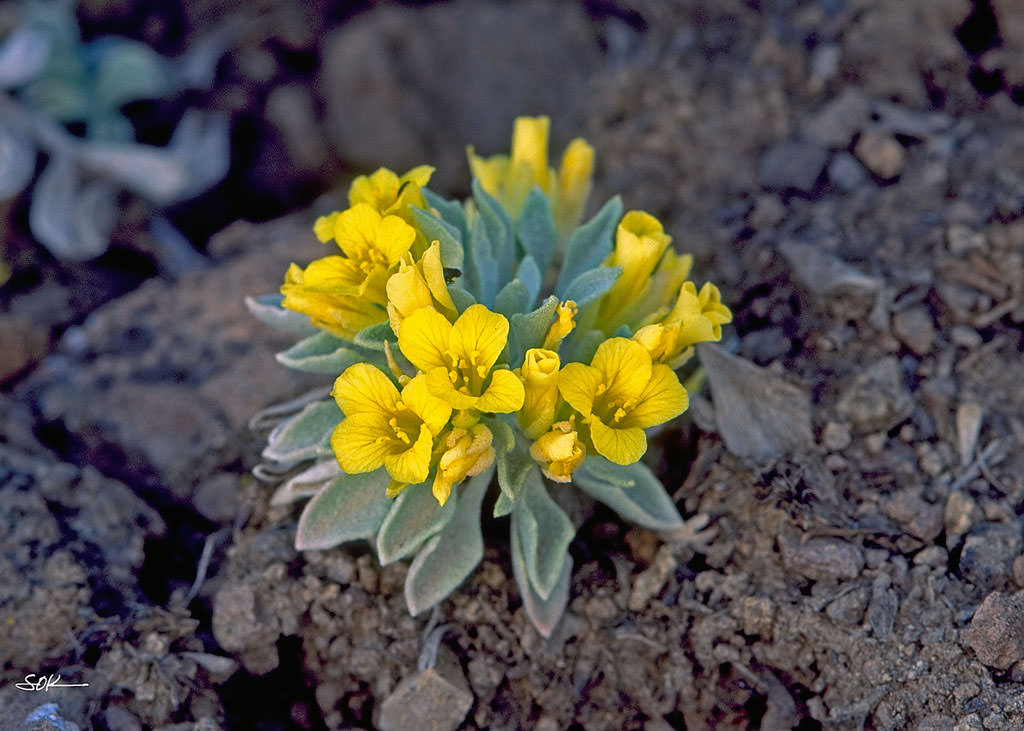
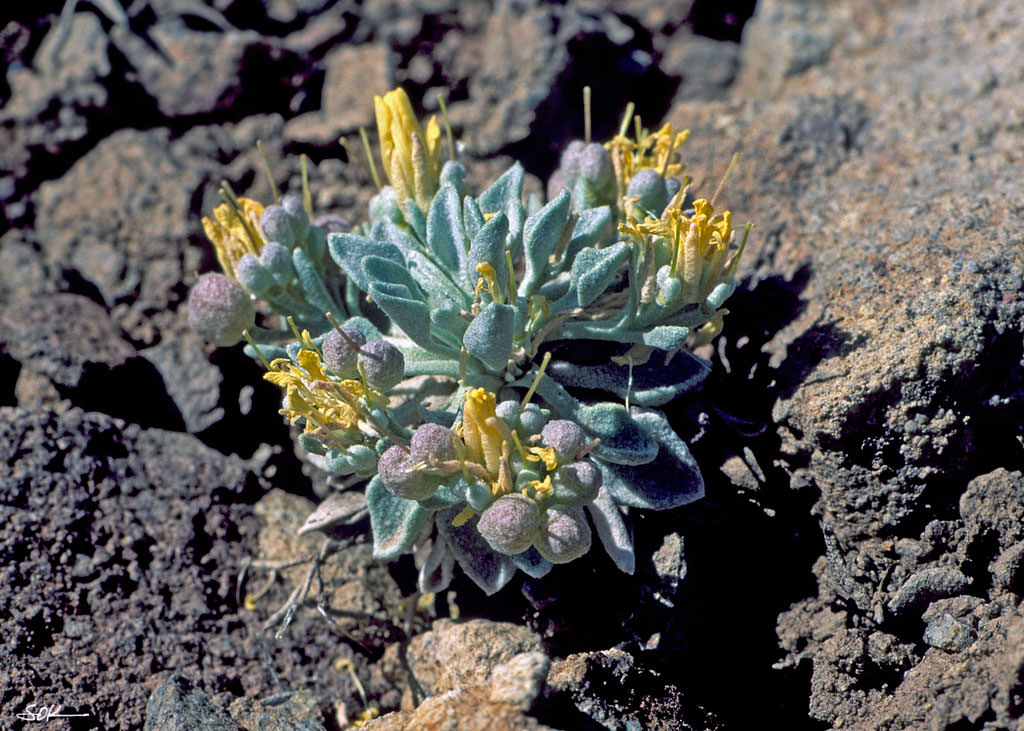
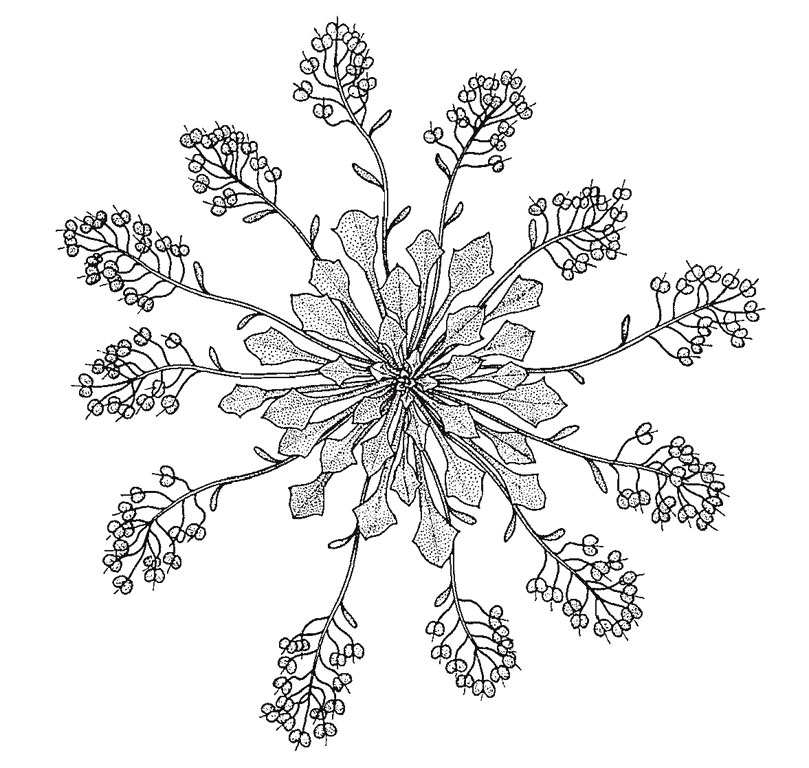
Physaria rollinsii is a small, compact, clump-forming perennial with silvery pubescence and bright yellow flowers. Stems are several from the base, decumbent, and 0.5-1 dm long. Basal leaves form a small rosette, and the leaf blades are usually oblanceolate or broader, and margins entire or with 1 or 2 broad teeth. Cauline leaves are oblanceolate with margins entire. Racemes are congested, and elongate moderately in fruit. Fruits are erect, arranged in pairs, suborbicular, and inflated; replum obovate to oblong, as wide as or wider than the fruit (FNA 2010).
Look Alikes:
Physaria rollinsii can be distinguished from other Physaria species by it's very small size; its linear-oblanceolate basal leaves, which are entire or with a single broad tooth on each side and less than 4 cm long; and it's relatively low elevation range (Weber and Wittmann 2012).
Phenology:
Flowers and fruit May-June (Rollins 1993, Colorado Natural Heritage Program 2012).
 |
Habitat
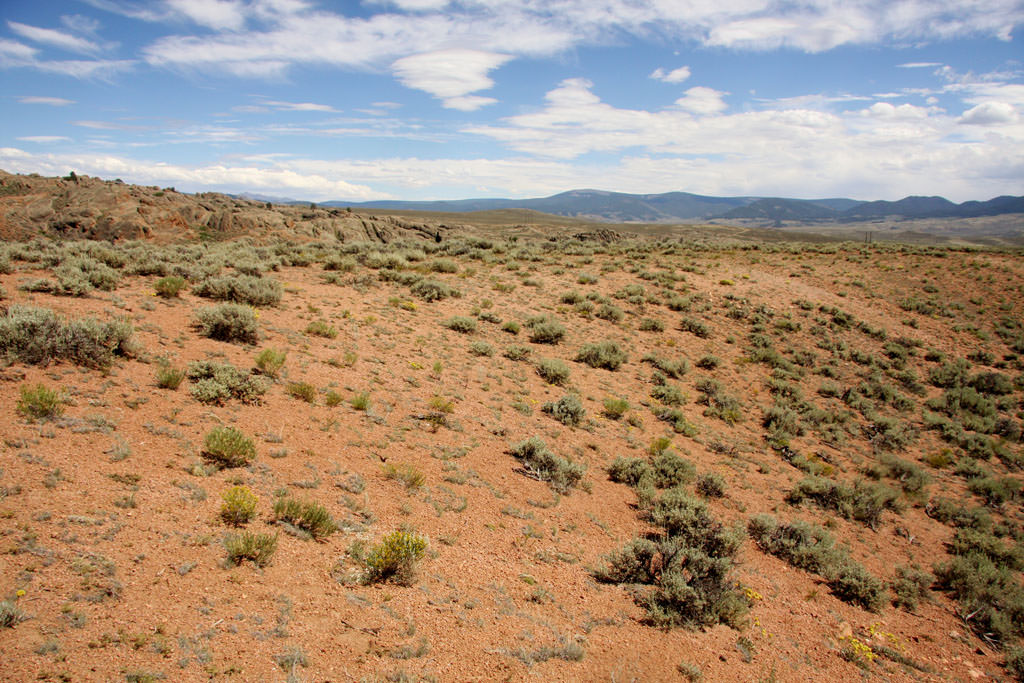
Physaria rollinsii is found in granitic talus, open knolls, limestone chiprock, steep slopes, clay banks, near granite boulders (Rollins 1993), and sagebrush (Weber and Wittmann 2012). Associated plant species include Opuntia fragilis, Cercocarpus montanus, Phlox longifolia, Artemisia tridentata, Chrysothamnus depressus, Penstemon caespitosus (Colorado Natural Heritage Program 2012).
click on image to enlarge
 |
Elevation Range:
7,354 - 9,305 feet (2,241 - 2,836 meters)
Distribution
Colorado Endemic:
Yes
Range:
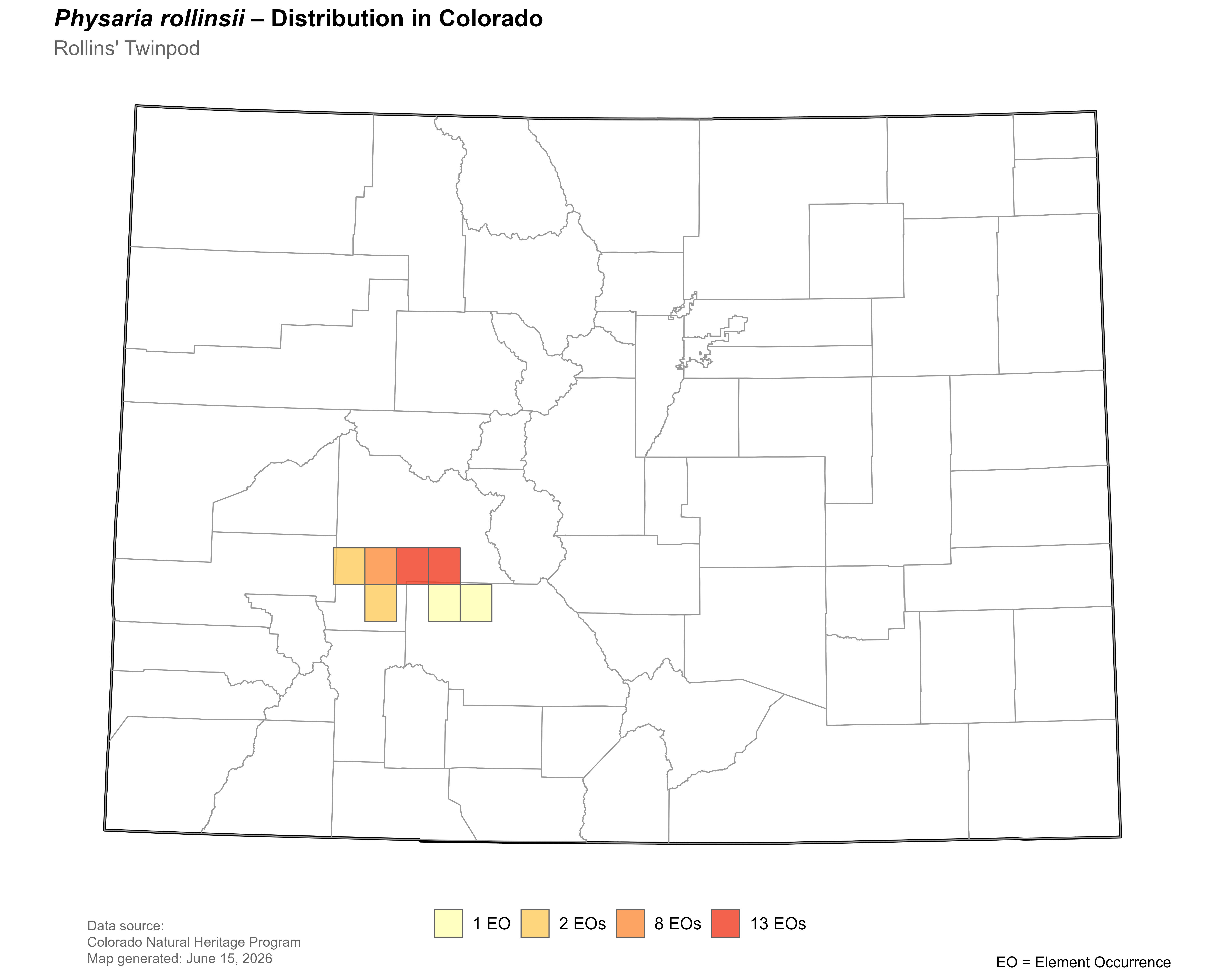
Physaria rollinsii is endemic to the Gunnison Basin in Colorado, USA, where it is found in Gunnison and Saguache counties. The estimated range extent in Colorado of 1243 square kilometers was calculated in GeoCAT using occurrence data provided by the Colorado Natural Heritage Program (2023).
.
Click on map to enlarge |
Threats and Management Issues
Potential observed threats to Physaria rollinsii include inappropriate livestock grazing, fragmentation of habitat by roads, railroads or pipelines, motorized and non-motorized recreation within occupied habitat and competition from invasive plant species, primarily cheatgrass (Bromus tectorum) (CNHP 2025). Other low level threats include fragmentation of habitat by mining and quarrying, residential development and heavy deer use of occupied habitat. Long-term drought throughout the species range is also a concern. This species is considered to have low adaptive capacity and is expected to be moderately to extremely vulnerable to climate change under both RCP 4.5 and 8.5 scenarios, as assessed for the 2025 Colorado State Wildlife Action Plan (CNHP 2025).
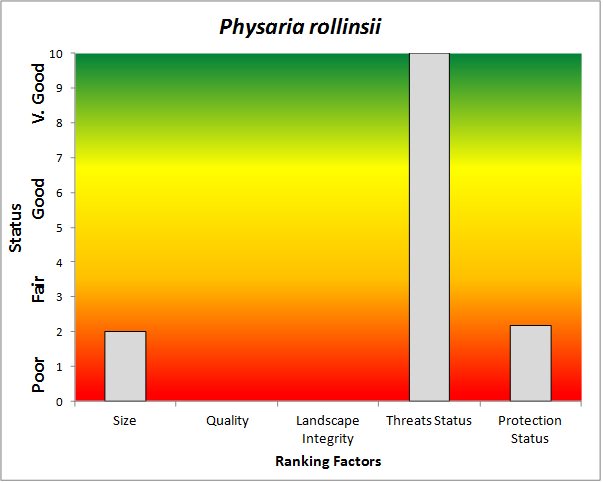
Summary results of an analysis of the status of Physaria rollinsii based on several ranking factors. This species was concluded to be Weakly Conserved. From Rondeau et al. 2011. |
References
- Ackerfield, J. 2012. The Flora of Colorado. Colorado State University Herbarium. 433 pp.
- Colorado Natural Heritage Program (CNHP). 2025. Climate Change Vulnerability Assessment of Colorado Tier 1 and Tier 2 Plant Species of Greatest Conservation Need (SCGN) for the 2025 Colorado State Wildlife Action Plan. Colorado Natural Heritage Program, Colorado State University, Fort Collins.
- Flora of North America Editorial Committee (FNA). 2010. Flora of North America north of Mexico. Vol. 7. Magnoliophyta: Salicaceae to Brassicaceae. Oxford University Press, New York. xxii + 797 pp.
- Handwerk, J., L. Grunau, and S. Panjabi. 2015. Colorado Wildlife Action Plan: 2015 Rare Plant Addendum. Colorado Natural Heritage Program, Colorado State University, Fort Collins, Colorado, USA.
- Kartesz, J.T. 1996. Species distribution data at state and province level for vascular plant taxa of the United States, Canada, and Greenland (accepted records), from unpublished data files at the North Carolina Botanical Garden, December, 1996.
- Lavender, A.E., M.M. Fink, S.E. Linn, D.M. Theobald. 2011. Colorado Ownership, Management, and Protection v9 Database. Colorado Natural Heritage Program and Geospatial Centroid, Colorado State University, Fort Collins, CO. (30 September).
- Neely, B., S. Panjabi, E. Lane, P. Lewis, C. Dawson, A. Kratz, B. Kurzel, T. Hogan, J. Handwerk, S. Krishnan, J. Neale, and N. Ripley. 2009. Colorado Rare Plant Conservation Strategy, Developed by the Colorado Rare Plant conservation Initiative. The Nature Conservancy, Boulder, Colorado, 117 pp.
- Rollins, R.C. 1993. The Cruciferae of Continental North America:Systematics of the Mustard Family from the Arctic to Panama. Stanford University Press. Stanford, CA.
- Rondeau, R., K. Decker, J. Handwerk, J. Siemers, L. Grunau, and C. Pague. 2011. The state of Colorado's biodiversity 2011. Prepared for The Nature Conservancy. Colorado Natural Heritage Program, Colorado State University, Fort Collins, Colorado.
- USDA, NRCS. 2022. The PLANTS Database. National Plant Data Team, Greensboro, NC 27401-4901 USA.
- Weber, W. A. and R. C. Wittmann. 2012. Colorado Flora, Eastern Slope, A Field Guide to the Vascular Plants, Fourth Edition. Boulder, Colorado. 555 pp.
- Weber, W. A. and R. C. Wittmann. 2012. Colorado Flora, Western Slope, A Field Guide to the Vascular Plants, Fourth Edition. Boulder, Colorado. 532 pp.