

Scientific Name : Astragalus missouriensis var. humistratus
Author : Isely NatureServe Explorer
Common Name : Missouri Milkvetch
 Current Research Activities


☰ Click link below for details.
Taxonomy
Fabaceae (pea family)
There are three varieties of A. missouriensis in Colorado. It is probable that a hybrid between A. humistratus and A. missouriensis is present in southwestern Colorado (Ackerfield 2022). Plants in this area have characteristics of both species - the lower stipules are connate and the plant is strongly caulescent but prostrate as in A. humistratus, however the straight, glabrous or sparsely pubescent pod is more similar to A.missouriensis. Astragalus humistratus has a lunately incurved pod or the pod is straight but incurved at the beak, and the surface is strigulose. The potential hybrid is here referred to as A. missouriensis var. humistratus (Ackerfield 2022).
Ranks and Status
State Rank : S2
State Rank Reason : Astragalus missouriensis var. humistratus is known from three counties in southwest Colorado, USA. Only four of the Colorado occurrences are known to be of good viability. Threats to the species include habitat loss and/or alteration from road construction and maintenance, housing development, competition from invasive plant species and the effects of climate change.
U.S. Endangered Species Act : none
Colorado Threatened and Endangered List : none
Other Statuses : SWAP SGIN, USFS
Description and Phenology
General Description:
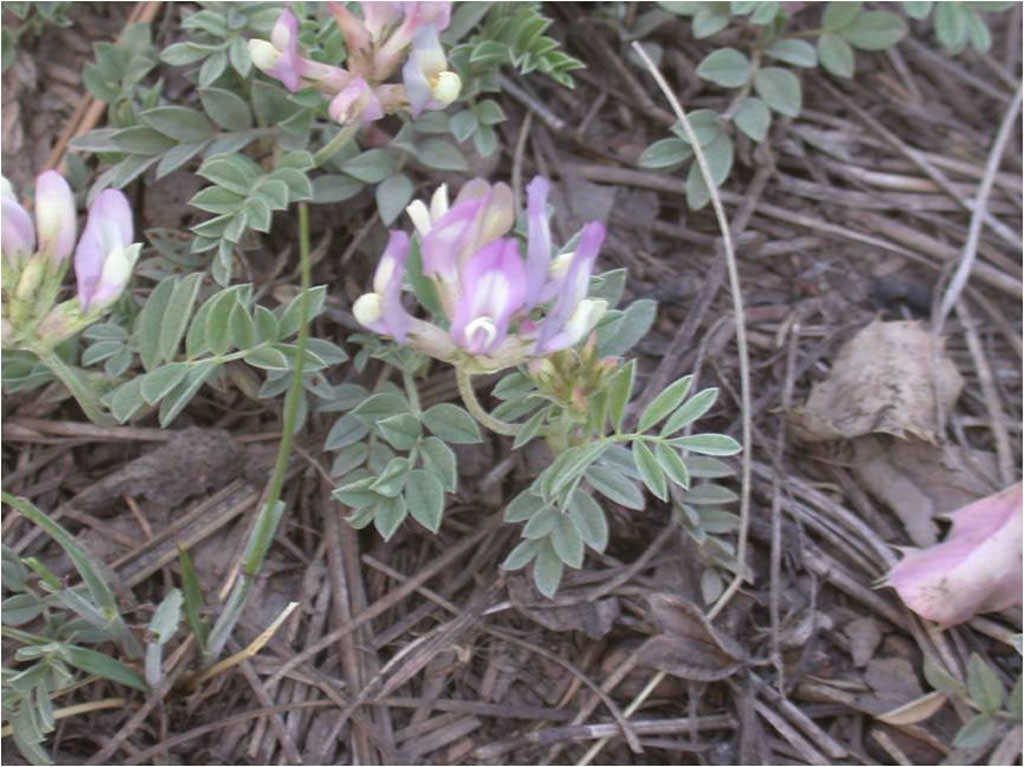
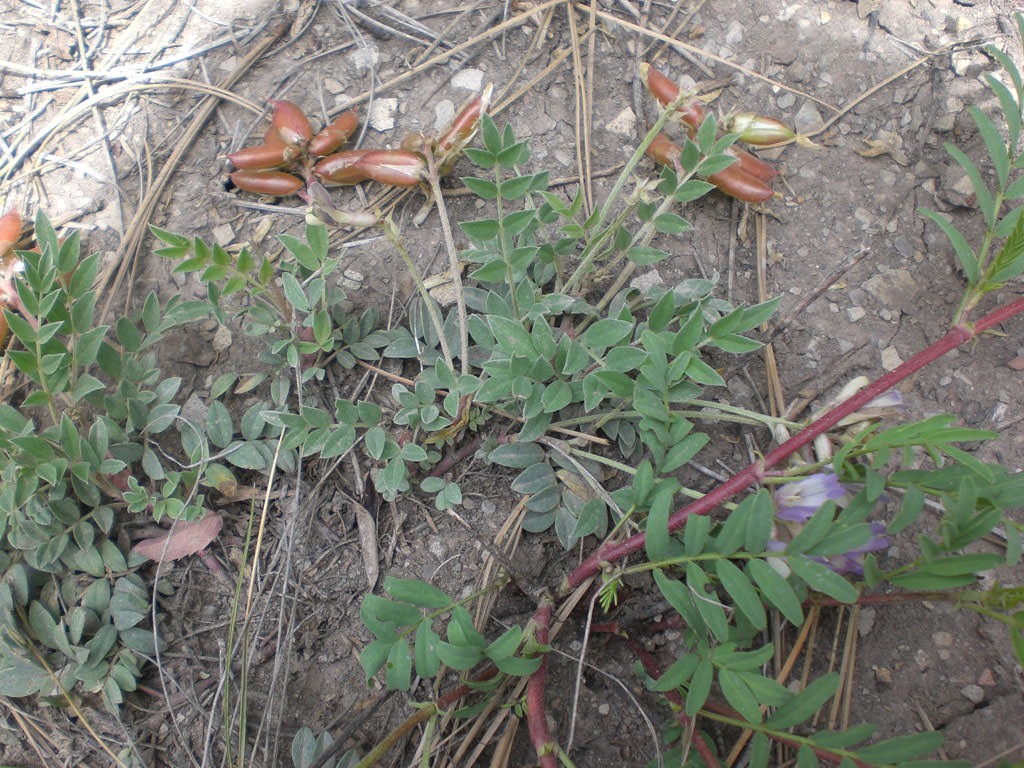
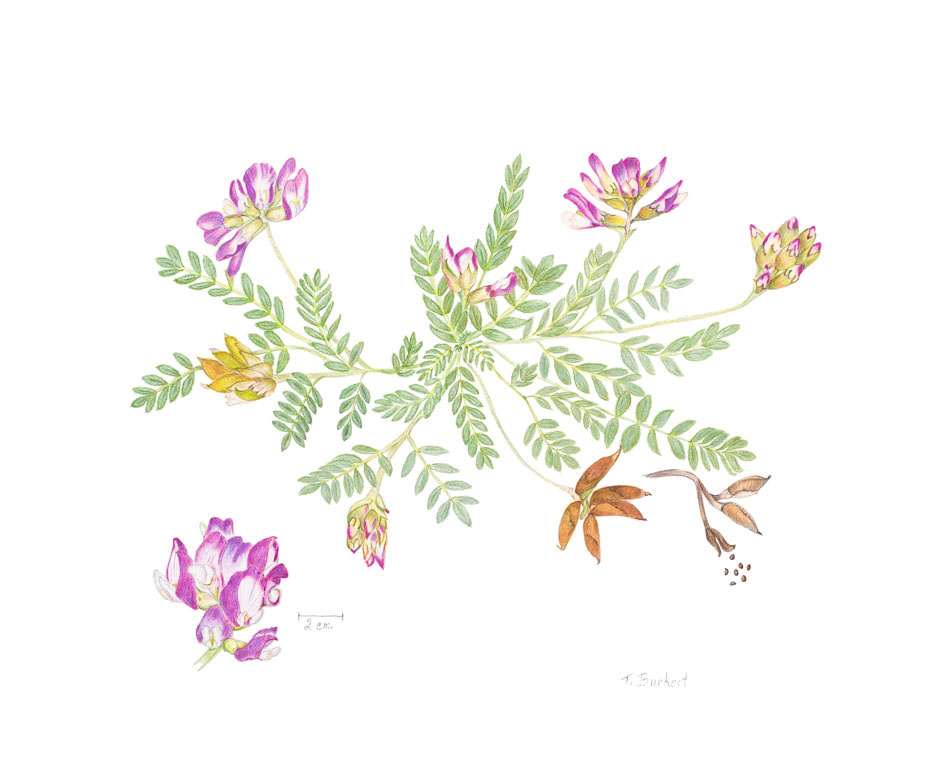
Astragalus missouriensis var. humistratus is a low-growing perennial with greenish-gray foliage. In contrast to other A. missouriensis varieties, var. humistratus has noticeable above ground prostrate stems 7 to 20 cm in length. The pinnately compound leaves are 4 to 14 cm in length, and typically have 11 to 17 narrowly elliptic leaflets. The racemes typically hold 8 to 12 ascending or spreading flowers with pinkish-purple, white-tipped petals. Flowers are large, with total length of calyx and banner typically in the range of 23 to 35 mm. The legumes (pods) are oblong-ellipsoid, straight, about 1.7 to 2 cm in length, without hairs (or very sparsely pubescent along the ventral suture and on the beak), and they remain on the plant after seeds have dispersed. Pods contain 33 to 40 ovules, and seeds are small (about 2 mm long). Mature pods are necessary to distinguish this variety from related species A. amphioxys and A. chameleuce, as well as other varieties of A. missouriensis (Barneby 1964, Isely 1983, 1986, and 1998).
Look Alikes:
Isely separates var. humistratus from var. amphibolus by the stipules, which are free in var. amphibolus but connate or amplexicaul in var. humistratus; the beak of the fruit, which is curved or incurved at the tip in var. amphibolus, but straight in var. humistratus; and the usual number of flowers on the stem-4-8 in var. amphibolus and 8-12 in var. humistratus.
Phenology:
Plants flower in May, and set fruit in May and June (Colorado Natural Heritage Program 2012).
 |
Habitat
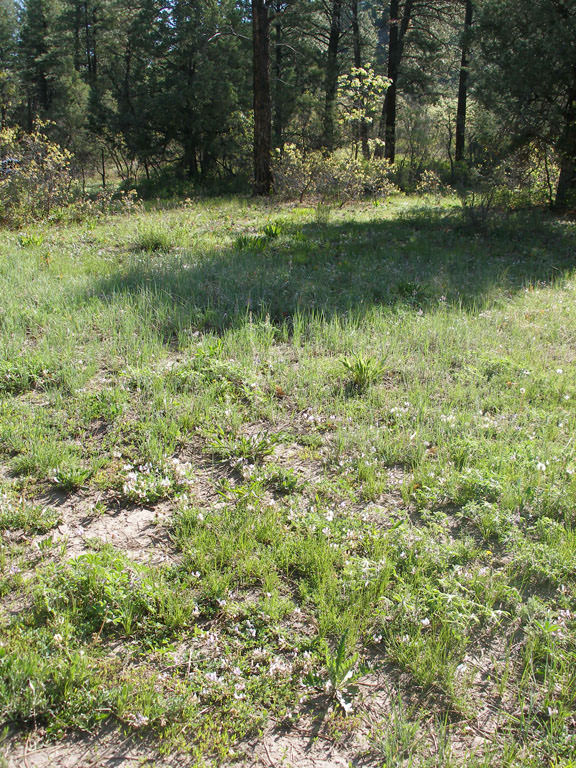
In Colorado this species is found in dry soils derived from Mancos Shale, on barrens, and in grasslands and Ponderosa pine woodlands. Associated species also include Picea engelmannii, Quercus gambellii, Ceanothus fendleri, Astragalus flavus, A. bisulcatus var. haydenianus, A. oocalycis, A. lonchocarpus, Ipomopsis polyantha, Lesquerella pruinosa, Townsendia glabella, Penstemon caespitosus, Penstemon teucroides, Erigeron flagellaris, Artemisia ludoviciana, Eriogonum racemosum, Tetraneruis torreyana, and others.
click on image to enlarge
 |
Elevation Range:
6,089 - 8,313 feet (1,856 - 2,534 meters)
Distribution
Colorado Endemic:
No
Range:
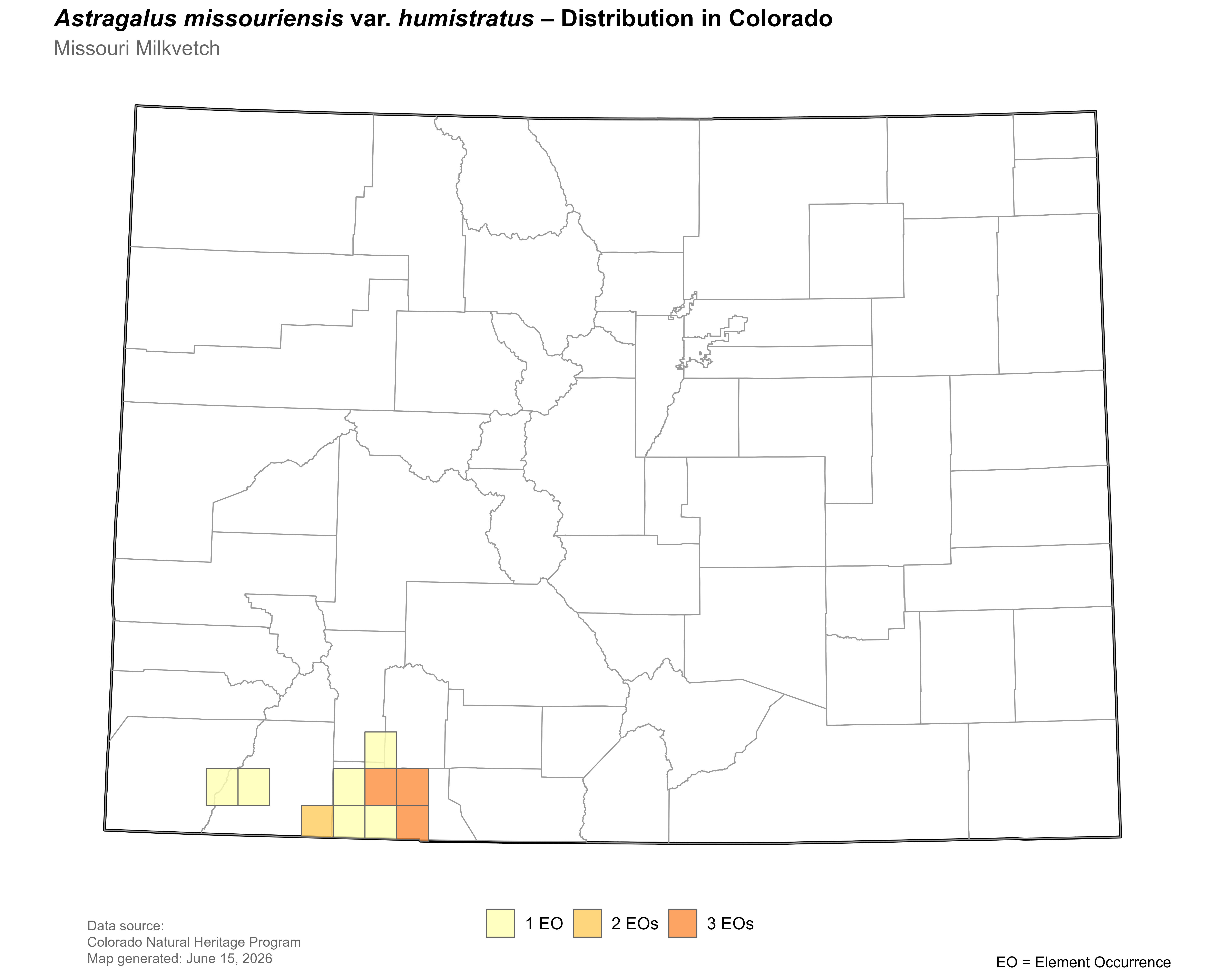
Astragalus missouriensis var. humistratus is known from Archuleta, Hinsdale, and La Plata counties in Colorado, USA. It is also known from Rio Arriba County in New Mexico. The estimated range extent in Colorado of 3144 square kilometers was calculated in GeoCAT using occurrence data provided by the Colorado Natural Heritage Program and includes historic and extant occurrences (2023).
Click on map to enlarge |
Threats and Management Issues
Threats to this species include road maintenance, competition from invasive species, and housing and urban development in the vicinity of Pagosa Springs. Most occurrences are along roadsides as the plants tend to grow in disturbed soil but road maintenance activities such as herbicide spraying could be detrimental. A few occurrences are along trails and may be impacted by recreation activities. Invasive plant species such as cheatgrass and Canada thistle have been observed at several occurrences (CNHP 2023). Little is known about the effects of grazing or other disturbance on this species. Astragalus missouriensis var. humistratus is considered to be extremely vulnerable to climate change (Handwerk et al. 2015).
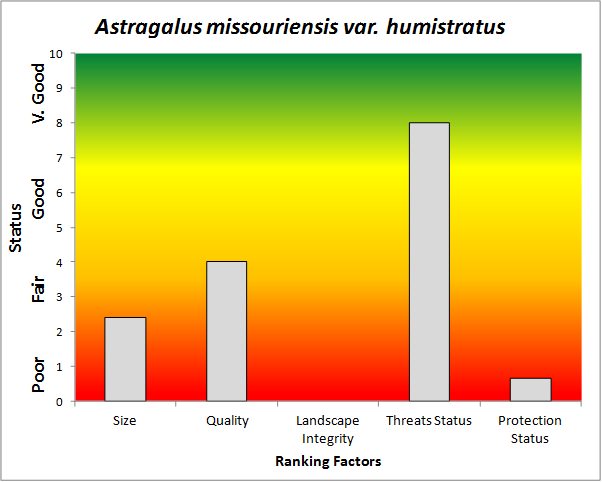
Summary results of an analysis of the status of Astragalus missouriensis var. humistratus based on several ranking factors. This species was concluded to be Weakly Conserved. From Rondeau et al. 2011. |
References
- Ackerfield, J. 2015. Flora of Colorado. BRIT Press, Botanical Research Institute of Texas, Fort Worth, TX. 818 pp.
- Colorado Natural Heritage Program. 2012. Biodiversity Tracking and Conservation System. Colorado State University, Fort Collins, CO.
- Decker, K. 2006. Astragalus missouriensis Nutt. var. humistratus Isely (Missouri milkvetch): a technical conservation assessment. USDA Forest Service, Rocky Mountain Region. Online. Available: http://www.fs.fed.us/r2/projects/scp/assessments/astragalusmissouriensisvarhumistratus.pdf (accessed 8 August 2011).
- Handwerk, J., L. Grunau, and S. Panjabi. 2015. Colorado Wildlife Action Plan: 2015 Rare Plant Addendum. Colorado Natural Heritage Program, Colorado State University, Fort Collins, Colorado, USA.
- Heil, K.D. 2007. New Mexico Rare Plants: Astragalus missouriensis var. humistratus (Pagosa milkvetch). New Mexico Rare Plant Technical Council, Albuquerque, New Mexico. Online. Available: http://nmrareplants.unm.edu (Accessed 2011).
- Heil, K.D., S.L. O'Kane Jr., L.M. Reeves, and A. Clifford, 2013. Flora of the Four Corners Region, Vascular Plants of the San Juan River Drainage; Arizona, Colorado, New Mexico, and Utah. Missouri Botanical Garden Press, St. Louis, Missouri. 1098 pp.
- Isely, D. 1983. New combinations and two new varieties in Astragalus, Orophaca and Oxytropis. Syst. Bot. 8:422-423.
- Isely, D. 1998. Native and naturalized Leguminosae (Fabaceae) of the United States (exclusive of Alaska and Hawaii). Monte L. Bean Life Science Museum, Brigham Young University; MLBM Press, Provo, Utah. 1007 pp.
- Neely, B., S. Panjabi, E. Lane, P. Lewis, C. Dawson, A. Kratz, B. Kurzel, T. Hogan, J. Handwerk, S. Krishnan, J. Neale, and N. Ripley. 2009. Colorado Rare Plant Conservation Strategy, Developed by the Colorado Rare Plant conservation Initiative. The Nature Conservancy, Boulder, Colorado, 117 pp.
- USDA, NRCS. 2013. The PLANTS Database. National Plant Data Team, Greensboro, NC 27401-4901 USA.
- USDA, NRCS. 2022. The PLANTS Database. National Plant Data Team, Greensboro, NC 27401-4901 USA.
- Weber, W. A. and R. C. Wittmann. 2012. Colorado Flora, Western Slope, A Field Guide to the Vascular Plants, Fourth Edition. Boulder, Colorado. 532 pp.
- Welsh, S.L. 2007. North American Species of Astragalus Linnaeus (Leguminosae) A Taxonomic Revision. Brigham Young University, Provo, Utah. 932 pp.