

Scientific Name : Astragalus piscator
Author : Barneby & Welsh NatureServe Explorer
Common Name : Fisher Towers Milkvetch
 Current Research Activities
 1997 profile


☰ Click link below for details.
Taxonomy
Fabaceae (pea family)
Ranks and Status
State Rank : S1
State Rank Reason : In Colorado, Astragalus piscator is known from only four occurrences in the Dolores River valley in Mesa County, Colorado, USA. Occupied habitat in low drainages and on gentle slopes is threatened by off-route motorized recreational use, competition from invasive non-native plant species and trampling from livestock grazing. Prolonged drought and habitat alteration due to climate change are also a concern for this species.
U.S. Endangered Species Act : none
Colorado Threatened and Endangered List : none
Other Statuses : BLM, SWAP Tier 2
Description and Phenology
General Description:
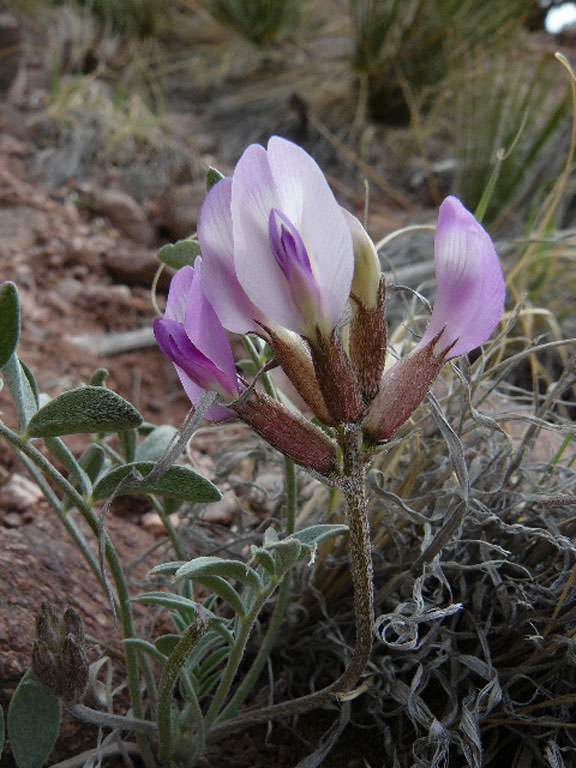
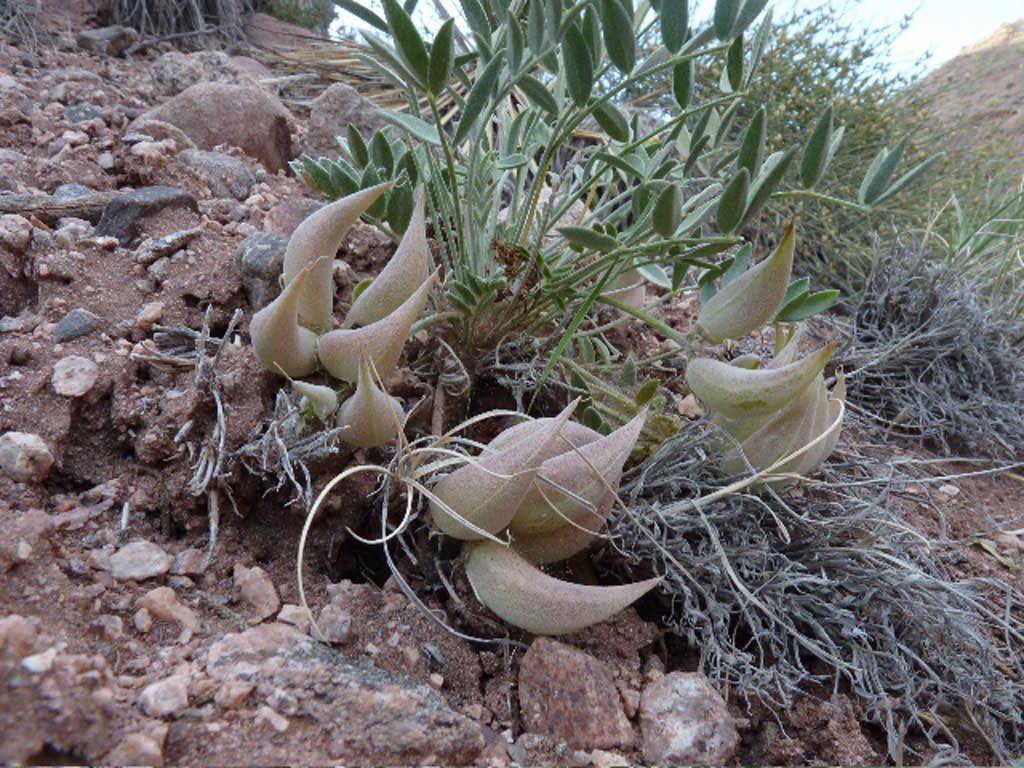
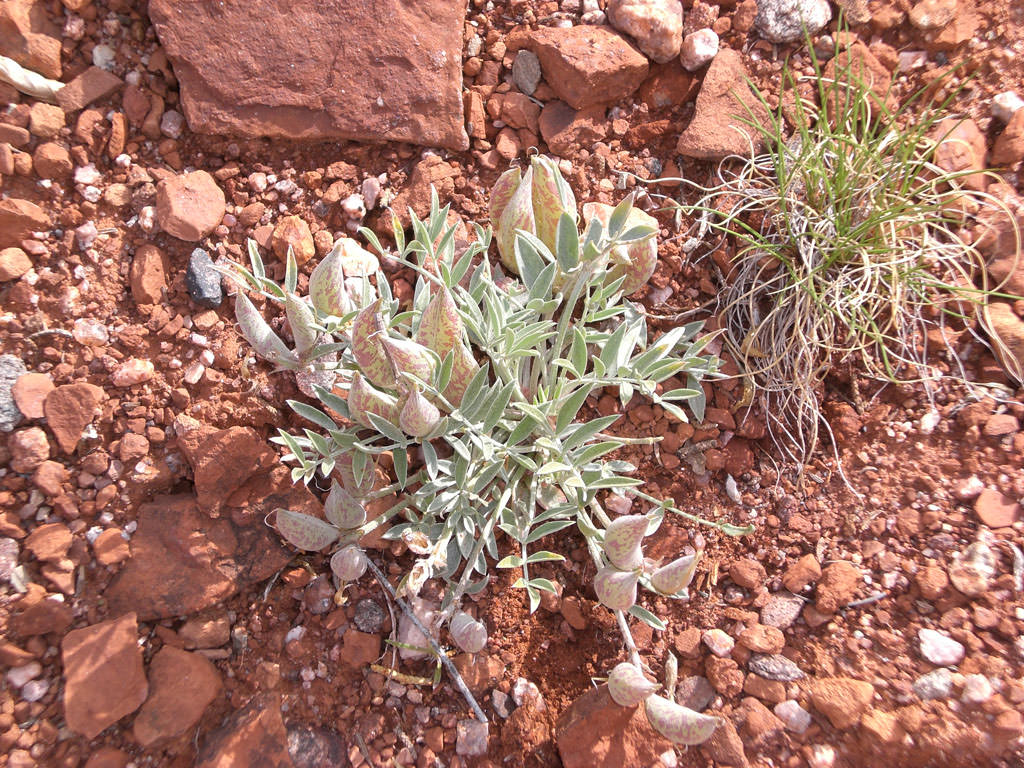
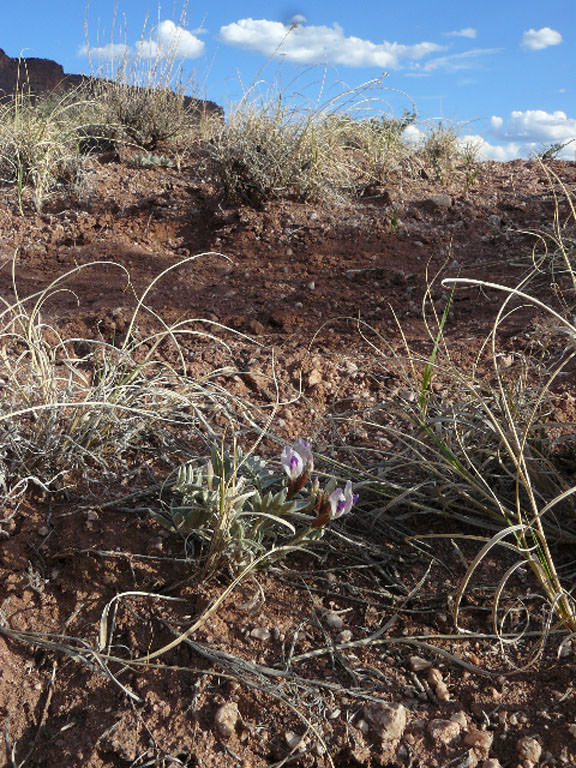
Astragalus piscator is a short-lived perennial, with 4-10 lavender or pale lilac flowers on leafless, or mostly leafless stems. Stems are erect when in flower, and often spread out at the base of the leaves when in fruit. The foliage is covered with appressed, dolabriform hairs and is yellowish-green on top and gray-green below. Leaves are pinnately compound with 5-11 leaflets. Pods are somewhat laterally compressed and densely strigose (Spackman et al. 1997, Ackerfield 2015).
Look Alikes:
Astragalus musiniensis is similar in appearance but has dorsiventrally compressed pods. Astragalus chamaeleuce also has similar pods but they lack the prominent dorsal structure and elliptic cross section of A. piscator (Spackman et al. 1997). Astragalus piscator is related to A. chamaeleuce, A. musiniensis, and A. amphioxis. It differs from the first two in having chartaceous, not alveolate-pithy pod walls, and differs from the third in flower color which is pale lilac as opposed to vivid pink. The habit and shape of its leaflets suggests A. musiniensis (Cronquist 1989).
Phenology:
Flowers late April to early June (Colorado Natural Heritage Program 2012, Ackerfield 2015).
Habitat
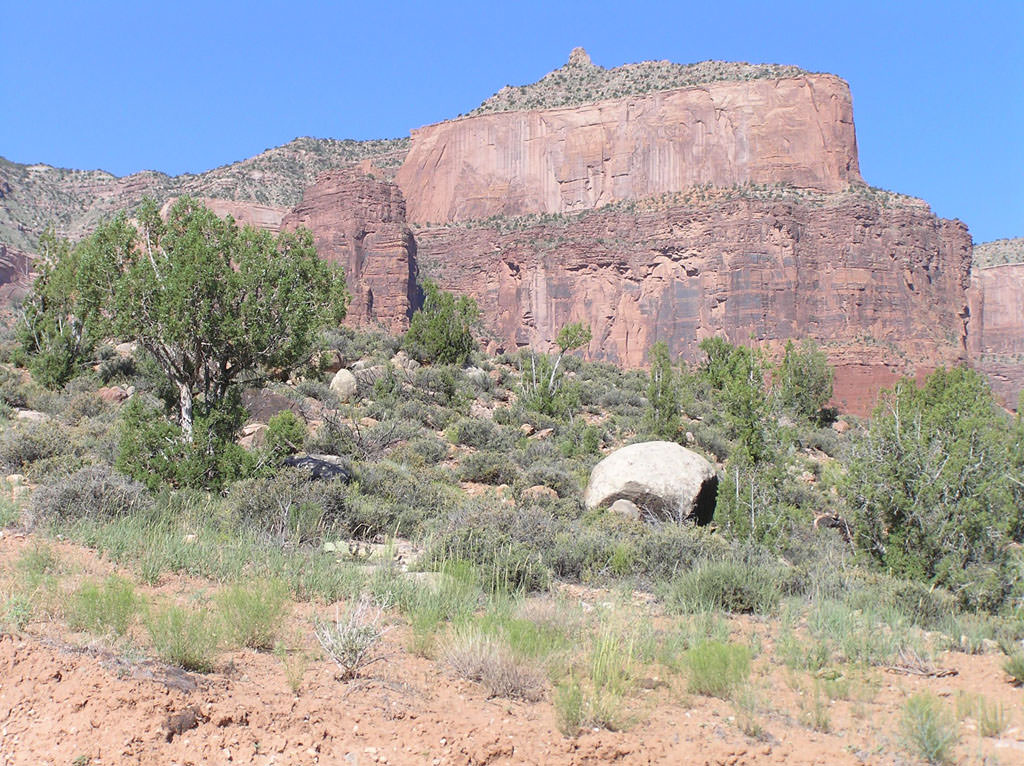
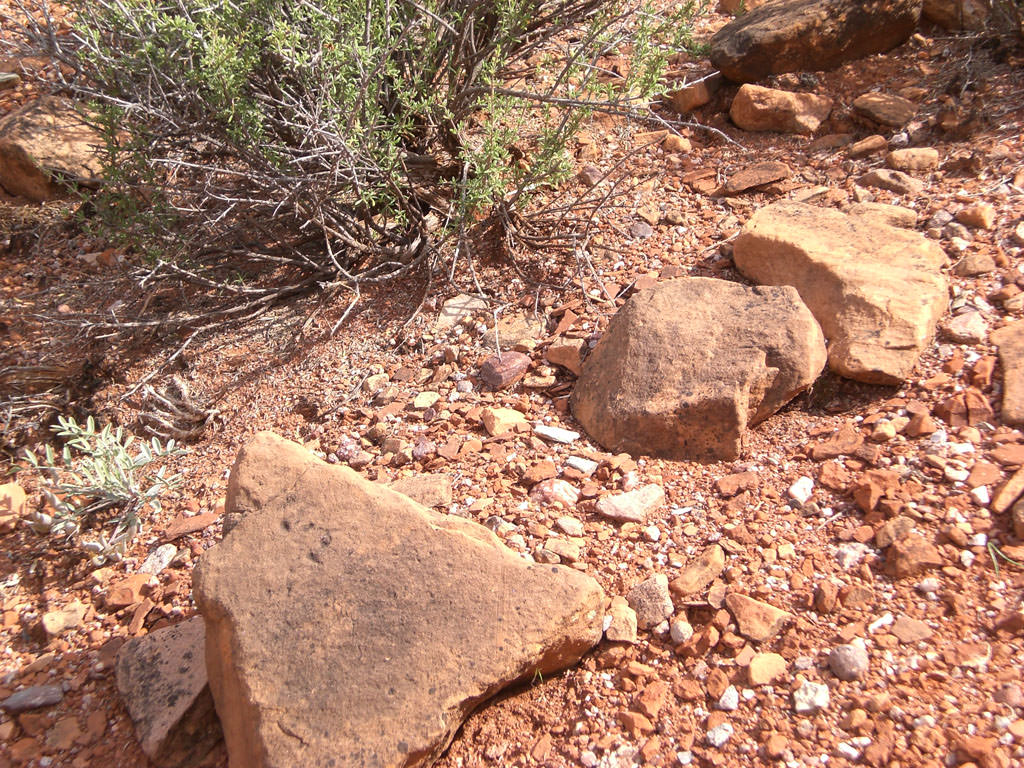
In Colorado, Astragalus piscator appears to be associated with the Cutler Formation (Colorado Natural Heritage Program 2015), in sandy, sometimes gypsiferous soils of valley benches and gullied foothills (Spackman et al. 1997). Associated plant community: Juniperus osteosperma. Additional associated plant species: Artemisia tridentata,Coleogyne ramosissima, Atriplex canescens, A. confertifolia, A. gardneri, Sarcobatus vermiculatus, Penstemon utahensis, Castilleja chromosa, C. scabrida, Physaria acutifolia, Cymopteris fendleri, Lepidium lasiocarpum, Arabis pulchra, Cryptantha gracilis, Bouteloua gracilis, Allium macropetalum, Erioneuron pulchellum, Townsendia incana, Oryzopsis hymenoides, Chrysothamnus viscidiflorus, Eriogonum inflatum, Astragalus lentiginosus, Oxytropis sericea, Astragalus flexuosus, Stephanomeria tenuifolia, Eriogonum corymbosum, Haplopappus nuttallii, Cryptantha fulvocanescens, Lepidium lasiocarpum, Cymopterus acaulis, Androstephium breviflorum, Townsendia incana, and Astragalus lonchocarpus.
click on image to enlarge
 |
 |
 |
Elevation Range:
4,509 - 5,581 feet (1,374 - 1,701 meters)
Distribution
Colorado Endemic:
No
Range:
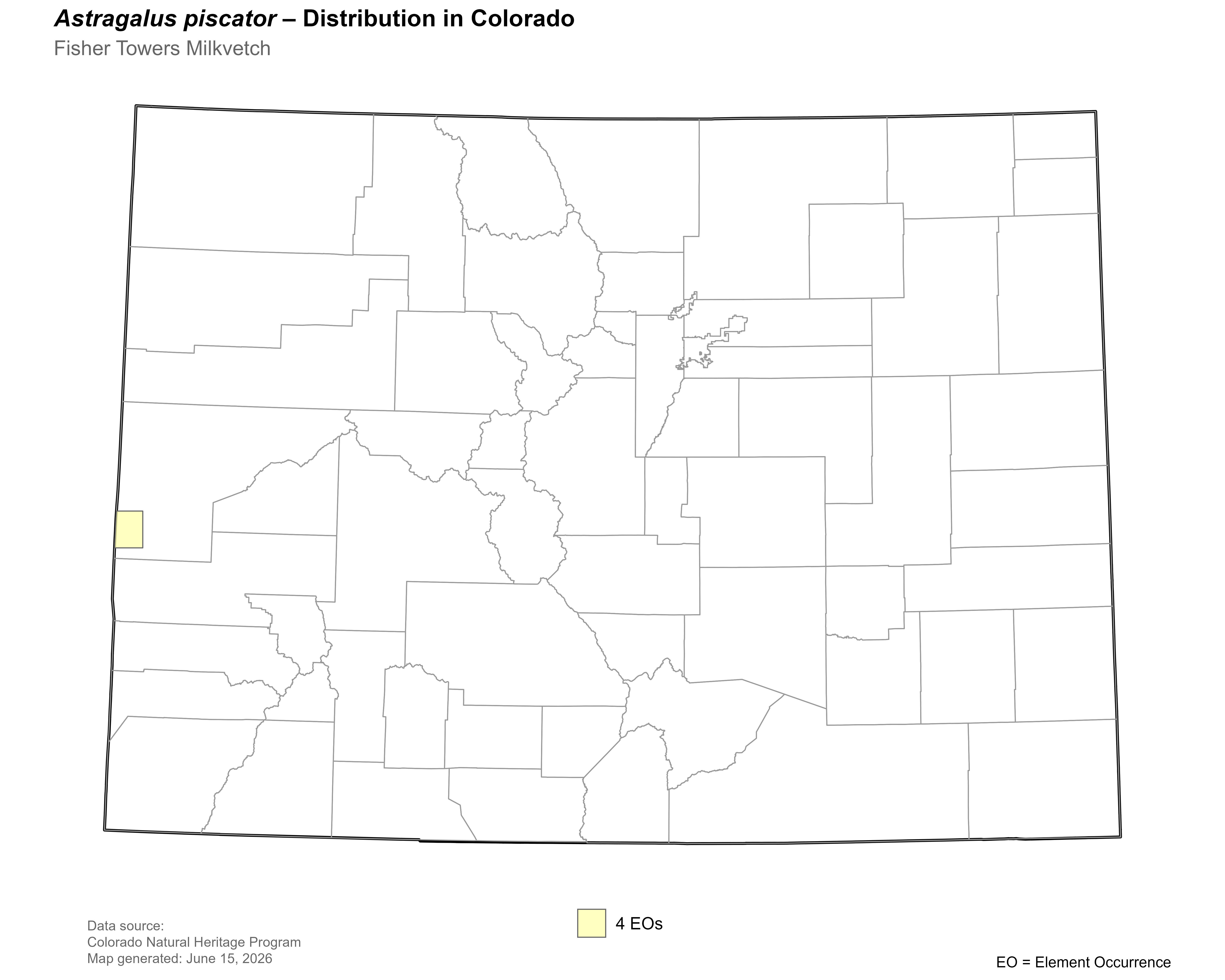
Astragalus piscator is known from the Dolores River valley in Mesa County, Colorado, USA. The species is also known from Arizona and Utah, USA. Estimated range extent in Colorado of 17 square kilometers was calculated in GeoCAT using occurrence data provided by the Colorado Natural Heritage Program (2022).
Click on map to enlarge |
Threats and Management Issues
Threats to Astragalus piscator include road maintenance, prolonged drought associated with climate change and growing recreation pressures (Handwerk et al. 2015, Smith 2019). The Colorado occurrences are partially within the BLM Palisade Wilderness Study Area, and the Palisade Area of Critical Environmental Concern (ACEC), which are either closed to motorized travel or classified as motorized travel limited to designated routes (BLM 2015); however portions of the populations of this species occur in lower drainages and gentle slopes where off-highway vehicle (OHV) use has been observed. Heavy grazing by livestock, which may lead to trampling of individuals, was noted in at least one occurrence. The invasive non-native plant species, cheatgrass and Russian knapweed, were noted in species habitat. The presence of cheatgrass may increase the potential for fire extent (Handwerk et al. 2015. This species is considered to have low adaptive capacity and is expected to be extremely vulnerable to climate change under both RCP 4.5 and 8.5 scenarios, as assessed for the 2025 Colorado State Wildlife Action Plan (CNHP 2025).
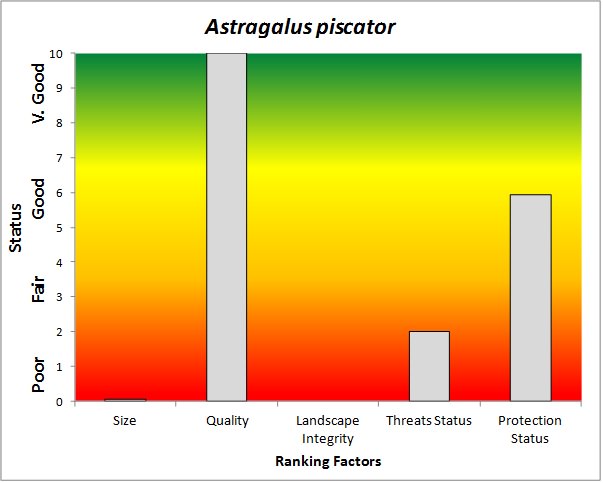
Summary results of an analysis of the status of Astragalus piscator based on several ranking factors. This species was concluded to be Moderately Conserved. From Rondeau et al. 2011. |
References
- Ackerfield, J. 2015. Flora of Colorado. BRIT Press, Botanical Research Institute of Texas, Fort Worth, TX. 818 pp.
- Barneby, R. C., and S. L. Welsh. 1986. New species of Astragalus (Leguminosae) from southeastern Utah. Great Basin Naturalist 45(3):551-552.
- Barneby, R.C. 1989. Fabales. In A. Cronquist, A.H. Holmgren, N.H. Holmgren, J.L. Reveal, and P.K. Holmgren (eds.). Intermountain flora: Vascular plants of the Intermountain West, U.S.A. Vol. 3, Part B. New York Botanical Garden, Bronx. 279 pp.
- Baskin, C.C., J.M. Baskin and E. Quarterman. 1972. Observations on the ecology of Astragalus tennesseensis. Amer. Midl. Natur. 88(1): 167-182.
- Bureau of Land Management (BLM), Grand Junction Field Office. Approved Resource Management Plan and Approved Travel Management Plan for the Bureau of Land Management Grand Junction Field Office. 2015. Available at https://eplanning.blm.gov/public_projects/lup/55944/67731/73684/4._GJFO_Approved_RMP.pdf.
- Colorado Natural Heritage Program (CNHP). 2022. Biodiversity Tracking and Conservation System (Biotics 5). Colorado Natural Heritage Program, Colorado State University, Fort Collins.
- Colorado Natural Heritage Program (CNHP). 2025. Climate Change Vulnerability Assessment of Colorado Tier 1 and Tier 2 Plant Species of Greatest Conservation Need (SCGN) for the 2025 Colorado State Wildlife Action Plan. Colorado Natural Heritage Program, Colorado State University, Fort Collins.
- Cronquist A. 1989. Intermountain Flora Vascular Plants of the Intermountain West, USA. Vol. 3, Part B. New York Botanical Garden, Bronx, NY.
- Green, T.W. and G.E. Bohart. 1975. The pollination ecology of Astragalus cibarius and Astragalus utahensis (Leguminosae). Amer. J. Bot. 62(4): 370-386.
- Handwerk, J., L. Grunau, and S. Panjabi. 2015. Colorado Wildlife Action Plan: 2015 Rare Plant Addendum. Colorado Natural Heritage Program, Colorado State University, Fort Collins, Colorado, USA.
- Neely, B., S. Panjabi, E. Lane, P. Lewis, C. Dawson, A. Kratz, B. Kurzel, T. Hogan, J. Handwerk, S. Krishnan, J. Neale, and N. Ripley. 2009. Colorado Rare Plant Conservation Strategy, Developed by the Colorado Rare Plant conservation Initiative. The Nature Conservancy, Boulder, Colorado, 117 pp.
- Panjabi, S., B. Neely and P. Lyon. 2011. Preliminary Conservation Action Plan for Rare Plants in the Gateway Priority Action Areas. Prepared by The Nature Conservancy and the Colorado Natural Heritage Program. Unpublished report prepared for the National Fish and Wildlife Foundation. 29 pp.
- Rondeau, R., K. Decker, J. Handwerk, J. Siemers, L. Grunau, and C. Pague. 2011. The state of Colorado's biodiversity 2011. Prepared for The Nature Conservancy. Colorado Natural Heritage Program, Colorado State University, Fort Collins, Colorado.
- Smith, J. 2019. Colorado Natural Areas Program Field Survey Report at Gateway Palisade Natural Area.
- Spackman, S., B. Jennings, J. Coles, C. Dawson, M. Minton, A. Kratz, and C. Spurrier. 1997. Colorado rare plant field guide. Prepared for Bureau of Land Management, U.S. Forest Service and U.S. Fish and Wildlife Service by Colorado Natural Heritage Program.
- USDA, NRCS. 2022. The PLANTS Database. National Plant Data Team, Greensboro, NC 27401-4901 USA.
- Weber, W. A. and R. C. Wittmann. 2012. Colorado Flora, Western Slope, A Field Guide to the Vascular Plants, Fourth Edition. Boulder, Colorado. 532 pp.
- Welsh, S.L., N.D. Atwood, S. Goodrich and L.C. Higgins. (Eds.) 2003. A Utah Flora. 3rd edition. Brigham Young University, Provo, Utah, U.S.A. 912 pp.
- Yeatts, Loraine. 2020. Colorado Natural Areas Program Field Survey Volunteer Steward Report at Gateway Palisade Natural Area.