

Scientific Name : Anticlea vaginata
Author : Rydb. NatureServe Explorer
Common Name : Alcove Death Camas
 Current Research Activities
 1997 profile


☰ Click link below for details.
Taxonomy
Melanthiaceae ()
Ackerfield (2022) lists this as Anticlea vaginata Rydb. and Weber and Wittmann (2012) list this as Anticlea vaginatus. Ackerfield (2015) and others use the name Zigadenus vaginatus.
Ranks and Status
State Rank : S1
State Rank Reason : There are six extant occurrences of Anticlea vaginata in Colorado, USA, all within a narrow range in the northwest corner of the state. The population appears to be fairly well protected and inaccessible, but is susceptible to changes in hydrologic conditions, trampling by livestock and encroachment of invasive plants species. It is considered extremely vulnerable to the effects of climate change (Handwerk et al. 2015).
U.S. Endangered Species Act : none
Colorado Threatened and Endangered List : none
Other Statuses : SWAP Tier 2
Description and Phenology
General Description:
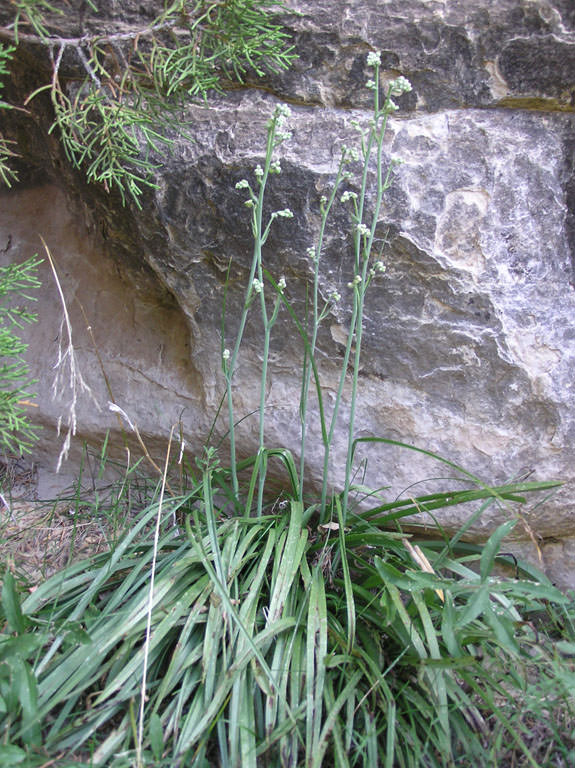
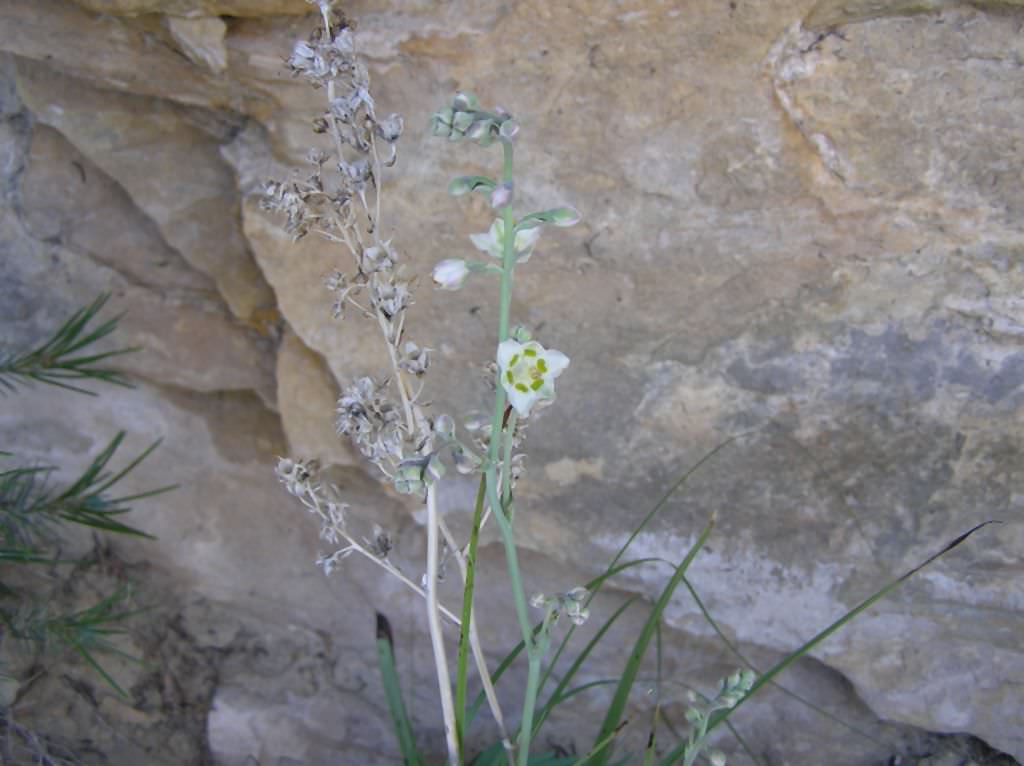
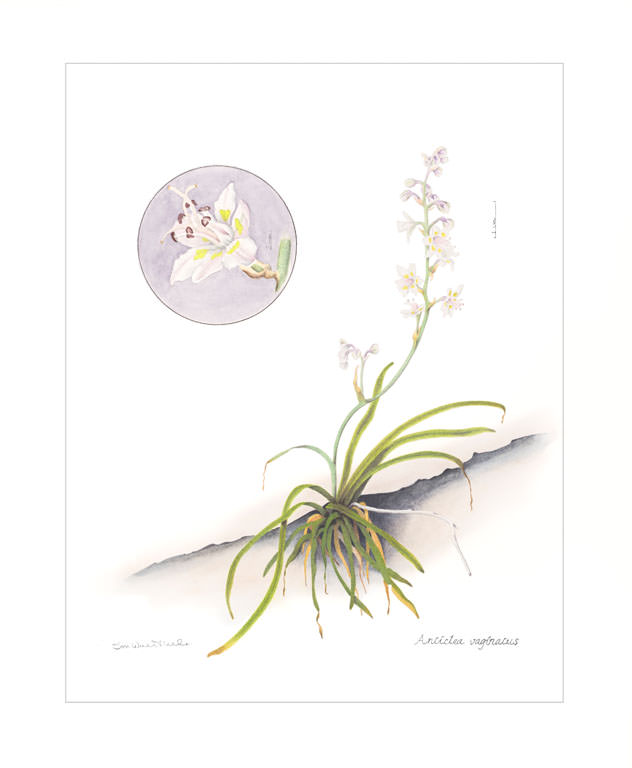
Plants 3-10 dm tall, or more. Flowers in panicles or less commonly in racemes; tepals 6-7 mm long, white. Leaves 20-70 cm long, 6-18 mm wide (Spackman et al. 1997).
Look Alikes:
Anticlea elegans is smaller (less than 50 cm tall), has larger flowers (15- 20 mm long), and occurs mainly at higher elevations (Spackman et al. 1997).
Phenology:
Flowers late July to the end of October (Spackman et al. 1997).
 |
Habitat
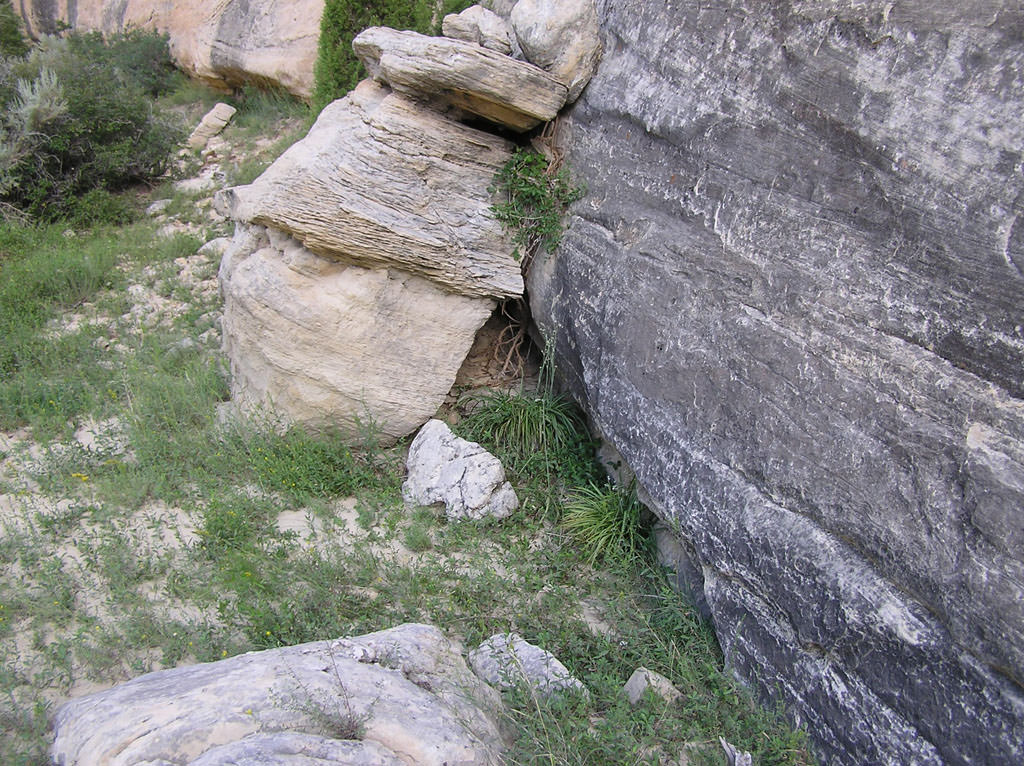
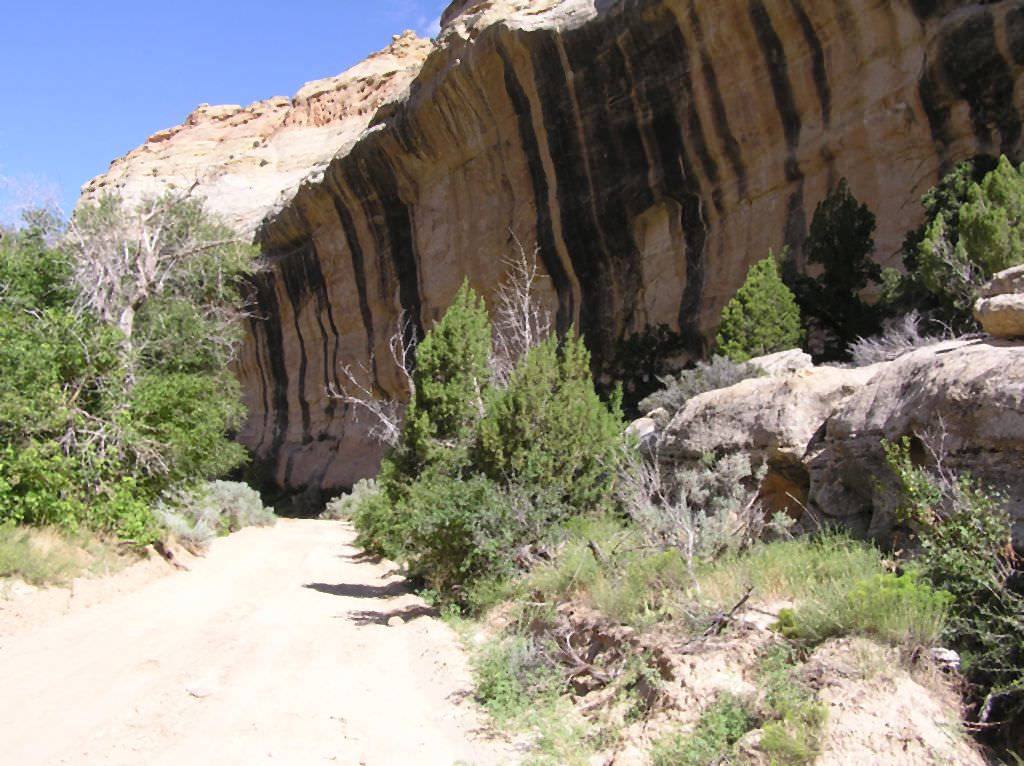
Hanging gardens with seeps and loose rich soil under overhanging canyon walls (Spackman et al. 1997) surrounded by pinyon-juniper woodlands. Associated taxa include Dodecatheon pulchellum, Calamagrostis scopoulorum, Carex aurea, Epipactis gigantea, Aquilegia micrantha, and Clematis ligusticifolia.
click on image to enlarge
 |
 |
Elevation Range:
5,084 - 6,003 feet (1,550 - 1,830 meters)
Distribution
Colorado Endemic:
No
Range:
This species is known from Moffat County in Colorado, USA; the only records are from Dinosaur National Monument. Estimated range extent in Colorado of 23 square kilometers was calculated in GeoCAT using occurrence data provided by the Colorado Natural Heritage Program (2023). This species is also known from Arizona, Utah, and the Navajo Nation.
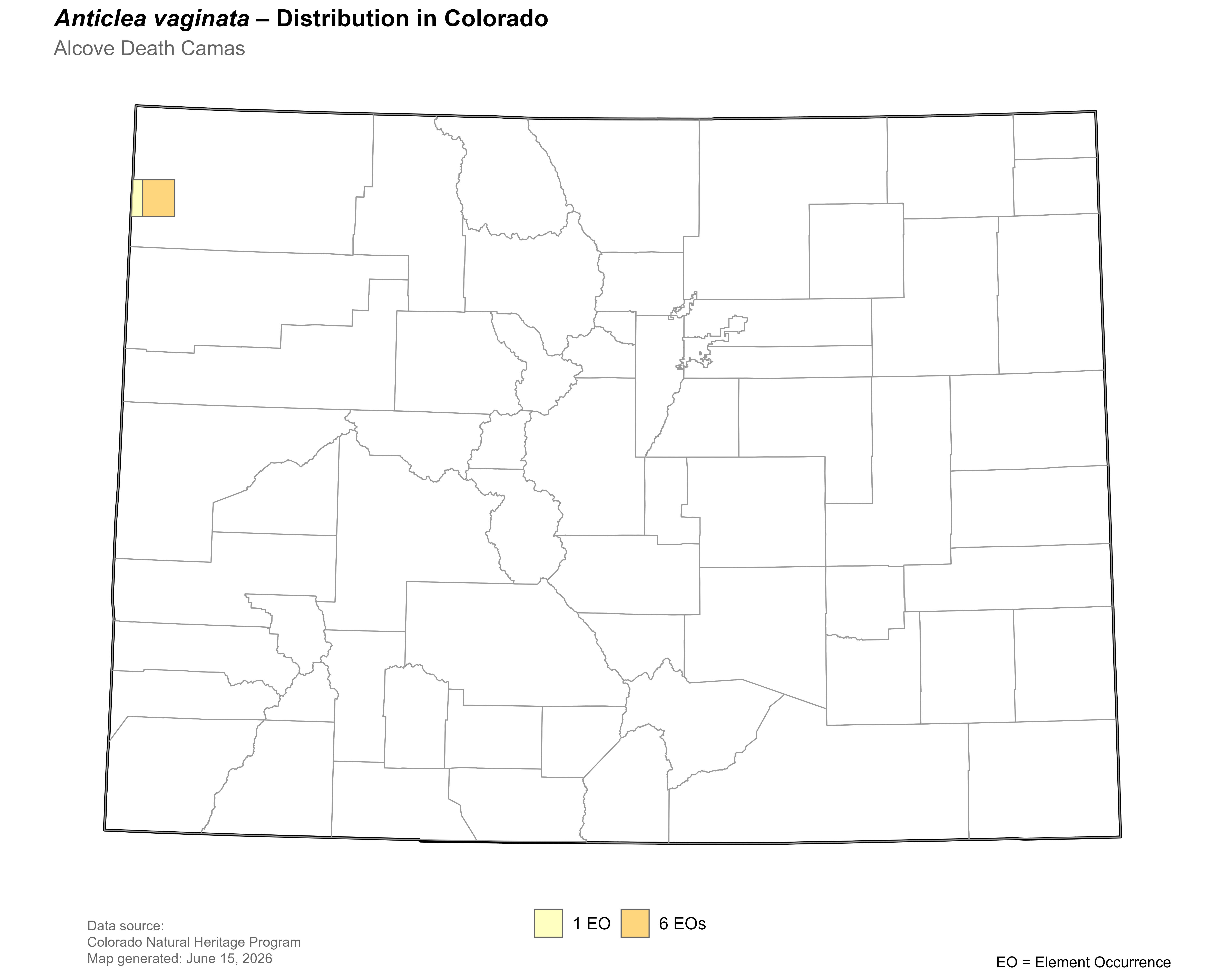
Click on map to enlarge |
Threats and Management Issues
The primary threat at this time is considered to be hydrologic alteration (Rondeau et al. 2011). The plants occur in hanging garden communities which are dependent on seeps and springs on the cliff faces; diversion of the mesa top springs and streams to other uses would disrupt this hydrologic system. Trampling by livestock and encroachment of invasive plants species, including Phalaris arundinacea and Bromus tectorum has been noted at three of the occurrences. This species is considered to have low adaptive capacity and is expected to be extremely vulnerable to climate change under both RCP 4.5 and 8.5 scenarios, as assessed for the 2025 Colorado State Wildlife Action Plan (CNHP 2025).
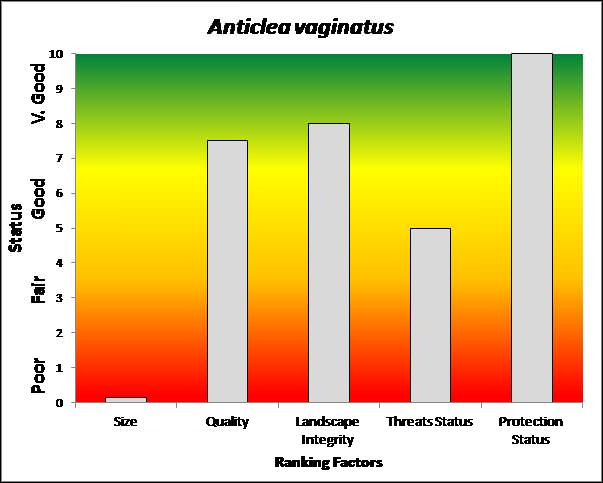
Summary results of an analysis of the status of Anticlea vaginatus based on several ranking factors. This species was concluded to be "Effectively Conserved. From Rondeau et al. 2011. |
References
- Ackerfield, J. 2015. Flora of Colorado. BRIT Press, Botanical Research Institute of Texas, Fort Worth, TX. 818 pp.
- Ackerfield, J. 2022. Flora of Colorado. Second Edition. Bot. Misc. 60. BRIT Press, Fort Worth Botanic Garden/Botanical Research Institute of Texas, U.S.A. 861 pp.
- Colorado Natural Heritage Program (CNHP). 2023. Biodiversity Tracking and Conservation System (Biotics 5). Colorado Natural Heritage Program, Colorado State University, Fort Collins.
- Colorado Natural Heritage Program (CNHP). 2025. Climate Change Vulnerability Assessment of Colorado Tier 1 and Tier 2 Plant Species of Greatest Conservation Need (SCGN) for the 2025 Colorado State Wildlife Action Plan. Colorado Natural Heritage Program, Colorado State University, Fort Collins.
- Cronquist, A., A. H. Holmgren, N. H. Holmgren, J. L. Reveal and P. K. Holmgren. 1977. Intermountain Flora Vascular Plants of the Intermountain West, USA: vol. 6. New York Botanical Garden, Bronx, NY.
- Flora of North America Editorial Committee, ed. (FNA). 1993+. Flora of North America North of Mexico. Oxford Univ. Press, New York, Oxford.
- Franklin, M.A. 2005. Plant information compiled by the Utah Natural Heritage Program: A progress report. Publication Number 05-40. Utah Division of Wildlife Resources, Salt Lake City, Utah. 341 pp. [http://dwrcdc.nr.utah.gov/ucdc/ViewReports/plantrpt.htm]
- Handwerk, J., L. Grunau, and S. Panjabi. 2015. Colorado Wildlife Action Plan: 2015 Rare Plant Addendum. Colorado Natural Heritage Program, Colorado State University, Fort Collins, Colorado, USA.
- Kartesz, J.T. 1994. A synonymized checklist of the vascular flora of the United States, Canada, and Greenland. 2nd edition. 2 vols. Timber Press, Portland, OR.
- Neely, B., S. Panjabi, E. Lane, P. Lewis, C. Dawson, A. Kratz, B. Kurzel, T. Hogan, J. Handwerk, S. Krishnan, J. Neale, and N. Ripley. 2009. Colorado Rare Plant Conservation Strategy, Developed by the Colorado Rare Plant conservation Initiative. The Nature Conservancy, Boulder, Colorado, 117 pp.
- O'Kane, S. L. 1988. Noteworthy Collections, Colorado. Madrono, 35(4):353-359.
- Palmquist, E.C. 2011. Phylogeny and evolutionary history of Anticlea vaginata Rydb. (Melanthiaceae): a hanging garden endemic. Final Report to the Colorado Plateau Cooperative Ecosystems Unit.
- Rondeau, R., K. Decker, J. Handwerk, J. Siemers, L. Grunau, and C. Pague. 2011. The state of Colorado's biodiversity 2011. Prepared for The Nature Conservancy. Colorado Natural Heritage Program, Colorado State University, Fort Collins, Colorado.
- Roth, D. 2008. Last update May 15. Species account for Zigadenus vaginatus. Navajo Natural Heritage Program, Window Rock, AZ. [http://nnhp.nndfw.org/Plants/ziva.pdf]
- Smithsonian Institution. 1980. Draft abstracts on rare plants. Unpublished. Perhaps 100 individual abstracts.
- Spackman, S., B. Jennings, J. Coles, C. Dawson, M. Minton, A. Kratz, and C. Spurrier. 1997. Colorado rare plant field guide. Prepared for Bureau of Land Management, U.S. Forest Service and U.S. Fish and Wildlife Service by Colorado Natural Heritage Program.
- USDA, NRCS. 2022. The PLANTS Database. National Plant Data Team, Greensboro, NC 27401-4901 USA.
- Utah Native Plant Society. 2003-2012. Utah rare plant guide. A.J. Frates editor/coordinator. Salt Lake City, UT. Utah Native Plant Society. Online. Available: http://www.utahrareplants.org (accessed 2012).
- Weber, W. A. and R. C. Wittmann. 2012. Colorado Flora, Western Slope, A Field Guide to the Vascular Plants, Fourth Edition. Boulder, Colorado. 532 pp.
- Welsh, S.L. 1979. Illustrated manual of proposed endangered and threatened plants of Utah. Brigham Young Univ., Provo, UT. 318 pp.
- Welsh, S.L., N.D. Atwood, S. Goodrich and L.C. Higgins. (Eds.) 2003. A Utah Flora. 3rd edition. Brigham Young University, Provo, Utah, U.S.A. 912 pp.