

Scientific Name : Astragalus rafaelensis
Author : M.E. Jones NatureServe Explorer
Common Name : San Rafael Milkvetch
 Current Research Activities
 1997 profile


☰ Click link below for details.
Taxonomy
Fabaceae (pea family)
This is the record for Astragalus rafaelensis, in the broad sense, including Astragalus linifolius. Statwick (2016) examined the genetic diversity within and between Astragalus rafaelensis and Astragalus linifolius and found that the two species are not genetically distinct and their morphological characteristics fall along a continuum. This taxon is listed as A. rafaelensis by Ackerfield (2022) and as A. linifolius by Ackerfield (2015).
Ranks and Status
State Rank : S2S3
State Rank Reason : As of 2023 there are 29 occurrences of Astragalus rafaelensis within three counties in southwestern Colorado, USA. Nearly half of the occurrences are exposed to moderate-low levels of threats from recreation and livestock grazing. The species is also considered vulnerable to the effects of climate change.
U.S. Endangered Species Act : none
Colorado Threatened and Endangered List : none
Other Statuses : BLM, SWAP Tier 2
Description and Phenology
General Description:
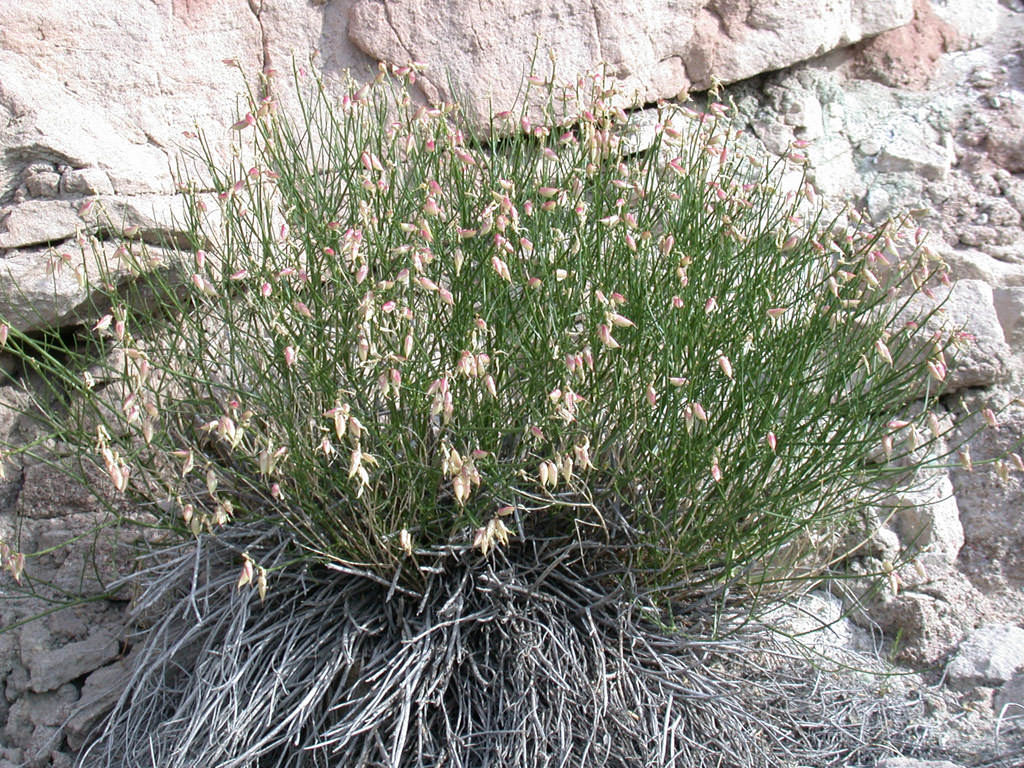
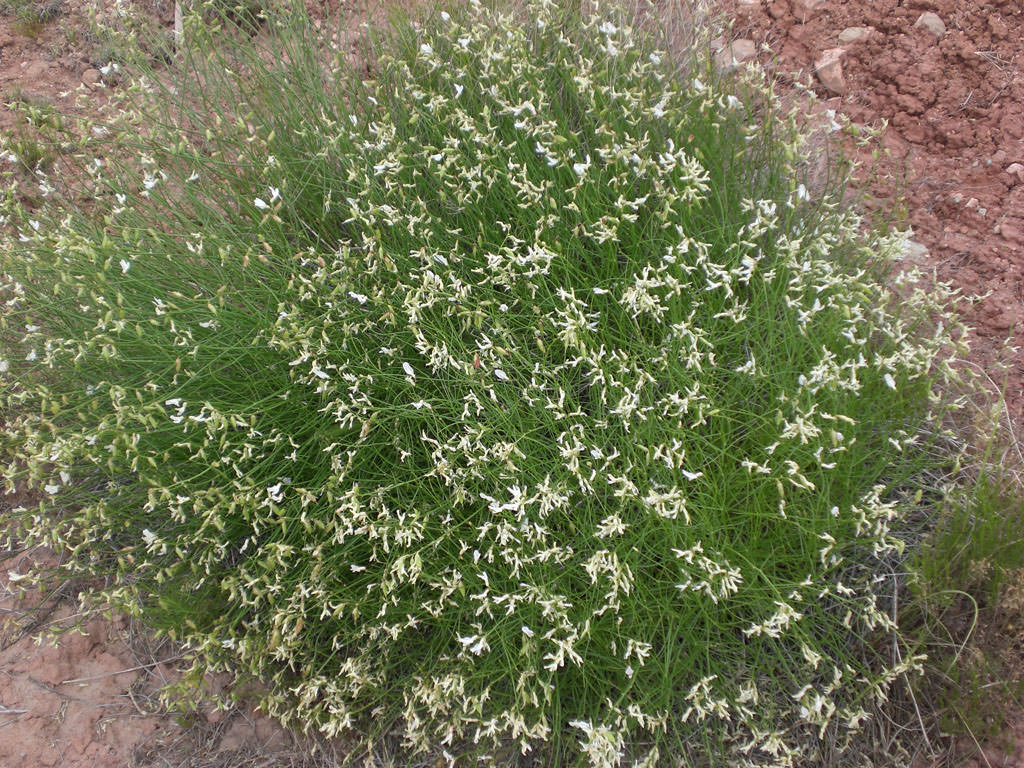
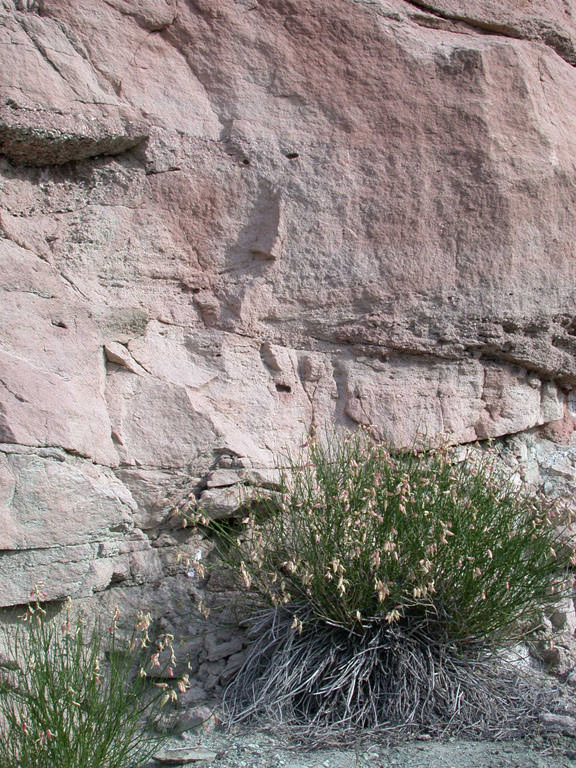
Perennials, 4-5 dm tall. Inflorescence with 6-12 flowers, usually pink-purple and white tipped, or white with purple tips. Pods sessile, mostly reflexed, although there may be some upright pods on the same plant. Pods are glabrous, ellipsoid to oblong, and laterally compressed (Ackerfield 2015, Spackman et al. 1997). Plants broomy, with many old stems forming thatch at base of plant. Leaves extremely narrow and reduced.
Look Alikes:
Astragalus saurinus differs in that it has longer, narrower, and less fleshy pods (Spackman et al. 1997).
Phenology:
Flowers late April through June. Fruits in June (Colorado Natural Heritage Program 2015).
Habitat
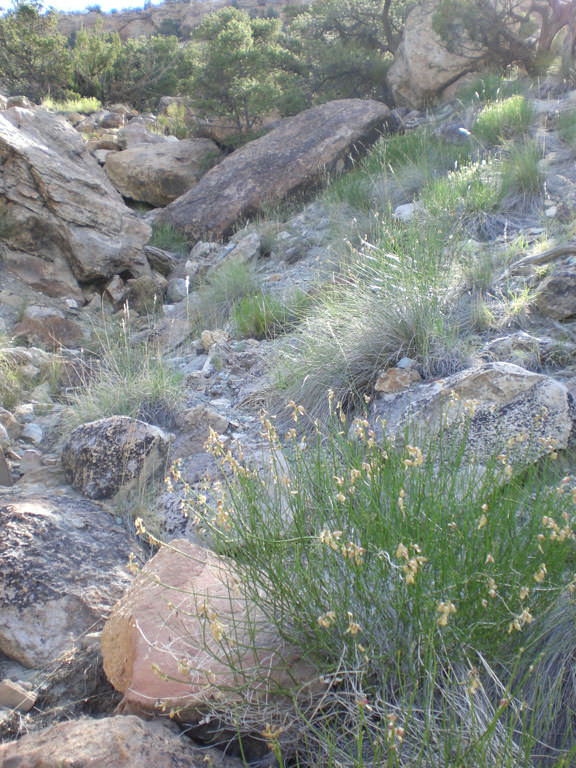
Gullied hills, washes, and talus under cliffs; in seleniferous clayey, silty, or sandy soils. (Spackman et al. 1997). Asociated plant community: Pinus edulis, Juniperus osteosperma, Cercocarpus montanus. Additional associated plant species: Cercocarpus montanus, Chrysothamnus vicidiflorus, Atriplex confertifolia, Purshia tridentata, P. stansburiana, Sarcobatus vermiculatus, Artemisia ludoviciana, Bouteloua curtipendula, Opuntia phaeocantha, Elymus elymoides, Petradaria pumila, Physaria acutifolia, Senecio multilobatus, Erysimum capitatum, Hymenopappus filifolius, Haplopappus armerioides, Lepidium montanum, Oryzopsis hymenoides, Astragalus lonchocarpus, Chaetopappa ericoides, Poa secunda, Hilaria jamesii, Castilleja chromosa, Astragalus flavus, Erigeron pumilus, Hymenoxys richardsonii, H. acaulis, Senecio multilobatus, Castilleja seabrida, C. linarifolia, Pediomelum megalanthum, Gutierrezia sarothrae, Astragalus wetherillii, Schoenocrambe linifolia, Townsendia incana, Astragalus eastwoodiae, Heterotheca villosa.
click on image to enlarge
 |
 |
Elevation Range:
4,645 - 7,325 feet (1,416 - 2,233 meters)
Distribution
Colorado Endemic:
No
Range:
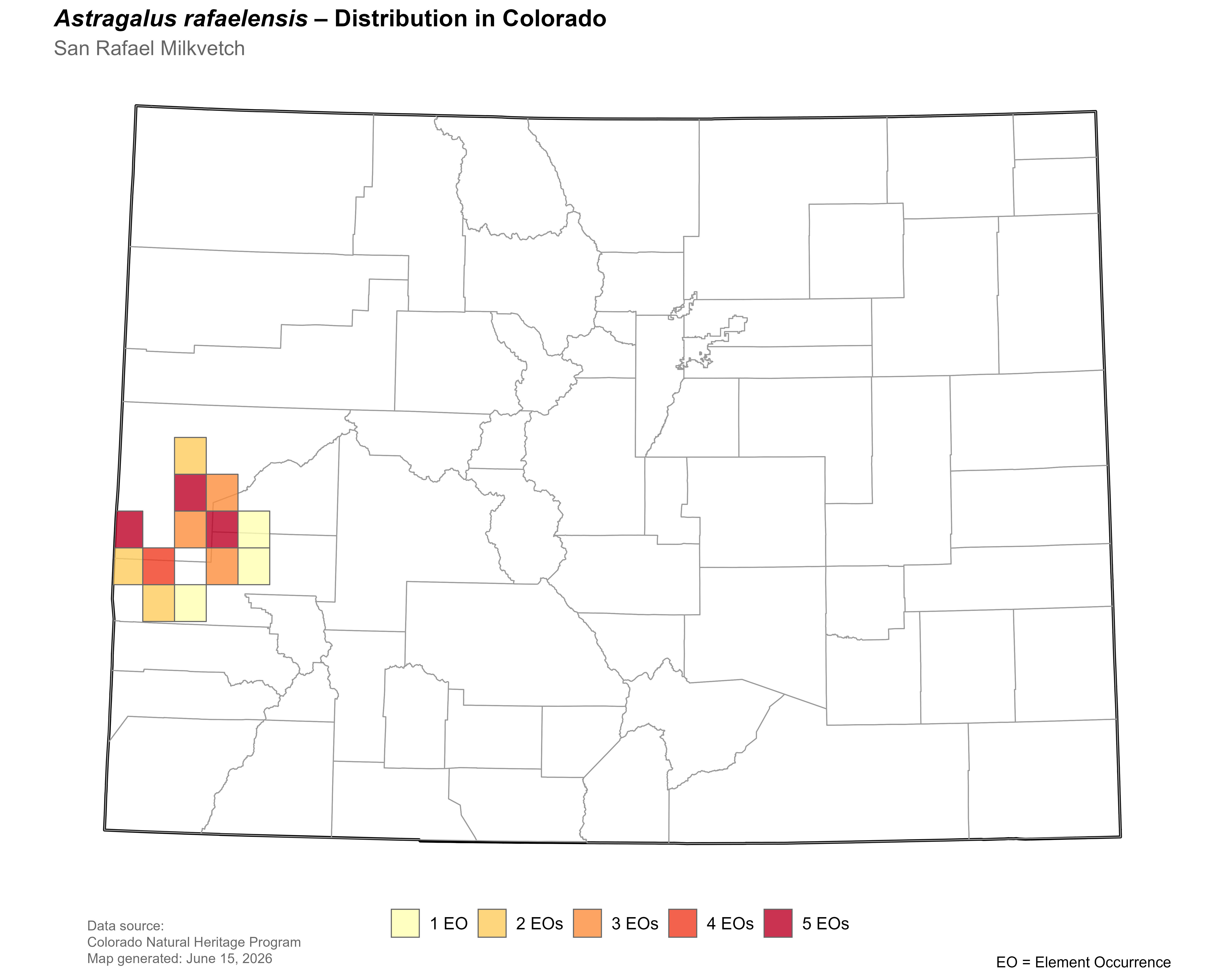
Astragalus rafaelensis is known from Delta, Mesa and Montrose counties in Colorado, USA. Estimated range extent in Colorado of 3,494 square kilometers was calculated in GeoCAT using occurrence data provided by the Colorado Natural Heritage Program (2023). This species is also known from Utah, USA.
Click on map to enlarge |
Threats and Management Issues
The Colorado occurrences are primarily within BLM lands with no special protection status. Either livestock grazing or motorized and non-motorized recreation occur at 25-50% of the occurrences. Invasive plant species have also been observed at several occurrences. This species is considered to have low adaptive capacity and is expected to be moderately to extremely vulnerable to climate change under both RCP 4.5 and 8.5 scenarios, as assessed for the 2025 Colorado State Wildlife Action Plan (CNHP 2025).
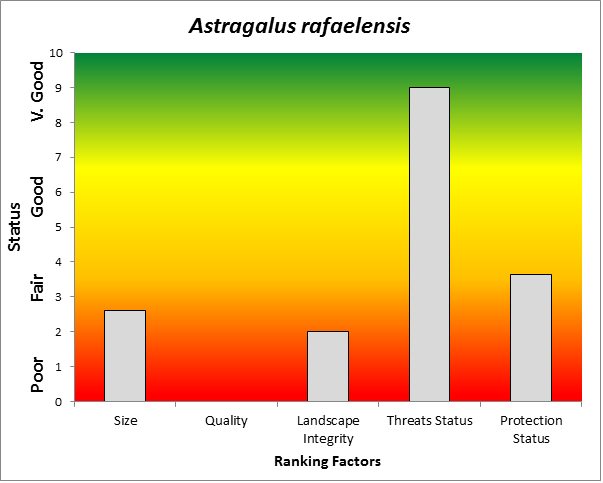
Summary results of an analysis of the status of Astragalus rafaelensis based on several ranking factors. This species was concluded to be Moderately Conserved. From Rondeau et al. 2011. |
References
- Ackerfield, J. 2015. Flora of Colorado. BRIT Press, Botanical Research Institute of Texas, Fort Worth, TX. 818 pp.
- Ackerfield, J. 2022. Flora of Colorado. Second Edition. Bot. Misc. 60. BRIT Press, Fort Worth Botanic Garden/Botanical Research Institute of Texas, U.S.A. 861 pp.
- Barneby, R. C. 1964. Atlas of North American Astragalus. Memoirs of New York Botanical Garden, vol. 13. New York Botanical Garden, Bronx, NY.
- Colorado Natural Heritage Program (CNHP). 2023. Biodiversity Tracking and Conservation System (Biotics 5). Colorado Natural Heritage Program, Colorado State University, Fort Collins.
- Colorado Natural Heritage Program (CNHP). 2025. Climate Change Vulnerability Assessment of Colorado Tier 1 and Tier 2 Plant Species of Greatest Conservation Need (SCGN) for the 2025 Colorado State Wildlife Action Plan. Colorado Natural Heritage Program, Colorado State University, Fort Collins.
- Cronquist A. 1989. Intermountain Flora Vascular Plants of the Intermountain West, USA. Vol. 3, Part B. New York Botanical Garden, Bronx, NY.
- Handwerk, J., L. Grunau, and S. Panjabi. 2015. Colorado Wildlife Action Plan: 2015 Rare Plant Addendum. Colorado Natural Heritage Program, Colorado State University, Fort Collins, Colorado, USA.
- Kartesz, J.T. 1994. A synonymized checklist of the vascular flora of the United States, Canada, and Greenland. 2nd edition. 2 vols. Timber Press, Portland, OR.
- Neely, B., S. Panjabi, E. Lane, P. Lewis, C. Dawson, A. Kratz, B. Kurzel, T. Hogan, J. Handwerk, S. Krishnan, J. Neale, and N. Ripley. 2009. Colorado Rare Plant Conservation Strategy, Developed by the Colorado Rare Plant conservation Initiative. The Nature Conservancy, Boulder, Colorado, 117 pp.
- Spackman, S., B. Jennings, J. Coles, C. Dawson, M. Minton, A. Kratz, and C. Spurrier. 1997. Colorado rare plant field guide. Prepared for Bureau of Land Management, U.S. Forest Service and U.S. Fish and Wildlife Service by Colorado Natural Heritage Program.
- Statwick, Joseph M., ""The Ecology and Evolution of Rare, Soil Specialist Astragalus Plants in the Arid Western U.S."" (2016). Electronic Theses and Dissertations. 1161. https://digitalcommons.du.edu/etd/1161
- Statwick, Joseph, Jennifer Ramp Neale, Anna Sher. 2016. A report to concerned parties on the taxonomy and conservation of the San Rafael milkvetch (Astragalus rafaelensis M.E. Jones) and Grand Junction milkvetch (Astragalus linifolius Osterh.) (Fabaceae).
- USDA, NRCS. 2022. The PLANTS Database. National Plant Data Team, Greensboro, NC 27401-4901 USA.
- Weber, W. A. and R. C. Wittmann. 2012. Colorado Flora, Western Slope, A Field Guide to the Vascular Plants, Fourth Edition. Boulder, Colorado. 532 pp.
- Welsh, S.L., N.D. Atwood, S. Goodrich and L.C. Higgins. (Eds.) 2003. A Utah Flora. 3rd edition. Brigham Young University, Provo, Utah, U.S.A. 912 pp.