

Scientific Name : Delphinium robustum
Author : Rydb. NatureServe Explorer
Common Name : Wahatoya Creek Larkspur
 Current Research Activities


☰ Click link below for details.
Taxonomy
Ranunculaceae (buttercup family)
There is some taxonomic uncertainly with D. robustum and how it is, or is not distinct from D. ramosum. Ackerfield (2015, 2022) does not recognize D. robustum as a separate species, but places it within D. ramosum. Weber and Wittmann (2012) recognize D. robustum as a distinct species. Flora of North America (1997) and Plants of the World Online (2023) consider D. robustum a valid Colorado taxon.
Ranks and Status
State Rank : S2?
State Rank Reason : Delphinium robustum is known from several counties in south central Colorado. There are 6 occurrences documented in the Colorado Natural Heritage Program database as of 2023, however, there are potentially additional occurrences that are not mapped due to the taxonomic uncertainty of this species. Threats to the long-term persistence of Delphinium robustum are mostly unknown because of a lack of species knowledge and research. Possible human-related threats to D. robustum include motorized and non-motorized recreation, road construction and maintenance, erosion and sedimentation related to roads, livestock trampling, and changes to natural disturbance regimes (e.g., fire suppression). This species may be vulnerable to climate change but there is insufficient information to make that assessment.
U.S. Endangered Species Act : none
Colorado Threatened and Endangered List : none
Other Statuses : SWAP SGIN
Description and Phenology
General Description:
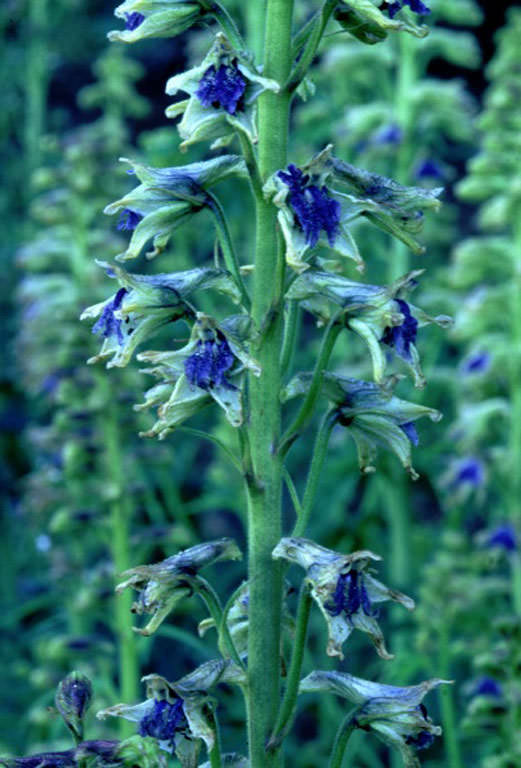
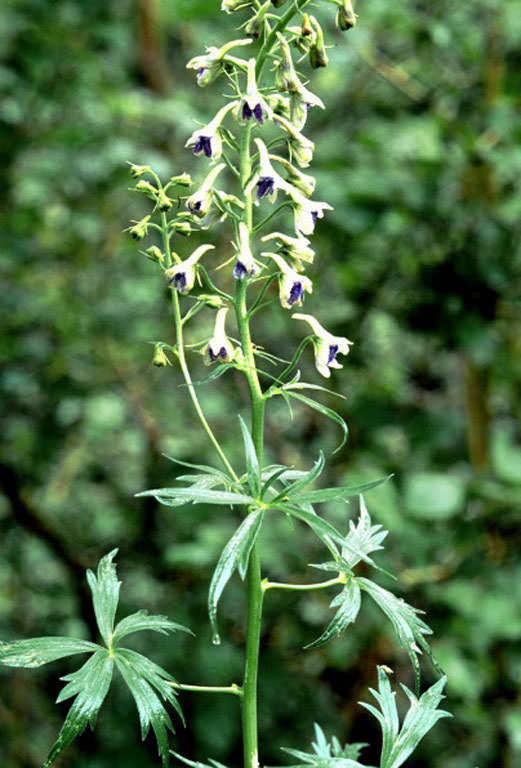
Perennial herb 1-2 m tall; stems glabrous or puberulent, sometimes reddish at the base; leaves all on stem and withered from the basal 1/5 of the stem at the time of anthesis, petioles 7-13 cm long, blades 10-20 cm long and 7-12 cm wide, palmately divided into 5 main lobes, each lobe further dissected into additional lobes or teeth that are rounded at the apex or acute with a blunt tooth (mucro); inflorescence of racemes that are paniculately branched at the base in larger specimens, 40- to 100-flowered, branches and pedicels with short hairs; sepals ovate-acute, bluish purple or pale lavender, rarely pink, sparsely pubescent, lateral sepals forward pointing, 9-14 mm long, the upper sepal extended basally into a spur 9-13 mm long; petal blades hairy, cleft, 5-7 mm long (New Mexico Rare Plant Technical Council 1999). Plants in Colorado have been observed to be 3 m or more tall (Colorado Natural Heritage Program 2012).
Look Alikes:
Delphinium ramosum is typically a shorter plant with pubescent lower stems and unbranched racemes (New Mexico Rare Plant Technical Council 1999).
Phenology:
Flowers July to August (Colorado Natural Heritage Program 2012).
Habitat
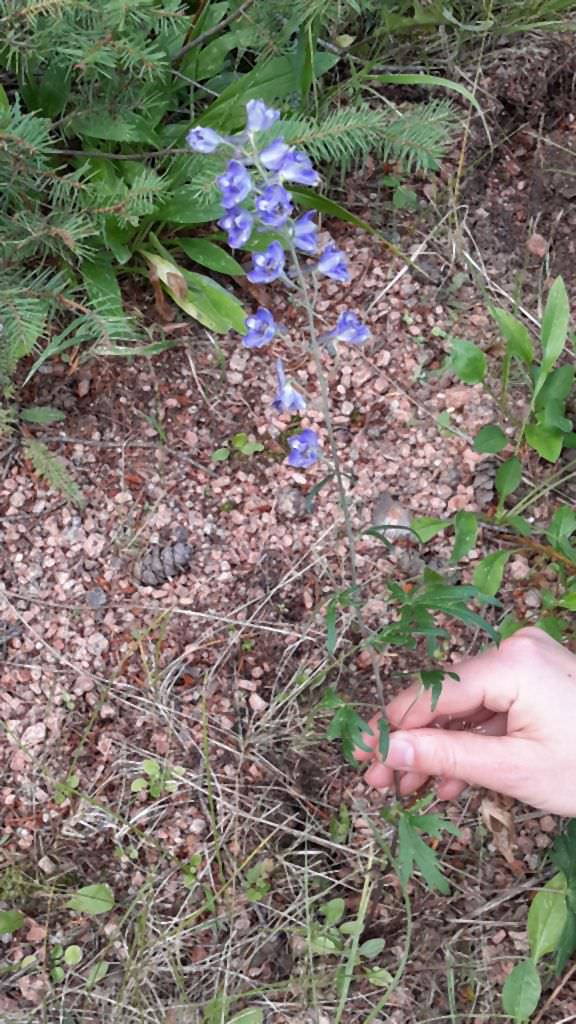
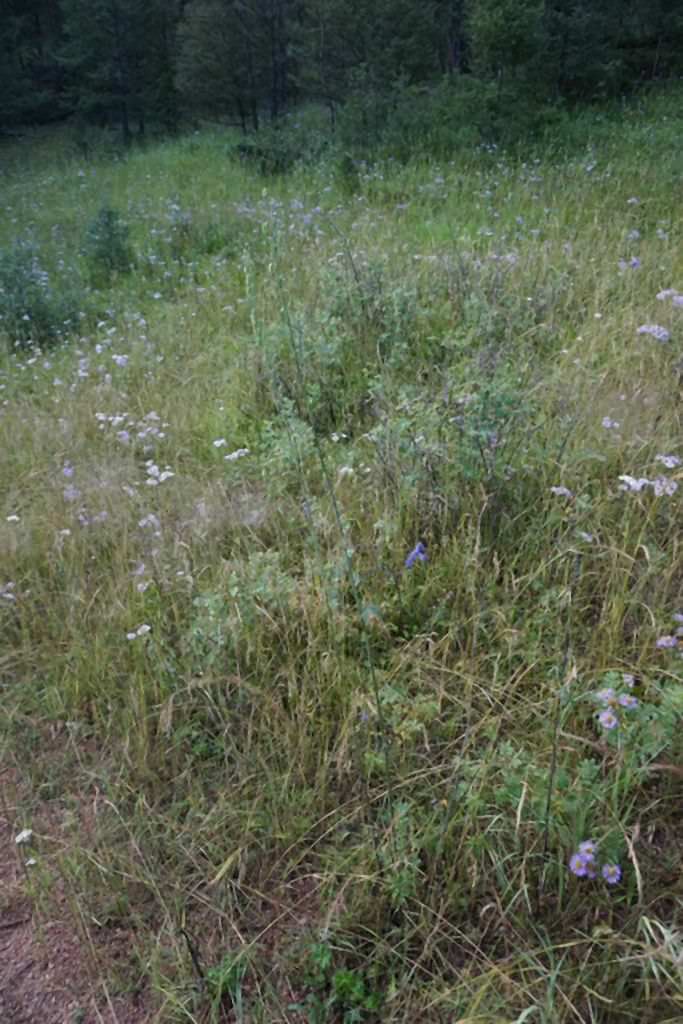
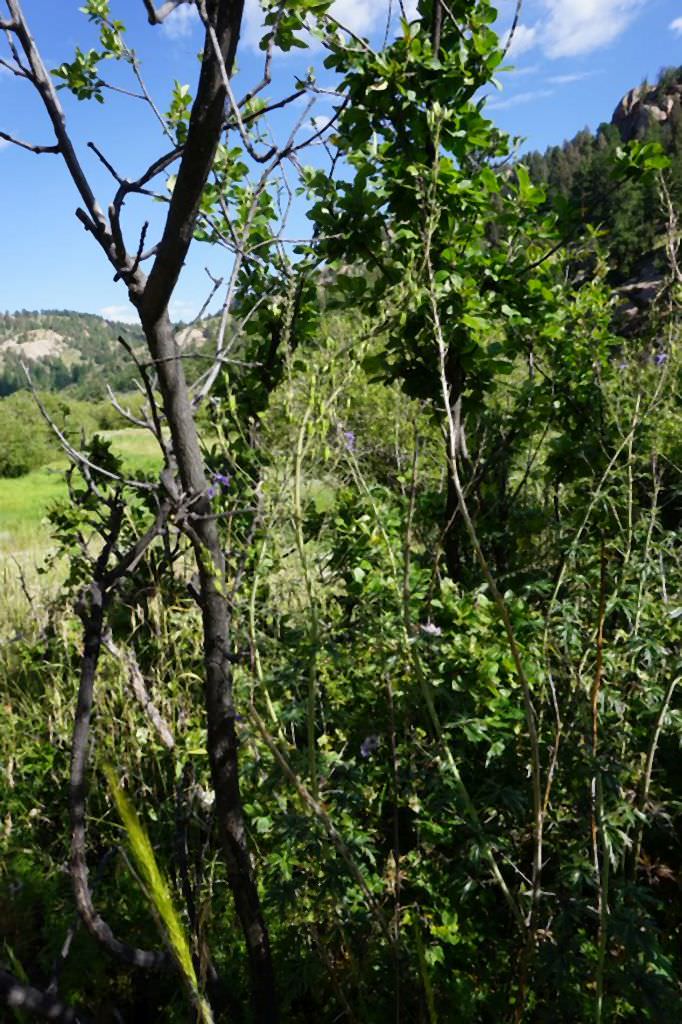
In Colorado, this species grows in broad canyon bottoms, along edges of meadows or in open woods. Found in sandy soil, on northwest slopes.
click on image to enlarge
 |
 |
Elevation Range:
8,270 - 11,247 feet (2,521 - 3,428 meters)
Distribution
Colorado Endemic:
No
Range:
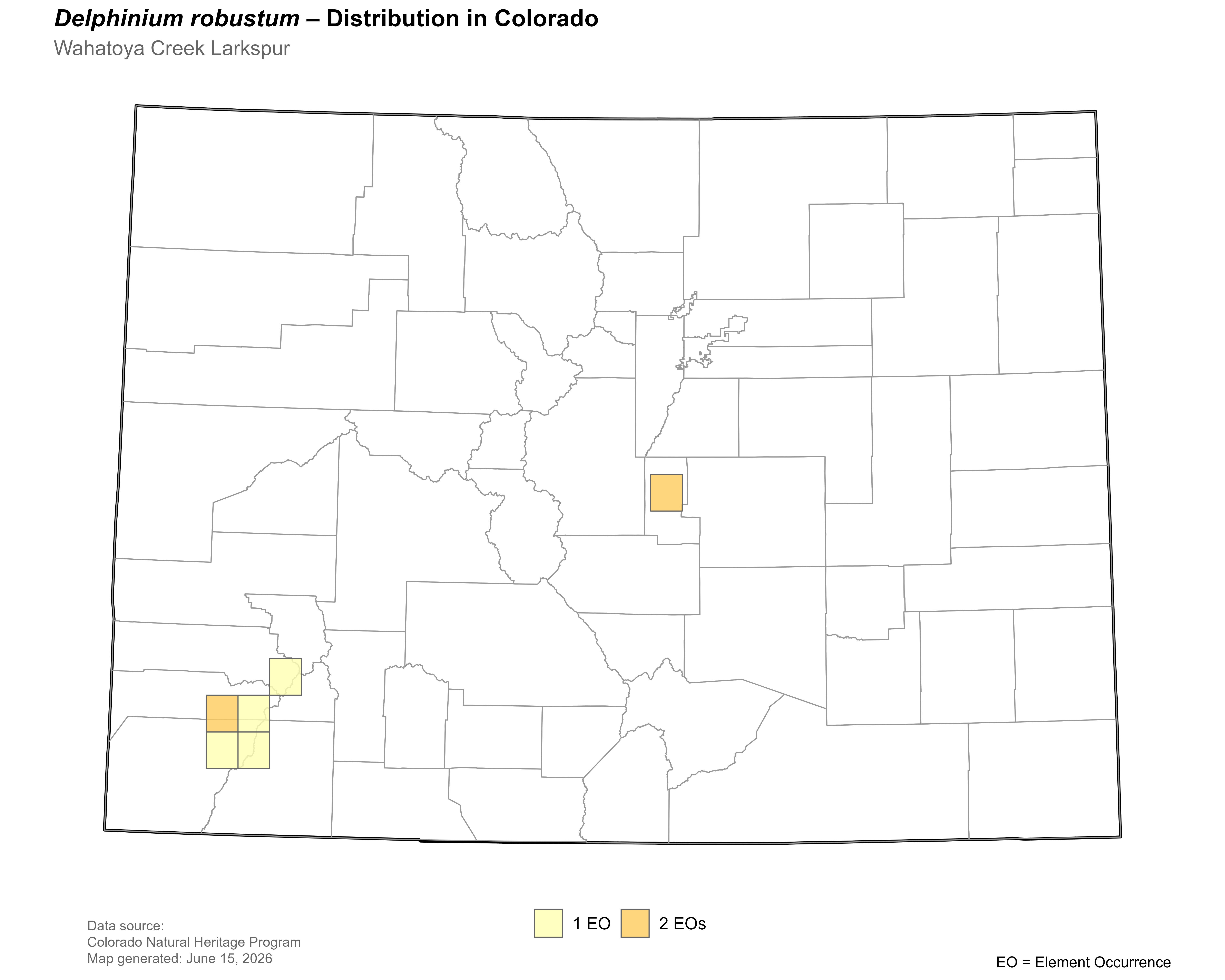
Delphinium robustum is known from Montezuma, San Miguel, and Teller counties in Colorado, USA. There are occurrences that are considered to be of questionable identity in Huerfano, Las Animas, and Saguache counties. Estimated range extent in Colorado of 5029 square kilometers was calculated in GeoCAT using occurrence data provided by the Colorado Natural Heritage Program (2023). Including the occurrences of questionable identity in the range extent indicates a range of 29,797 square kilometers. This taxon is also known from New Mexico, USA.
Click on map to enlarge |
Threats and Management Issues
Delphinium robustum is vulnerable because of its endemic distribution, small number of documented occurrences, possible population declines, and potential human-related and environmental threats. Threats to the long-term persistence of Delphinium robustum are mostly unknown because of a lack of species knowledge and research. Possible human-related threats to D. robustum include motorized and non-motorized recreation, structure construction, road construction and maintenance, erosion and sedimentation related to roads, livestock trampling, and changes to natural disturbance regimes (e.g., fire suppression). The extent of these activities near existing occurrences of D. robustum or in suitable D. robustum habitat is unknown. Disturbances and land management activities, such as burning, thinning, or grazing, may maintain suitable habitat for this species or negatively impact existing occurrences, depending on the disturbance intensity, frequency, and type. Possible environmental and biological threats to occurrences of D. robustum include environmental fluctuations (e.g., drought), non-native species invasion, extensive herbivory, succession, genetic isolation, hybridization, inadequate pollination, and global climate changes (Beatty et al. 2004). This species may be vulnerable to climate change but there is insufficient information to make that assessment (Handwerk et al. 2015).
References
- Ackerfield, J. 2015. Flora of Colorado. BRIT Press, Botanical Research Institute of Texas, Fort Worth, TX. 818 pp.
- Beatty, B.L., W.F. Jennings, and R.C. Rawlinson (2004, July 26). Delphinium robustum Rydb. (Wahatoya Creek larkspur): a technical conservation assessment. [Online]. USDA Forest Service, Rocky Mountain Region. Available: http://www.fs.fed.us/r2/projects/scp/assessments/delphiniumrobustum.pdf [March 2006].
- Colorado Natural Heritage Program (CNHP). 2023. Biodiversity Tracking and Conservation System (Biotics 5). Colorado Natural Heritage Program, Colorado State University, Fort Collins.
- Colorado Natural Heritage Program. 2012. Biodiversity Tracking and Conservation System. Colorado State University, Fort Collins, CO.
- Flora of North America Editorial Committee (FNA). 1997. Flora of North America north of Mexico. Vol. 3. Magnoliophyta: Magnoliidae and Hamamelidae. Oxford Univ. Press, New York. xxiii + 590 pp.
- Flora of North America Editorial Committee, ed. (FNA). 1993+. Flora of North America North of Mexico. Oxford Univ. Press, New York, Oxford.
- Handwerk, J., L. Grunau, and S. Panjabi. 2015. Colorado Wildlife Action Plan: 2015 Rare Plant Addendum. Colorado Natural Heritage Program, Colorado State University, Fort Collins, Colorado, USA.
- Harrington, H.D. 1954. Manual of the plants of Colorado. Sage Press, Chicago. 666 pp.
- Kartesz, J.T. 1996. Species distribution data at state and province level for vascular plant taxa of the United States, Canada, and Greenland (accepted records), from unpublished data files at the North Carolina Botanical Garden, December, 1996.
- Lavender, A.E., M.M. Fink, S.E. Linn, D.M. Theobald. 2011. Colorado Ownership, Management, and Protection v9 Database. Colorado Natural Heritage Program and Geospatial Centroid, Colorado State University, Fort Collins, CO. (30 September).
- Martin, W.C., and C.R. Hutchins. 1980-1981. A flora of New Mexico. 1980, Vol. 1; 1981, Vol. 2. J. Cramer, in der A.R. Gantner Verlag, K.G., Vaduz, Liechtenstein. 2591 pp.
- Neely, B., S. Panjabi, E. Lane, P. Lewis, C. Dawson, A. Kratz, B. Kurzel, T. Hogan, J. Handwerk, S. Krishnan, J. Neale, and N. Ripley. 2009. Colorado Rare Plant Conservation Strategy, Developed by the Colorado Rare Plant conservation Initiative. The Nature Conservancy, Boulder, Colorado, 117 pp.
- New Mexico Rare Plant Technical Council. 1999. New Mexico Rare Plants. Albuquerque, NM: New Mexico Rare Plants Home Page. http://nmrareplants.unm.edu (Latest update: 29 Nov 2023).
- Plants of the World Online (POWO). 2023. Plants of the World Online. Facilitated by the Royal Botanic Gardens, Kew. Online. Available: http://www.plantsoftheworldonline.org/ (accessed 2023).
- Sivinski, R. 2011. Delphinium robustum, New Mexico Rare Plants. Online at: http://nmrareplants.unm.edu/rarelist_single.php?SpeciesID=65 (accessed 11/11/15).
- USDA, NRCS. 2022. The PLANTS Database. National Plant Data Team, Greensboro, NC 27401-4901 USA.
- Weber, W. A. and R. C. Wittmann. 2012. Colorado Flora, Eastern Slope, A Field Guide to the Vascular Plants, Fourth Edition. Boulder, Colorado. 555 pp.