

Scientific Name : Penstemon scariosus var. cyanomontanus
Author : Neese NatureServe Explorer
Common Name : Plateau Penstemon
 Current Research Activities
 1997 profile
☰ Click link below for details.
Taxonomy
Plantaginaceae (plantain family)
Ackerfield (2015, 2022) places this genus in the Plantaginaceae family.
Ranks and Status
State Rank : S2
State Rank Reason : Penstemon scariosus var. cyanomontanus is known from a limited range in western Colorado (USA) near the Utah border. Of the nine occurrences documented in Colorado, only four are of good viability, the remainder are of unknown viability or known only from historical observations. Potential threats to the species include incompatible grazing and competition from invasive plant species such as cheatgrass. Penstemon scariosus var. cyanomontanus is also considered to be moderately to extremely vulnerable to the effects of climate change.
U.S. Endangered Species Act : none
Colorado Threatened and Endangered List : none
Other Statuses : BLM, SWAP Tier 1
Description and Phenology
General Description:
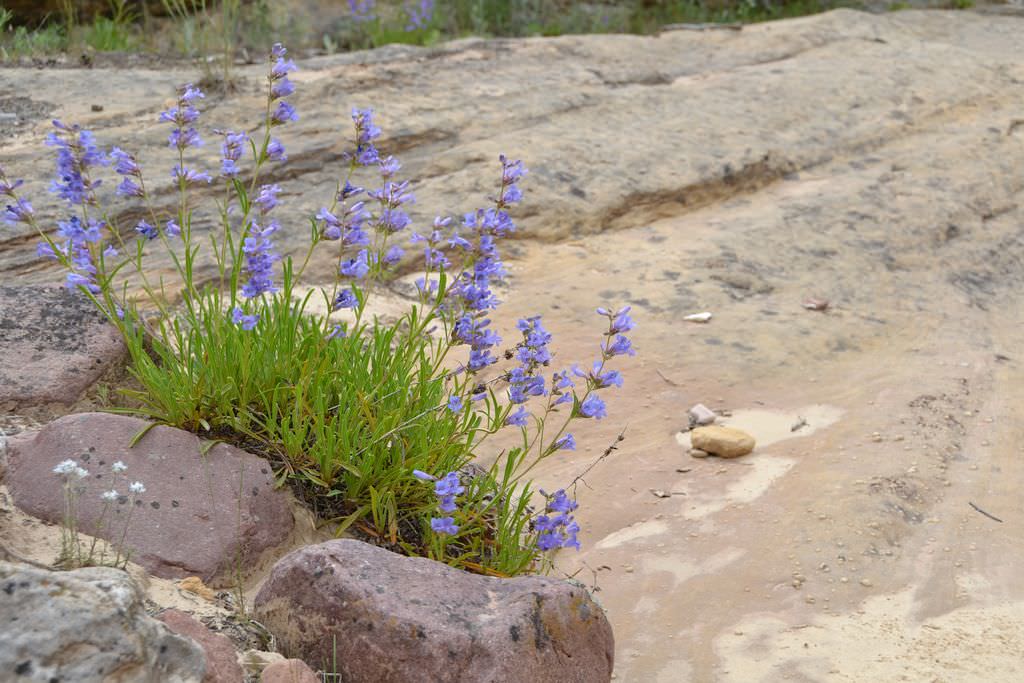
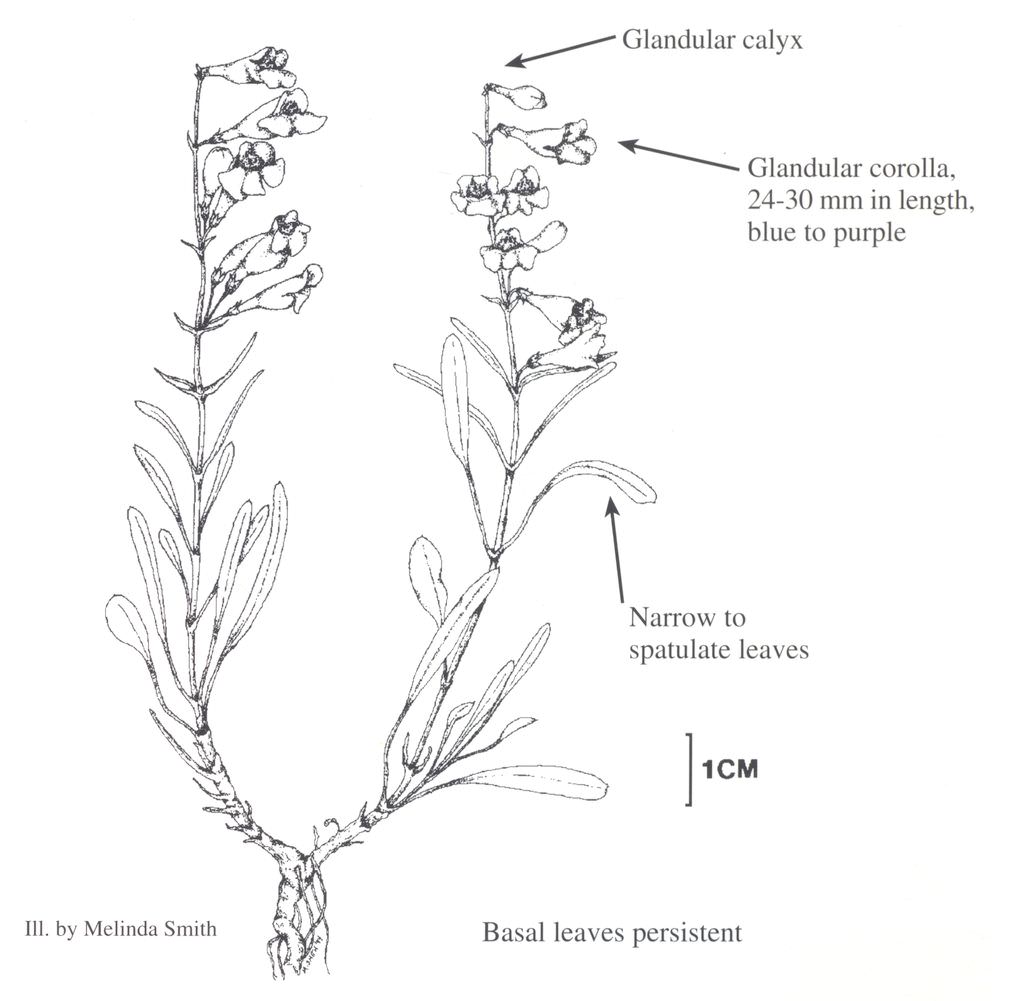
Penstemon scariosus var. cyanomontanus is a perennial forb with several stems decumbent to ascending to 1.5- 5 dm tall. Leaves are narrow to spatulate, basal leaves are persistent. Flower stems are 2-19 cm tall, each with 3-20 pink to purple flowers. Flowers are blue to purple, 24-30 mm long with glandular hairs (Welsh et al. 2003). Glandular hairs on the corolla distinguish the species from its close relatives (Spackman et al. 1997).
Look Alikes:
It is a close relative to Penstemon scariosus and other members of the complex by a series of small morphological features: P. scariosus var. alvibluvis has basal leaves that are lacking or poorly developed contrasting will-developed basal leaves of relatives; anther hairs are longer than widths in relatives; corolla lenth is 20-22 mm in P. scariosus var. albifluvis, 24-30 mm in relatives (Galatawitsch 1985). P. scariosus var. cyanomontanus has glandular hairs on the corolla which are a distinguishing character (Spackman et al. 1997).
Phenology:
Flowers mid-May through mid-June.
 |
Habitat
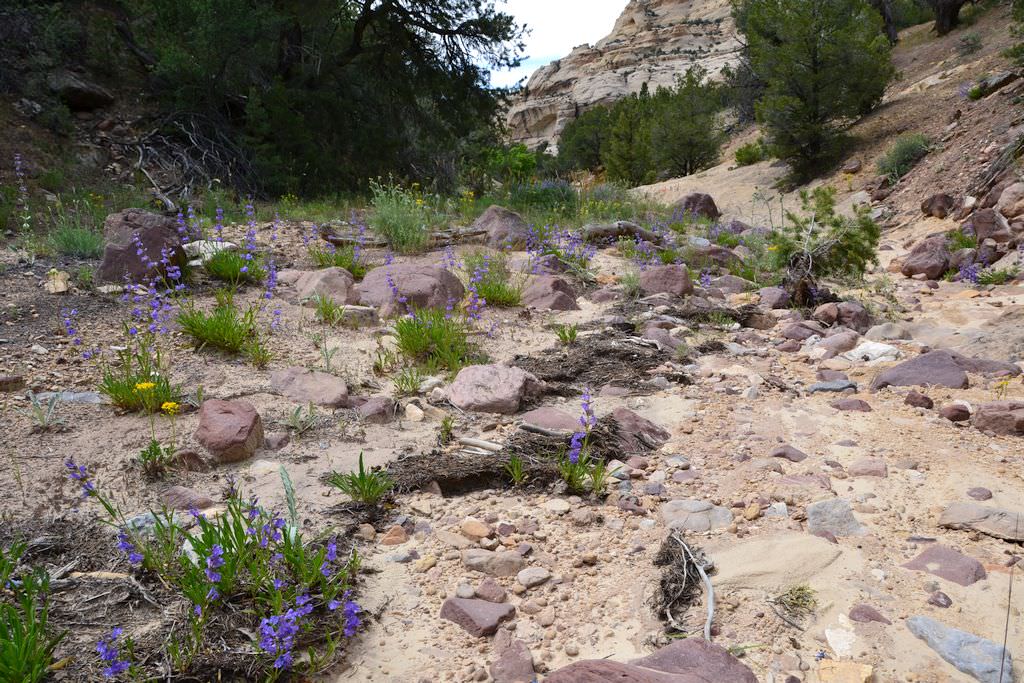
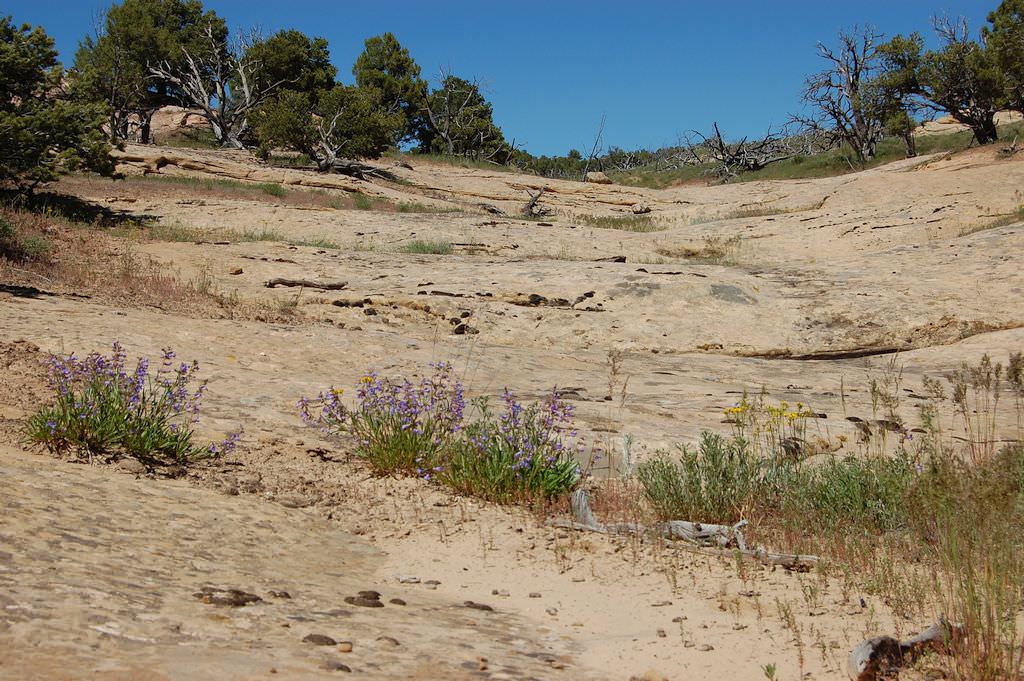
Occurs in pinyon-juniper or sagebrush-grassland communities, on sandy soil or in sandstone crevices (Colorado Native Plant Society 1997). Other associated plants include: Artemesia ludoviciana and A. tridentata, Ephedra, Agoseris glauca, Senecio integerrimus, Delphinium, Pseudostellaria, Eremogone congesta, Eriogonum heracleoides, Sedum lanceolatum, Antennaria dimorpha, Amerosedum lanceolatum, Erythronium, Artemisia tridentata ssp. wyomingensis, Amelachier alnifolia, Heterotheca villosa, Artemisia ludoviciana, and Symphoricarpos rotundifolia (Colorado Natural Heritage Program 2022).
click on image to enlarge
 |
 |
Elevation Range:
5,262 - 9,568 feet (1,604 - 2,916 meters)
Distribution
Colorado Endemic:
No
Range:
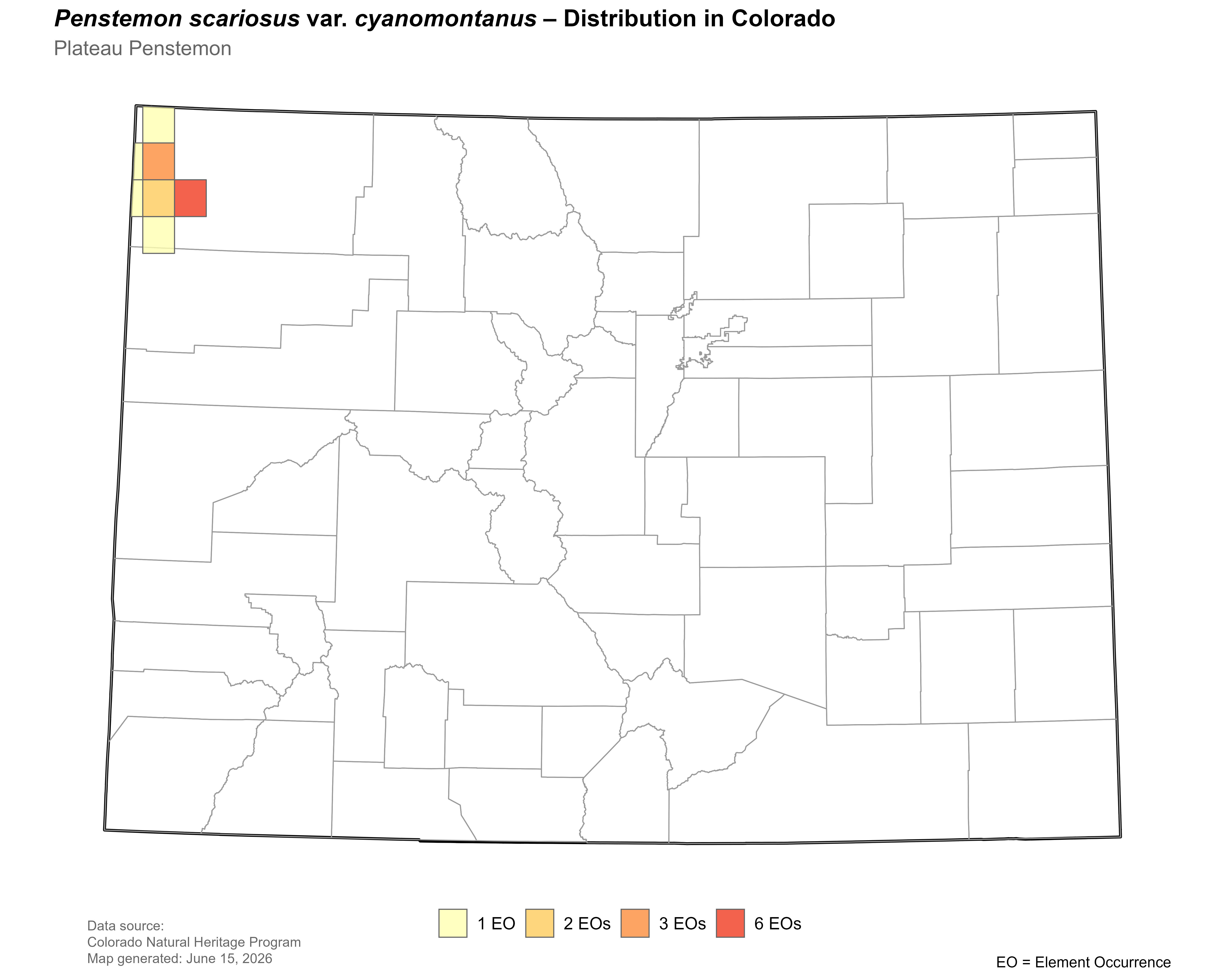
Penstemon scariosus var. cyanomontanus is known from Moffat County in Colorado, USA. Estimated range extent in Colorado of 800 square kilometers was calculated in GeoCAT using occurrence data provided by the Colorado Natural Heritage Program (2023). This species can also be found in Utah.
Click on map to enlarge |
Threats and Management Issues
The primary threat at this time is considered to be incompatible grazing (Rondeau et al. 2011). Nearly half of the occurrences have documented soil disturbance and trampling from livestock grazing. Competition from invasive plant species such as cheatgrass is also a concern (CNHP 2023). This species is considered to have low adaptive capacity and is expected to be moderately to extremely vulnerable to climate change under both RCP 4.5 and 8.5 scenarios, as assessed for the 2025 Colorado State Wildlife Action Plan (CNHP 2025).
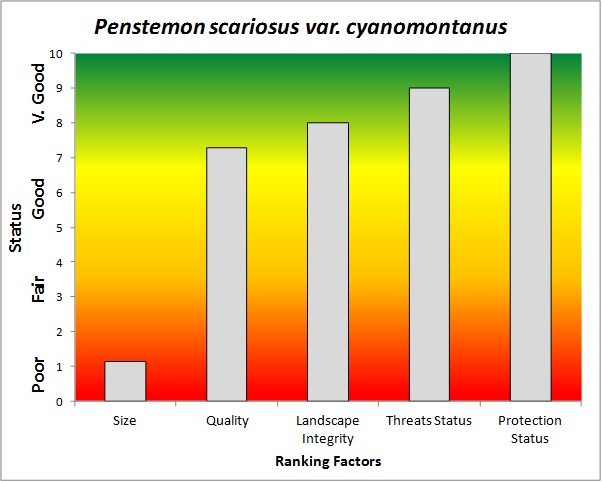
Summary results of an analysis of the status of Penstemon scariosus var. cyanomontanus based on several ranking factors. This species was concluded to be Effectively Conserved. From Rondeau et al. 2011. |
References
- Ackerfield, J. 2015. Flora of Colorado. BRIT Press, Botanical Research Institute of Texas, Fort Worth, TX. 818 pp.
- Ackerfield, J. 2022. Flora of Colorado. Second Edition. Bot. Misc. 60. BRIT Press, Fort Worth Botanic Garden/Botanical Research Institute of Texas, U.S.A. 861 pp.
- Colorado Native Plant Society. 1997. Rare Plants of Colorado, second edition. Falcon Press Publ., Helena, MT.
- Colorado Natural Heritage Program (CNHP). 2023. Biodiversity Tracking and Conservation System (Biotics 5). Colorado Natural Heritage Program, Colorado State University, Fort Collins.
- Colorado Natural Heritage Program (CNHP). 2025. Climate Change Vulnerability Assessment of Colorado Tier 1 and Tier 2 Plant Species of Greatest Conservation Need (SCGN) for the 2025 Colorado State Wildlife Action Plan. Colorado Natural Heritage Program, Colorado State University, Fort Collins.
- Galatawitsch, S. 1985. Plant Species of Special Concern.
- Goodrich, S., and E. Neese. 1986. Uinta Basin flora. U.S. Forest Service, Intermountain Region, Ogden, Utah. 320 pp.
- Handwerk, J., L. Grunau, and S. Panjabi. 2015. Colorado Wildlife Action Plan: 2015 Rare Plant Addendum. Colorado Natural Heritage Program, Colorado State University, Fort Collins, Colorado, USA.
- Neely, B., S. Panjabi, E. Lane, P. Lewis, C. Dawson, A. Kratz, B. Kurzel, T. Hogan, J. Handwerk, S. Krishnan, J. Neale, and N. Ripley. 2009. Colorado Rare Plant Conservation Strategy, Developed by the Colorado Rare Plant conservation Initiative. The Nature Conservancy, Boulder, Colorado, 117 pp.
- Neese, E.C. 1987. New taxa and nomenclatural changes in Utah Penstemon (Scrophulariaceae). Great Basin Naturalist 46(3):459-460.
- Rondeau, R., K. Decker, J. Handwerk, J. Siemers, L. Grunau, and C. Pague. 2011. The state of Colorado's biodiversity 2011. Prepared for The Nature Conservancy. Colorado Natural Heritage Program, Colorado State University, Fort Collins, Colorado.
- Spackman, S., B. Jennings, J. Coles, C. Dawson, M. Minton, A. Kratz, and C. Spurrier. 1997. Colorado rare plant field guide. Prepared for Bureau of Land Management, U.S. Forest Service and U.S. Fish and Wildlife Service by Colorado Natural Heritage Program.
- USDA, NRCS. 2022. The PLANTS Database. National Plant Data Team, Greensboro, NC 27401-4901 USA.
- Welsh, S.L., N.D. Atwood, L.C. Higgins and S. Goodrich. 1987. Utah Flora, Great Basin Naturalist Memoirs, No. 9. Brigham Young University, Provo, Utah. 986 pp.