

Scientific Name : Astragalus jejunus
Author : S. Wats. NatureServe Explorer
Common Name : Starveling Milkvetch
 Current Research Activities
☰ Click link below for details.
Taxonomy
Fabaceae (pea family)
Ranks and Status
State Rank : S1
State Rank Reason : Astragalus jejunus is known from 1 occurrence in northwestern Colorado. Current threats are not known.
U.S. Endangered Species Act : none
Colorado Threatened and Endangered List : none
Other Statuses : SWAP SGIN
Description and Phenology
General Description:
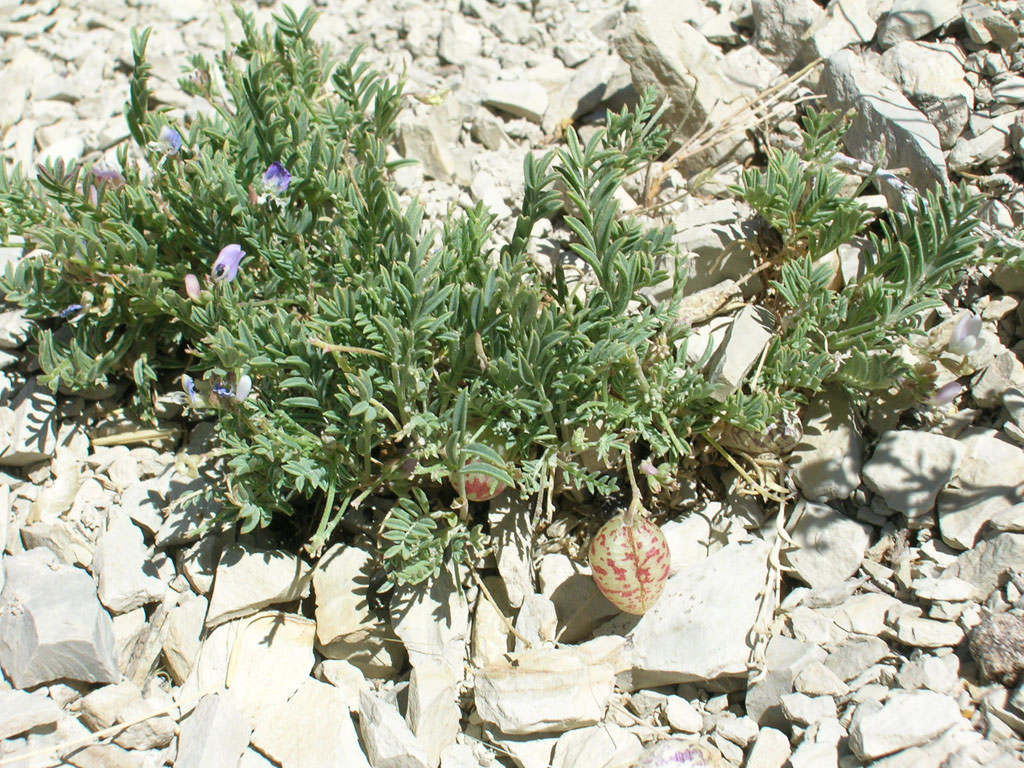
Low-growing, densely tufted, multi-stemmed perennial with a woody, branching caudex and stout taproot. Inflorescence a 3-7 flowered raceme; flowers 5-7 mm long; calyx tube 1.5-2 mm long, banner purple, wings white, keel lavender. Pods bladdery-inflated, papery, purplish or red-mottled, almost spherical. The rachises of the leaves of the previous year persist as dried straws, but they are hardly rigid or spine-like. The terminal leaflets are continuous with the rachis. (Ackerfield 2012, Weber and Wittmann 2012, Spackman and Anderson 2002).
Look Alikes:
A.wetherillii has oval leaflets and does not have mottled pods.
Phenology:
Flowers May through July (Cronquist 1989, Ackerfield 2012).
Habitat
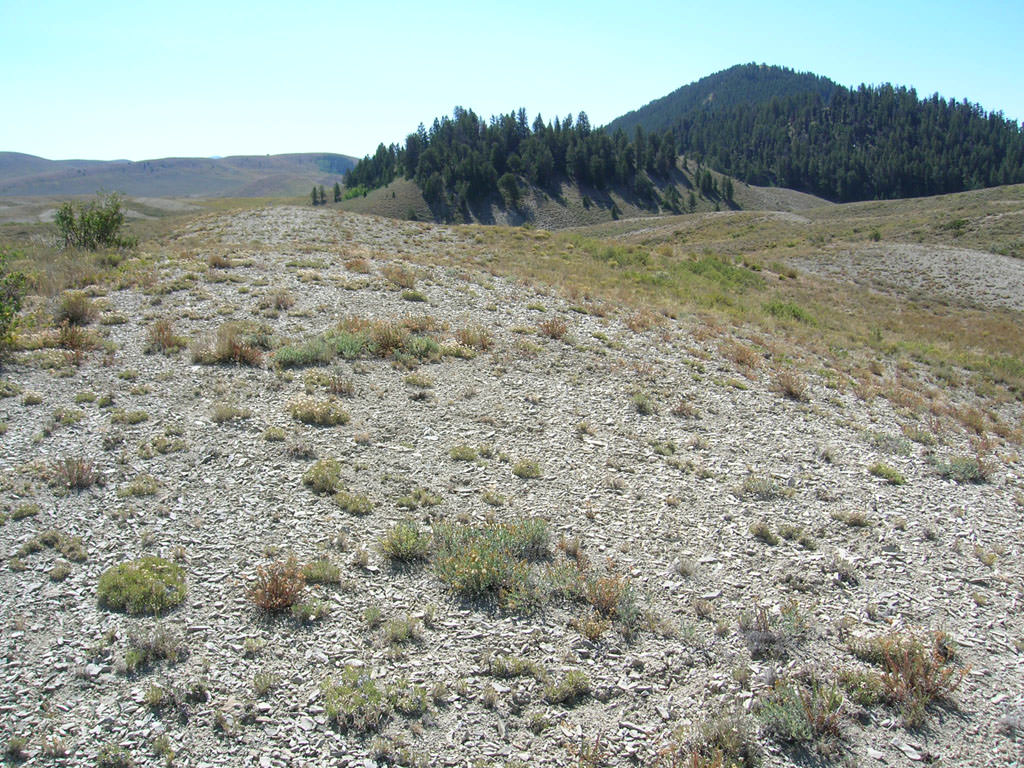
Found on dry hilltops, gullied bluffs, and barren ridges or river terraces, on tuff, shale, sandstone, or clays (Cronquist 1989).
Uncommon in sandy or clay soil, often with sagebrush or juniper, 6500-7000 ft. (Ackerfield 2012).
click on image to enlarge
 |
Elevation Range:
6,635 - 6,823 feet (2,022 - 2,080 meters)
Distribution
Colorado Endemic:
No
Range:
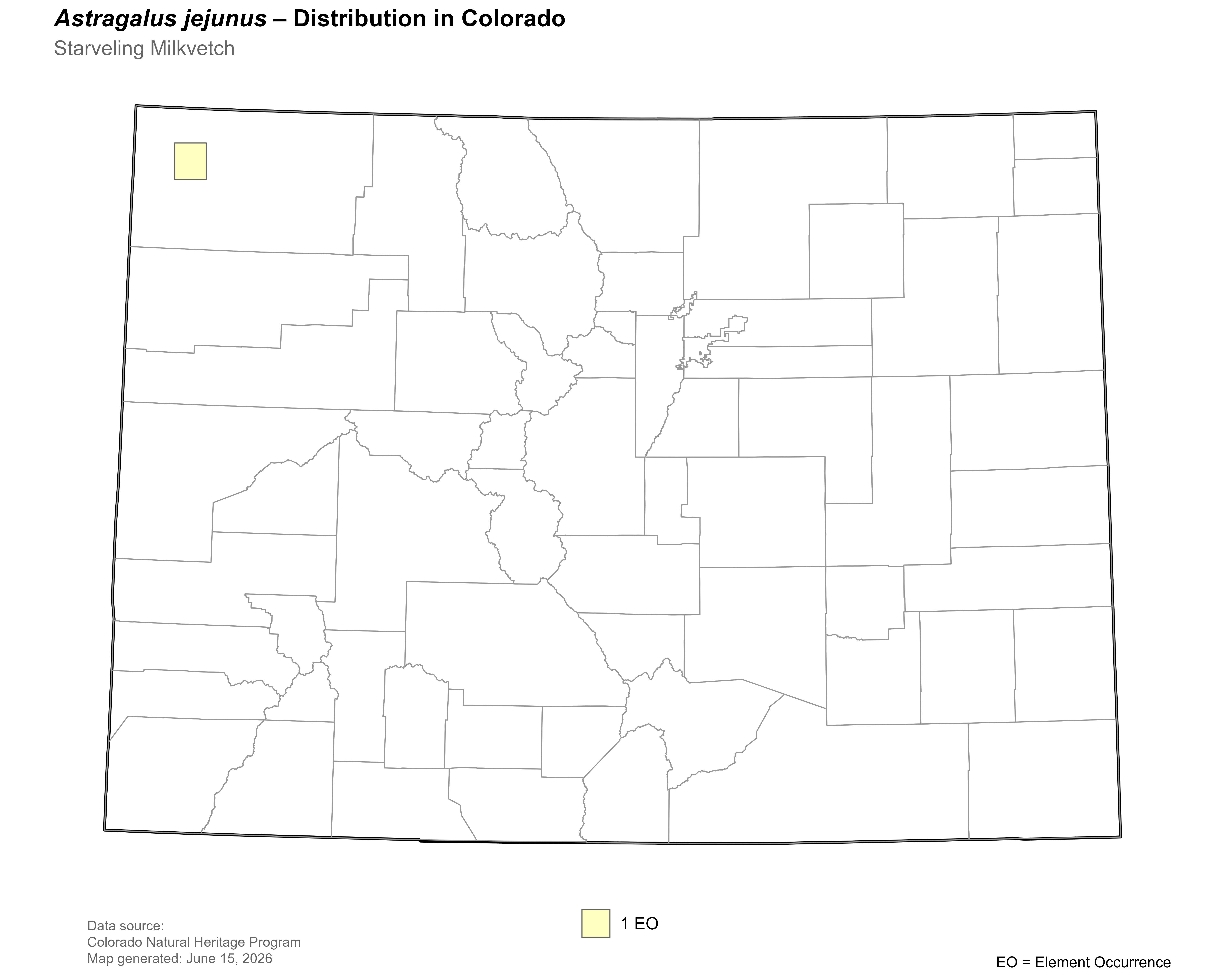
Astragalus jejunus is known from one location in Moffat County, Colorado, USA. This species is also known from Idaho, Nevada, Wyoming, and Utah.
Click on map to enlarge |
Threats and Management Issues
Threats have not been documented for the plants known from Colorado.
References
- Ackerfield, J. 2012. The Flora of Colorado. Colorado State University Herbarium. 433 pp.
- Barneby, R.C. 1964. Atlas of North American Astragalus. 2 Vols. New York Botanical Garden, Bronx, New York. 1188 pp.
- Barneby, R.C. 1989. Fabales. In A. Cronquist, A.H. Holmgren, N.H. Holmgren, J.L. Reveal, and P.K. Holmgren (eds.). Intermountain flora: Vascular plants of the Intermountain West, U.S.A. Vol. 3, Part B. New York Botanical Garden, Bronx. 279 pp.
- Colorado Natural Heritage Program (CNHP). 2023. Biodiversity Tracking and Conservation System (Biotics 5). Colorado Natural Heritage Program, Colorado State University, Fort Collins.
- Cronquist A. 1989. Intermountain Flora Vascular Plants of the Intermountain West, USA. Vol. 3, Part B. New York Botanical Garden, Bronx, NY.
- Dorn, R.D. 1992. Vascular plants of Wyoming, 2nd edition. Mountain West Publishing, Cheyenne, Wyoming.
- Kartesz, J.T. 1999. A synonymized checklist and atlas with biological attributes for the vascular flora of the United States, Canada, and Greenland. First edition. In: Kartesz, J.T., and C.A. Meacham. Synthesis of the North American Flora, Version 1.0. North Carolina Botanical Garden, Chapel Hill, N.C.
- USDA, NRCS. 2022. The PLANTS Database. National Plant Data Team, Greensboro, NC 27401-4901 USA.
- Weber, W. A. and R. C. Wittmann. 2012. Colorado Flora, Western Slope, A Field Guide to the Vascular Plants, Fourth Edition. Boulder, Colorado. 532 pp.
- Welsh, S.L. 2007. North American Species of Astragalus Linnaeus (Leguminosae) A Taxonomic Revision. Brigham Young University, Provo, Utah. 932 pp.
- Welsh, S.L., N.D. Atwood, S. Goodrich, and L.C. Higgins (eds.) 1993. A Utah flora. 2nd edition. Brigham Young Univ., Provo, Utah. 986 pp.