

Scientific Name : Primula egaliksensis
Author : Wormsk. ex Hornem. NatureServe Explorer
Common Name : Greenland Primrose
 Current Research Activities
 1997 profile


☰ Click link below for details.
Taxonomy
Primulaceae (primrose family)
Ranks and Status
State Rank : S2
State Rank Reason : Primula egaliksensis is known from 22 occurrences in one county. One occurrence is protected on a TNC preserve. Fourteen occurrences are reported as potentially threatened or impacted by events including grazing, trampling, highway traffic, alterations in hydrology, and peat mining. Climate change is also a concern.
U.S. Endangered Species Act : none
Colorado Threatened and Endangered List : none
Other Statuses : USFS
Description and Phenology
General Description:
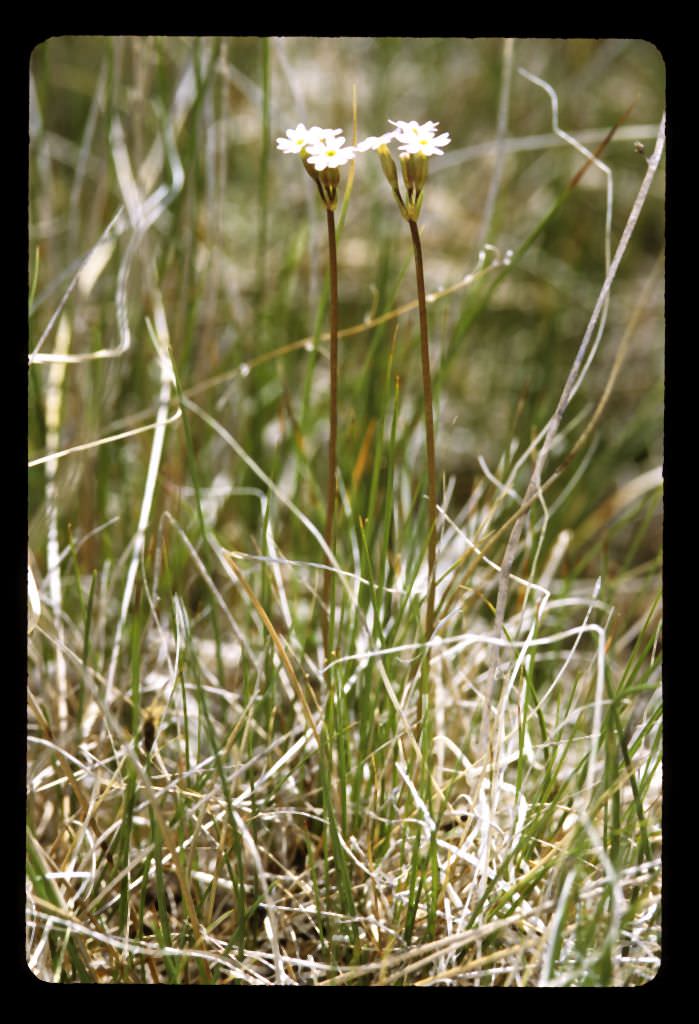
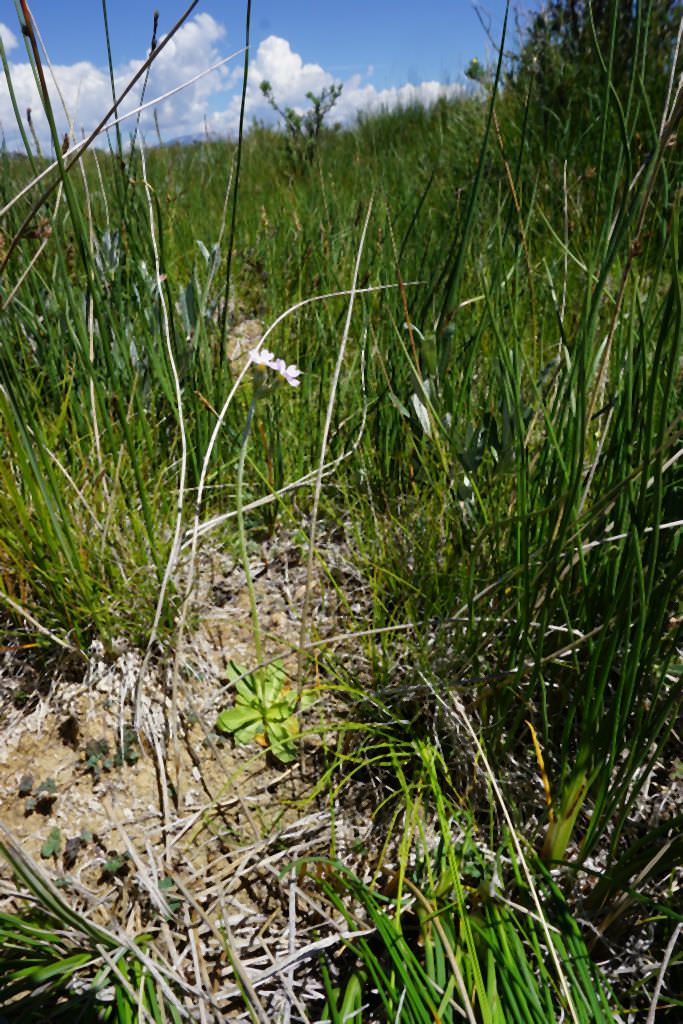
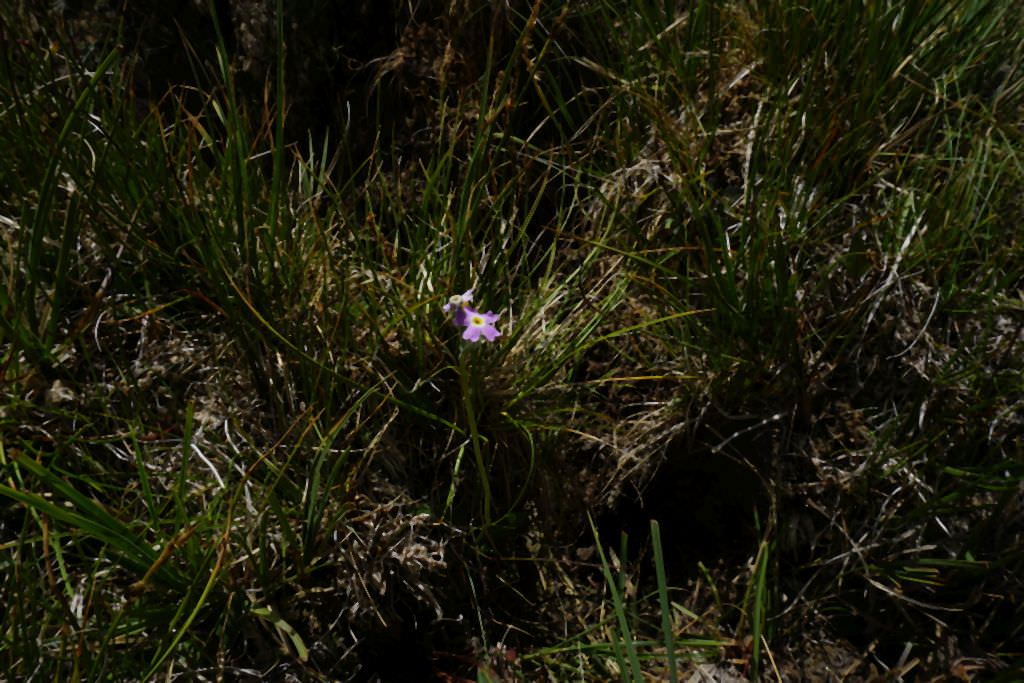
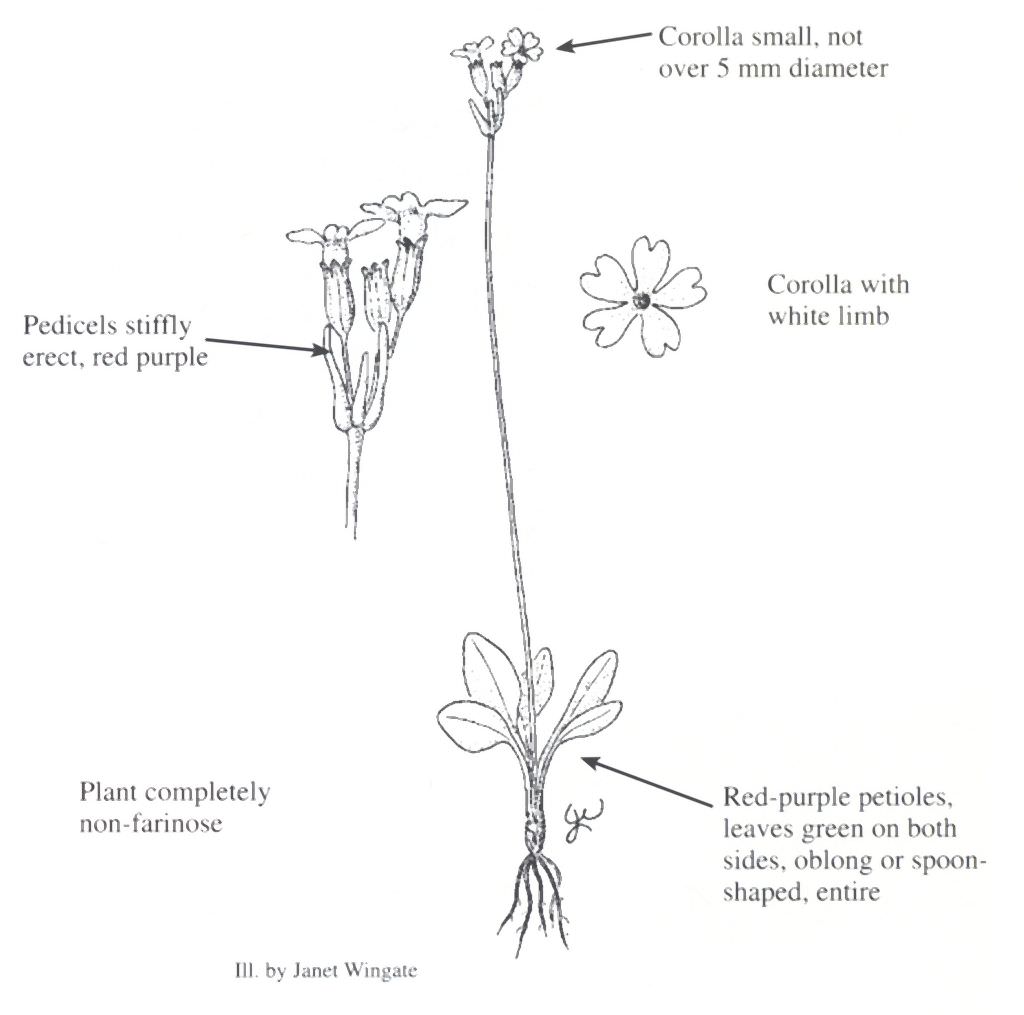
Plants 4-12.5 cm, herbaceous; rhizomes thin, short; rosettes not clumped; vegetative parts efarinose. Leaves not aromatic, abruptly petiolate; petiole not winged; blade without deep reticulate veins abaxially, elliptic, 1.5-5.5 × 0.5-0.9 cm, thin, margins entire, undulate, or slightly denticulate, apex rounded, surfaces glabrous. Inflorescences 1-3(-6)-flowered; involucral bracts gibbous but not auriculate, ± equal. Pedicels nodding, thin, 2-9 mm, length 1-3 times bracts, flexuous. Flowers homostylous; calyx green or with purple stripes, cylindric, 4-6 mm; corolla white or lavender, tube 6-8 mm, length 1-1.2 times calyx, eglandular, limb 6-8 mm diam., lobes 3-4 mm, apex slightly emarginate. Capsules narrowly cylindric, length 1.5-2 times calyx. Seeds without flanged edges, reticulate (Flora of North America 1993+).
Look Alikes:
Primula incana is taller and more robust with green pedicels and leaves that are usually white-farinose beneath at least when young. Primula incana also has small teeth near the leaf apex while P. egaliksensis has red-purple pedicels and entire leaves that are green on both sides. Where the two species grow together, P. egaliksensis occurs in slightly wetter microsites. Parnassia parviflora has leafy stems, white flowers, and broad, oval-shaped fruit. Dodecatheon spp. can be distinguished in fruit by their broader capsules (Culver and Lemly 2013).
Phenology:
Flowers June-July (Culver and Lemly 2013, Ackerfield 2022).
 |
Habitat
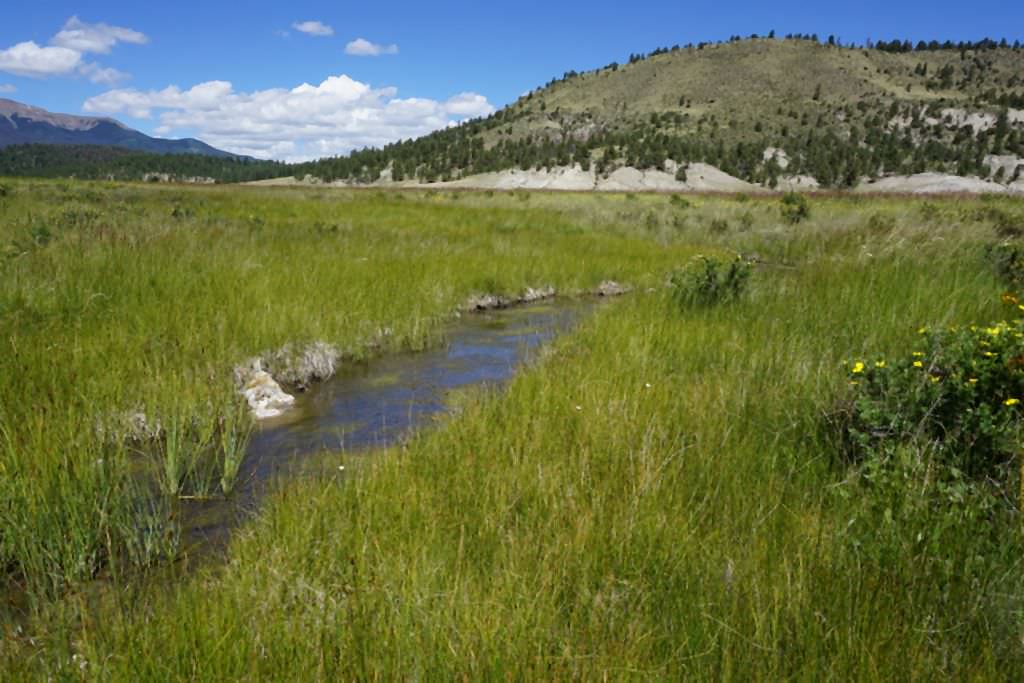
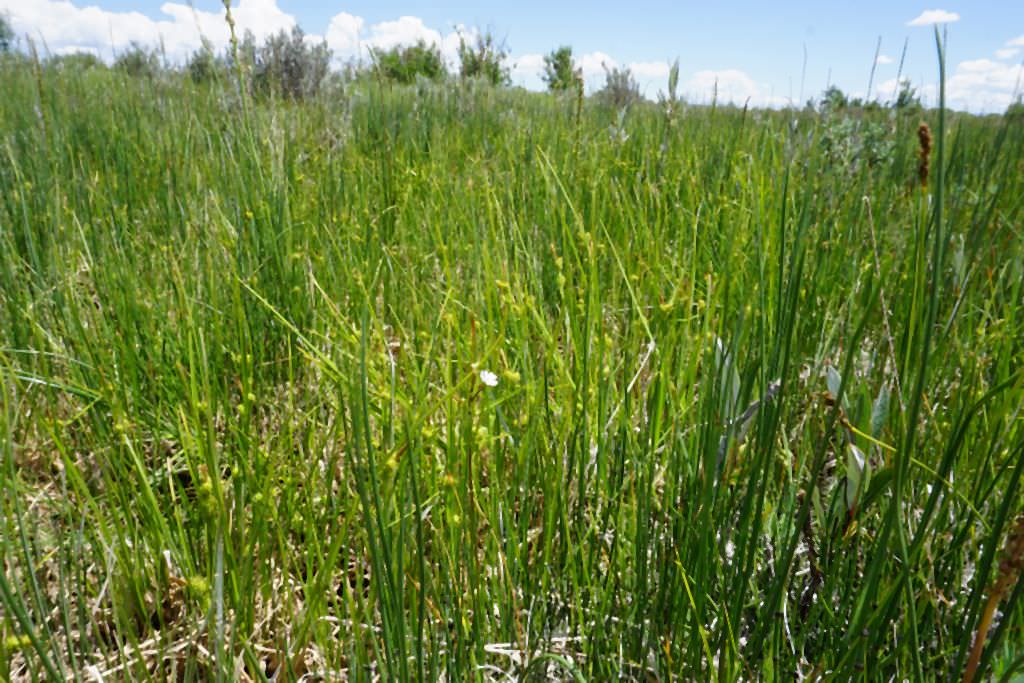
Wet meadows, rich, calcareous fens, on hummocks. Associated taxa include: Salix monticola, S. candida, S. myrtillifolia, S. planifolia, Pentaphylloides floribunda,Thalictrum alpinum, Carex aquatilis, C. nebrascensis, C. utriculata, C. praegracilis, C. hallii, C. scirpoidea, C. simulata, Juncus sp., Sisyrinchium pallidum, Glaux maritima, Ranunculus cymbalaria, Dodecatheon pulchellum, Achillea sp., Kobresia myosuroides, Lomatogonium rotatum, Packera pauciflora, Astragalus leptaleus, Ranunculus alismifolius, Pedicularis crenulata, P. procera, P. scopulorum, Triglochin palustris, Elymus glaucus, Deschampsia caespitosa, Poa secunda ssp. juncifolia, Eleocharis suksdorfiana, Kobresia simpliciuscula, Calamagrostis stricta, Cinna latifolia, Eleocharis palustris.
click on image to enlarge
 |
 |
Elevation Range:
8,907 - 10,043 feet (2,715 - 3,061 meters)
Distribution
Colorado Endemic:
No
Range:
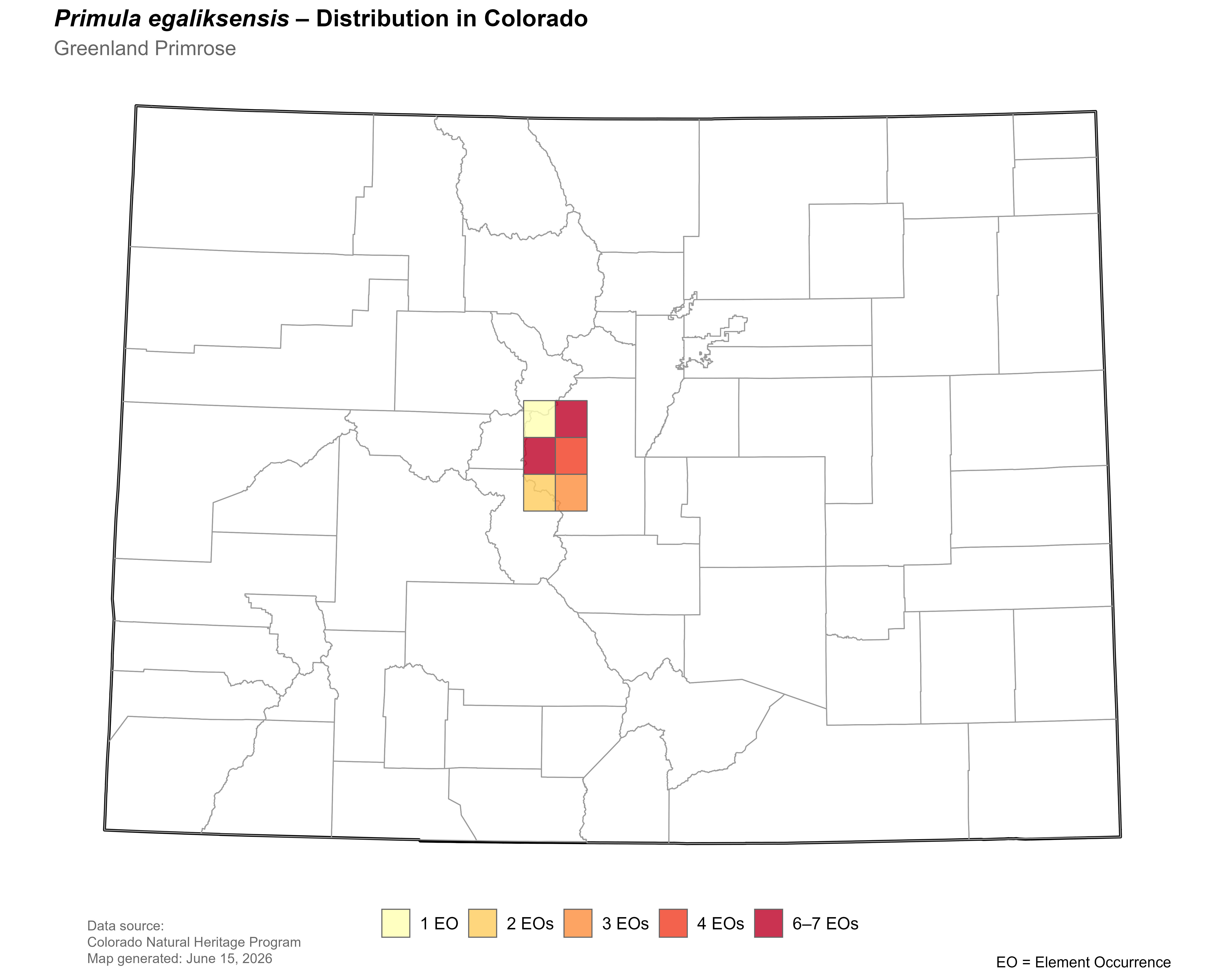
Primula egaliksensis is only found only in Park County in Colorado, USA. Estimated range extent in Colorado of 805 square kilometers was calculated in GeoCAT using occurrence data provided by the Colorado Natural Heritage Program (2023). This species can also be found in Alaska and Wyoming, USA. In Canada it can be found in almost every province and territory.
Click on map to enlarge |
Threats and Management Issues
Element occurs on easily accessible land. Three occurrences report highway traffic, nine occurrences report grazing and/or trampling, four report mining or proposed peat mining, two report alterations in hydrology, one reports proposed reservoir expansion, and one occurrence reports fisherman traffic as impacting the site. Climate change is also a concern.
References
- Ackerfield, J. 2022. Flora of Colorado. Second Edition. Bot. Misc. 60. BRIT Press, Fort Worth Botanic Garden/Botanical Research Institute of Texas, U.S.A. 861 pp.
- Colorado Native Plant Society. 1989. Rare plants of Colorado. Rocky Mountain Nature Association, Colorado Native Plant Society, Estes Park, Colorado. 73 pp.
- Colorado Native Plant Society. 1997. Rare Plants of Colorado, second edition. Falcon Press Publ., Helena, MT.
- Colorado Natural Heritage Program (CNHP). 2023. Biodiversity Tracking and Conservation System (Biotics 5). Colorado Natural Heritage Program, Colorado State University, Fort Collins.
- Culver, D.R. and J.M. Lemly. 2013. Field Guide to Colorado's Wetland Plants; Identification, Ecology and Conservation. Colorado Natural Heritage Program, Colorado State University, Fort Collins, 694 pp.
- Flora of North America Editorial Committee, ed. (FNA). 1993+. Flora of North America North of Mexico. Oxford Univ. Press, New York, Oxford.
- Spackman, S., B. Jennings, J. Coles, C. Dawson, M. Minton, A. Kratz, and C. Spurrier. 1997. Colorado rare plant field guide. Prepared for Bureau of Land Management, U.S. Forest Service and U.S. Fish and Wildlife Service by Colorado Natural Heritage Program.
- Weber, W. A. and R. C. Wittmann. 2012. Colorado Flora, Eastern Slope, A Field Guide to the Vascular Plants, Fourth Edition. Boulder, Colorado. 555 pp.