

Scientific Name : Claytonia rubra
Author : (T.J. Howell) Tidestrom NatureServe Explorer
Common Name : Redstem Spring Beauty
 Current Research Activities


☰ Click link below for details.
Taxonomy
Montiaceae ()
Ackerfield (2015, 2022) places this genus in the Montiaceae, or the Miner?s Lettuce Family. The Flora of North America (2003) lists Montia rubra as a synonym, and describes two subspecies, based on leaf shape, ssp. rubra and ssp. depressa. These subspecies are not recognized by the authors of recent Colorado floras (Weber and Wittmann 2012, Ackerfield 2015, 2022).
Ranks and Status
State Rank : S2
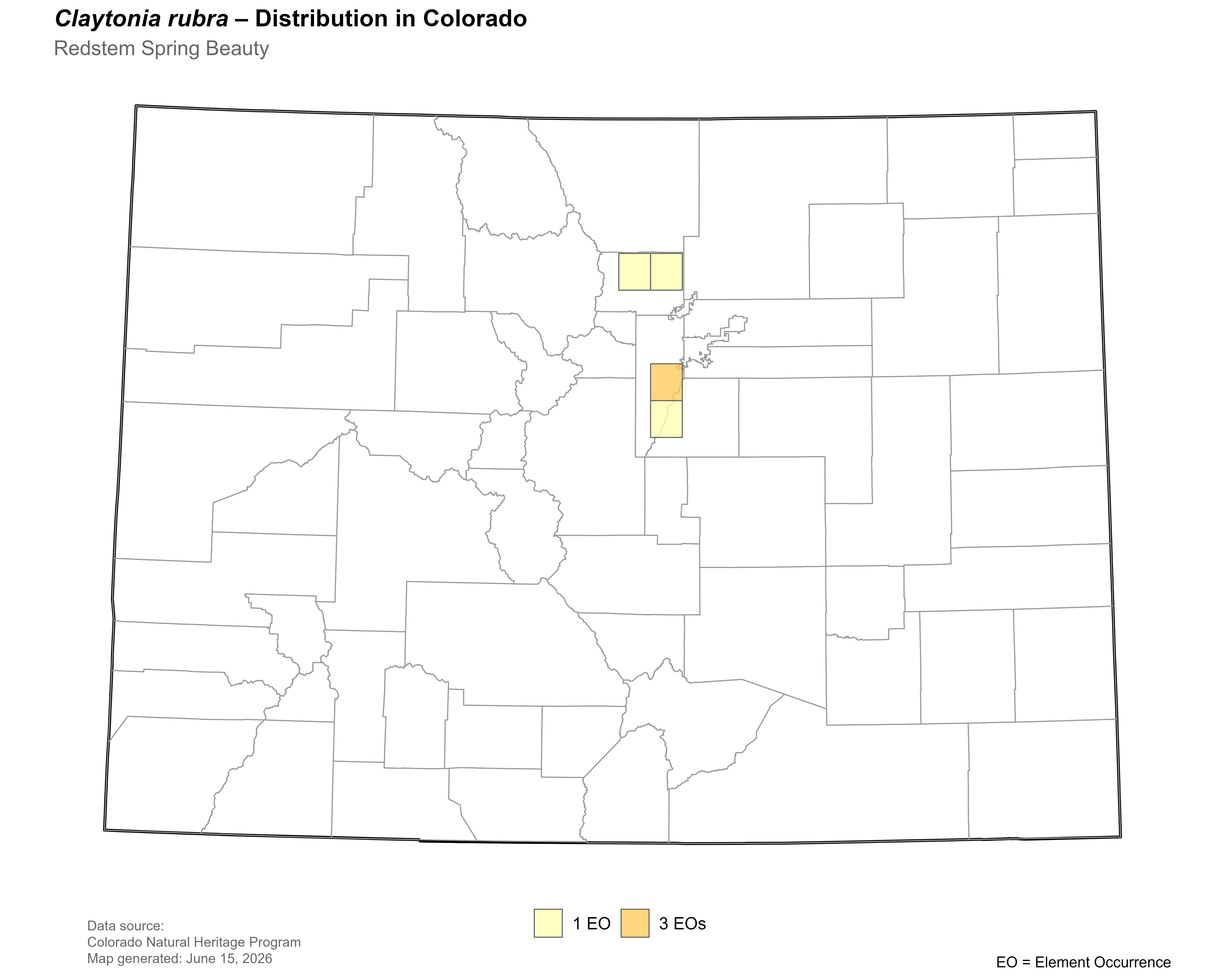
State Rank Reason : Claytonia rubra is known from 5 occurrences along the Front Range of Colorado, USA. Non-motorized recreation and the potential effects of climate change are the primary threats to the species.
U.S. Endangered Species Act : none
Colorado Threatened and Endangered List : none
Other Statuses : none
Description and Phenology
General Description:
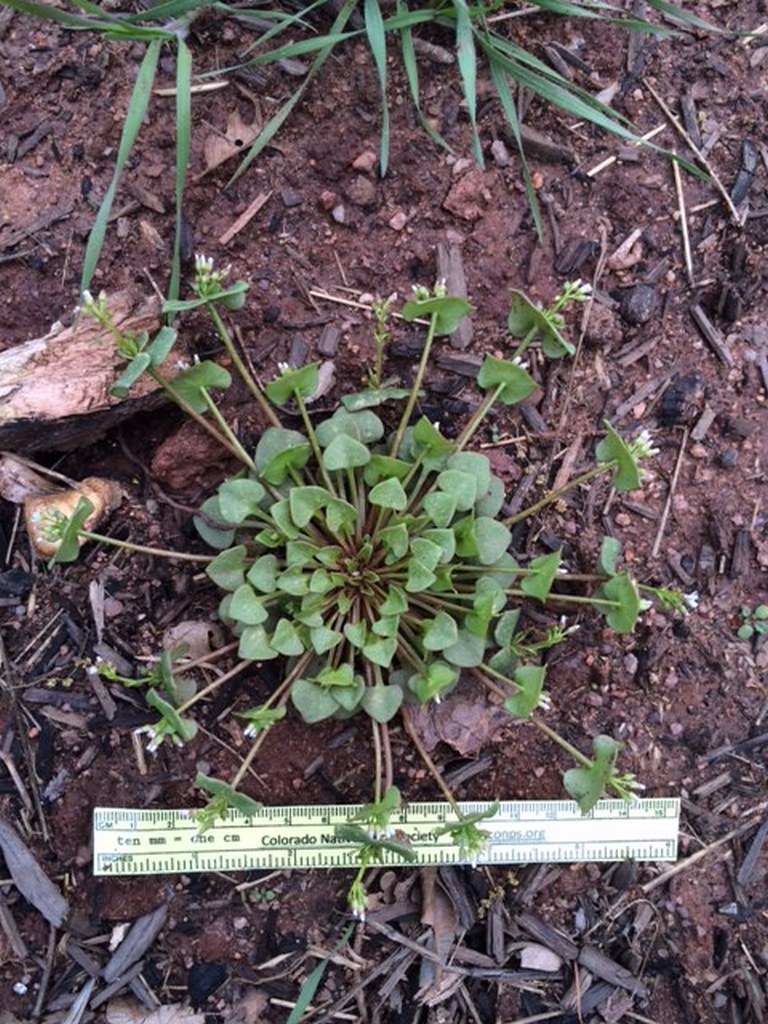
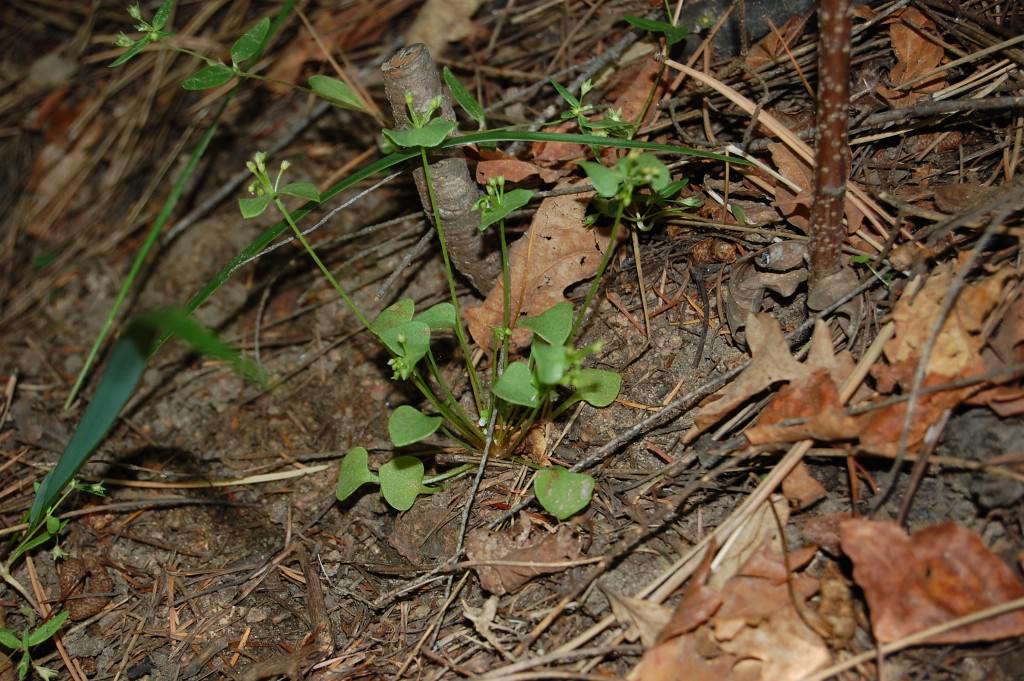
Claytonia rubra is an annual, sometimes overwintering and biennial, from minute tubers, 1-10 cm tall. Basal leaves are found in flattened to suberect rosettes, 0.5-6 cm across, blades with strong red pigmentation even in juvenile plants. Basal leaves are narrowly rhombic to ovate, spatulate, or trullate, 0.5-1.5 × 0.5-1 cm, apex obtuse. Cauline leaves are distinct or connate on 1 side or perfoliate (pierced), sessile, blade ovate. Inflorescence: 1-bracteate; bract leaf-like, 0.5-15 mm. Flowers are 2-5 mm in diameter; sepals 1.5-2.5 mm; petals 2-3 mm, pinkish white to white. Fruit is a capsule. Seeds are 2-3 mm in diameter, shiny and smooth (Flora of North America 2003, Ackerfield 2015, Colorado Plant Database 2017).
Look Alikes:
Not likely to be confused with other species in this area. The annual habit is distinctive.
Phenology:
In Colorado, plants flower April-August (Ackerfield 2015).
Habitat
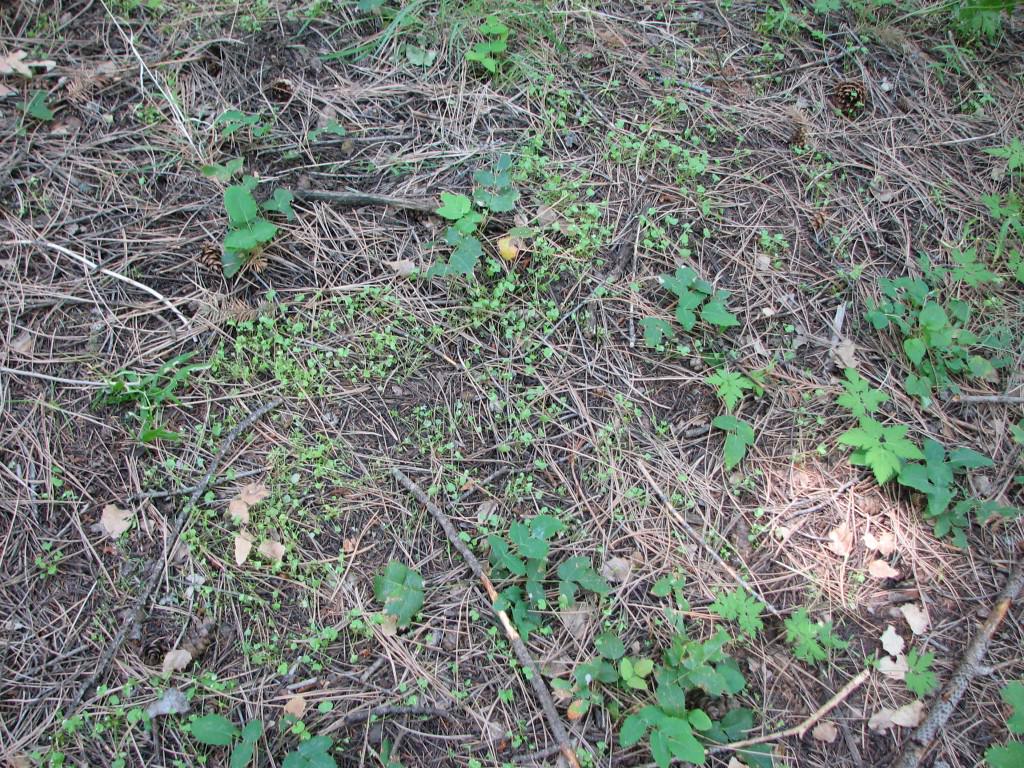
In Colorado, Claytonia rubra is found on eroding slopes and trail-sides (Colorado Plant Database 2017), in moist, shady places, cool canyons and ravines (Ackerfield 2015). Plants are found on dry to moist cut banks, mossy trail sides, and small naturally disturbed patches in Douglas fir and Ponderosa pine forests, or Gambel’s oak woodlands. Additional associated plant species: Achillea lanulosa, Mahonia repens, Osmorhiza depauperata, Carex geyeri, Viola sp., Heuchera parvifolia, Galium sp., moss. One occurrence in an oak woodland was growing in a thick layer of oak leaves without other associated species (Colorado Natural Heritage Program occurrence records 2017).
click on image to enlarge
 |
Elevation Range:
5,581 - 7,176 feet (1,701 - 2,187 meters)
Distribution
Colorado Endemic:
No
Range:
Claytonia rubra is known from Boulder, Douglas and Jefferson counties, Colorado, USA. Estimated range extent in Colorado of 357 square kilometers was calculated in GeoCAT using occurrence data provided by the Colorado Natural Heritage Program (2023). This species can also be found in Arizona, California, Idaho, Montana, Nevada, Oregon, South Dakota, Utah, Washington, and Wyoming, USA. It can also be found in British Columbia, Canada (Flora of North America 2003).
Click on map to enlarge |
Threats and Management Issues
Non-motorized recreation is the primary threat to the species. Colorado climate scenarios for 2050 suggest temperature will increase by 3-7 F and precipitation may decrease or increase. The impact to any given rare plant habitat is likely to vary. Long-term monitoring that includes weather and soil moisture data is critical to understanding climate impacts.
References
- Ackerfield, J. 2015. Flora of Colorado. BRIT Press, Botanical Research Institute of Texas, Fort Worth, TX. 818 pp.
- Colorado Natural Heritage Program (CNHP). 2023. Biodiversity Tracking and Conservation System (Biotics 5). Colorado Natural Heritage Program, Colorado State University, Fort Collins.
- Colorado Natural Heritage Program and the Geospatial Centroid. 2017. The Colorado Ownership and Protection Map (COMaP). Colorado State University, Ft. Collins, CO.
- Colorado Plant Database, Sponsored by the Colorado Native Plant Master Program, CSU Extension, http://jeffco.us/coopext/intro.jsp. Accessed in 2017.
- Flora of North America Editorial Committee, ed. (FNA). 1993+. Flora of North America North of Mexico. Oxford Univ. Press, New York, Oxford.
- Hickman, J. C., ed. 1993. The Jepson manual: Higher plants of California. University of California Press, Berkeley, CA. 1400 pp.
- Kartesz, J.T. 1996. Species distribution data at state and province level for vascular plant taxa of the United States, Canada, and Greenland (accepted records), from unpublished data files at the North Carolina Botanical Garden, December, 1996.
- USDA, NRCS. 2016. The PLANTS Database. National Plant Data Team, Greensboro, NC 27401-4901 USA.
- USDA, NRCS. 2022. The PLANTS Database. National Plant Data Team, Greensboro, NC 27401-4901 USA.
- Weber, W. A. and R. C. Wittmann. 2012. Colorado Flora, Eastern Slope, A Field Guide to the Vascular Plants, Fourth Edition. Boulder, Colorado. 555 pp.
- Weber, W. A. and R. C. Wittmann. 2012. Colorado Flora, Western Slope, A Field Guide to the Vascular Plants, Fourth Edition. Boulder, Colorado. 532 pp.