

Scientific Name : Aquilegia chrysantha
Author : Gray NatureServe Explorer
Common Name : Golden Columbine
 Current Research Activities
 1997 profile


☰ Click link below for details.
Taxonomy
Ranunculaceae (buttercup family)
This taxon was previously tracked as Aquilegia chrysantha var. rydbergii (G4T1Q/S1). The letter Q was used after the T-rank to indicate that the taxon has questionable taxonomy that may reduce conservation priority (Nature Serve 2013). The Flora of North America (Vol. 3, 1997) questions the distinctiveness of the variety rydbergii, saying that material seen displays traits which fall within the normal variation for the species. Ackerfield (2015) and Weber and Wittmann (2012) only report A. chrysantha for the state, and do not report any varieties. The Plants Database (USDA NRCS 2013) shows A. chrysantha in Arizona, Colorado, New Mexico, Texas and Utah, and A. chrysantha var. rydbergii in Arizona, Colorado, and New Mexico. Reports from New Mexico and Arizona (USDA NRCS 2013) are probably erroneous, possibly originating because NM and AZ are listed in the range of var. rydbergii in the 1985 Notice of Review for Listing as Endangered or Threatened Species. A synonym for Aquilegia chrysantha var. rydbergii is A. thalictrifolia (Rydberg 1902, Ladyman 2005).
Ranks and Status
State Rank : S2
State Rank Reason : Aquilegia chrysantha is known from 14 small occurrences within 6 counties in Colorado, USA. Recreational uses are thought to be the primary threat to the species, as well as habitat alteration from livestock grazing and competition from non-native invasive plant species.
U.S. Endangered Species Act : none
Colorado Threatened and Endangered List : none
Other Statuses : USFS
Description and Phenology
General Description:
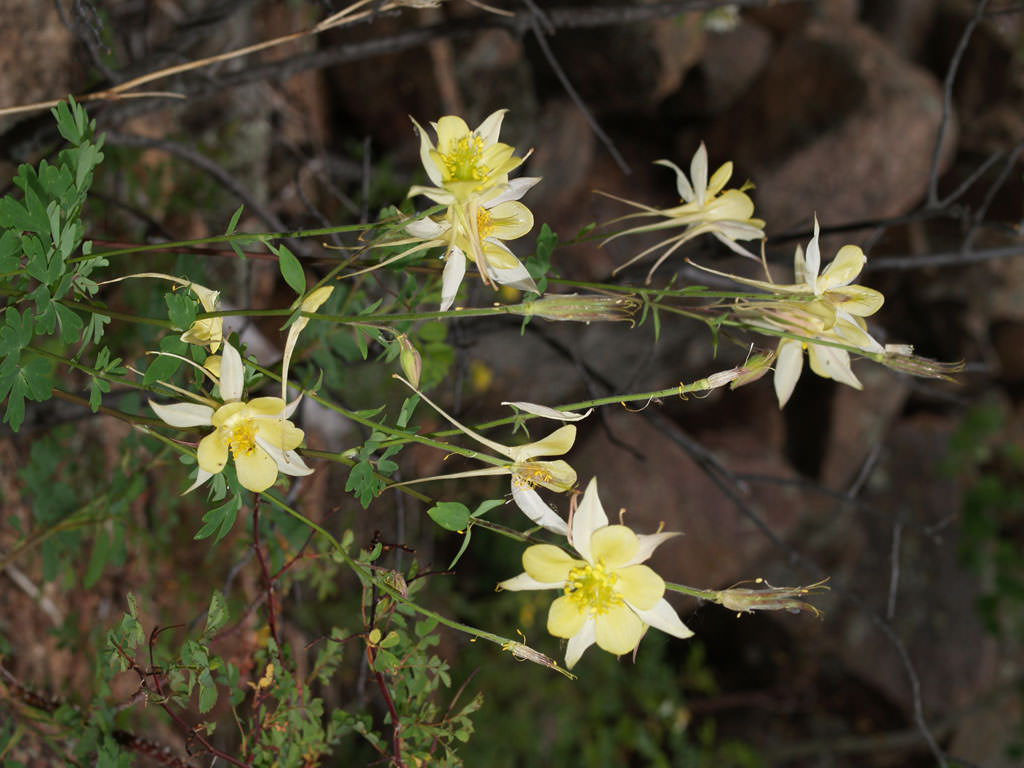
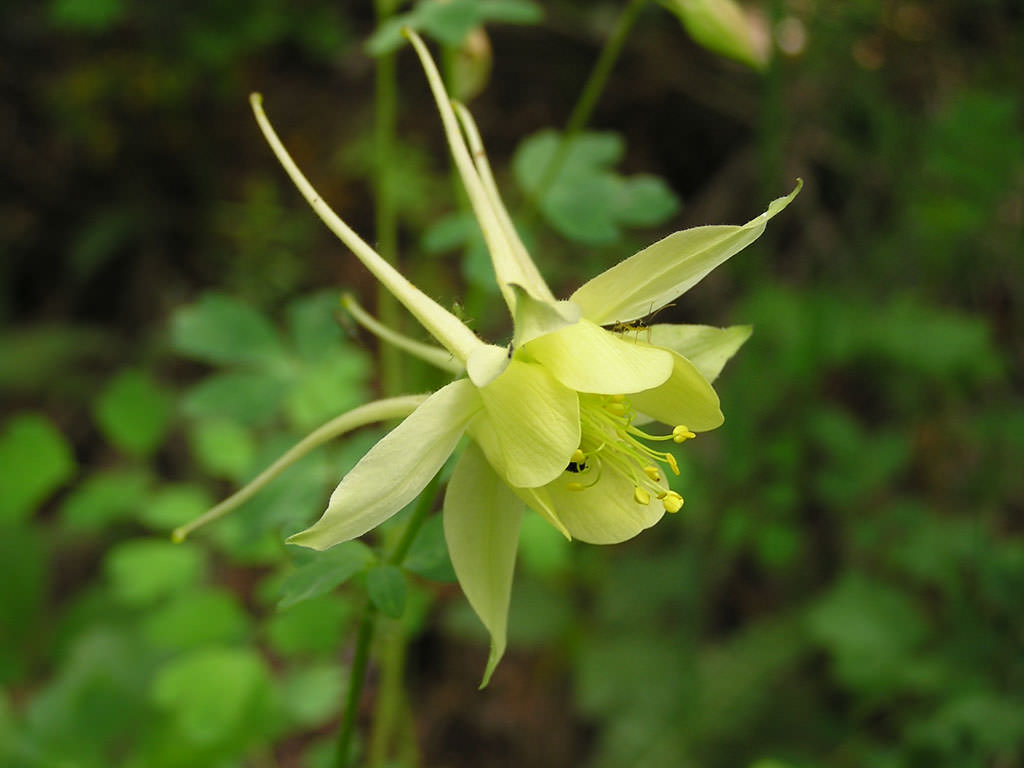
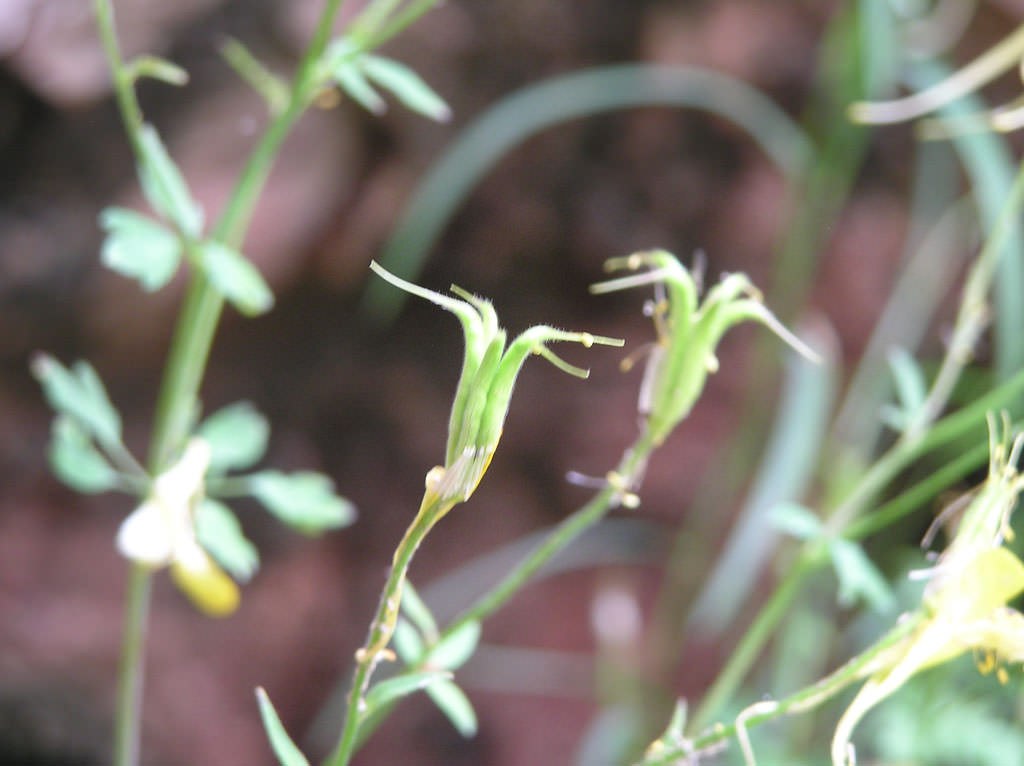
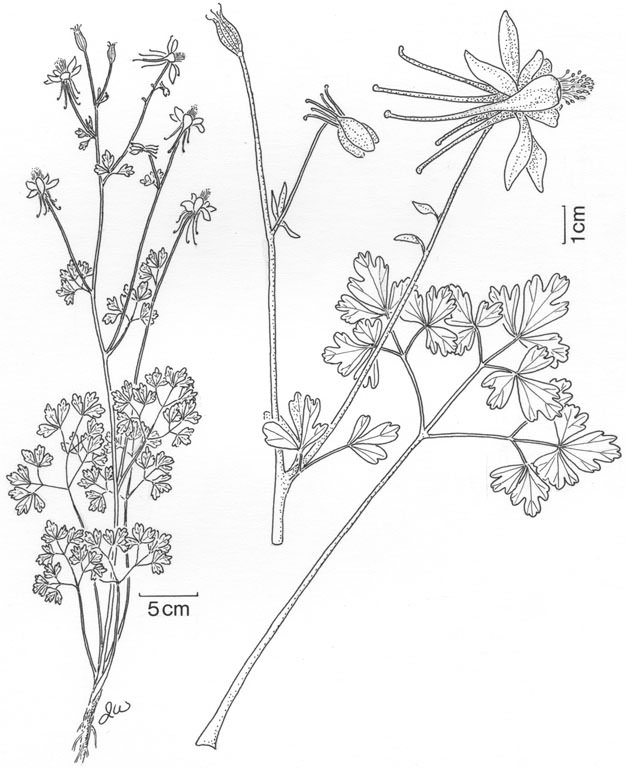
Aquilegia chrysantha is an herbaceous perennial with a short rootstock. It has numerous slender stems that are 20 to 120 cm tall. Towards the base, the stems are thicker and essentially hairless. Soft hairs (pubescence) cover the upper parts of the stem. The basal leaves are mostly triternate, rather thin, hairless, and light bluish-green. The yellow flowers are relatively small, the sepals being 10 to 18 mm long, the petals 7 to 12 mm long, and the nectar spurs 3.5 to 4 cm long. The stamens are exserted from the flower, and the mature styles are about 1 cm long. The fruits are derived from a single carpel that, when dry, dehisces, or splits open to release its seed, along only one side. Such a dry fruit is termed a follicle. The seeds are 1.5 to 2 mm long (Ladyman 2005).
Look Alikes:
Aquilegia chrysantha is the only all yellow columbine in Colorado (Spackman et al. 1997, Weber and Wittmann 2012).
Phenology:
Flowers in June (Colorado Natural Heritage Program 2012).
 |
Habitat
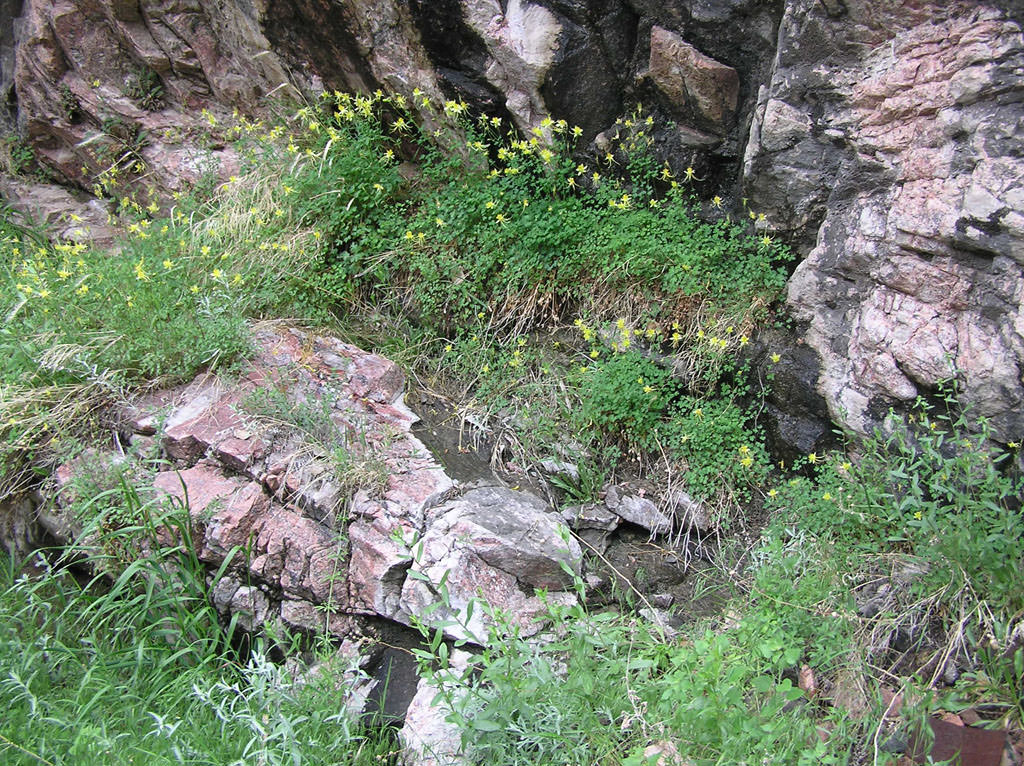
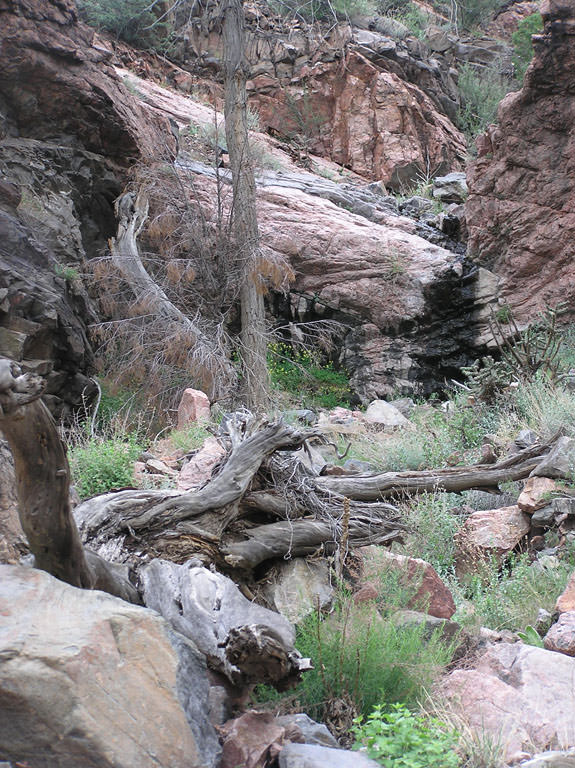
In canyons and foothills along streams or in rocky ravines (Spackman et al. 1997, Weber and Wittman 2012). Aquilegia chrysantha grows in organic soils and has also been observed in gravel derived from granite parent material. Often found near the base of boulders on the canyon sides and floor, it may also grow on seep-fed rocky ledges. It grows in shady and moist areas on slopes above a creek, along the side drainages, and within the riparian area of a perennial stream. Associatied taxa include Corylus cornuta (hazelnut), Populus angustifolia (narrowleaf cottonwood), Betula occidentalis (river birch), Prunus virginiana (chokecherry), Acer glabrum (Rocky Mountain maple), Populus tremuloides (aspen), Salix spp. (willow), Epilobium, Fragaria, Gallium, Geranium, Heracleum, Mertensia, and others (Ladyman 2005, Colorado Natural Heritage Program 2013).
click on image to enlarge
 |
 |
Elevation Range:
4,705 - 11,290 feet (1,434 - 3,441 meters)
Distribution
Colorado Endemic:
No
Range:
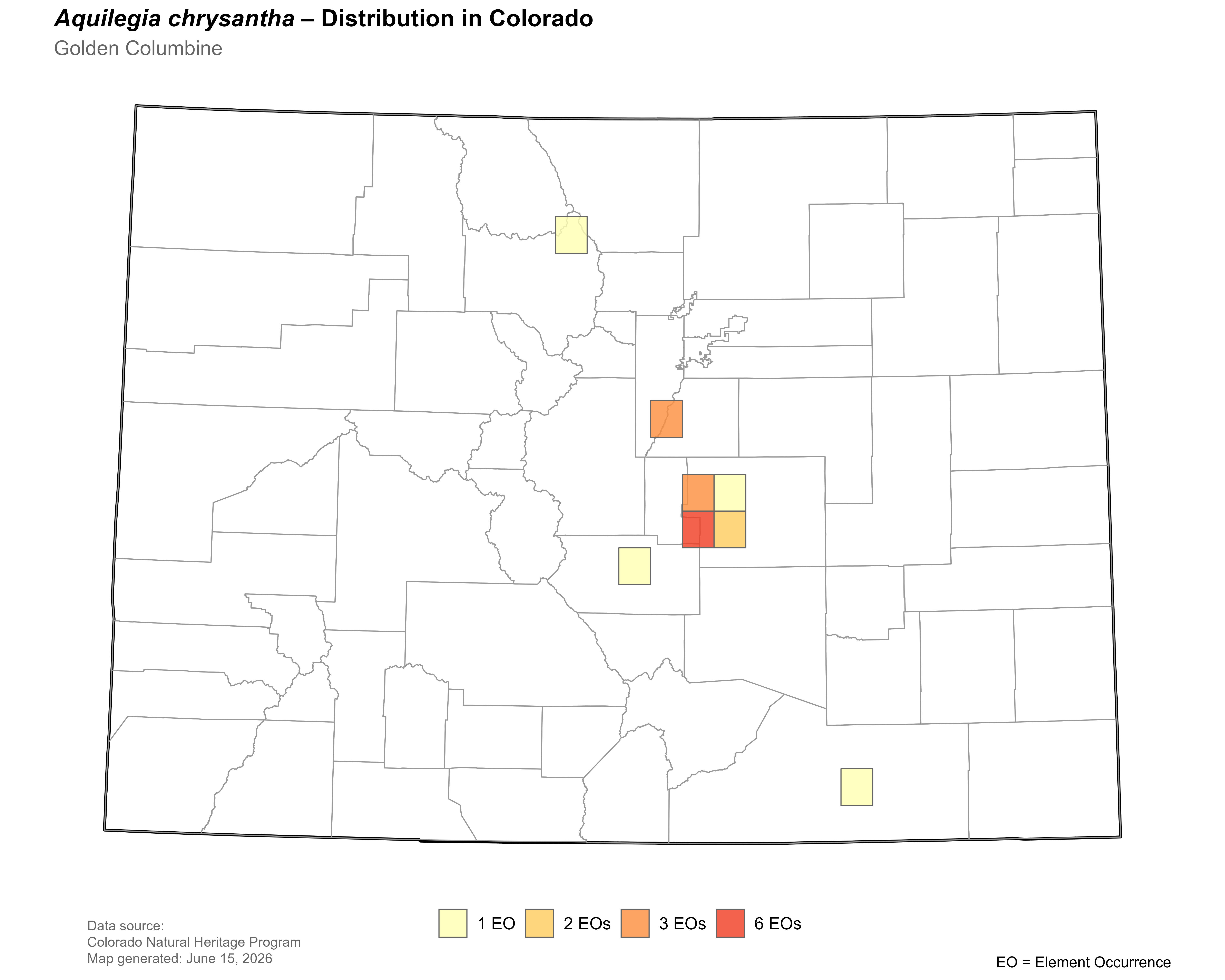
Aquilegia chrysantha is known from El Paso, Fremont, Grand, Jefferson, Las Animas, and Montrose counties in Colorado, USA. Estimated range extent in Colorado of 62,689 square kilometers was calculated in GeoCAT using occurrence data provided by the Colorado Natural Heritage Program (2022). This species is also found in Arizona, Nevada, New Mexico, Texas, and Utah.
Click on map to enlarge |
Threats and Management Issues
Aquilegia chrysantha is vulnerable to habitat loss caused by activities associated with recreation (Ladyman 2005). Much of the habitat for this taxon has already been severely altered and degraded. Occupied habitat on the Pike-San Isabel National Forest is currently managed primarily for recreation; hiking, biking, and horse-riding trails go through the existing occurrences (Ladyman 2005). Habitat encroachment by invasive weeds and livestock grazing are other potential threats. Long-term population sustainability may be vulnerable to declines in pollinator populations. As urbanization encroaches upon natural habitat, introduction of horticultural varieties of A. chrysantha may also become a concern. These varieties could hybridize with the natural populations and thus cause genetic dilution (Ladyman 2005).

Summary results of an analysis of the status of Aquilegia chrysantha based on several ranking factors. This species was concluded to be effectively conserved. From Rondeau et al. 2011. |
References
- Harrington, H. D. 1954. Manual of the Plants of Colorado. Sage Books, Denver, CO. 666 pp.
- Neely, B., S. Panjabi, E. Lane, P. Lewis, C. Dawson, A. Kratz, B. Kurzel, T. Hogan, J. Handwerk, S. Krishnan, J. Neale, and N. Ripley. 2009. Colorado Rare Plant Conservation Strategy, Developed by the Colorado Rare Plant conservation Initiative. The Nature Conservancy, Boulder, Colorado, 117 pp.
- Rocky Mountain Society of Botanical Artists. 2009. RARE Imperiled Plants of Colorado, a traveling art exhibition. Exhibition catalogue developed by the Denver Botanic Gardens and Steamboat Art Museum.
- Spackman, S., B. Jennings, J. Coles, C. Dawson, M. Minton, A. Kratz, and C. Spurrier. 1997. Colorado rare plant field guide. Prepared for Bureau of Land Management, U.S. Forest Service and U.S. Fish and Wildlife Service by Colorado Natural Heritage Program.
- USDA, NRCS. 2022. The PLANTS Database. National Plant Data Team, Greensboro, NC 27401-4901 USA.