

Scientific Name : Astragalus naturitensis
Author : Payson NatureServe Explorer
Common Name : Naturita Milkvetch
 Current Research Activities
 1997 profile


☰ Click link below for details.
Taxonomy
Fabaceae (pea family)
Ranks and Status
State Rank : S3
State Rank Reason : As of 2023 there are 73 documented occurrences of Astragalus naturitensis in western Colorado (USA), with at least 25 considered historical or of poor viability. Threats include energy development, motorized and non motorized recreation, grazing, invasive species such as Bromus tectorum, and long-term drought resulting from climate change. However, plants are thought to respond positively to some disturbance.
U.S. Endangered Species Act : none
Colorado Threatened and Endangered List : none
Other Statuses : BLM, SWAP Tier 2, USFS GMUG
Description and Phenology
General Description:
Naturita Milkvetch is a white and purple flowered perennial, growing from a basal rosette of leaves. The plants have extremely small pinnate leaves with tiny gray-green leaflets that tend to fold in half, showing their lighter-colored undersides. The pods are red-mottled, firm-walled, and dorsiventrally compressed.
Look Alikes:
Species similar to Astragalus naturitensis include: Astragalus deterior which is distinguished by its yellowish white flowers, and Astragalus desperatus which has smaller flowers, a shallower calyx-tube, and a loosely hirsute pod of broader and shorter outline (Barneby 1964). Astragalus monumentalis is similar but has firm-walled dorsiventrally compressed, essentially unilocular pods (Cronquist 1989).
Phenology:
Flowers April through early June, fruits in late May through early June (Colorado Natural Heritage Program 2012).
 |
Habitat
Astragalus naturitensis occurs on sandstone ledges, crevices of sandstone bedrock, dry rock mesas, ledges, and detrital slopes (Harrington 1954). This species is found in pinyon-juniper woodlands in areas with shallow soils over exposed bedrock (Peterson 1981). Usually it is in small soil pockets or rock crevices in sandstone pavement along canyon rims. Sometimes it is found nearby in depper sandy soils with or without soil. Dominant plant community: Pinus edulis/Juniperus osteosperma. Associated plant species: Castilleja chromosa, Delphinium scaposum, Artemisia nova, Physaria acutifolia, Purshia tridentata, Oreocarya suffruiticosa.
click on image to enlarge
 |
Elevation Range:
4,742 - 7,028 feet (1,445 - 2,142 meters)
Distribution
Colorado Endemic:
No
Range:
Astragalus naturitensis is known from Delta, Dolores, Garfield, Mesa, Montezuma, Montrose and San Miguel counties in Colorado, USA. Estimated range extent in Colorado of 12,951 square kilometers was calculated in GeoCAT using occurrence data provided by the Colorado Natural Heritage Program (2023). This species is also known from New Mexico, Utah, and the Navajo Nation.
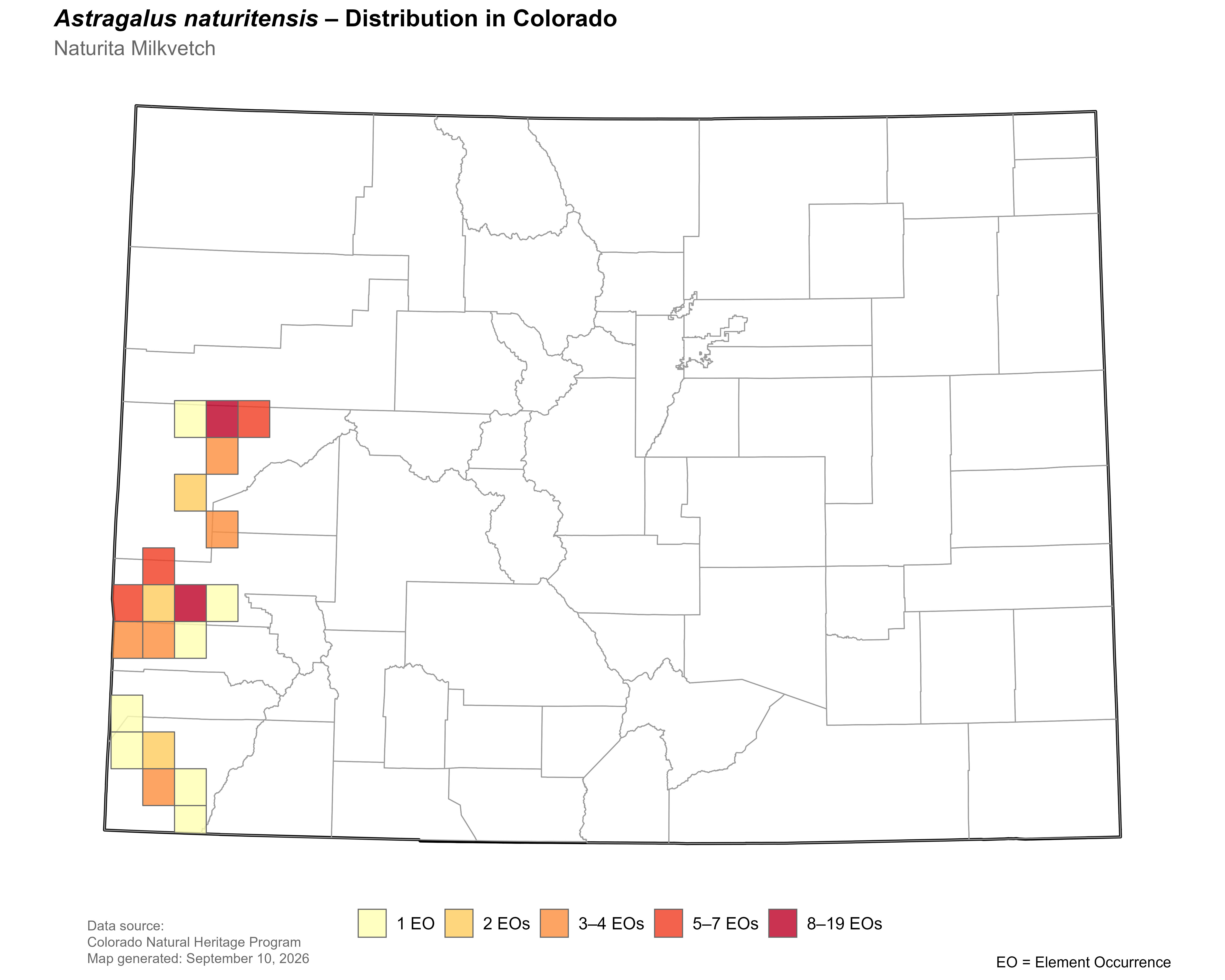
Click on map to enlarge |
Threats and Management Issues
As of 2022, 71% of the occurrences are found in habitat with minimal to low levels of landscape disturbance (CNHP 2021). However, at the local level threats occur from oil, gas and uranium extraction, grazing, exotic species, and recreation (ATVs, bikes, motorized bikes, and camping). Recreation and trampling by livestock can disrupt soil crusts which allows invasive plant species to become established more easily but the habitat of the plant (primarily sandstone mesas, ledges, and crevices) may afford the plant some natural protection. Long term drought is widespread throughout this species range. It is considered to have moderate adaptive capacity and is expected to be moderately vulnerable to climate change under both RCP 4.5 and 8.5 scenarios, as assessed for the 2025 Colorado State Wildlife Action Plan (CNHP 2025).

Summary results of an analysis of the status of Astragalus naturitensis based on several ranking factors. This species was concluded to be Moderately Conserved. From Rondeau et al. 2011. |
References
- Ackerfield, J. 2015. Flora of Colorado. BRIT Press, Botanical Research Institute of Texas, Fort Worth, TX. 818 pp.
- Barneby, R. C. 1964. Atlas of North American Astragalus. Memoirs of New York Botanical Garden, vol. 13. New York Botanical Garden, Bronx, NY.
- Barneby, R.C. 1989. Fabales. In A. Cronquist, A.H. Holmgren, N.H. Holmgren, J.L. Reveal, and P.K. Holmgren (eds.). Intermountain flora: Vascular plants of the Intermountain West, U.S.A. Vol. 3, Part B. New York Botanical Garden, Bronx. 279 pp.
- Bureau of Land Management (BLM). 2023. BLM Colorado Sensitive Species List (signed by state director on August 24). https://www.blm.gov/sites/default/files/docs/2023-09/BLM%20CO%20Sensitive%20Species%20List_2023.pdf
- Colorado Natural Heritage Program (CNHP). 2023. Biodiversity Tracking and Conservation System (Biotics 5). Colorado Natural Heritage Program, Colorado State University, Fort Collins.
- Colorado Natural Heritage Program (CNHP). 2025. Climate Change Vulnerability Assessment of Colorado Tier 1 and Tier 2 Plant Species of Greatest Conservation Need (SCGN) for the 2025 Colorado State Wildlife Action Plan. Colorado Natural Heritage Program, Colorado State University, Fort Collins.
- Colorado Natural Heritage Program. 2021. Landscape Disturbance Index Layer for Colorado. Edition 04_2021. Raster Digital Data Set. Colorado Natural Heritage Program, Fort Collins, CO. April 21, 2021.
- Cronquist A. 1989. Intermountain Flora Vascular Plants of the Intermountain West, USA. Vol. 3, Part B. New York Botanical Garden, Bronx, NY.
- Harrington, H. D. 1954. Manual of the Plants of Colorado. Sage Books, Denver, CO. 666 pp.
- Neely, B., S. Panjabi, E. Lane, P. Lewis, C. Dawson, A. Kratz, B. Kurzel, T. Hogan, J. Handwerk, S. Krishnan, J. Neale, and N. Ripley. 2009. Colorado Rare Plant Conservation Strategy, Developed by the Colorado Rare Plant conservation Initiative. The Nature Conservancy, Boulder, Colorado, 117 pp.
- New Mexico Rare Plant Technical Council (NMRPTC). 1999. Last update 2022. New Mexico Rare Plants. Albuquerque, NM: New Mexico Rare Plants Home Page. Online. Available: http://nmrareplants.unm.edu (accessed 2022).
- Peterson, J. S. 1981. Status Report for Astragalus naturitensis. Unpublished report for the Colorado Natural Areas Program, Denver, CO.
- Rondeau, R., K. Decker, J. Handwerk, J. Siemers, L. Grunau, and C. Pague. 2011. The state of Colorado's biodiversity 2011. Prepared for The Nature Conservancy. Colorado Natural Heritage Program, Colorado State University, Fort Collins, Colorado.
- Schneider, A. 2013. Wildflowers, Ferns, and Trees of the Four Corners Regions of Colorado, New Mexico, Arizona, and Utah. Accessed on-line at http://www.swcoloradowildflowers.com.
- Spackman, S., B. Jennings, J. Coles, C. Dawson, M. Minton, A. Kratz, and C. Spurrier. 1997. Colorado rare plant field guide. Prepared for Bureau of Land Management, U.S. Forest Service and U.S. Fish and Wildlife Service by Colorado Natural Heritage Program.
- USDA, NRCS. 2022. The PLANTS Database. National Plant Data Team, Greensboro, NC 27401-4901 USA.
- Weber, W. A. and R. C. Wittmann. 2012. Colorado Flora, Western Slope, A Field Guide to the Vascular Plants, Fourth Edition. Boulder, Colorado. 532 pp.
- Welsh, S.L., N.D. Atwood, S. Goodrich and L.C. Higgins. (Eds.) 2003. A Utah Flora. 3rd edition. Brigham Young University, Provo, Utah, U.S.A. 912 pp.