

Scientific Name : Sisyrinchium pallidum
Author : Cholewa & D. Henderson NatureServe Explorer
Common Name : Pale Blue- eyed- grass
 Current Research Activities
 1997 profile


☰ Click link below for details.
Taxonomy
Iridaceae (iris family)
Ranks and Status
State Rank : S3
State Rank Reason : Sisyrinchium pallidum is known from over sixty occurrences in eleven counties in Colorado, USA, however, about half of the occurrences have not been observed within the last 20 years. Threats include water diversions and other hydrological disruptions, incompatible livestock grazing, road maintenance, motorized and non-motorized recreation, and competition from non-native invasive plants. This species is also considered vulnerable to the effects of climate change.
U.S. Endangered Species Act : none
Colorado Threatened and Endangered List : none
Other Statuses : BLM, SWAP Tier 2
Description and Phenology
General Description:
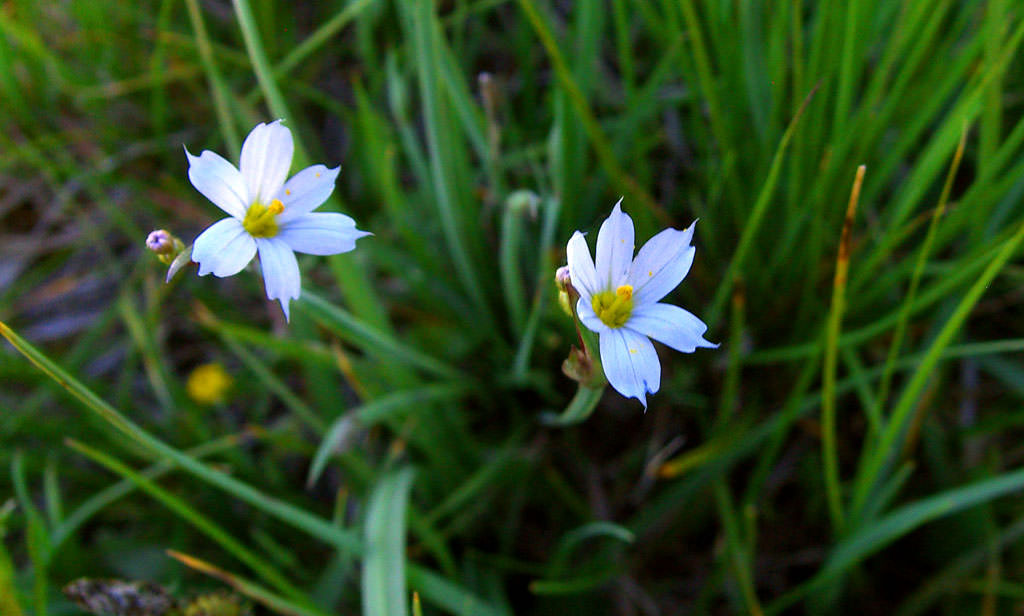
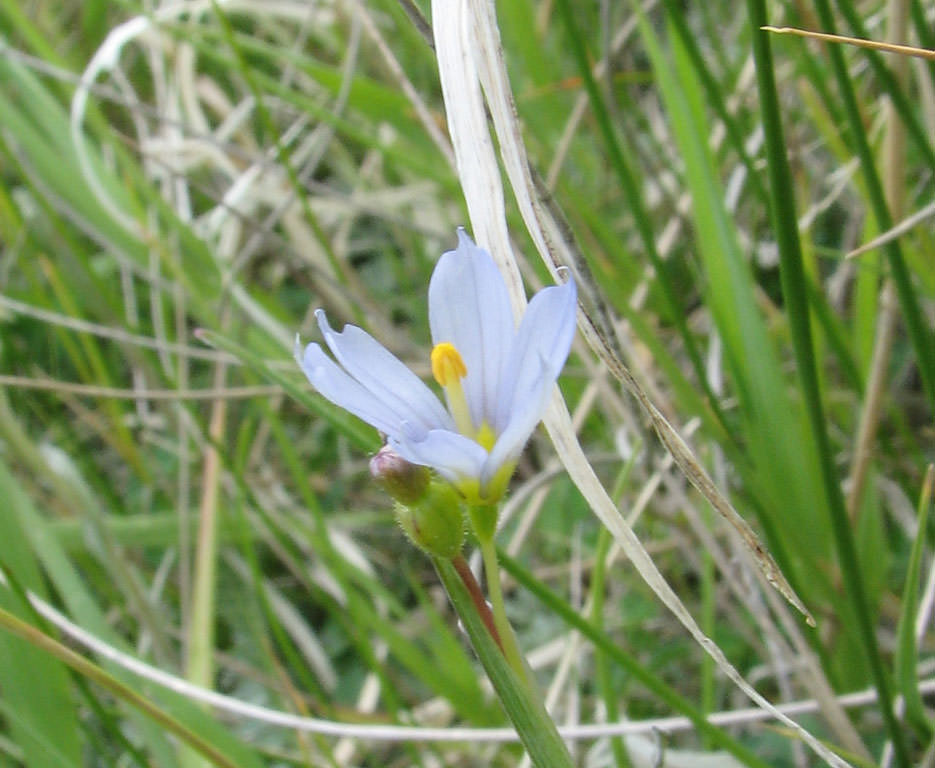
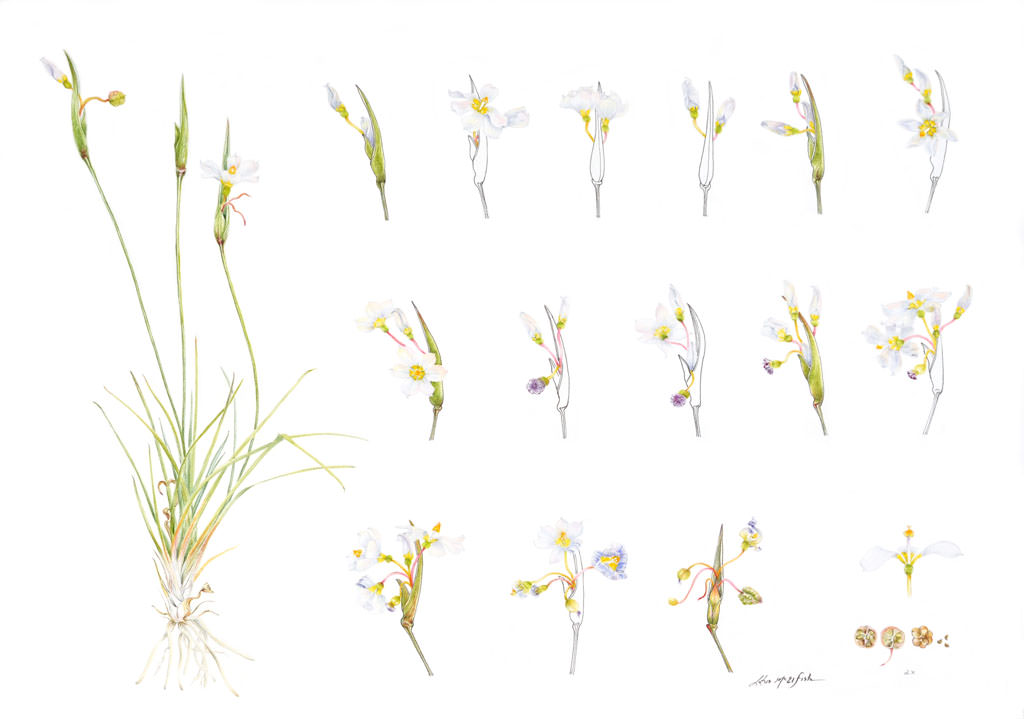
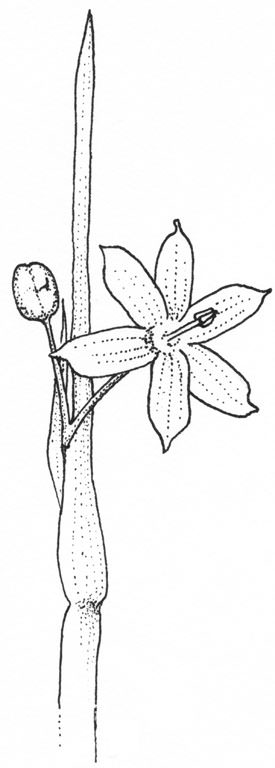
Perennial, herbaceous monocot with grass-like leaves and six pale blue tepals that are yellow at the base. Plants grow to 3 dm, with unbranched stems. Outer tepals are 7-10 mm long. Outer spathe bracts are (18) 28-40 (49) mm long. Inner bracts have a narrow hyaline margin all the way to the tip. The fruits, 2.7 to 6.8 mm long, are tan to dark brown capsules, globose in shape (Cholewa and Henderson 1984, Culver and Lemly 2013, Ackerfield 2015).
Look Alikes:
Sisyrinchium montanum and S. idahoense var. occidentale have deep blue flowers. The outer bract of S. idahoense var. occidentale is subequal to the inner bract. Sisyrinchium demissum usually has more than one pedunculate spathe (bract below the inflorescence) arising from the axil of a leaf-like bract on the stem, while S. pallidum has a single sessile spathe (Spackman et al. 1997). It is especially important to note the color of the flowers (pale blue vs. deep blue) when specimens are taken.
Phenology:
Flowering occurs from about mid June through July and likely depends on annual growing conditions, especially the availability of water. Mature fruits are present from near the end of June into early August (Hartman 1992).
 |
 |
Habitat
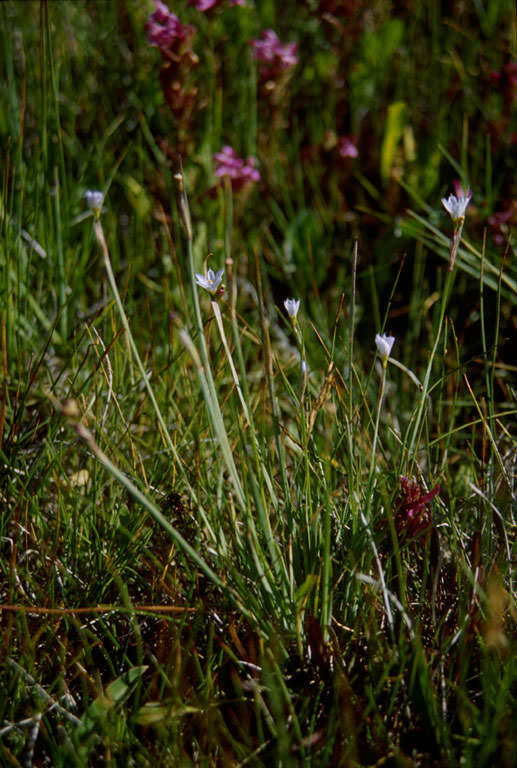
Sisyrinchium pallidum occurs in wet meadows often where ample fresh, often standing water is available at least through June or early July. These include stream, lake and river margins up slope from the most hydrophytic sedges and rushes, seep areas down stream from earthen dams, and irrigated hay meadows (Hartman 1992). It grows especially on alkaline soils (Culver and Lemly 2013), often with Juncus arcticus and Carex aquatilis.
click on image to enlarge
 |
Elevation Range:
6,533 - 9,805 feet (1,991 - 2,989 meters)
Distribution
Colorado Endemic:
No
Range:
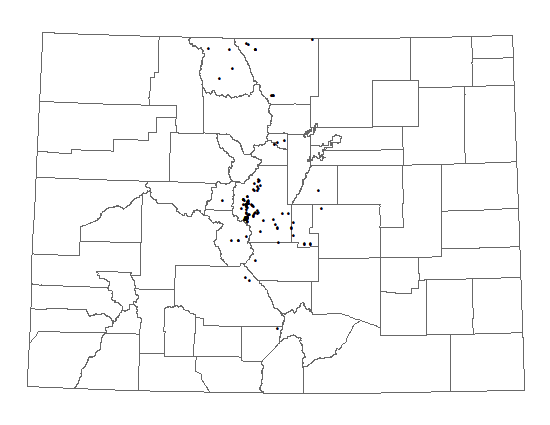
Sisyrinchium pallidum is known from Alamosa, Chaffee, El Paso, Fremont, Gilpin, Jackson, Lake, Larimer, Park, Saguache and Teller counties in Colorado, USA. Estimated range extent in Colorado of 37,710 square kilometers was calculated in GeoCAT using occurrence data provided by the Colorado Natural Heritage Program (2023). This species is also known from Wyoming, USA.
 Click on map to enlarge |
Threats and Management Issues
The primary threat at this time is considered to be alteration of wetland habitat through peat mining and water diversion projects. Often wetlands are drained to facilitate the extraction of peat. Ground water changes could ultimately alter the quality of wetlands favored by S. pallidum and ownership of water rights could permit diversion of surface water. Because of the uncertainty of how changes in the hydrological regime affect the long-term viability of the plants, modification of the wetland hydrology remains a serious threat. Additional threats include incompatible livestock grazing, road maintenance, motorized and non-motorized recreation and competition from non-native invasive plants. Invasive species such as Cirsium arvense, C. canadensis, and Bromus inermis have been reported from nearly 40% of the occurrences. Livestock use has been reported from 58% of the occurrences; recreation and road maintenance occur at approximately 14% of the occurrences. Other localized threats include haying/mowing and peat mining. This species is considered to have moderate adaptive capacity and is expected to be slightly vulnerable to climate change under both RCP 4.5 and 8.5 scenarios, as assessed for the 2025 Colorado State Wildlife Action Plan (CNHP 2025).
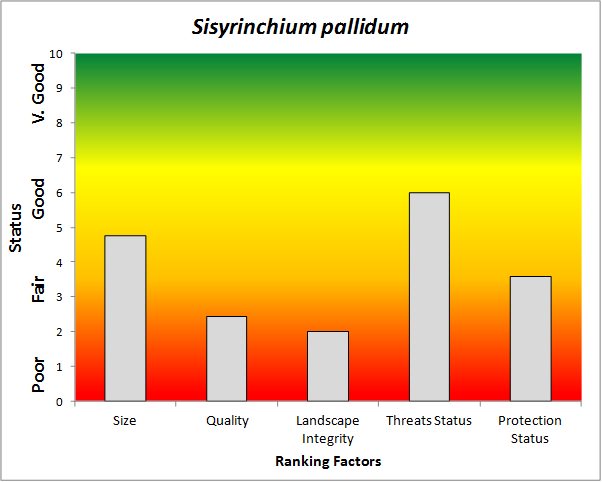 Summary results of an analysis of the status of Sisyrinchium pallidum based on several ranking factors. This species was concluded to be Moderately Conserved. From Rondeau et al. 2011. |
References
- Ackerfield, J. 2015. Flora of Colorado. BRIT Press, Botanical Research Institute of Texas, Fort Worth, TX. 818 pp.
- Cholewa, A.F., and D.M. Henderson. 1984. Biosystematics of Sisyrinchium section Bermundiana (Iridaceae) of the Rocky Mountains. Brittonia 36(4):342-363.
- Colorado Native Plant Society. 1989. Rare plants of Colorado. Rocky Mountain Nature Association, Colorado Native Plant Society, Estes Park, Colorado. 73 pp.
- Colorado Natural Heritage Program (CNHP). 2023. Biodiversity Tracking and Conservation System (Biotics 5). Colorado Natural Heritage Program, Colorado State University, Fort Collins.
- Colorado Natural Heritage Program (CNHP). 2025. Climate Change Vulnerability Assessment of Colorado Tier 1 and Tier 2 Plant Species of Greatest Conservation Need (SCGN) for the 2025 Colorado State Wildlife Action Plan. Colorado Natural Heritage Program, Colorado State University, Fort Collins.
- Culver, D.R. and J.M. Lemly. 2013. Field Guide to Colorado's Wetland Plants; Identification, Ecology and Conservation. Colorado Natural Heritage Program, Colorado State University, Fort Collins, 694 pp.
- Fertig, W., C. Refsdal, and J. Whipple. 1994. Wyoming rare plant field guide. Wyoming Rare Plant Technical Committee, Cheyenne. No pagination.
- Hartman, R. L. 1992. Report on the status of Sisyrinchium pallidum, a Candidate Threatened species. Unpublished report prepared for the U.S. Fish and Wildlife Service by the Rocky Mountain Herbarium, University of Wyoming, Laramie, WY.
- Henderson, D.M. 1976. A biosystematic study of Pacific Northwestern blue-eyed grasses (Sisyrinchium, Iridaceae). Brittonia 28: 149-176.
- Jennings, W.F. 1990c. Status Report on SISYRINCHIUM PALLIDUM. Unpublished Report for The Nature Conservancy, Colorado Field Office, Boulder, Colorado.
- K. Decker, L. Grunau, J. Handwerk, and J. Siemers, editors. 2015. Climate Change Vulnerability Assessment for Colorado Bureau of Land Management. Colorado Natural Heritage Program, Colorado State University, Fort Collins, Colorado.
- Neely, B., S. Panjabi, E. Lane, P. Lewis, C. Dawson, A. Kratz, B. Kurzel, T. Hogan, J. Handwerk, S. Krishnan, J. Neale, and N. Ripley. 2009. Colorado Rare Plant Conservation Strategy, Developed by the Colorado Rare Plant conservation Initiative. The Nature Conservancy, Boulder, Colorado, 117 pp.
- O'Kane, S. L. 1988. Colorado's Rare Flora. Great Basin Naturalist. 48(4):434-484.
- Spackman, S., B. Jennings, J. Coles, C. Dawson, M. Minton, A. Kratz, and C. Spurrier. 1997. Colorado rare plant field guide. Prepared for Bureau of Land Management, U.S. Forest Service and U.S. Fish and Wildlife Service by Colorado Natural Heritage Program.
- USDA, NRCS. 2022. The PLANTS Database. National Plant Data Team, Greensboro, NC 27401-4901 USA.
- Weber, W. A. and R. C. Wittmann. 2012. Colorado Flora, Eastern Slope, A Field Guide to the Vascular Plants, Fourth Edition. Boulder, Colorado. 555 pp.