

Scientific Name : Astragalus musiniensis
Author : M.E. Jones NatureServe Explorer
Common Name : Ferron's Milkvetch
 Current Research Activities
 1997 profile
☰ Click link below for details.
Taxonomy
Fabaceae (pea family)
Ranks and Status
State Rank : S1
State Rank Reason : Astragalus musiniensis is known from six occurrences in west central Colorado, USA. Threats are largely unknown but motorized recreation, livestock grazing and invasive plant species have been observed at two occurrences. Long-term drought is also a concern.
U.S. Endangered Species Act : none
Colorado Threatened and Endangered List : none
Other Statuses : BLM, SWAP Tier 2
Description and Phenology
General Description:
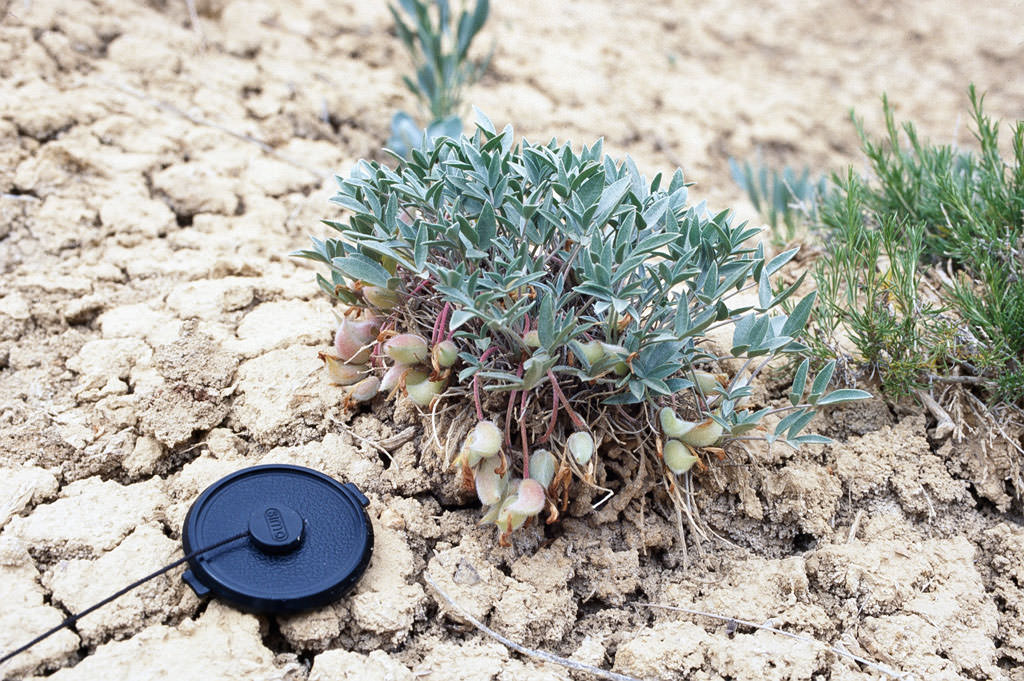
Low-growing, stemless perennial plants with pink-purple or reddish-violet flowers. Caylyx tube is dark hairy. Leaves are 2-12 cm long, commonly with 3-5 leaflets, sometimes with 1-3, or 7. Leaflets are pointed at each end and broadest in the middle. Pods are thinly pilose, ovoid-lanceolate, 15-36 mm x 10-17 mm, slightly dorsiventrally compressed; beak is laterally compressed (Spackman et al. 1997, Weber and Wittmann 2012, Ackerfield 2015).
Look Alikes:
Astragalus piscator has laterally compressed pods. Astragalus chamaeleuce has more numerous, smaller leaflets and a less prominently beaked, purple spotted or mottled pod (Spackman et al. 1997).
Phenology:
Flowers late April through early June (Colorado Natural Heritage Program 2012).
Habitat
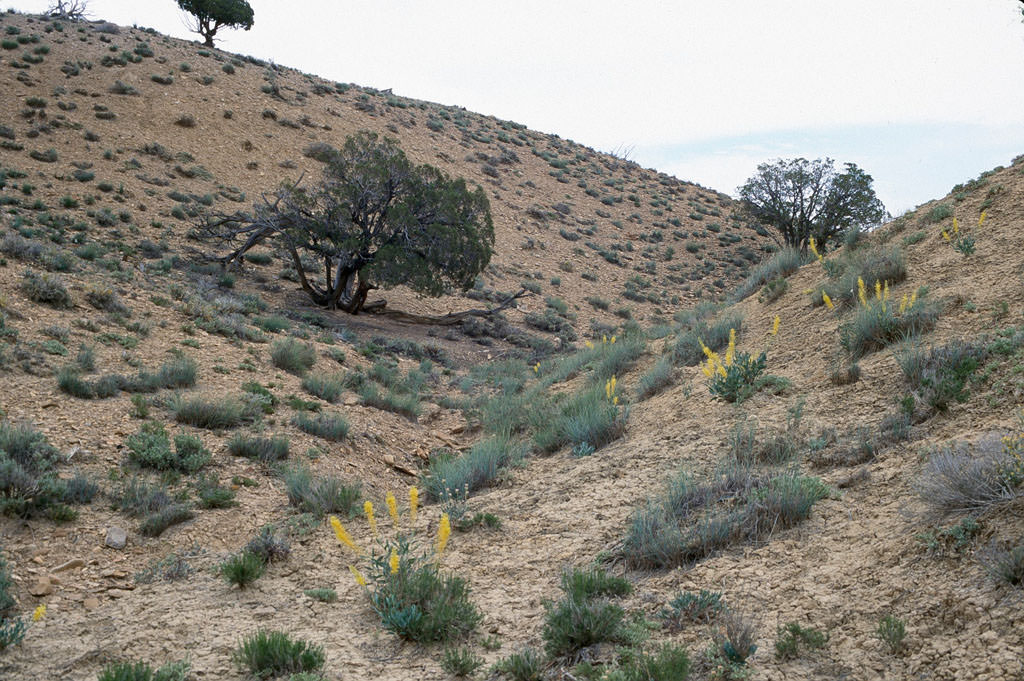
Gullied bluffs, knolls, benches and open hillsides; in pinyon-juniper woodlands or desert shrub communities, mostly on shale, sandstone, or alluvium derived from them (Spackman et al. 1997). Associated species include: Atriplex gardneri, Leymus salinus, Eriogonum contortum and Cryptantha elata.
click on image to enlarge
 |
Elevation Range:
4,562 - 5,488 feet (1,390 - 1,673 meters)
Distribution
Colorado Endemic:
No
Range:
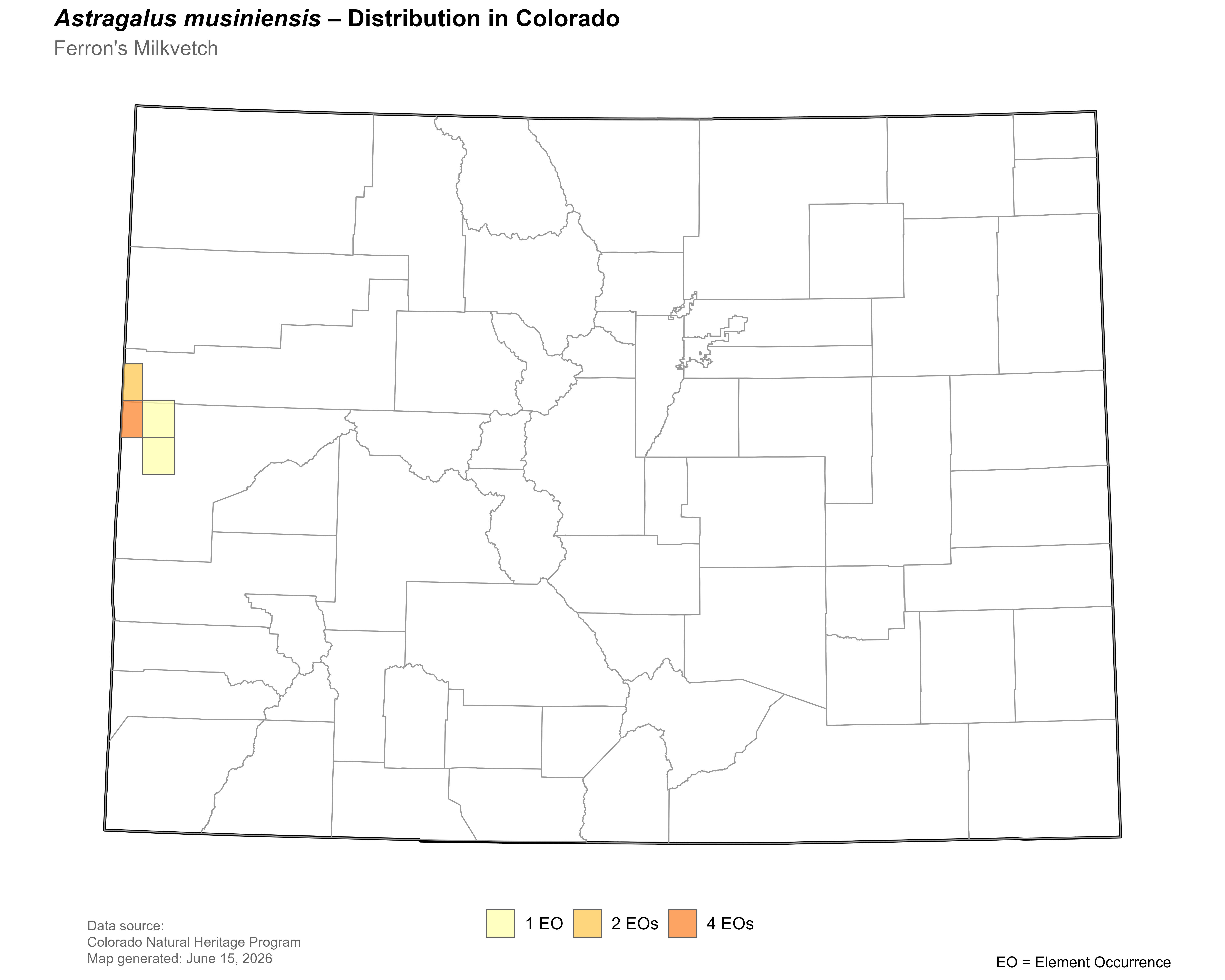
Astragalus musiniensis is known from Mesa and Garfield counties in Colorado, USA. Estimated range extent in Colorado of 169 square kilometers was calculated in GeoCAT using occurrence data provided by the Colorado Natural Heritage Program (2023). This species is also known from Utah, USA (Welsh et al. 1993).
Click on map to enlarge |
Threats and Management Issues
Livestock grazing, motorized recreation and competition from the invasive species Bromus tectorum have been observed at two of the six occurrences; the remainder do not report on site conditions. Rangewide, long-term drought is a concern for this species. This species is considered to have low adaptive capacity and is expected to be extremely vulnerable to climate change under both RCP 4.5 and 8.5 scenarios, as assessed for the 2025 Colorado State Wildlife Action Plan (CNHP 2025).
References
- Ackerfield, J. 2015. Flora of Colorado. BRIT Press, Botanical Research Institute of Texas, Fort Worth, TX. 818 pp.
- Barneby, R. C. 1964. Atlas of North American Astragalus. Memoirs of New York Botanical Garden, vol. 13. New York Botanical Garden, Bronx, NY.
- Colorado Natural Heritage Program (CNHP). 2023. Biodiversity Tracking and Conservation System (Biotics 5). Colorado Natural Heritage Program, Colorado State University, Fort Collins.
- Colorado Natural Heritage Program (CNHP). 2025. Climate Change Vulnerability Assessment of Colorado Tier 1 and Tier 2 Plant Species of Greatest Conservation Need (SCGN) for the 2025 Colorado State Wildlife Action Plan. Colorado Natural Heritage Program, Colorado State University, Fort Collins.
- Cronquist A. 1989. Intermountain Flora Vascular Plants of the Intermountain West, USA. Vol. 3, Part B. New York Botanical Garden, Bronx, NY.
- Spackman, S., B. Jennings, J. Coles, C. Dawson, M. Minton, A. Kratz, and C. Spurrier. 1997. Colorado rare plant field guide. Prepared for Bureau of Land Management, U.S. Forest Service and U.S. Fish and Wildlife Service by Colorado Natural Heritage Program.
- USDA, NRCS. 2022. The PLANTS Database. National Plant Data Team, Greensboro, NC 27401-4901 USA.
- Weber, W. A. and R. C. Wittmann. 2012. Colorado Flora, Western Slope, A Field Guide to the Vascular Plants, Fourth Edition. Boulder, Colorado. 532 pp.
- Welsh, S.L., N.D. Atwood, S. Goodrich and L.C. Higgins. (Eds.) 2003. A Utah Flora. 3rd edition. Brigham Young University, Provo, Utah, U.S.A. 912 pp.