

Scientific Name : Mertensia humilis
Author : Rydb. NatureServe Explorer
Common Name : Rocky Mountain Bluebells
 Current Research Activities
☰ Click link below for details.
Taxonomy
Boraginaceae (borage family)
Ranks and Status
State Rank : S1
State Rank Reason : Mertensia humilis is known from ten small occurrences in Jackson and Larimer counties in Colorado, USA. No threats have been documented in the occurrences, but this species is considered to be vulnerable to the effects of climate change.
U.S. Endangered Species Act : none
Colorado Threatened and Endangered List : none
Other Statuses : SWAP SGIN
Description and Phenology
General Description:
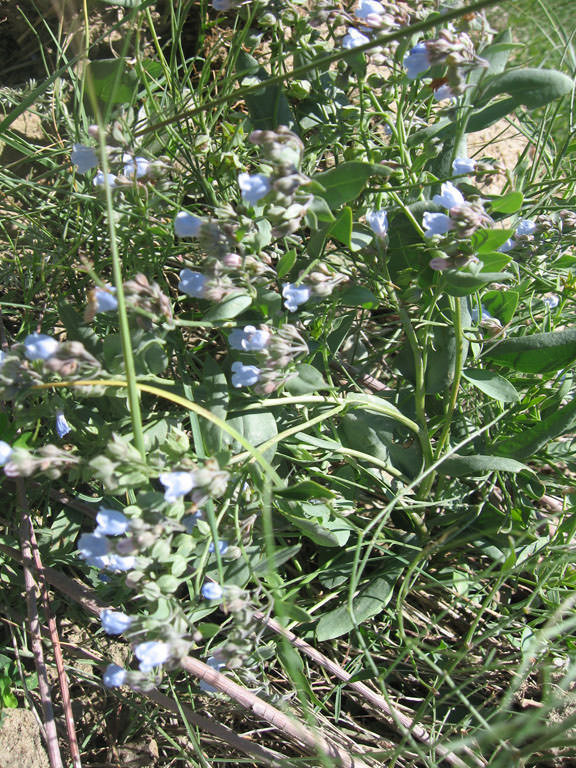
Perennial plants, 4-20 cm. tall, with blue flowers. Basal leaves are ovate to oblong-lanceolate, and petioled; cauline leaves are oblong-lanceolate, and sessile, or nearly so. Leaves are glabrous (or mostly glabrous), pustulose (but not supporting hairs), and rather thick. Inflorescence is congested with flowers 2-6 mm long (Harrington 1954, Ackerfield 2011).
Look Alikes:
Distinguished from other species in northcentral Colorado by its leaves that are glabrous, or pustulate, but not supporting hairs (Ackerfield 2012).
Phenology:
Flowers May-June (Ackerfield 2012, Colorado Natural Heritage Program 2012).
Habitat
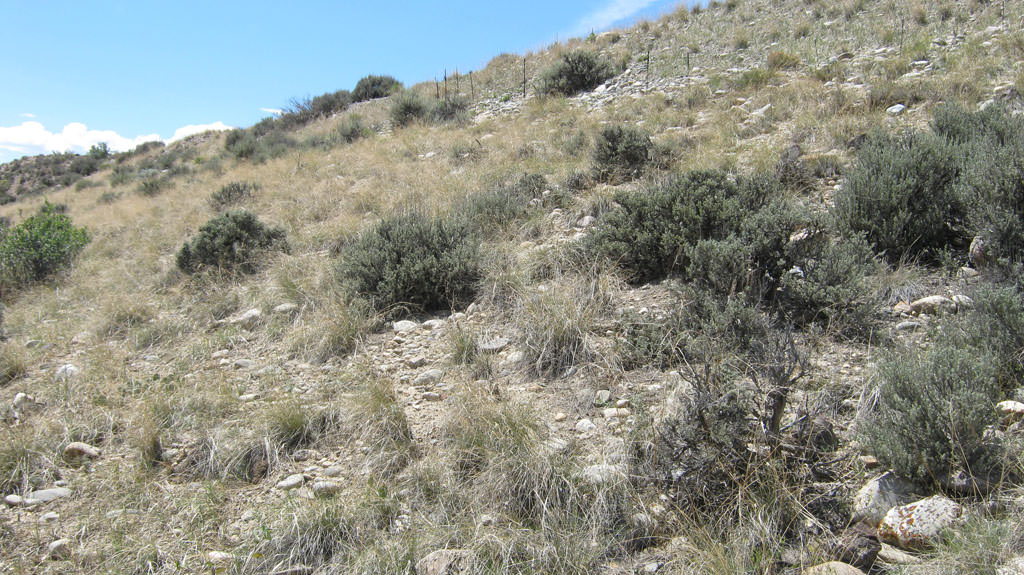
Sagebrush meadows (Ackerfield 2012, Weber and Wittmann 2012). Associated species include: Artemisia tridentata ssp. wyomingensis, Comandra umbellata, Achnatherum hymenoides, Chrysothamnus spp., Linum lewisii, and Sphaeralcea coccinea (Colorado Natural Heritage Program 2012).
click on image to enlarge
 |
Elevation Range:
5,260 - 9,562 feet (1,603 - 2,915 meters)
Distribution
Colorado Endemic:
No
Range:
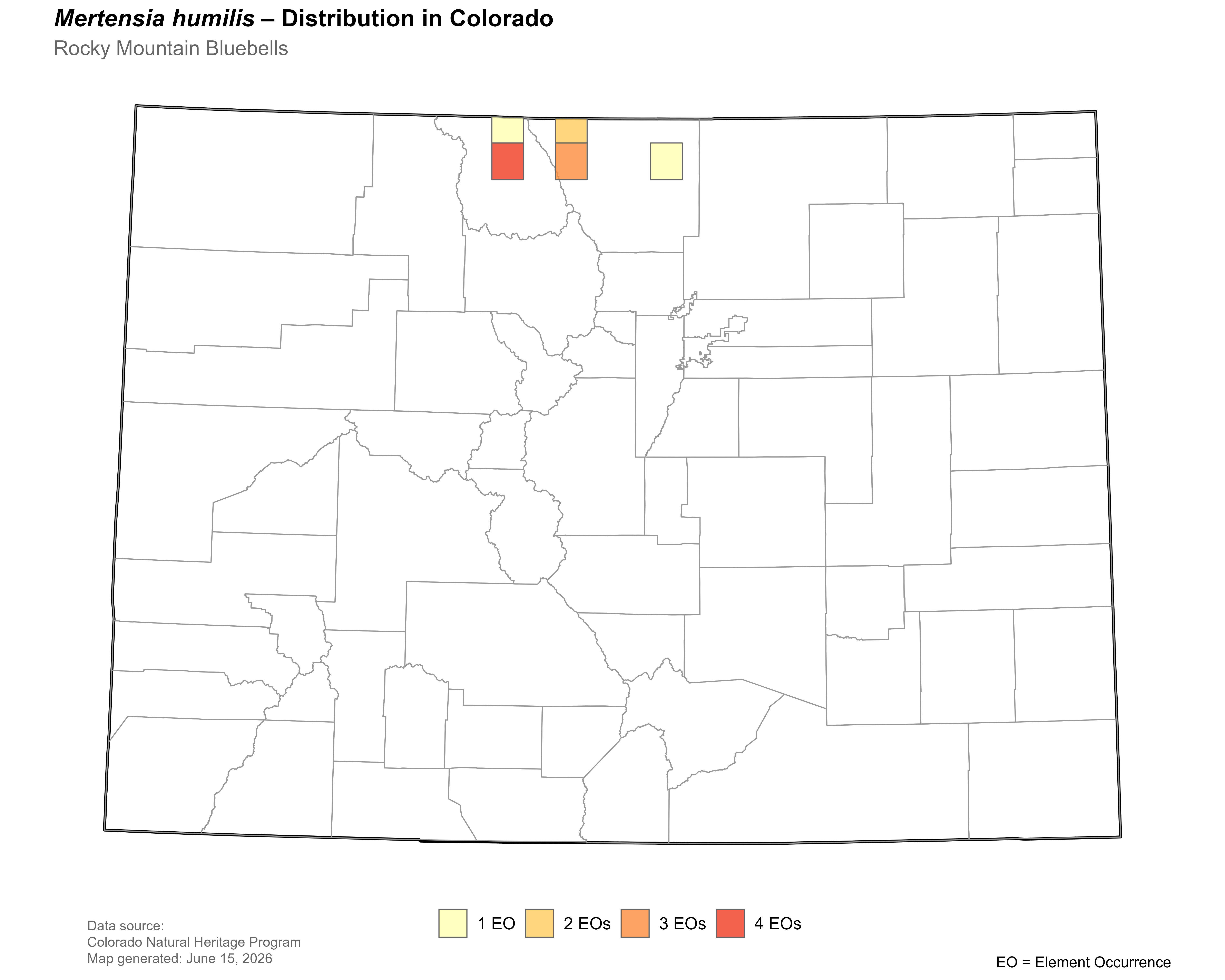
Mertensia humilis is known from Jackson and Larimer counties in Colorado, USA. Estimated range extent in Colorado of 1605 square kilometers was calculated in GeoCAT using occurrence data provided by the Colorado Natural Heritage Program (2025). This species also occurs in Wyoming, USA.
Click on map to enlarge |
Threats and Management Issues
No threats have been documented, but this species is considered to be extremely vulnerable to climate change (Handwerk et al. 2015).
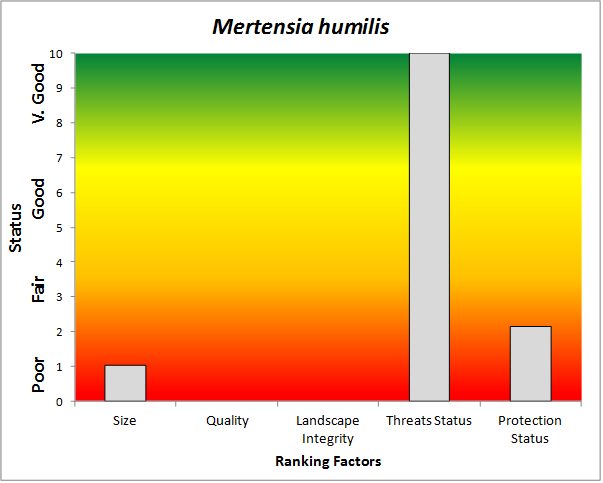
Summary results of an analysis of the status of Mertensia humilis based on several ranking factors. This species was concluded to be Weakly Conserved. From Rondeau et al. 2011. |
References
- Ackerfield, J. 2015. Flora of Colorado. BRIT Press, Botanical Research Institute of Texas, Fort Worth, TX. 818 pp.
- Colorado Natural Heritage Program (CNHP). 2025. Biodiversity Tracking and Conservation System (Biotics 5). Colorado Natural Heritage Program, Colorado State University, Fort Collins.
- Colorado Natural Heritage Program. 2012. Biodiversity Tracking and Conservation System. Colorado State University, Fort Collins, CO.
- Dorn, R.D. 1992. Vascular plants of Wyoming, 2nd edition. Mountain West Publishing, Cheyenne, Wyoming.
- Handwerk, J., L. Grunau, and S. Panjabi. 2015. Colorado Wildlife Action Plan: 2015 Rare Plant Addendum. Colorado Natural Heritage Program, Colorado State University, Fort Collins, Colorado, USA.
- Harrington, H.D. 1954. Manual of the plants of Colorado. Sage Press, Chicago. 666 pp.
- Kartesz, J.T. 1996. Species distribution data at state and province level for vascular plant taxa of the United States, Canada, and Greenland (accepted records), from unpublished data files at the North Carolina Botanical Garden, December, 1996.
- Lavender, A.E., M.M. Fink, S.E. Linn, D.M. Theobald. 2011. Colorado Ownership, Management, and Protection v9 Database. Colorado Natural Heritage Program and Geospatial Centroid, Colorado State University, Fort Collins, CO. (30 September).
- Neely, B., S. Panjabi, E. Lane, P. Lewis, C. Dawson, A. Kratz, B. Kurzel, T. Hogan, J. Handwerk, S. Krishnan, J. Neale, and N. Ripley. 2009. Colorado Rare Plant Conservation Strategy, Developed by the Colorado Rare Plant conservation Initiative. The Nature Conservancy, Boulder, Colorado, 117 pp.
- Rondeau, R., K. Decker, J. Handwerk, J. Siemers, L. Grunau, and C. Pague. 2011. The state of Colorado's biodiversity 2011. Prepared for The Nature Conservancy. Colorado Natural Heritage Program, Colorado State University, Fort Collins, Colorado.
- USDA, NRCS. 2022. The PLANTS Database. National Plant Data Team, Greensboro, NC 27401-4901 USA.
- Weber, W. A. and R. C. Wittmann. 2012. Colorado Flora, Eastern Slope, A Field Guide to the Vascular Plants, Fourth Edition. Boulder, Colorado. 555 pp.