

Scientific Name : Erythranthe eastwoodiae
Author : (Rydberg) G.L. Nesom & N.S. Fraga NatureServe Explorer
Common Name : Eastwood Monkeyflower
 Current Research Activities
 1997 profile


☰ Click link below for details.
Taxonomy
Phrymaceae ()
Listed as Erythranthe eastwoodiae by Ackerfield (2022) and Mimulus eastwoodiae by Ackerfield (2015). Ackerfield (2015, 2022) places the genus Mimulus/Erythranthe in the family Phrymaceae (the Lopseed Family). Weber and Wittmann (2012) place this genus in the Scrophulariaceae family.
Ranks and Status
State Rank : S1S2
State Rank Reason : Erythranthe eastwoodiae is a regional endemic known from a narrow distribution within four southwestern counties in Colorado, USA. The primary threat to this species is alteration of the hydrology that supports its habitat.
U.S. Endangered Species Act : none
Colorado Threatened and Endangered List : none
Other Statuses : none
Description and Phenology
General Description:
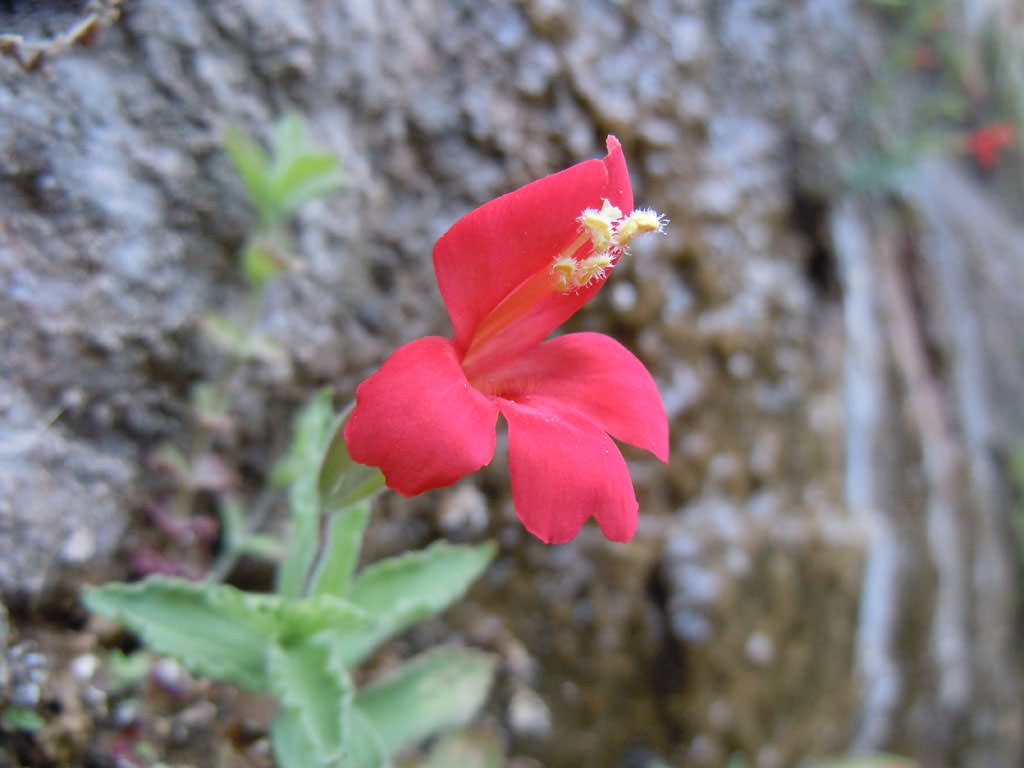
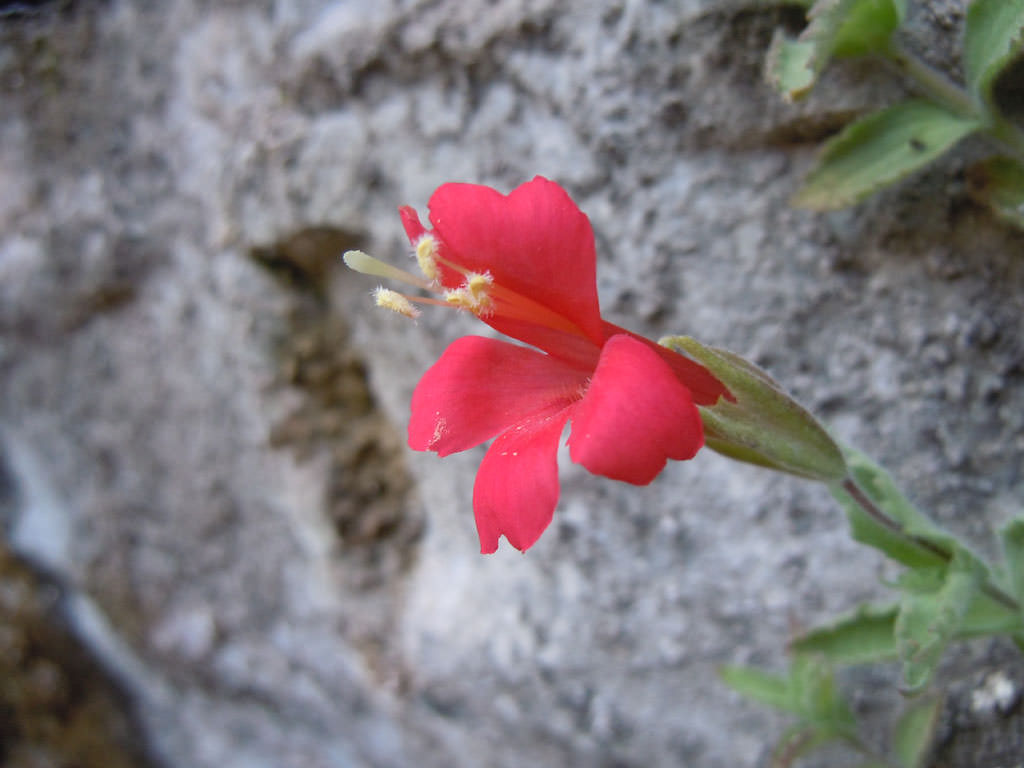
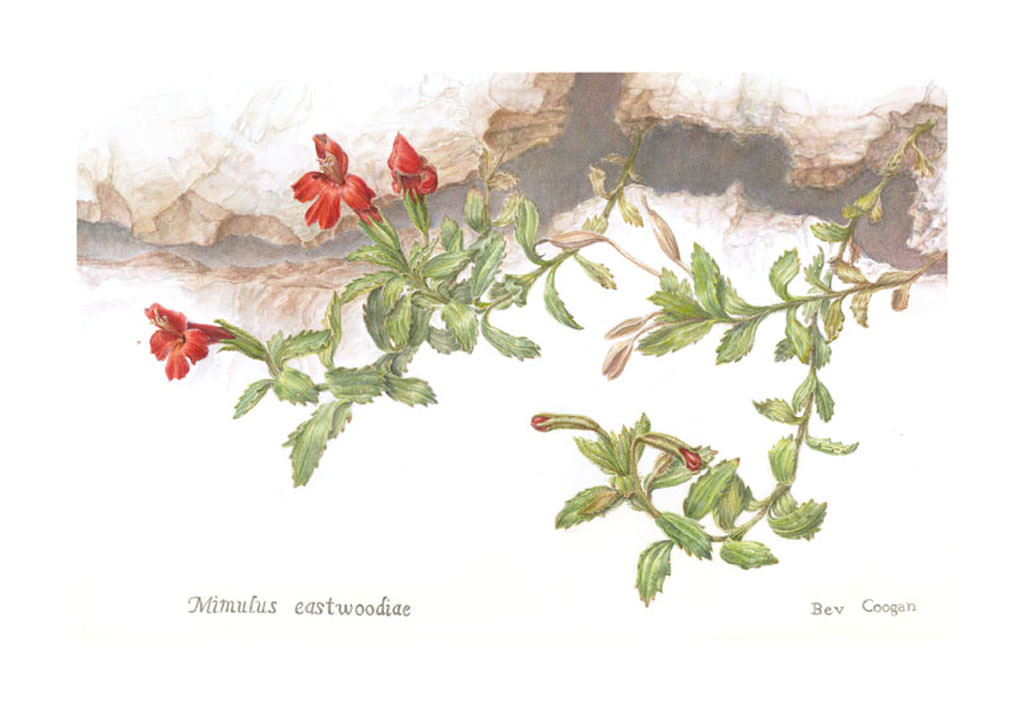
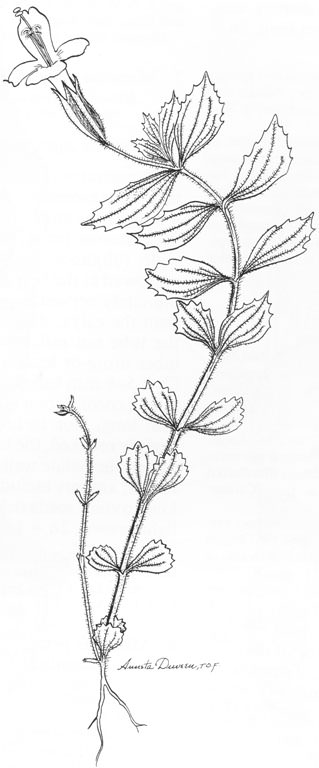
Stoloniferous perennial, stems 5-30 cm long. New fertile plants are produced wherever roots take hold. Plants are climbing to pendulous from ceilings of overhanging cliffs, gladular-puberulent, sometimes viscid-villous. Leaves are sessile, fan-shaped, corsely toothed and palmately 3-5 veined. Corolla scarlet to orangish-red, four stamens, and calyx strongly 5-angled (Spackman et al. 1997, Culver and Lemly 2013).
Look Alikes:
Mimulus lewisii has an erect growth form, and pink-purple flowers (Spackman et al. 1997).
Phenology:
Flowers July-September (Ackerfield 2015, Spackman et al. 1997).
 |  |
Habitat
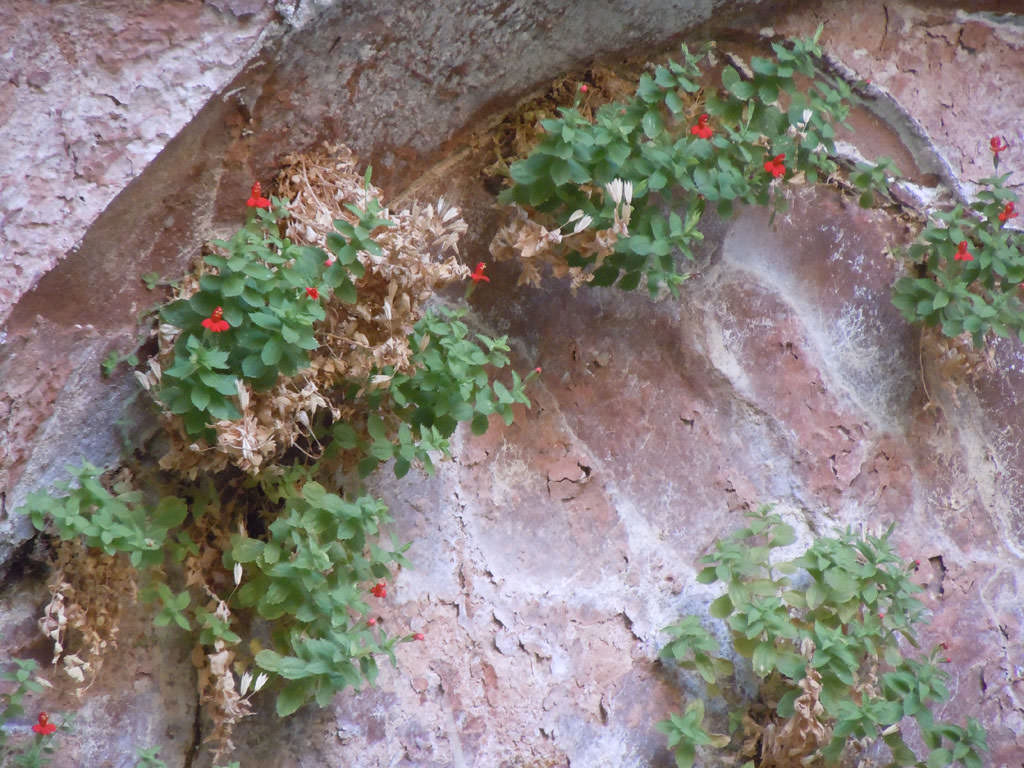
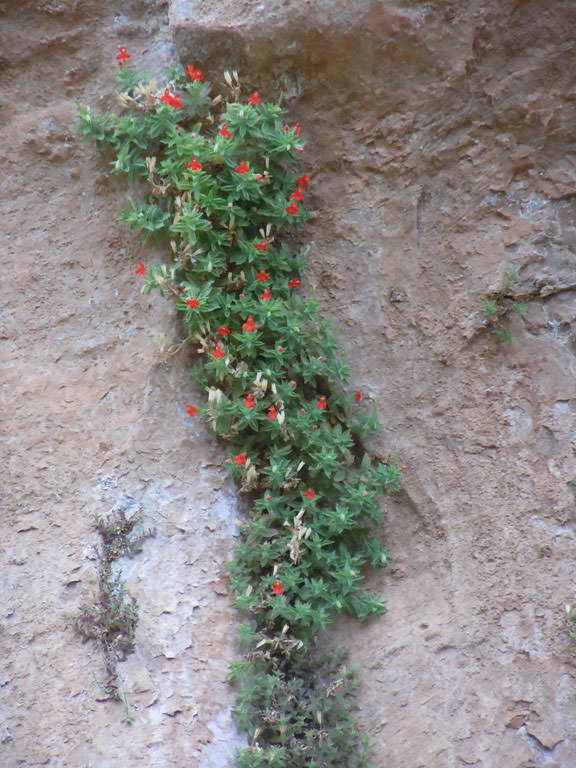
Grows in moist crevices of perpendicular or overhanging sandstone canyon walls. The moist seeps support a lush association of plants, unusual in the dry, desert country. Associated species are Smilacina stellata, Epipactis gigantea, Erigeron kachinensis, Aquilegia micrantha (Spackman et al. 1997, Colorado Native Plant Society 1997, Culver and Lemly 2013, Ackerfield 2015).
click on image to enlarge
 |
 |
Elevation Range:
4,689 - 6,414 feet (1,429 - 1,955 meters)
Distribution
Colorado Endemic:
No
Range:
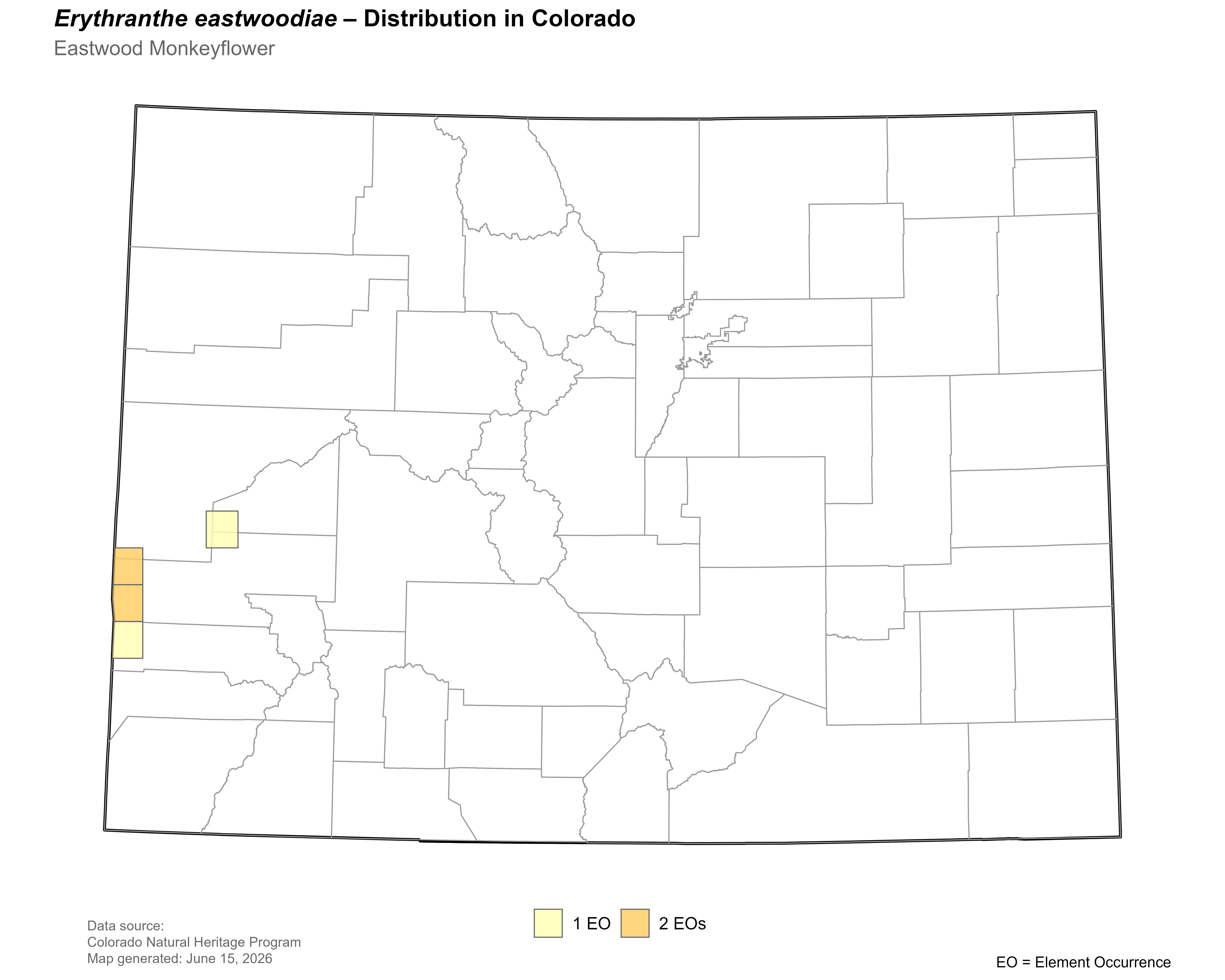
In Colorado, Erythranthe eastwoodiae is known from Delta, Mesa, Montrose, and San Miguel counties, Colorado, USA. Estimated range extent in Colorado of 1309 square kilometers was calculated in GeoCAT using occurrence data provided by the Colorado Natural Heritage Program (2023). This species can also be found in Arizona, Utah, and the Navajo Nation.
Click on map to enlarge |
Threats and Management Issues
The primary threat to this species is the alteration of hydrological setting that supports the habitat in which it occurs.
References
- Ackerfield, J. 2015. Flora of Colorado. BRIT Press, Botanical Research Institute of Texas, Fort Worth, TX. 818 pp.
- Ackerfield, J. 2022. Flora of Colorado. Second Edition. Bot. Misc. 60. BRIT Press, Fort Worth Botanic Garden/Botanical Research Institute of Texas, U.S.A. 861 pp.
- Cronquist, A., A.H. Holmgren, N.H. Holmgren, J.L. Reveal, and P.K. Holmgren. 1984. Intermountain Flora: Vascular Plants of the Intermountain West, U.S.A. Vol. 4, Subclass Asteridae (except Asteraceae). New York Botanical Garden, Bronx. 573 pp.
- Culver, D.R. and J.M. Lemly. 2013. Field Guide to Colorado's Wetland Plants; Identification, Ecology and Conservation. Colorado Natural Heritage Program, Colorado State University, Fort Collins, 694 pp.
- Heil, K.D., S.L. O'Kane, Jr., and A. Clifford. 2002. Additions to the Flora of New Mexico from the San Juan Basin Flora Project. New Mexico Botanist 24: 1-4. [https://floraneomexicana.files.wordpress.com/2014/08/24.pdf]
- Kearney, T.H., R.H. Peebles, and collaborators. 1951. Arizona flora. 2nd edition with Supplement (1960) by J.T. Howell, E. McClintock, and collaborators. Univ. California Press, Berkeley. 1085 pp.
- Rocky Mountain Society of Botanical Artists. 2009. RARE Imperiled Plants of Colorado, a traveling art exhibition. Exhibition catalogue developed by the Denver Botanic Gardens and Steamboat Art Museum.
- Rydberg. 1913. Mimulus eastwoodiae. In: Studies on the Rocky Mountain Flora. Bulletin of the Torrey Botany Club Vol. 40:483-484.
- Schneider, A. 2013. Wildflowers, Ferns, and Trees of the Four Corners Regions of Colorado, New Mexico, Arizona, and Utah. Accessed on-line at http://www.swcoloradowildflowers.com.
- Spackman, S., B. Jennings, J. Coles, C. Dawson, M. Minton, A. Kratz, and C. Spurrier. 1997. Colorado rare plant field guide. Prepared for Bureau of Land Management, U.S. Forest Service and U.S. Fish and Wildlife Service by Colorado Natural Heritage Program.
- The Colorado Native Plant Society. 1997. Rare Plants of Colorado, second edition. Falcon Press Publishing Co.,Inc. Helena, Montana. 105pp.
- USDA, NRCS. 2022. The PLANTS Database. National Plant Data Team, Greensboro, NC 27401-4901 USA.
- Weber, W. A. and R. C. Wittmann. 2012. Colorado Flora, Western Slope, A Field Guide to the Vascular Plants, Fourth Edition. Boulder, Colorado. 532 pp.
- Welsh, S.L., N.D. Atwood, S. Goodrich and L.C. Higgins. (Eds.) 2003. A Utah Flora. 3rd edition. Brigham Young University, Provo, Utah, U.S.A. 912 pp.