

Scientific Name : Oreocarya osterhoutii
Author : Payson NatureServe Explorer
Common Name : Osterhout Cat's- eye
 Current Research Activities
 1997 profile


☰ Click link below for details.
Taxonomy
Boraginaceae (borage family)
=Cryptantha osterhoutii
Ranks and Status
State Rank : S2
State Rank Reason : Oreocarya osterhoutii is known from only nine occurrences in one county in western Colorado, USA. Threats are poorly understood but impacts from non-motorized recreation and invasive non-native plant species have been noted at two occurrences. Rangewide the effects of long-term drought and climate change are also a concern.
U.S. Endangered Species Act : none
Colorado Threatened and Endangered List : none
Other Statuses : BLM, SWAP Tier 2
Description and Phenology
General Description:
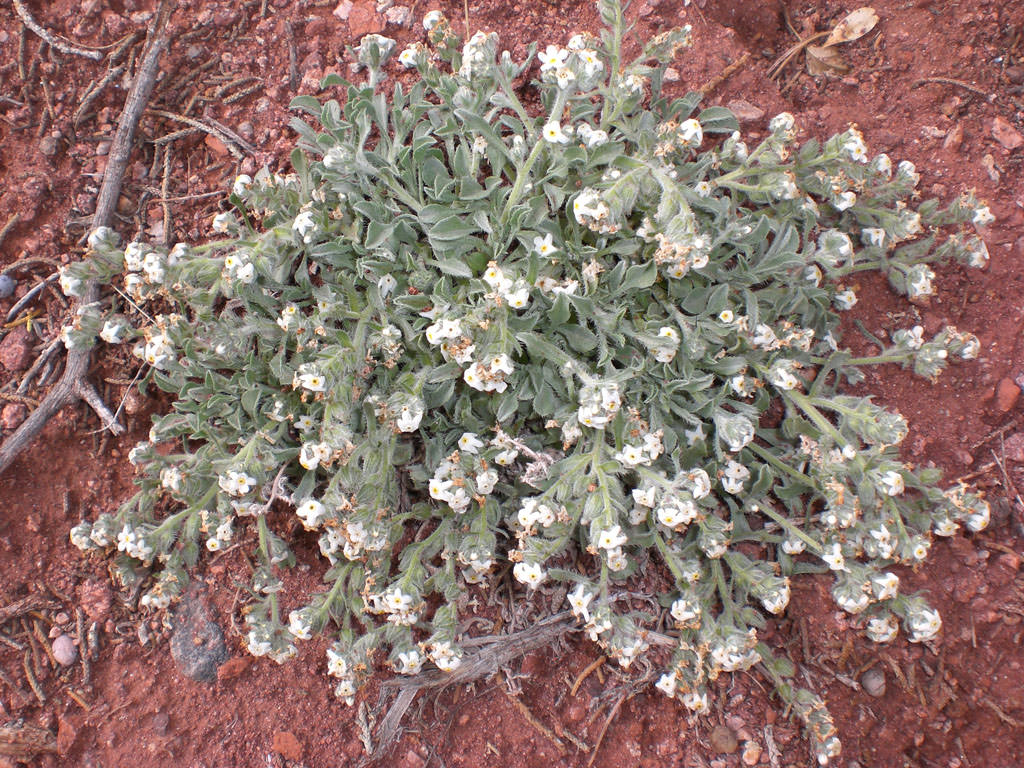
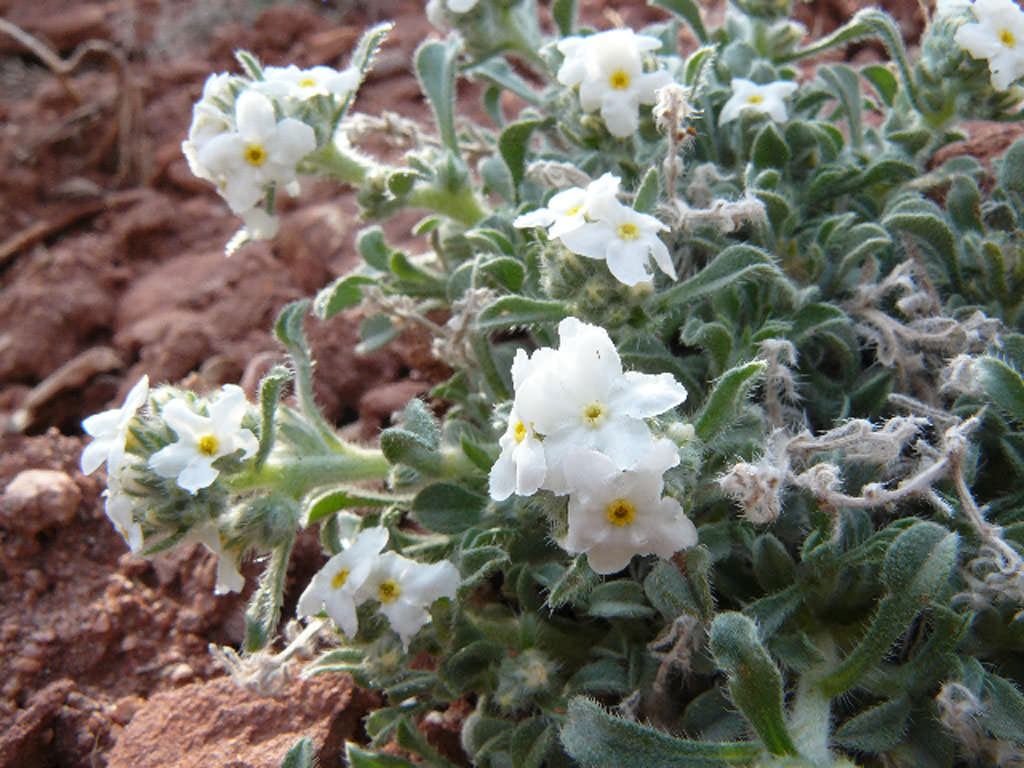
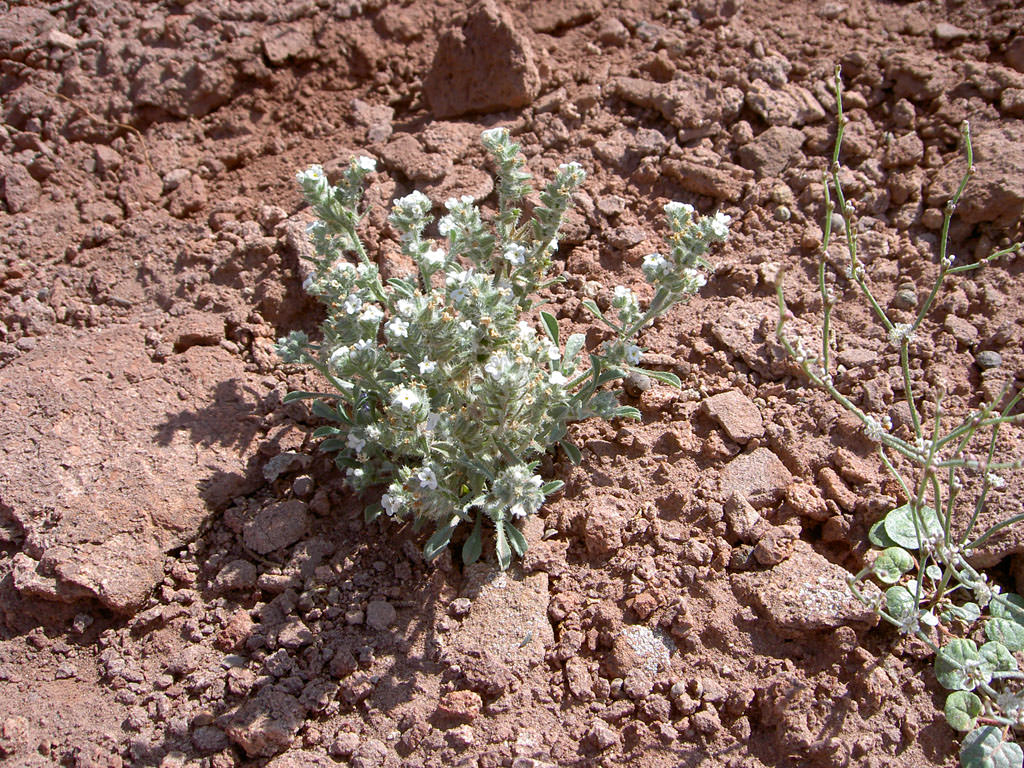
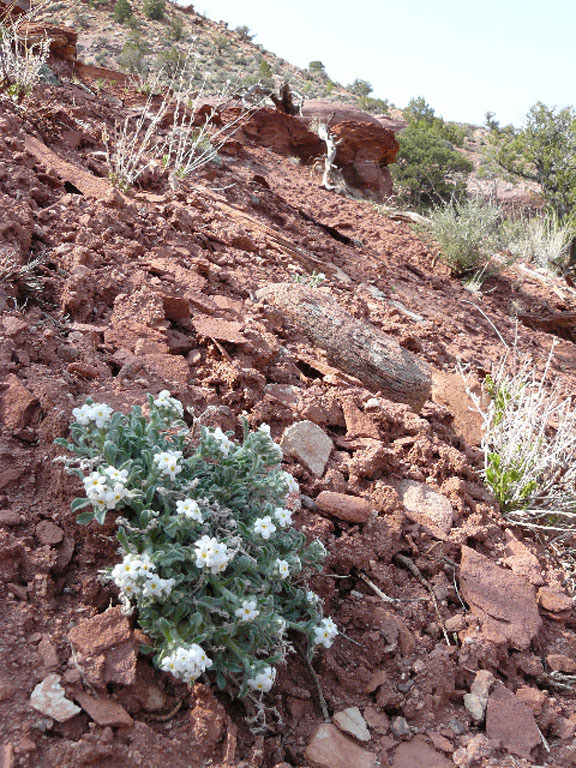
Low, perennial, taprooted plants about 10 cm tall, often caespitose. Flowers white with well developed yellow fornices, and a short corolla tube. Basal leaves are oblanceolate. Plants covered with white hairs. Style exceeds the mature nutlet by less than 1mm. Nutlet scar is open, constricted below the middle (Spackman et al. 1997, Ackerfield 2015).
Look Alikes:
This species is easily distinguishable from others, but its distinctive aspect is hard to describe effectively (Cronquist 1984). This is one of the most distinct in the Oreocarya genus because of its small size (Higgins 1971).
Phenology:
Flowers April-early June (Cronquist 1984, Spackman et al. 1997, Ackerfield 2015). Fruits mature by mid-June (Colorado Natural Heritage Program 2015).
Habitat
Dry, barren sites, in reddish-purple decomposed sandstone (Spackman et al. 1997), often with juniper or sagebrush communities (Ackerfield 2015). Associated plant species include: Coleogyne ramosissima, Fraxinus anomala, Purshia stansburiana, Lepidium montanum, Mirabilis multiflora, Tetraneuris ivesiana, Cryptantha flava, Castilleja scabrida, Astragalus wingatanus, and Astragalus lentiginosus.
click on image to enlarge
 |
Elevation Range:
4,433 - 7,057 feet (1,351 - 2,151 meters)
Distribution
Colorado Endemic:
No
Range:
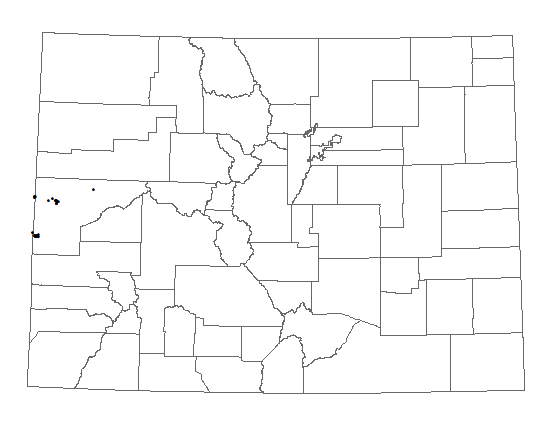
Oreocarya osterhoutii is known from Mesa County in Colorado, USA. Estimated range extent in Colorado of 2105 square kilometers was calculated in GeoCAT using occurrence data provided by the Colorado Natural Heritage Program (2023). This species can also be found in Arizona and Utah, USA.
 Click on map to enlarge |
Threats and Management Issues
The primary threat at this time is considered to be recreation/hiking (Rondeau et al. 2011). The invasive non-native plant Bromus tectorum (cheatgrass) has been observed at one occurrence. It is not known if all of the occurrences are or are not threatened by these activities. Long term drought is a serious concern throughout the species range. This species is considered to have low adaptive capacity and is expected to be extremely vulnerable to climate change under both RCP 4.5 and 8.5 scenarios, as assessed for the 2025 Colorado State Wildlife Action Plan (CNHP 2025).
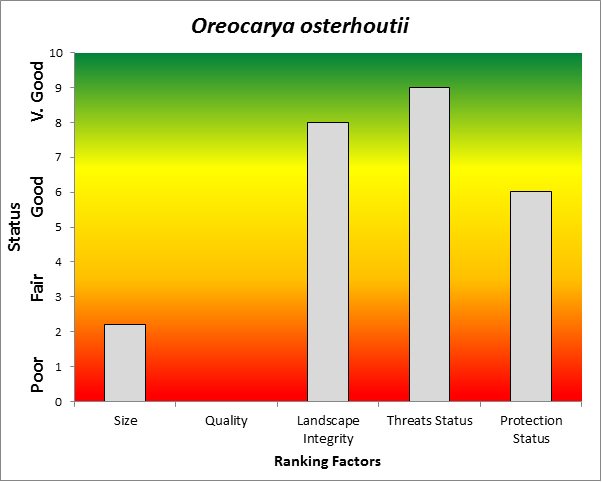 Summary results of an analysis of the status of Oreocarya osterhoutii based on several ranking factors. This species was concluded to be Moderately Conserved. From Rondeau et al. 2011. |
References
- Ackerfield, J. 2015. Flora of Colorado. BRIT Press, Botanical Research Institute of Texas, Fort Worth, TX. 818 pp.
- Colorado Natural Heritage Program (CNHP). 2023. Biodiversity Tracking and Conservation System (Biotics 5). Colorado Natural Heritage Program, Colorado State University, Fort Collins.
- Colorado Natural Heritage Program (CNHP). 2025. Climate Change Vulnerability Assessment of Colorado Tier 1 and Tier 2 Plant Species of Greatest Conservation Need (SCGN) for the 2025 Colorado State Wildlife Action Plan. Colorado Natural Heritage Program, Colorado State University, Fort Collins.
- Cronquist, A., A.H. Holmgren, N.H. Holmgren, J.L. Reveal, and P.K. Holmgren. 1984. Intermountain Flora: Vascular Plants of the Intermountain West, U.S.A. Vol. 4, Subclass Asteridae (except Asteraceae). New York Botanical Garden, Bronx. 573 pp.
- Handwerk, J., L. Grunau, and S. Panjabi. 2015. Colorado Wildlife Action Plan: 2015 Rare Plant Addendum. Colorado Natural Heritage Program, Colorado State University, Fort Collins, Colorado, USA.
- Heil, K.D, S.L. O'Kane Jr., L.M. Reeves, and A. Clifford. 2013. Flora of the Four Corners Region. Vascular Plants of the San Juan River Drainage: Arizona, Colorado, New Mexico, and Utah. Monographs in systematic botany from the Missouri Botanical Garden, Vol. 124, Missouri Botanical Garden Press, St. Louis, MO. xvi + 1098 pp.
- Higgins, L.C. 1971. A revision of Cryptantha subgenus Oreocarya. Brigham Young University Science Bulletin. Volume 13:1-63.
- Neely, B., S. Panjabi, E. Lane, P. Lewis, C. Dawson, A. Kratz, B. Kurzel, T. Hogan, J. Handwerk, S. Krishnan, J. Neale, and N. Ripley. 2009. Colorado Rare Plant Conservation Strategy, Developed by the Colorado Rare Plant conservation Initiative. The Nature Conservancy, Boulder, Colorado, 117 pp.
- Panjabi, S., B. Neely and P. Lyon. 2011. Preliminary Conservation Action Plan for Rare Plants in the Gateway Priority Action Areas. Prepared by The Nature Conservancy and the Colorado Natural Heritage Program. Unpublished report prepared for the National Fish and Wildlife Foundation. 29 pp.
- Rondeau, R., K. Decker, J. Handwerk, J. Siemers, L. Grunau, and C. Pague. 2011. The state of Colorado's biodiversity 2011. Prepared for The Nature Conservancy. Colorado Natural Heritage Program, Colorado State University, Fort Collins, Colorado.
- USDA, NRCS. 2022. The PLANTS Database. National Plant Data Team, Greensboro, NC 27401-4901 USA.
- Weber, W. A. and R. C. Wittmann. 2012. Colorado Flora, Western Slope, A Field Guide to the Vascular Plants, Fourth Edition. Boulder, Colorado. 532 pp.
- Welsh, S.L., N.D. Atwood, S. Goodrich and L.C. Higgins. (Eds.) 2003. A Utah Flora. 3rd edition. Brigham Young University, Provo, Utah, U.S.A. 912 pp.