

Scientific Name : Physaria calcicola
Author : (Rollins) O'Kane & Al-Shehbaz NatureServe Explorer
Common Name : Rocky Mountain Bladderpod
 Current Research Activities


☰ Click link below for details.
Taxonomy
Brassicaceae (mustard family)
=Lesquerella calcicola
Ranks and Status
State Rank : S3
State Rank Reason : Physaria calcicola is a regional endemic, known in Colorado, USA, from a limited distribution in southeast portion of the state. There are currently over 40 documented occurrences in the CNHP database. However, the species occurs in areas that are experiencing rapid development pressures, and nearly half of the occurrences do not document viability, or are historical observations. Additional threats include inappropriate livestock grazing, road and utility line maintenance, military maneuvers, recreational uses, erosion, and noxious weed invasions. This species is expected to be slightly to moderately vulnerable to climate change.
U.S. Endangered Species Act : none
Colorado Threatened and Endangered List : none
Other Statuses : SWAP Tier 2
Description and Phenology
General Description:
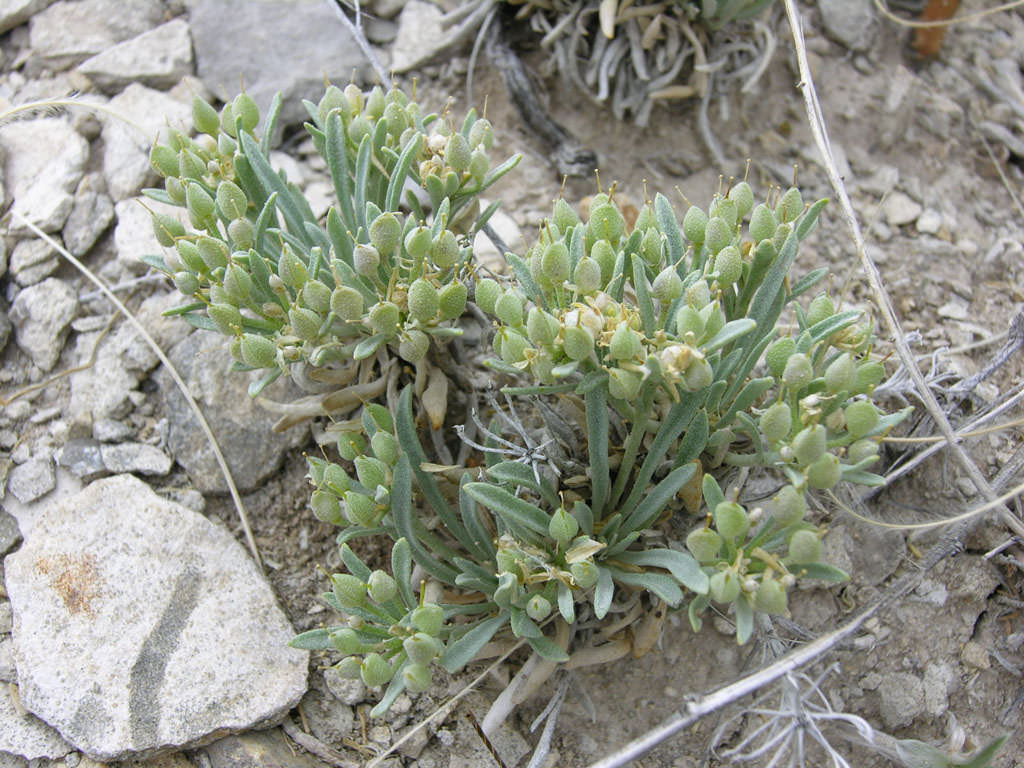
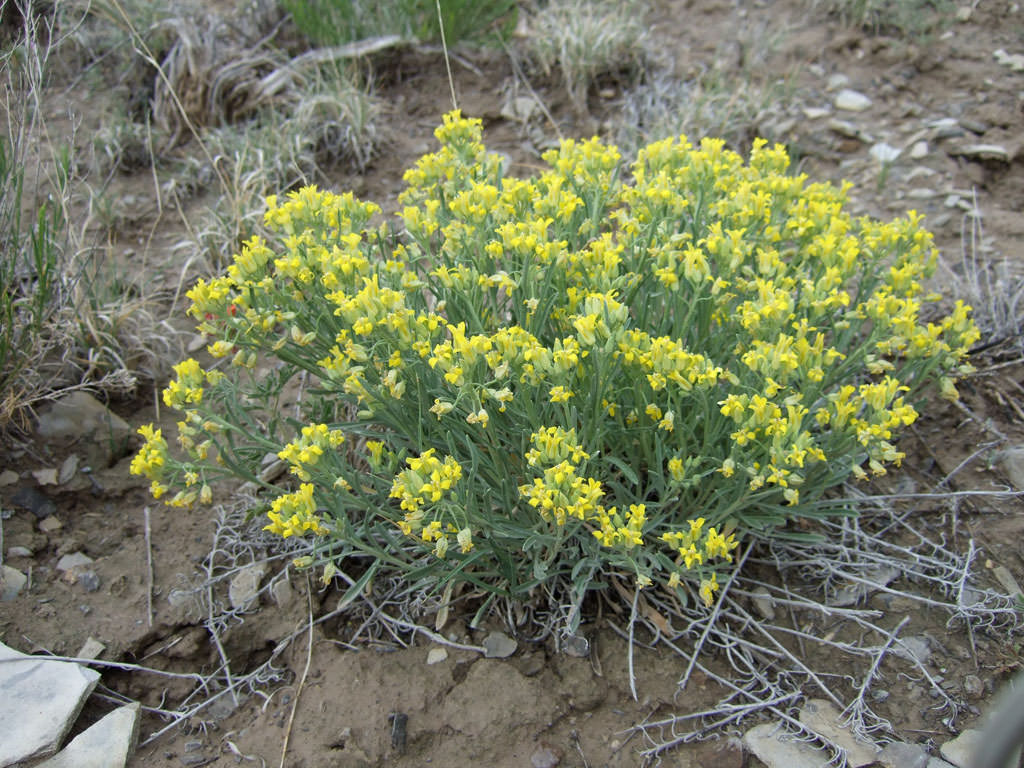
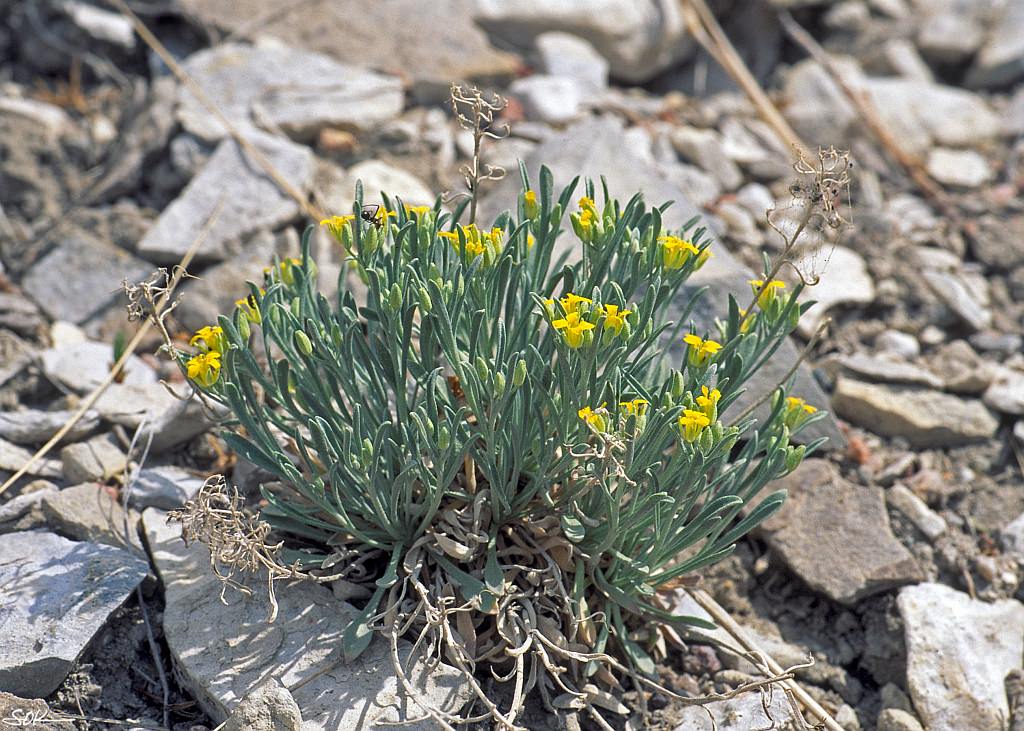
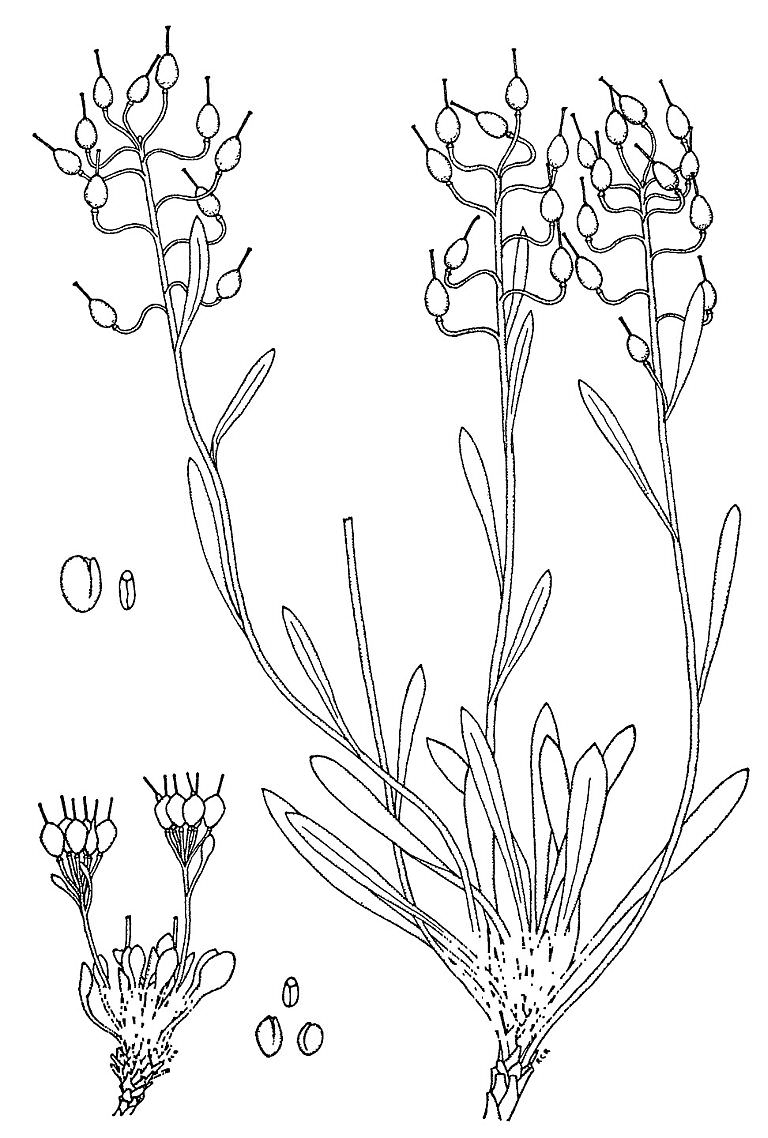
This yellow flowered perennial is silvery-stellate throughout. The caudex is simple or closely branched. Stems are 10-30 cm long with radial basal leaves. Outer stems are often decumbent. Leaves are oblanceolate to linear. Basal leaves are 2-4 mm wide, to 7 (10) cm long, flat or folded but not involute; outer stems often decumbent. The racemes do not elongate in fruit; the fruit are crowded at the top. Fruit is 5-9 mm long. Pedicel forms a sigmoid shape (Harrington 1954, Weber and Wittmann 2012, Ackerfield 2012).
Look Alikes:
Physaria fendleri has trichomes with rays fused to half or more their length, while P. calcicola has trichome rays unfused. This character is very easy to see with a hand lens (pers. comm. O'Kane 2014).
Phenology:
Colorado Natural Heritage Program occurrence records suggest that this species flowers in May and June, and produces fruit in June-September, or even later in the calendar year (Colorado Natural Heritage Program 2012).
 |
Habitat
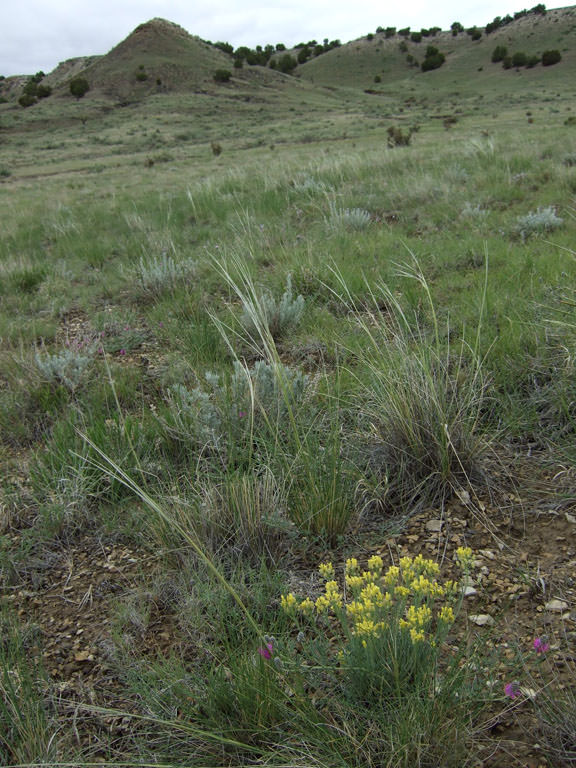
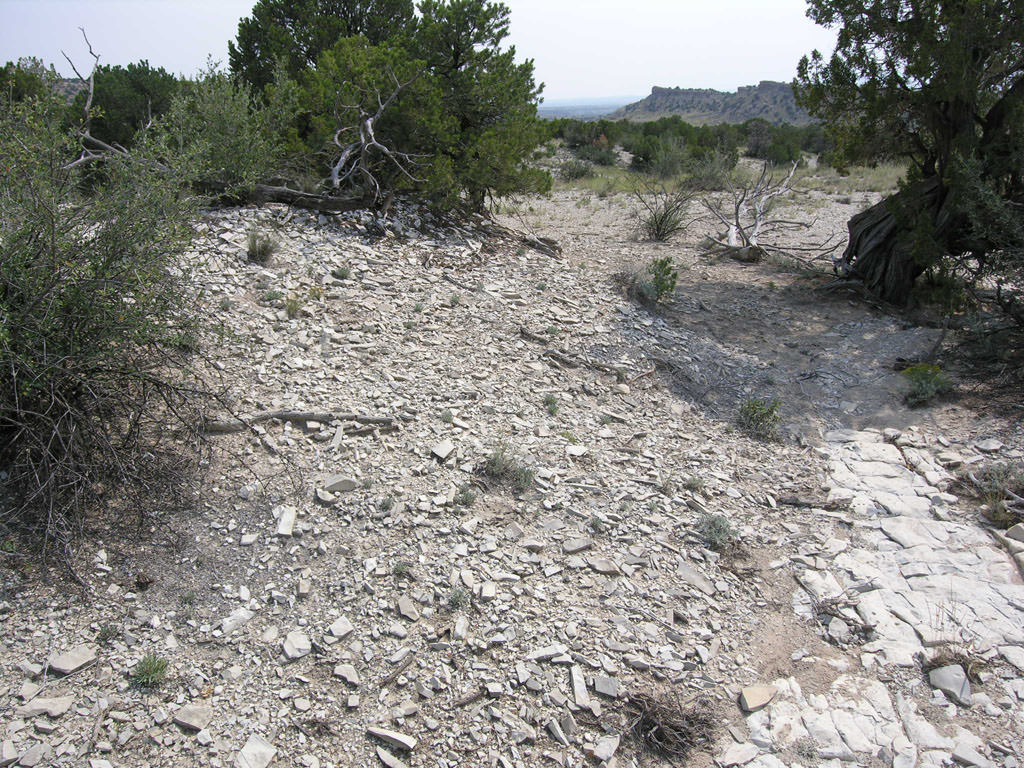
Shale barrens within grassland and pinyon-juniper mosaic. Other commonly associated species include Cercocarpus montanus, Frankenia jamesii, Gutierrezia sarothrae, Oryzopsis hymenoides, Hilaria jamesii, Melampodium leucanthum, Oonopsis foliosa ssp. foliosa, Tetraneuris acaulis, Eriogonum spp., as well as other globally rare shale barren species such as Mirabilis rotundifolia and Oonopsis puebloensis.
click on image to enlarge
 |
 |
Elevation Range:
4,780 - 10,831 feet (1,457 - 3,301 meters)
Distribution
Colorado Endemic:
No
Range:
Physaria calcicola is known from Bent, Custer, El Paso, Fremont, Huerfano, Las Animas, Otero, and Pueblo counties in Colorado, USA. Estimated range extent in Colorado of 22,077 square kilometers was calculated in GeoCAT using occurrence data provided by the Colorado Natural Heritage Program (2024). This species can also be found in New Mexico.
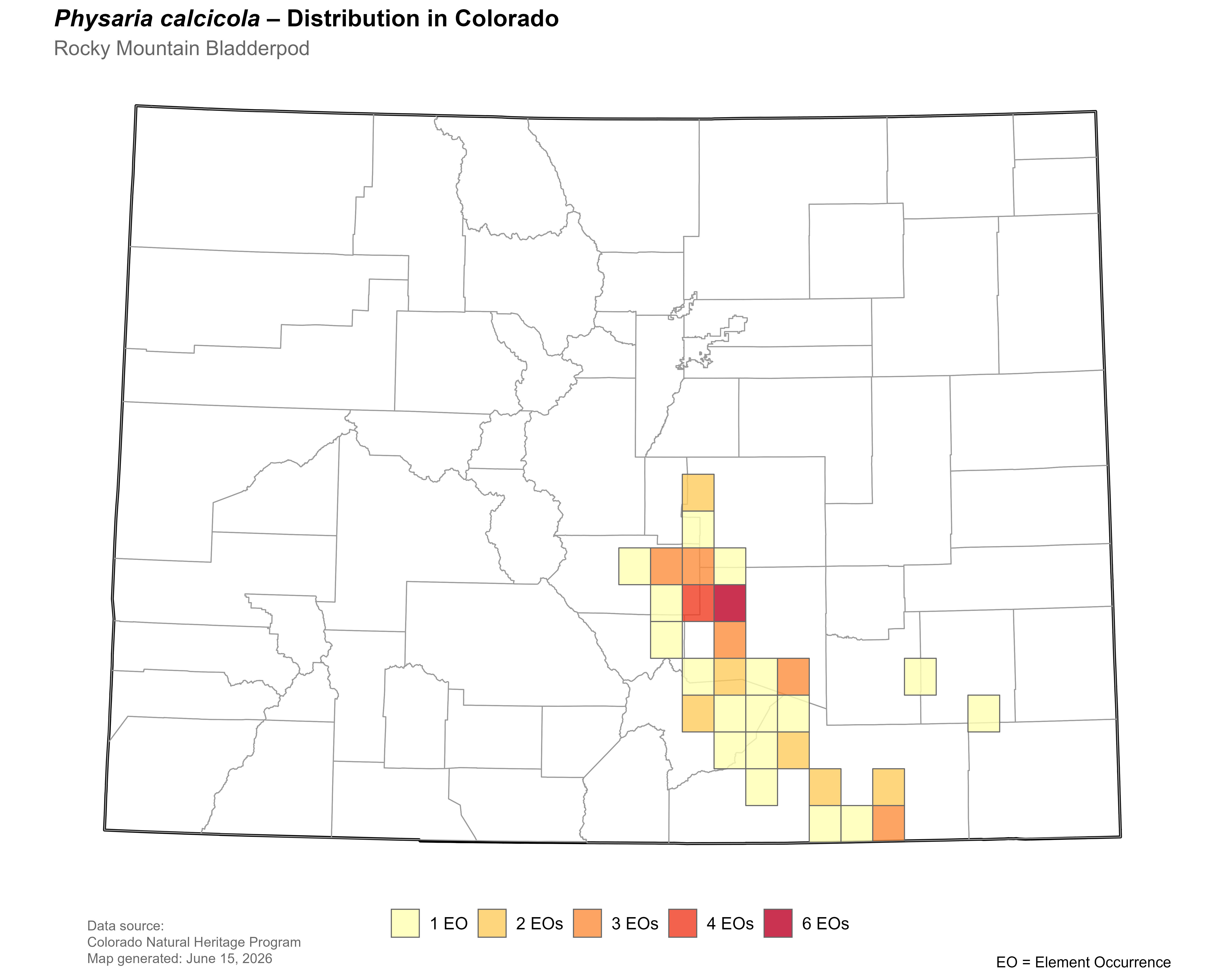
Click on map to enlarge |
Threats and Management Issues
The primary threat at this time is considered to be housing/urban development. Observations from the element occurrence records indicate this species may also be threatened by inappropriate livestock grazing, road and utility line maintenance, recreational uses, erosion, and noxious weed invasions. Residential and commercial development is fragmenting the species habitat and affects at least 15% of the occurrences. Livestock grazing has been documented at several sites but is likely more widespread. Fragmentation of habitat by roads, railroads or pipelines has been noted at 10% of occurrences. Competition from non-native invasive plants including Salsola tragus and Kochia sp. has been documented at 15% of the occurrences. Other low level threats include fragmentation of habitat by mining and quarrying or military training activities and localized erosion. Long-term drought throughout the species' range is also a concern. This species is considered to have moderate adaptive capacity and is expected to be slightly to moderately vulnerable to climate change under both RCP 4.5 and 8.5 scenarios, as assessed for the 2025 Colorado State Wildlife Action Plan (CNHP 2025).
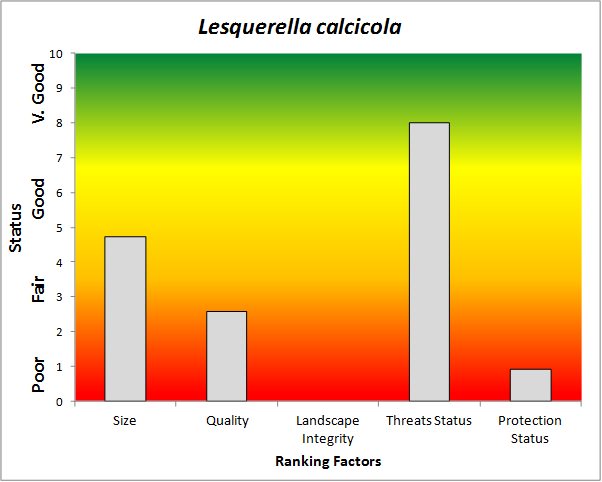
Summary results of an analysis of the status of Physaria calcicola based on several ranking factors. This species was concluded to be Weakly Conserved. From Rondeau et al. 2011. |
References
- Ackerfield, J. 2015. Flora of Colorado. BRIT Press, Botanical Research Institute of Texas, Fort Worth, TX. 818 pp.
- Al-Shehbaz, I. A., and S. L. O'Kane. 2002. Lesquerella is united with Physaria (Brassicaceae). Novon 12:319-329.
- Bleakly, D.L. 1998. New Mexico Rare Plants: Lesquerella calcicola Rollins. New Mexico Rare Plant Technical Council, Albuquerque, New Mexico. Online. Available: http://nmrareplants.unm.edu (Accessed 2005).
- Colorado Natural Heritage Program (CNHP). 2024. Biodiversity Tracking and Conservation System (Biotics 5). Colorado Natural Heritage Program, Colorado State University, Fort Collins.
- Colorado Natural Heritage Program (CNHP). 2025. Climate Change Vulnerability Assessment of Colorado Tier 1 and Tier 2 Plant Species of Greatest Conservation Need (SCGN) for the 2025 Colorado State Wildlife Action Plan. Colorado Natural Heritage Program, Colorado State University, Fort Collins.
- Flora of North America Editorial Committee (FNA). 2010. Flora of North America north of Mexico. Vol. 7. Magnoliophyta: Salicaceae to Brassicaceae. Oxford University Press, New York. xxii + 797 pp.
- Harrington, H.D. 1954. Manual of the plants of Colorado. Sage Press, Chicago. 666 pp.
- Kartesz, J.T. 1994. A synonymized checklist of the vascular flora of the United States, Canada, and Greenland. 2nd edition. 2 vols. Timber Press, Portland, OR.
- Lavender, A.E., M.M. Fink, S.E. Linn, D.M. Theobald. 2011. Colorado Ownership, Management, and Protection v9 Database. Colorado Natural Heritage Program and Geospatial Centroid, Colorado State University, Fort Collins, CO. (30 September).
- Martin, W.C., and C.R. Hutchins. 1980-1981. A flora of New Mexico. 1980, Vol. 1; 1981, Vol. 2. J. Cramer, in der A.R. Gantner Verlag, K.G., Vaduz, Liechtenstein. 2591 pp.
- Neely, B., S. Panjabi, E. Lane, P. Lewis, C. Dawson, A. Kratz, B. Kurzel, T. Hogan, J. Handwerk, S. Krishnan, J. Neale, and N. Ripley. 2009. Colorado Rare Plant Conservation Strategy, Developed by the Colorado Rare Plant conservation Initiative. The Nature Conservancy, Boulder, Colorado, 117 pp.
- Rollins, R.C., and E.A. Shaw. 1973. The genus Lesquerella (Cruciferae) in North America. Harvard Univ. Press. Cambridge, MA. 288 pp.
- Rondeau, R., K. Decker, J. Handwerk, J. Siemers, L. Grunau, and C. Pague. 2011. The state of Colorado's biodiversity 2011. Prepared for The Nature Conservancy. Colorado Natural Heritage Program, Colorado State University, Fort Collins, Colorado.
- Sivinski, R., and K. Lightfoot, eds. 1994. Inventory of the rare and endangered plants of New Mexico. 2nd edition. Miscellaneous Publication No. 3, New Mexico Forestry and Resources Conservation Division, New Mexico Energy, Minerals and Natural Resources Dept., Santa Fe. 46 pp.
- USDA, NRCS. 2022. The PLANTS Database. National Plant Data Team, Greensboro, NC 27401-4901 USA.
- Weber, W. A. and R. C. Wittmann. 2012. Colorado Flora, Eastern Slope, A Field Guide to the Vascular Plants, Fourth Edition. Boulder, Colorado. 555 pp.
- Weber, W. A. and R. C. Wittmann. 2012. Colorado Flora, Western Slope, A Field Guide to the Vascular Plants, Fourth Edition. Boulder, Colorado. 532 pp.