

Scientific Name : Townsendia glabella
Author : Gray NatureServe Explorer
Common Name : Smooth Easter Daisy
 Current Research Activities
☰ Click link below for details.
Taxonomy
Asteraceae (sunflower family)
Distinctions between Townsendia glabella and T. rothrockii are subtle. Types of the two names are probably better considered to be conspecific (Flora of North America 1993+).
Ranks and Status
State Rank : S3
State Rank Reason : Townsendia glabella is endemic to Colorado (USA), where it is known from Archuleta, La Plata and Montezuma counties. There are 35 known occurrences, however only 6 are of good to excellent viability, the remainder are poorly documented or known only from historical observations. Potential threats include residential development, recreation, inappropriate livestock grazing, competition with invasive plant species and disturbance from road maintenance, oil and gas development, and pipeline construction. This species is also considered to be moderately vulnerable to the effects of climate change, particularly long-term drought.
U.S. Endangered Species Act : none
Colorado Threatened and Endangered List : none
Other Statuses : SWAP Tier 2
Description and Phenology
General Description:
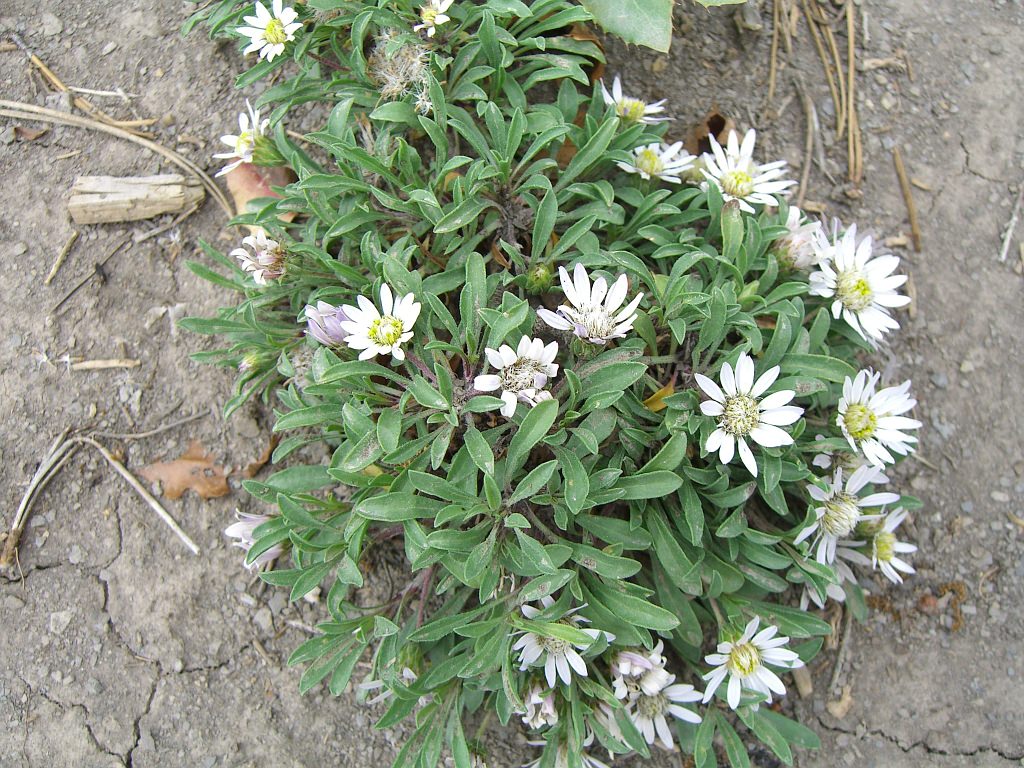
Townsendia glabella is a perennial, cushion-forming plant (1-5 cm) with white to pink ray flowers and yellow disk flowers. Stems are more or less erect; and are strigose. The plants have basal and cauline leaves. Leaf blades are spatulate to oblanceolate, usually glabrous, and sometimes sparsely strigillose. Phyllaries are 20-28+ in 3-4+ series, the longer more or less lanceolate, 5-9 mm, apices acute, abaxial faces glabrous or sparsely strigillose. Ray florets are 12-34+; corollas usually white, sometimes pink or blue adaxially (Flora of North America 2006).
Look Alikes:
Townsendia rothrockii has succulent leaves, and phyllaries that are obovate, ovate, or broadly lanceolate. Townsendia glabella does not have succulent leaves and the phyllaries are lanceolate and acute (Weber and Wittmann 2012).
Phenology:
Flowers May through August (FNA 1993+).
Habitat
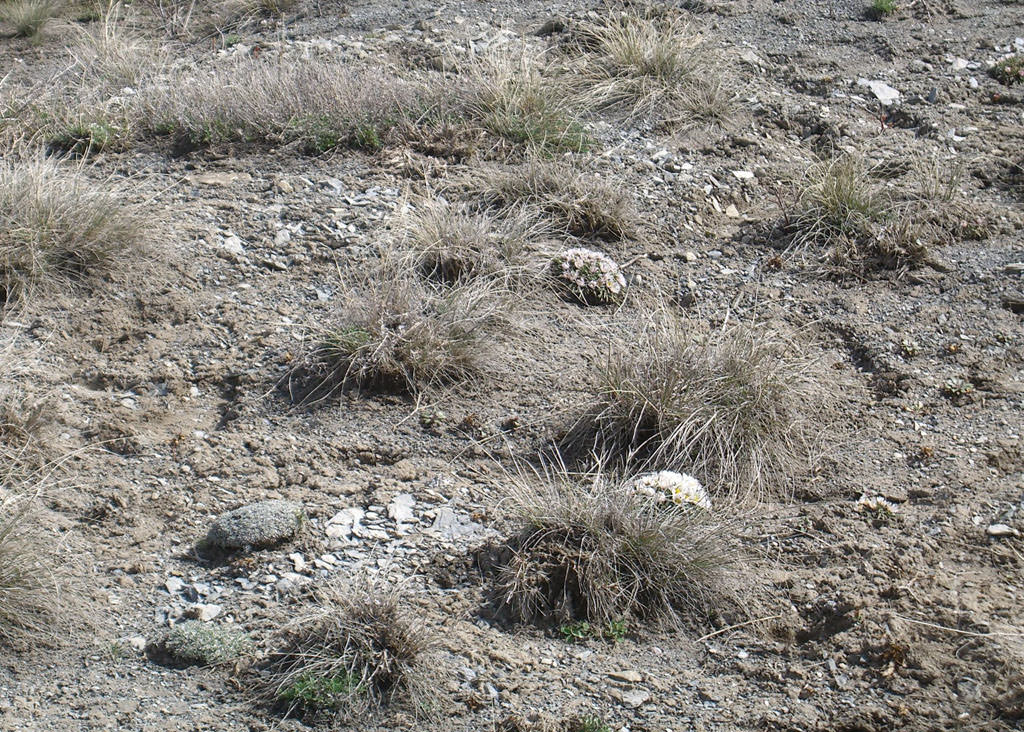
This species grows on steeply sloping shale slopes, at lower altitudes (Weber and Wittmann 2001). Found only on the Smokey Hill Member of Mancos Shale, Oyster Beds (Schnider 2012). Associated species include Pinus ponderosa, Quercus gambelii, Pinus edulis, Juniperus osteosperma, Cercocarpus montanus, Amelanchier utahensis, Rhus trilobata, Chrysothamnus nauseosus, Rosa woodsii, Purshia tridentata, Heterotheca villosa, Astragalus lonchocarpus, A. pattersonii, A. wingatanus, Eriogonum alatum, E. leptophyllum, E. lonchophyllum, Physaria acutifolia, Cymopterus fendleri, Mahonia repens, Oenothera albicaulis, Tetraneruis torreyana, Penstemon cespitosus, Oryzopsis hymenoides, Lathyrus eucosmus, Hymenopappus filifolius, Frasera speciosa, Erigeron flagellaris, Allium acuminatum, Antennaria parviflora, Artemisia ludoviciana (Colorado Natural Heritage Program 2012).
click on image to enlarge
 |
Elevation Range:
6,248 - 9,674 feet (1,904 - 2,949 meters)
Distribution
Colorado Endemic:
Yes
Range:
Townsendia glabella is a Colorado (USA) endemic; it is known from Archuleta, La Plata, Montezuma, and Rio Grande counties. Estimated range extent in Colorado of 5400 square kilometers was calculated in GeoCAT using occurrence data provided by the Colorado Natural Heritage Program (2024).
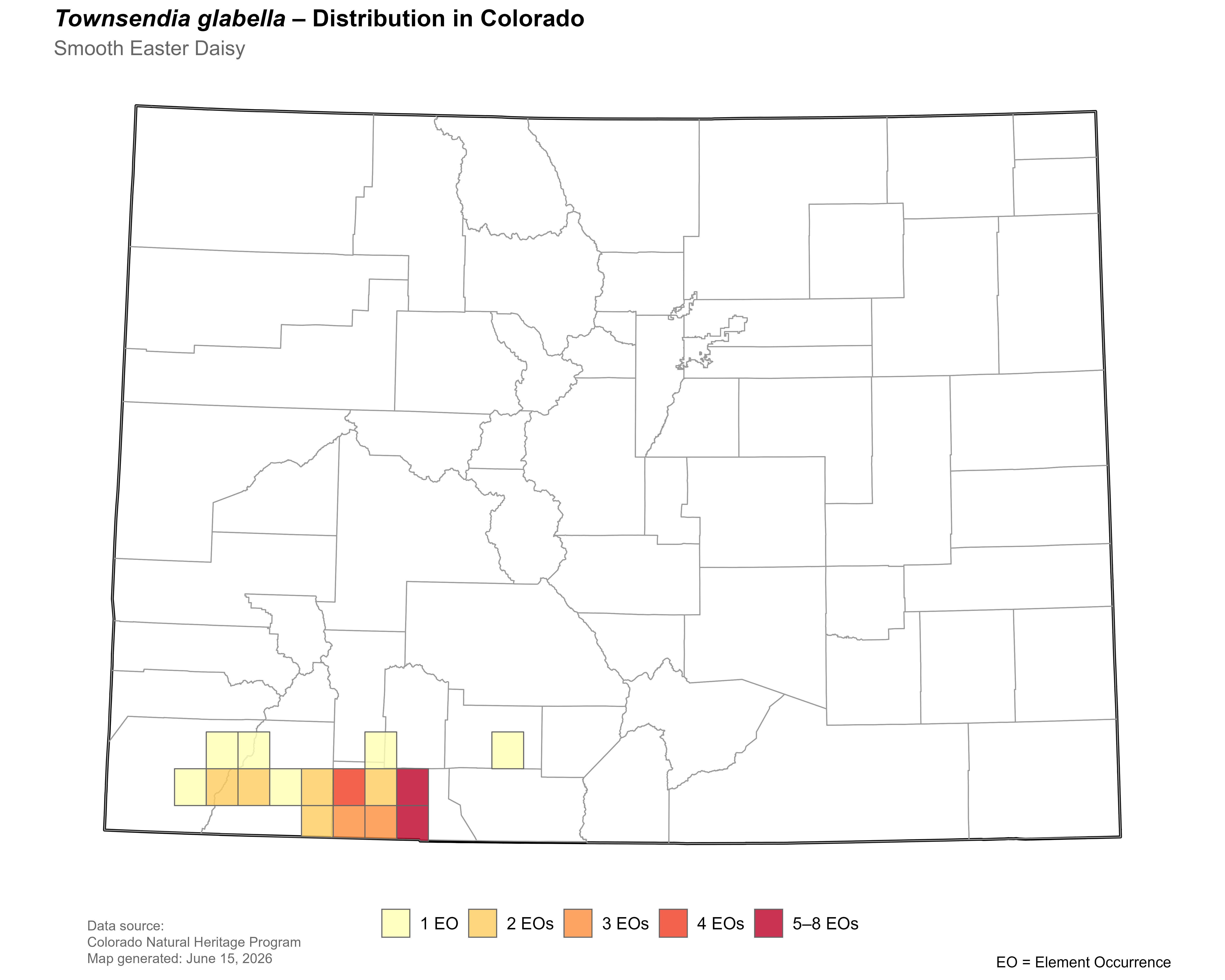
Click on map to enlarge |
Threats and Management Issues
Residential development was once thought to be the primary threat to the species (Rondeau et al. 2011), however, additional threats have been reported since 2011 and include recreation, inappropriate livestock grazing, competition with invasive plant species and disturbance from road maintenance, oil and gas development and pipeline construction. Overall, these impacts have only been noted less at than 30% of the occurrences with 10% reporting no threats or management concerns, and the remaining 70% of occurrences having no information on threats. Nonetheless, three occurrences have direct impacts from energy and utility development; inappropriate livestock use, and competition from invasive plant species such as Bromus tectorum, Melilotus officinale, Carduus nutans has been documented at 14% of the occurrences. Range wide the effects of long-term drought remain a concern. Townsendia glabella is species is considered to have moderate adaptive capacity and is expected to be moderately vulnerable to climate change under both RCP 4.5 and 8.5 scenarios, as assessed for the 2025 Colorado State Wildlife Action Plan (CNHP 2025).
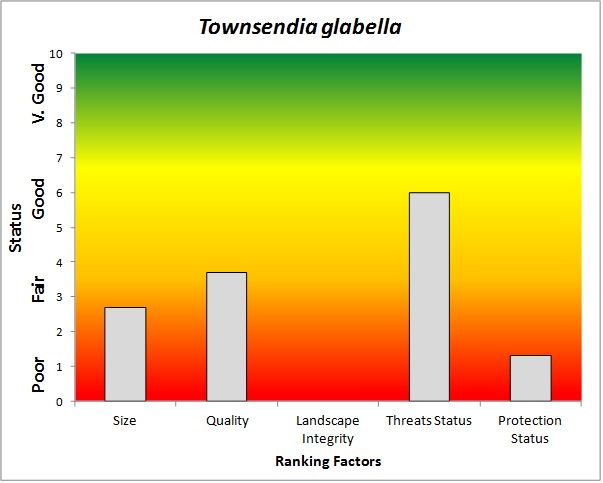
Summary results of an analysis of the status of Townsendia glabella based on several ranking factors. This species was concluded to be Weakly Conserved. From Rondeau et al. 2011. |
References
- Ackerfield, J. 2015. Flora of Colorado. BRIT Press, Botanical Research Institute of Texas, Fort Worth, TX. 818 pp.
- Colorado Natural Heritage Program (CNHP). 2024. Biodiversity Tracking and Conservation System (Biotics 5). Colorado Natural Heritage Program, Colorado State University, Fort Collins.
- Colorado Natural Heritage Program (CNHP). 2025. Climate Change Vulnerability Assessment of Colorado Tier 1 and Tier 2 Plant Species of Greatest Conservation Need (SCGN) for the 2025 Colorado State Wildlife Action Plan. Colorado Natural Heritage Program, Colorado State University, Fort Collins.
- Colorado Natural Heritage Program. 2012. Biodiversity Tracking and Conservation System. Colorado State University, Fort Collins, CO.
- Flora of North America Editorial Committee, ed. (FNA). 1993+. Flora of North America North of Mexico. Oxford Univ. Press, New York, Oxford.
- Handwerk, J., L. Grunau, and S. Panjabi. 2015. Colorado Wildlife Action Plan: 2015 Rare Plant Addendum. Colorado Natural Heritage Program, Colorado State University, Fort Collins, Colorado, USA.
- Harrington, H.D. 1954. Manual of the plants of Colorado. Sage Press, Chicago. 666 pp.
- Heil, K.D., S.L. O'Kane Jr., L.M. Reeves, and A. Clifford, 2013. Flora of the Four Corners Region, Vascular Plants of the San Juan River Drainage; Arizona, Colorado, New Mexico, and Utah. Missouri Botanical Garden Press, St. Louis, Missouri. 1098 pp.
- Lavender, A.E., M.M. Fink, S.E. Linn, D.M. Theobald. 2011. Colorado Ownership, Management, and Protection v9 Database. Colorado Natural Heritage Program and Geospatial Centroid, Colorado State University, Fort Collins, CO. (30 September).
- Neely, B., S. Panjabi, E. Lane, P. Lewis, C. Dawson, A. Kratz, B. Kurzel, T. Hogan, J. Handwerk, S. Krishnan, J. Neale, and N. Ripley. 2009. Colorado Rare Plant Conservation Strategy, Developed by the Colorado Rare Plant conservation Initiative. The Nature Conservancy, Boulder, Colorado, 117 pp.
- Rondeau, R., K. Decker, J. Handwerk, J. Siemers, L. Grunau, and C. Pague. 2011. The state of Colorado's biodiversity 2011. Prepared for The Nature Conservancy. Colorado Natural Heritage Program, Colorado State University, Fort Collins, Colorado.
- Schneider, A. 2013. Wildflowers, Ferns, and Trees of the Four Corners Regions of Colorado, New Mexico, Arizona, and Utah. Accessed on-line at http://www.swcoloradowildflowers.com.
- USDA, NRCS. 2013. The PLANTS Database. National Plant Data Team, Greensboro, NC 27401-4901 USA.
- USDA, NRCS. 2022. The PLANTS Database. National Plant Data Team, Greensboro, NC 27401-4901 USA.
- Weber, W. A. and R. C. Wittmann. 2012. Colorado Flora, Western Slope, A Field Guide to the Vascular Plants, Fourth Edition. Boulder, Colorado. 532 pp.