

Scientific Name : Botrychium lineare
Author : W.H. Wagner NatureServe Explorer
Common Name : Narrowleaf Grapefern
 Current Research Activities
 1997 profile
☰ Click link below for details.
Taxonomy
Ophioglossaceae (adder's-tongue family)
The second edition of Ackerfield (2022) refers to this taxon as Botrychium lineare and Ackerfield (2015) refers to this taxon as Botrychium campestre var. lineare . Recent genetic work places Colorado occurrences of this species in B. campestre var. lineare ined. (Farrar and Gilman 2017; Farrar 2011; Weber & Wittmann 2012). Botrychium campestre CNHP element occurrences have been transferred to this element. The close relationship of Botrychium lineare to B. campestre has been suggested since its original description (Wagner & Wagner, 1994). Genetic studies indicate that 'lineare' is best treated as an infraspecific taxon of B. campestre and the published name by Farrar and Gilman (2017) is Botrychium campestre var. lineare.
Ranks and Status
State Rank : S2S3
State Rank Reason : Survey efforts from the late 1990's to 2014 have resulted in documentation of over 50 sites and 17 metapopulations of Botrychium lineare. Undoubtedly more sites are present, but the taxon remains relatively uncommon compared to the five most common moonworts. Road maintenance may be a threat to the species. Botrychium lineare is considered to be extremely vulnerable to climate change.
U.S. Endangered Species Act : none
Colorado Threatened and Endangered List : none
Other Statuses : SWAP SGIN, USFS
Description and Phenology
General Description:
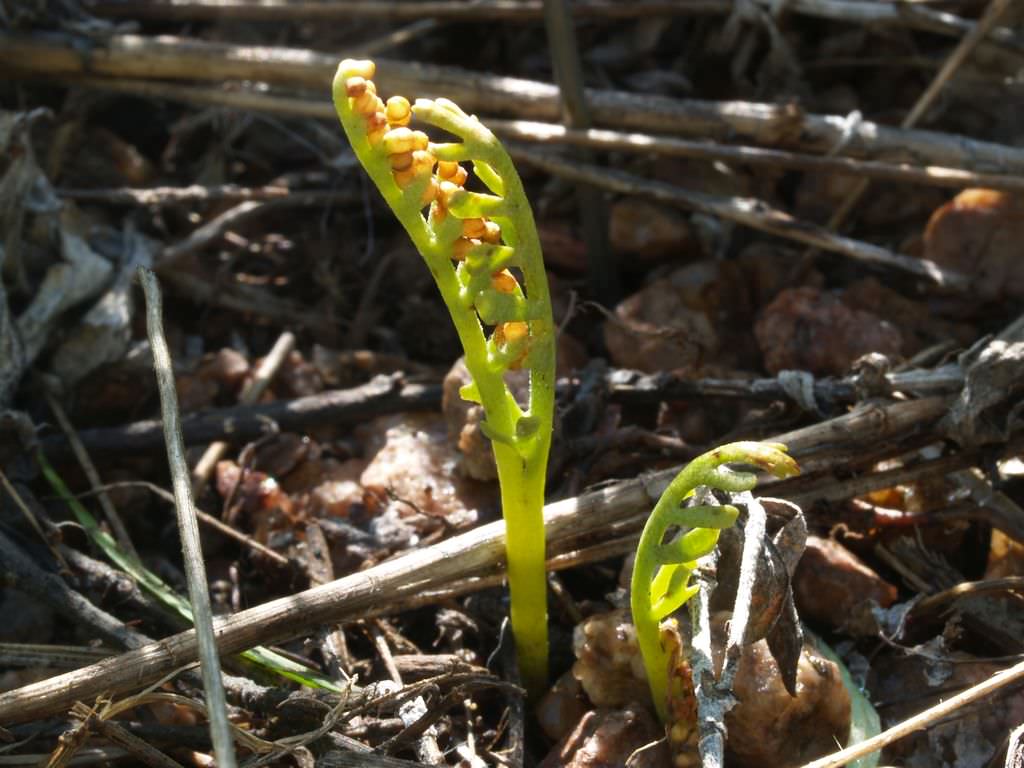
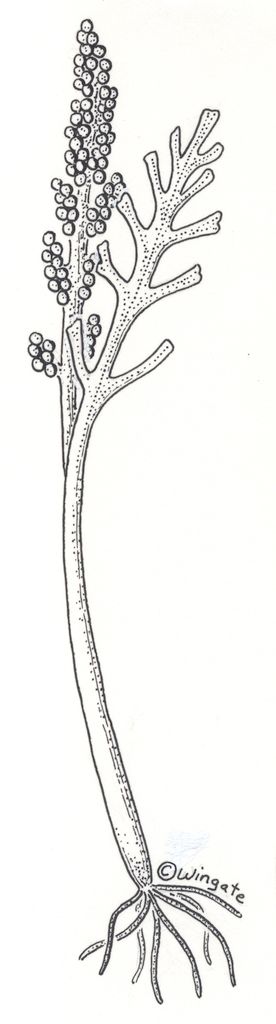
A small Botrychium, the leaf 6-18 cm. long above the upright subterranean stem .5-3.0 cm long. Trophophore sessile to stalked up to 1 cm. Blade oblong, 1 pinnate. Pinna pairs 4-5, strongly separated by 2-5 times the width of segments to moderately ascending, approximately equal in length, except for shorter apical 1-4 pairs of segments. Pinnae mostly straight, slightly upcurved, narrowly linear (narrowest in small plants), often expanded at the truncate apex or rarely linear-spatulate, commonly bifid with linear lobes. Color: pale green; texture thick chartaceous, rigid. Sporophores 1-2 times the length of trophophore with a single major axis (Wagner and Wagner 1994).
Look Alikes:
The pinnae of Botrychium campestre var. lineare have the narrowest pinna span of all moonworts, hence the common name, slender moonwort. They broaden scarcely at all toward their outer margin except as they divide, usually into two lobes diverging at an angle of about 45 degrees or more. The basal pinnae are typically the largest and longest. Only two other taxa approach this morphology. Botrychium campestre var. campestre has shorter, broader pinnae that are less deeply lobed and a rachis that is broader relative to the total leaf width. In var. campestre, the largest and longest pinnae are typically above the basal pair. Narrow-pinnae forms of B. ascendens may be similarly lobed, but the lobes broaden toward an outer margin that is dentate. At maturity the sporophore stalk of B. ascendens is usually approximately half the length of the trophophore whereas it is distinctly less than half (usually 1/3 or less) the length of the trophophore in both varieties of B. campestre. Variety lineare and B. ascendens tend to be less glaucous than B. campestre var. campestre.
Phenology:
Reproductive in June.
 |
Habitat
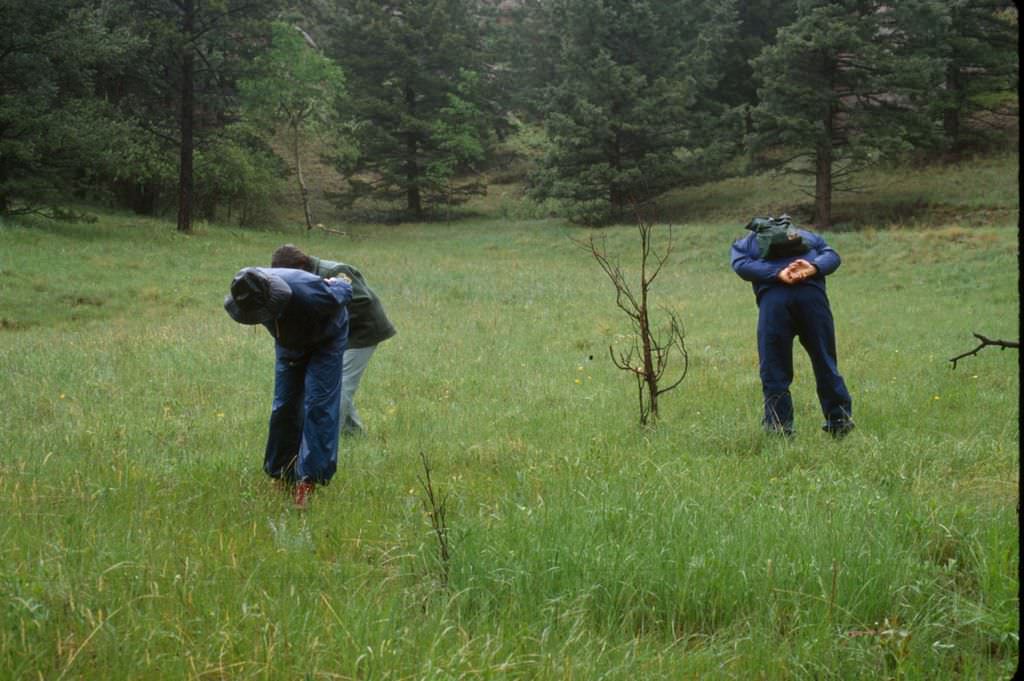
In Colorado this species occurs on grassy slopes, among medium height grasses, along edges of streamside forests, however, it occurs in widely ranging habitats across its range. Associates include: Populus tremuloides, Picea engelmannii, Pinus flexilis, Pinus ponderosa, Pseudocymopterus montanus, Antenaria rosea, Elymus trachycaulus, Mianthemum stellatum, Schizachyrium scoparium, Bouteloua curtipendula, Ribes montigenum, Festuca thurberi, Festuca idahoensis, Erigeron formosissimus, Fragaria virginiana, Potentilla gracilis and Astragalus alpinus.
click on image to enlarge
 |
Elevation Range:
3,750 - 11,910 feet (1,143 - 3,630 meters)
Distribution
Colorado Endemic:
No
Range:
Botrychium lineare is known from scattered locations in El Paso, Lake, Larimer, Mineral, and Yuma counties in Colorado, USA. Estimated range extent in Colorado of 77,144 square kilometers was calculated in GeoCAT using occurrence data provided by the Colorado Natural Heritage Program (2023). This species is also known from Alaska, California, Idaho, Minnesota, Montana, New Mexico, Oregon, South Dakota, Utah, Washington, and Wyoming, USA. In Canada, this species is known from Alberta, British Columbia, New Brunswick, Quebec, and Yukon.
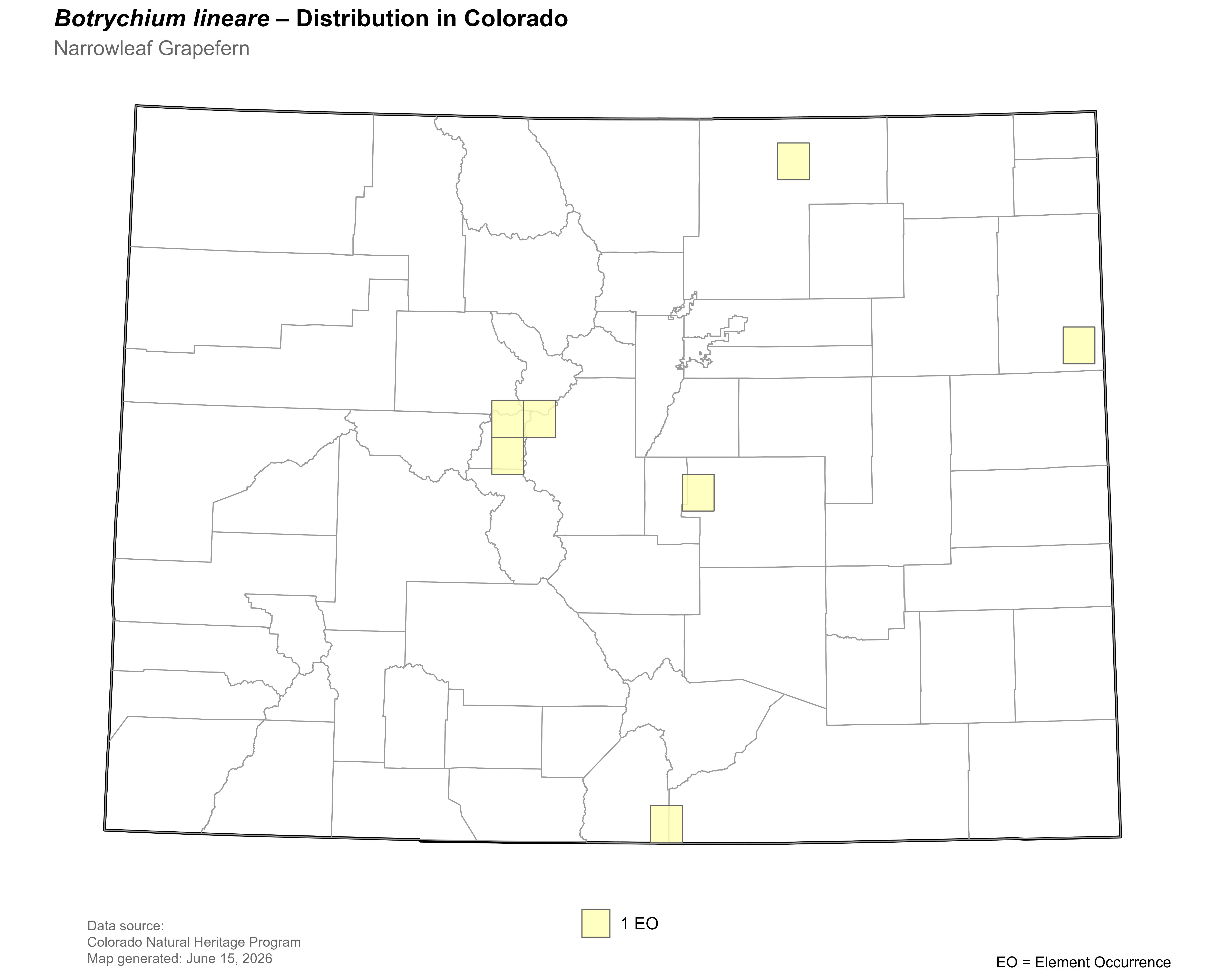
Click on map to enlarge |
Threats and Management Issues
The primary threat at this time is considered to be roads (Rondeau et al. 2011). It is not known if all of the occurrences are or are not threatened by these activities. Botrychium ascendens, B. crenulatum, and B. lineare are considered to be very rare, with few documented occurrences, small population abundances, and widely-disjunct occurrences within large ranges. Botrychium species throughout western North America may be threatened by a variety of factors: road construction and maintenance, herbicide application, recreational activities, grazing and trampling by wildlife and/or livestock, structure construction, timber harvest, competition from non-native species, and changes to natural disturbance regimes. Disturbances and land management activities may create and maintain suitable habitat for this species or may negatively impact existing populations, depending on the disturbance intensity and frequency. The specific threats to B. ascendens, B. crenulatum, and B. lineare within Region 2 are largely unknown or unassessed. Although no immediate concerns have been identified, existing populations of B. ascendens and B. lineare have few individuals and cover a small area. Thus, a random, catastrophic disturbance could destroy these populations completely. The only population of B. crenulatum in Region 2 has not been confirmed or relocated in recent years, and the status of this occurrence is unknown. The primary threats to existing populations of B. ascendens, B. crenulatum, and B. lineare in Region 2, given the current understanding, are: road, trail, or structure construction and maintenance; trampling by wildlife, livestock, or off-trail recreational activities; competition from non-native plant species; natural habitat succession or fire suppression; and changes in hydrology affecting soil moisture or mycorrhizal existence. Specific populations could be at a greater risk than other populations, depending on the landscape context, characteristics of the natural and human disturbance regimes, and biological characteristics of each species. For example, B. crenulatum tends to be found in wetter habitats, and some populations of this species could potentially be less threatened by damage from recreational activities than B. ascendens or B. lineare (Beatty et al. 2003). This species is considered to be extremely vulnerable to climate change (Handwerk et al. 2015).
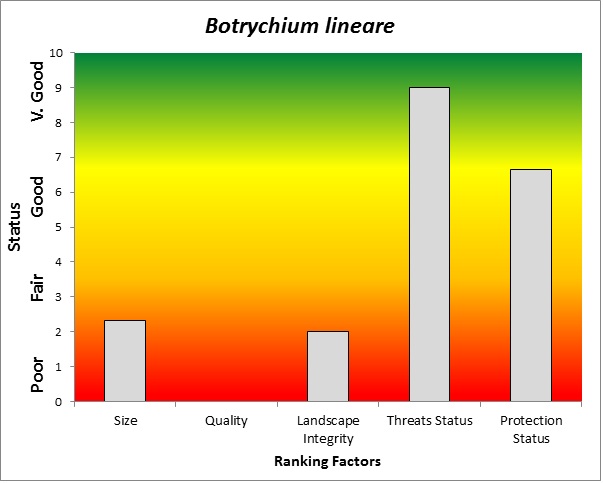
Summary results of an analysis of the status of Botrychium campestre var. lineare based on several ranking factors. This species was concluded to be Moderately Conserved. From Rondeau et al. 2011. |
References
- Ackerfield, J. 2015. Flora of Colorado. BRIT Press, Botanical Research Institute of Texas, Fort Worth, TX. 818 pp.
- Ackerfield, J. 2022. Flora of Colorado. Second Edition. Bot. Misc. 60. BRIT Press, Fort Worth Botanic Garden/Botanical Research Institute of Texas, U.S.A. 861 pp.
- Beatty, B.L., W.F. Jennings, and R.C. Rawlinson (2003, November 12). Botrychium ascendens W.H. Wagner (trianglelobe moonwort), B. crenulatum W.H. Wagner (scalloped moonwort), and B. lineare W.H. Wagner (narrowleaf grapefern): a technical conservation assessment. [Online]. USDA Forest Service, Rocky Mountain Region. Available: http://www.fs.fed.us/r2/projects/scp/assessments/botrychiums.pdf [March 2006].
- Colorado Natural Heritage Program (CNHP). 2023. Biodiversity Tracking and Conservation System (Biotics 5). Colorado Natural Heritage Program, Colorado State University, Fort Collins.
- Farrar, D. 2009. Determination of the Taxonomic Relationship between Botrychium lineare and Botrychium campestre; a study conducted under Order No. 10181-5-M847 of the United States Fish and Wildlife Service. Supervisory Program Manager, 1387 S. Vinnell Way, Room 368, Boise, Idaho 83709; 35 pp.
- Farrar, D.R. and A.V. Gilman. 2017. Relationships in the Botrychium campestre (Ophioglossaceae) complex. Brittonia 69: 265–275.
- Farrar, Donald R. 2011. Botrychium lineare fact sheet. Ada Hayden Herbarium (ISC). Iowa State University, Ames, Iowa. Online. Available: http://www.public.iastate.edu/~herbarium/botrychium.html. Accessed July, 2014.
- Farrar, Donald R. 2011. Botrychium campestre var. lineare comb. nov. ined. fact sheet. Ada Hayden Herbarium (ISC). Iowa State University, Ames, Iowa. Online. Available: http://www.public.iastate.edu/~herbarium/botrychium.html. Accessed July, 2014.
- Handwerk, J., L. Grunau, and S. Panjabi. 2015. Colorado Wildlife Action Plan: 2015 Rare Plant Addendum. Colorado Natural Heritage Program, Colorado State University, Fort Collins, Colorado, USA.
- Mantas, M. and R. S. Wirt. 1995. Moonworts of western Montana (BOTRYCHIUM subgenus BOTRYCHIUM). Flathead National Forest. 103 pp.
- Neely, B., S. Panjabi, E. Lane, P. Lewis, C. Dawson, A. Kratz, B. Kurzel, T. Hogan, J. Handwerk, S. Krishnan, J. Neale, and N. Ripley. 2009. Colorado Rare Plant Conservation Strategy, Developed by the Colorado Rare Plant conservation Initiative. The Nature Conservancy, Boulder, Colorado, 117 pp.
- Rocky Mountain Society of Botanical Artists. 2009. RARE Imperiled Plants of Colorado, a traveling art exhibition. Exhibition catalogue developed by the Denver Botanic Gardens and Steamboat Art Museum.
- Rondeau, R., K. Decker, J. Handwerk, J. Siemers, L. Grunau, and C. Pague. 2011. The state of Colorado's biodiversity 2011. Prepared for The Nature Conservancy. Colorado Natural Heritage Program, Colorado State University, Fort Collins, Colorado.
- Spackman, S., B. Jennings, J. Coles, C. Dawson, M. Minton, A. Kratz, and C. Spurrier. 1997. Colorado rare plant field guide. Prepared for Bureau of Land Management, U.S. Forest Service and U.S. Fish and Wildlife Service by Colorado Natural Heritage Program.
- U.S. Fish and Wildlife Service. 1996. Endangered and threatened wildlife and plants: review of plant and animal taxa that are candidates for listing as endangered or threatened species. Federal Register 61(40): 7596-7613.
- USDA, NRCS. 2022. The PLANTS Database. National Plant Data Team, Greensboro, NC 27401-4901 USA.
- Wagner, W.H. and F.S. Wagner. 1994. Another Widely Disjunct, Rare and Local North American Moonwort (Ophioglossaceae: Botrychium subg. Botrychium). American Fern Journal 84(1): 5-10.
- Weber, W. A. and R. C. Wittmann. 2012. Colorado Flora, Eastern Slope, A Field Guide to the Vascular Plants, Fourth Edition. Boulder, Colorado. 555 pp.
- Weber, W. A. and R. C. Wittmann. 2012. Colorado Flora, Western Slope, A Field Guide to the Vascular Plants, Fourth Edition. Boulder, Colorado. 532 pp.