

Scientific Name : Oxytropis besseyi var. obnapiformis
Author : (C.L. Porter) Welsh NatureServe Explorer
Common Name : Bessey Locoweed
 Current Research Activities
☰ Click link below for details.
Taxonomy
Fabaceae (pea family)
Ranks and Status
State Rank : S2S3
State Rank Reason : Oxytropis besseyi var. obnapiformis is known from 22 known occurrences in northwest Colorado (USA), however approximately one third of them are of poor viability or based on historical observations. Threats to the species include livestock grazing and competition from invasive nonnative species (primarily cheatgrass). Additionally, long term drought is occurring throughout the range of this species in Colorado, and it is considered to be highly vulnerable to the effects of climate change.
U.S. Endangered Species Act : none
Colorado Threatened and Endangered List : none
Other Statuses : BLM, SWAP SGIN
Description and Phenology
General Description:
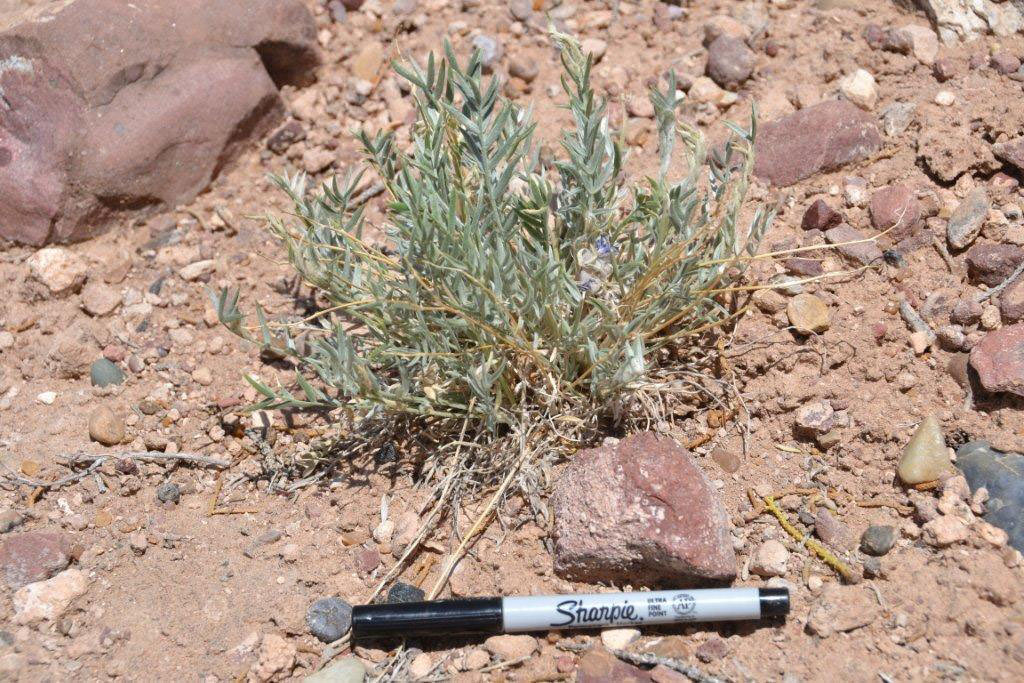
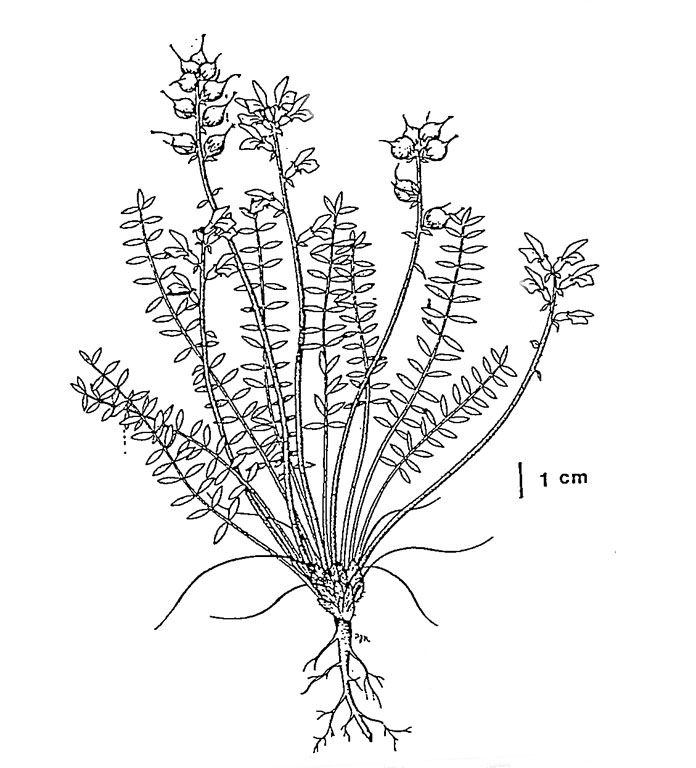
Oxytropis besseyi var. obnapiformis is a densely hairy perennial herb with a stout taproot and stems up to 20 cm tall. Leaves are all basal, 10-20 cm long, usually equaling or surpassing the flowering stems, and have 9-15 leaflets. Hairs are basally attached to the leaves. Flower stems are 2-19 cm tall, each with 3-20 (rarely up to 29) pink to purple pea flowers. The calyx is less than 5 mm wide. Pods are papery, sessile or nearly so, hairy, and strongly inflated (Barneby 1989). Pods are ovoid or subglobose (Ackerfield 2012).
Look Alikes:
Oxytropis lambertii calyx is not inflated, and the pods are elongated (lance- to linear-ellipsoid) and protrude from the calyx (Ackerfield 2012, Weber and Wittmann 2012). Oxytropis lambertii also has hairs attached at points near the middle rather than at the bases as in O. besseyi var. obnapiformis (Wyoming Natural Diversity Database 2012).
Phenology:
This species flowers May through July (Cronquist 1989, Colorado Natural Heritage Program 2012).
 |
Habitat
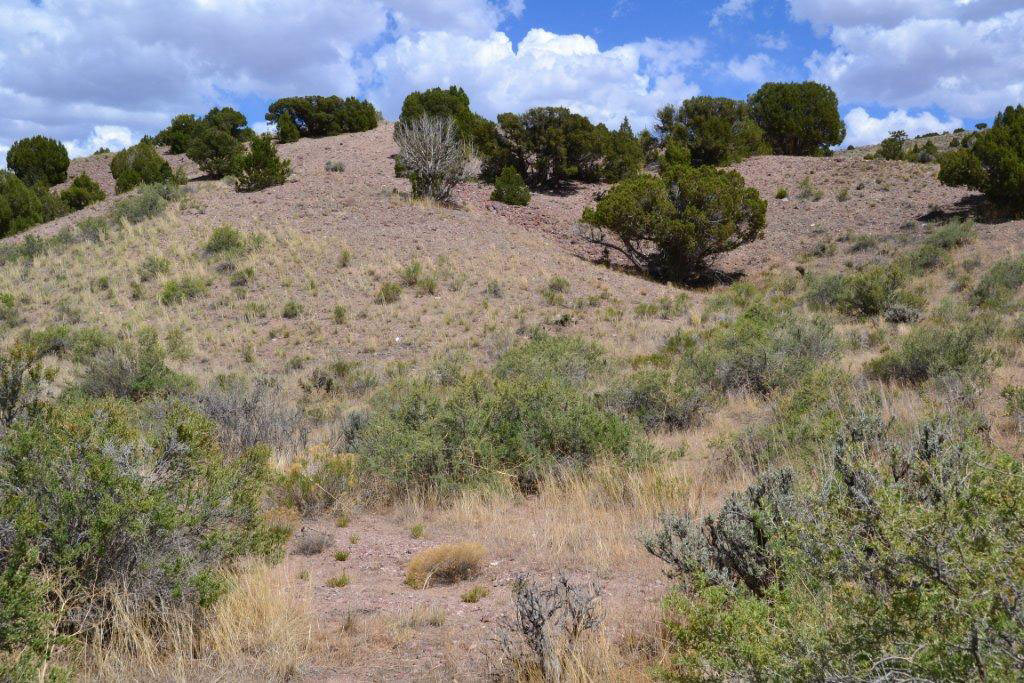
This species is associated with pinyon-juniper and sagebrush communities, often on barrens in either fine-textured or sandy substrates (Welsh 1993). Found on hilltops, bluffs, and breaks along rivers of foothill gulches, sandy or shaley talus, less often on tuffaceous knolls or sand dunes (Cronquist 1989).
click on image to enlarge
 |
Elevation Range:
5,398 - 6,888 feet (1,645 - 2,099 meters)
Distribution
Colorado Endemic:
No
Range:
Oxytropis besseyi var. obnapiformis is known from Moffat and Rio Blanco counties in Colorado. Estimated range extent in Colorado of 3521 square kilometers was calculated in GeoCAT using occurrence data provided by the Colorado Natural Heritage Program (2022). This taxon is also known from Utah and Wyoming, USA.
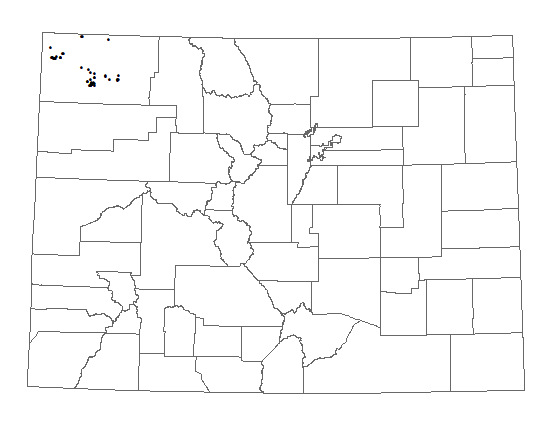 Click on map to enlarge |
Threats and Management Issues
As of 2022, 59% of the occurrences are found in habitat with minimal to low levels of landscape disturbance, the remainder are in areas with moderate to high levels of landscape disturbance (CNHP 2021). At the local level the majority of the occurrences are threatened by livestock grazing and invasive nonnative species (primarily cheatgrass); OHV activities also occur in several occurrences. Additionally, long term drought is occurring throughout the range of this species. This species is considered to be highly vulnerable to climate change (Handwerk et al. 2015).
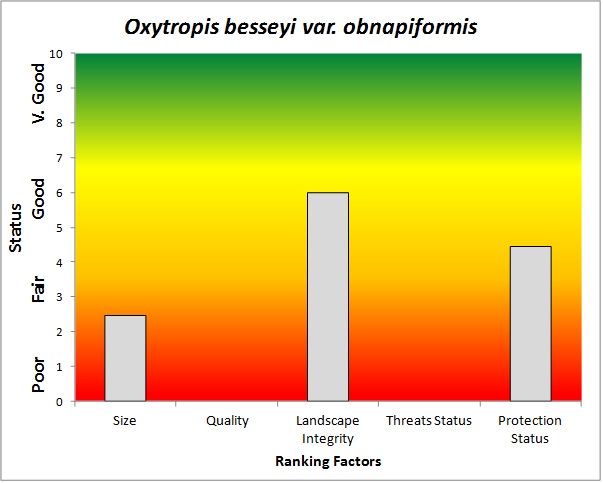 Summary results of an analysis of the status of Oxytropis besseyi var. obnapiformis based on several ranking factors. This species was concluded to be Weakly Conserved. From Rondeau et al. 2011. |
References
- Ackerfield, J. 2015. Flora of Colorado. BRIT Press, Botanical Research Institute of Texas, Fort Worth, TX. 818 pp.
- Barneby, R.C. 1989. Fabales. In A. Cronquist, A.H. Holmgren, N.H. Holmgren, J.L. Reveal, and P.K. Holmgren (eds.). Intermountain flora: Vascular plants of the Intermountain West, U.S.A. Vol. 3, Part B. New York Botanical Garden, Bronx. 279 pp.
- Colorado Natural Heritage Program (CNHP). 2022. Biodiversity Tracking and Conservation System (Biotics 5). Colorado Natural Heritage Program, Colorado State University, Fort Collins.
- Colorado Natural Heritage Program. 2012. Biodiversity Tracking and Conservation System. Colorado State University, Fort Collins, CO.
- Colorado Natural Heritage Program. 2021. Landscape Disturbance Index Layer for Colorado. Edition 04_2021. Raster Digital Data Set. Colorado Natural Heritage Program, Fort Collins, CO. April 21, 2021.
- Cronquist A. 1989. Intermountain Flora Vascular Plants of the Intermountain West, USA. Vol. 3, Part B. New York Botanical Garden, Bronx, NY.
- Handwerk, J., L. Grunau, and S. Panjabi. 2015. Colorado Wildlife Action Plan: 2015 Rare Plant Addendum. Colorado Natural Heritage Program, Colorado State University, Fort Collins, Colorado, USA.
- Harrington, H. D. 1954. Manual of the Plants of Colorado. Sage Books, Denver, CO. 666 pp.
- Isley, D. 1983. New combinations and two new varieties in Astragalus, Orophaca, and Oxytropis (Leguminosae). Systematic Botany, Vol. 8, No. 4, pages 420-426.
- Lavender, A.E., M.M. Fink, S.E. Linn, D.M. Theobald. 2011. Colorado Ownership, Management, and Protection v9 Database. Colorado Natural Heritage Program and Geospatial Centroid, Colorado State University, Fort Collins, CO. (30 September).
- Neely, B., S. Panjabi, E. Lane, P. Lewis, C. Dawson, A. Kratz, B. Kurzel, T. Hogan, J. Handwerk, S. Krishnan, J. Neale, and N. Ripley. 2009. Colorado Rare Plant Conservation Strategy, Developed by the Colorado Rare Plant conservation Initiative. The Nature Conservancy, Boulder, Colorado, 117 pp.
- Porter, C.L. 1947. A new species of Oxytropis from the Central Rocky Mountains. Madrono, vol. 9: pp. 133-135.
- Rondeau, R., K. Decker, J. Handwerk, J. Siemers, L. Grunau, and C. Pague. 2011. The state of Colorado's biodiversity 2011. Prepared for The Nature Conservancy. Colorado Natural Heritage Program, Colorado State University, Fort Collins, Colorado.
- USDA, NRCS. 2022. The PLANTS Database. National Plant Data Team, Greensboro, NC 27401-4901 USA.
- Utah Native Plant Society. 2003-2014. Utah rare plant guide. A.J. Frates editor/coordinator. Salt Lake City, UT. Utah Native Plant Society. Online. Available: http://www.utahrareplants.org (accessed 2014).
- Weber, W. A. and R. C. Wittmann. 2012. Colorado Flora, Western Slope, A Field Guide to the Vascular Plants, Fourth Edition. Boulder, Colorado. 532 pp.
- Welsh, S.L., N.D. Atwood, S. Goodrich, and L.C. Higgins. (Eds). 2015. A Utah flora, fifth edition, revised 2015. Monte L. Bean Life Science Museum, Provo, Utah. 987 pp.
- Wyoming Natural Diverisity Database. 2012. Plant Species of Concern. Accessed at: http://www.uwyo.edu/wyndd/species-of-concern/plants/vascular-plants.html