


Scientific Name : Oenothera coloradensis
Author : (Rydb.) W.L. Wagner & Hoch NatureServe Explorer
Common Name : Colorado Butterfly Plant
 Current Research Activities
 1997 profile


☰ Click link below for details.
Taxonomy
Onagraceae (evening primrose family)
=Gaura neomexicana ssp. coloradensis
Ranks and Status
State Rank : S1
State Rank Reason : Oenothera coloradensis is known only from 14 occurrences along the plains of the northern Front Range of Colorado (USA). However, only seven occurrences are considered extant, the remainder are historical, and possibly extirpated. Many of the historical occurrences have been searched for repeatedly and not found. Threats to Oenothera coloradensis include overgrazing, hydrologic alterations, urban development and competition from invasive plant species. This species is also considered to be extremely vulnerable to climate change.
U.S. Endangered Species Act : none
Colorado Threatened and Endangered List : none
Other Statuses : SWAP Tier 2, USFS
Description and Phenology
General Description:
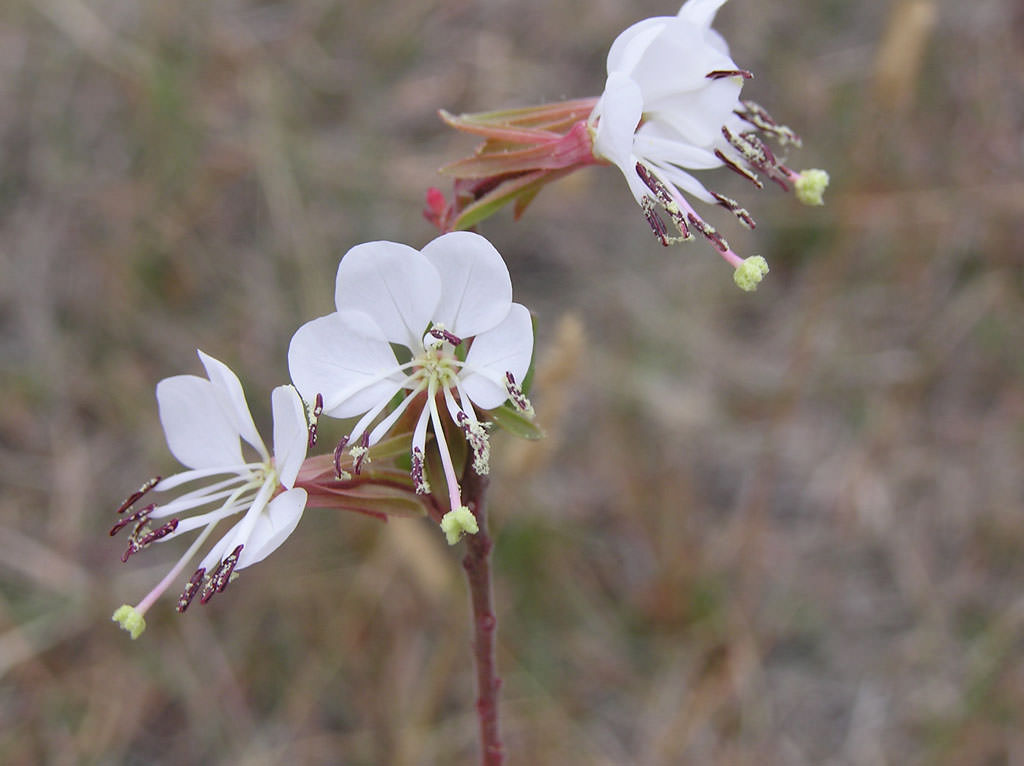
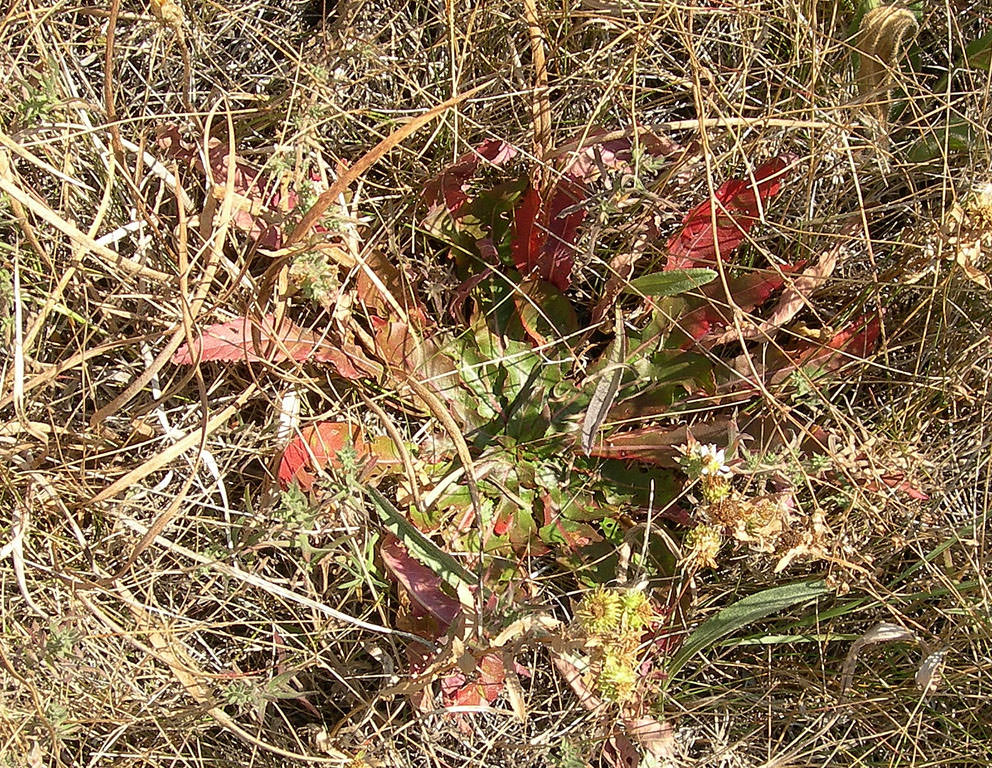
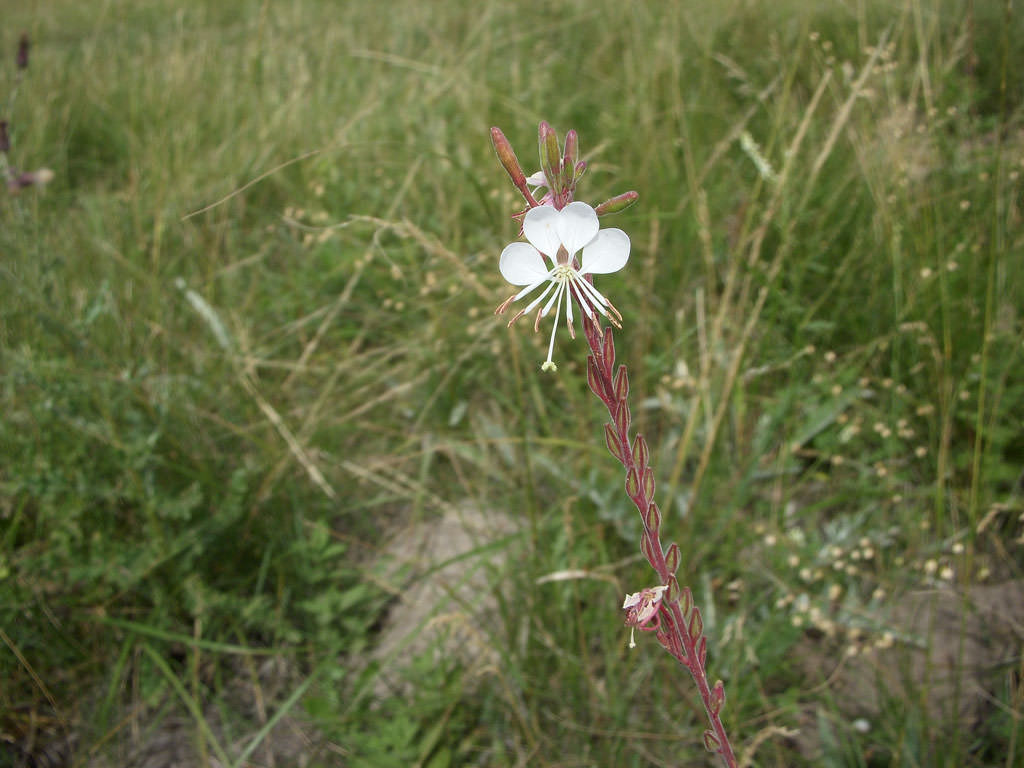
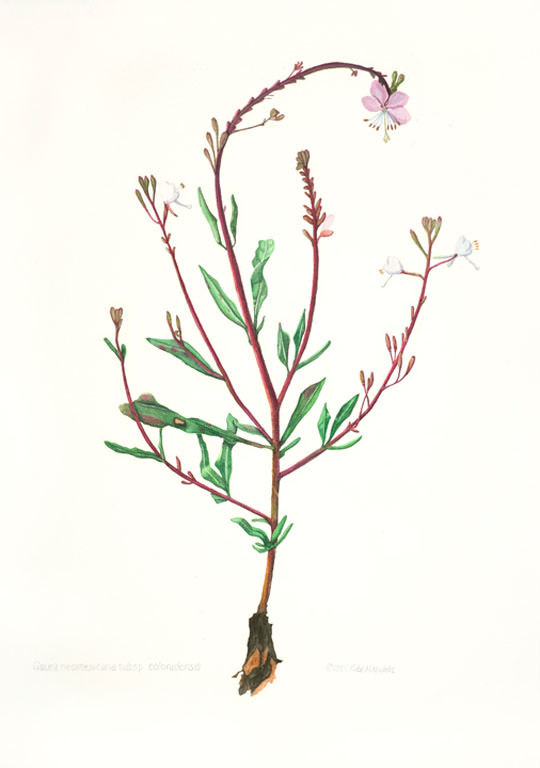
Short-lived perennial herb with one to several reddish, pubescent stems 50-80 cm tall. Lower leaves are lance-shaped, with smooth or wavy-toothed margins and average 5-10 cm long, while those higher on the stem are smaller and reduced in number. The inflorescence is located above the leaves and is flat-topped in bud. The multiple branches of the inflorescence elongate as the flowering season progresses. Usually only a few flowers are present at any time and are located between the floral buds and the mature fruits. Flowers have 4 white petals (turning pink with age) and are 1-1.5 cm wide. The hard, nut-like fruits are 4-angled and sessile (Fertig et al. 1994; Fertig 1994).
Look Alikes:
Gaura parviflora is an annual with a narrow, elongate inflorescence at all stages, and with white flowers less than 3 mm long. Gaura coccinea is a low-growing perennial with leaves less than 3 mm long, and found in drier sites.
Phenology:
Flowers June-September; fruiting July-October (Spackman et al. 1997).
 |
Habitat
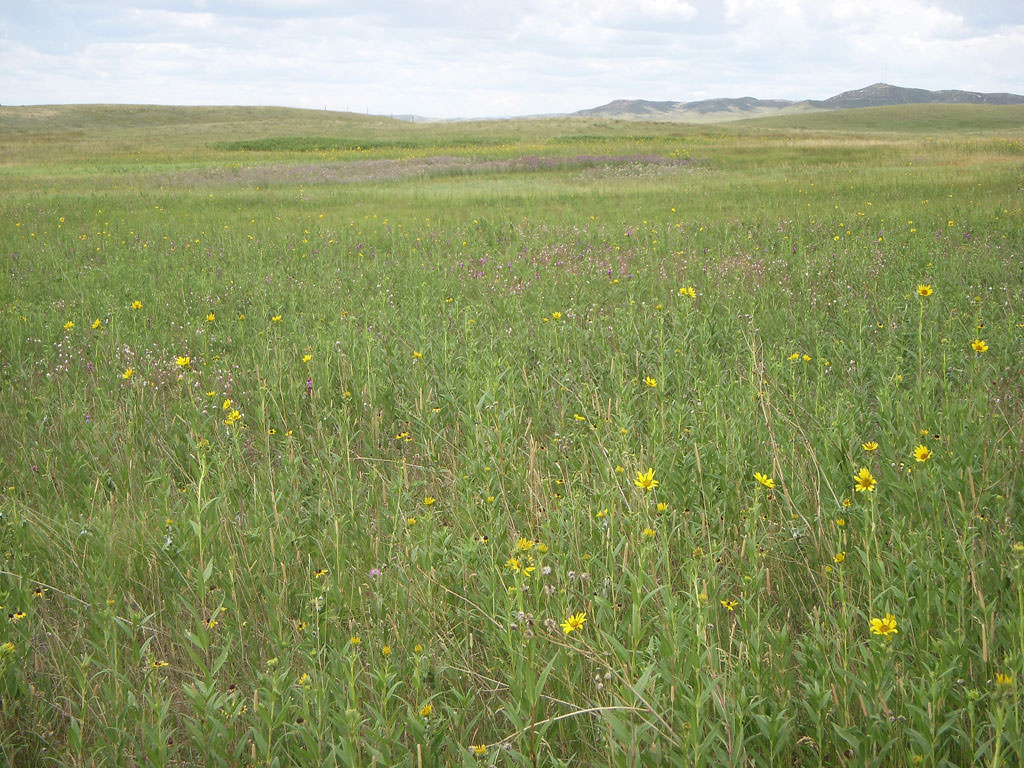
Sub-irrigated, alluvial soils of drainage bottoms surrounded by mixed grass prairie (Spackman et al. 1997). Frequently associated with species of Carex and Scirpus (Colorado Natural Heritage Program 1996; O'Kane 1988).
click on image to enlarge
 |
Elevation Range:
4,858 - 6,483 feet (1,481 - 1,976 meters)
Distribution
Colorado Endemic:
No
Range:
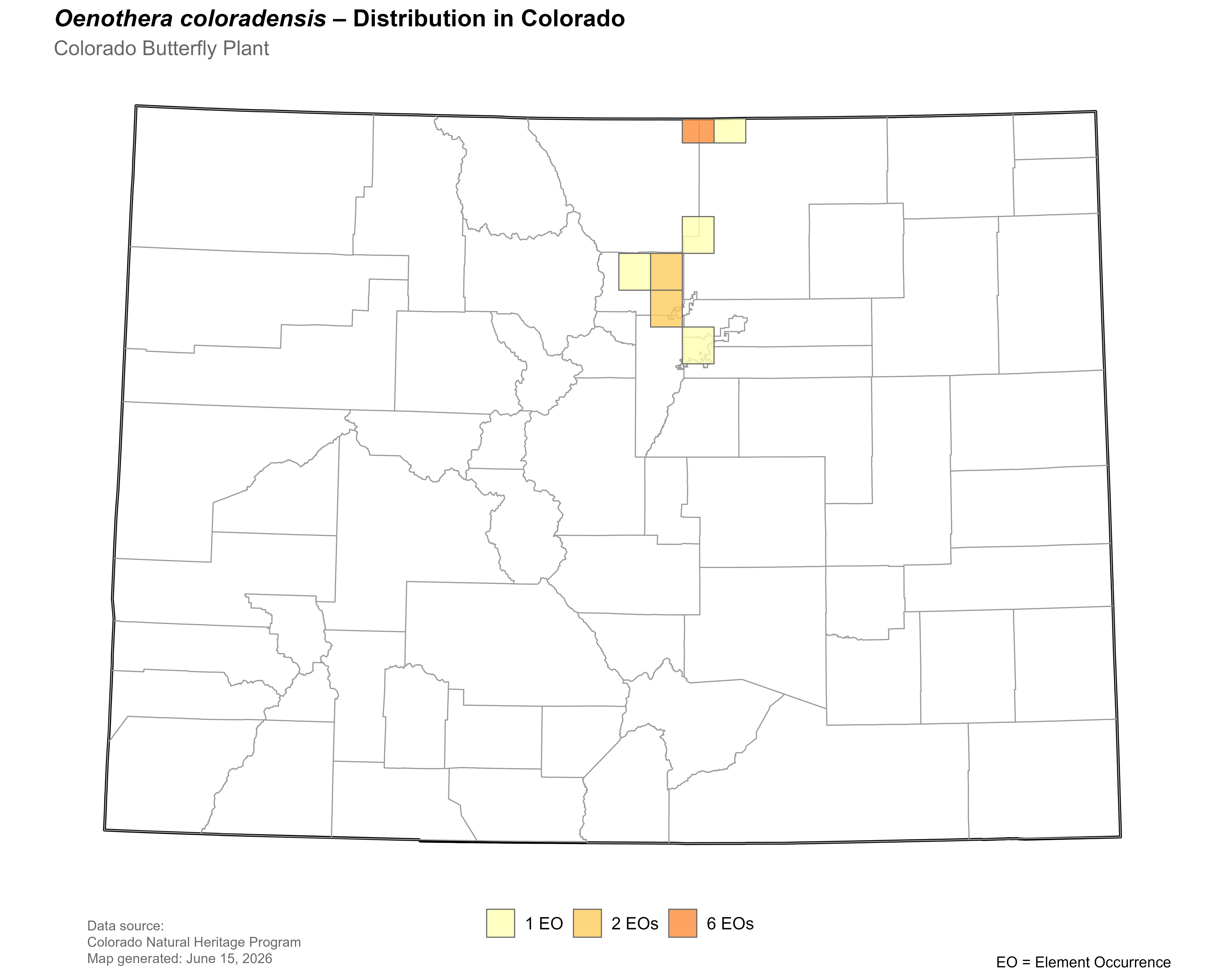
Oenothera coloradensis has been documented in Adams, Boulder, Douglas, Jefferson, Larimer and Weld counties in Colorado, USA, however, several occurrences, including those in Boulder, Douglas, and portions of Larimer and Weld counties are now considered historical, and possibly extirpated. The current estimated range extent in Colorado of 3147 square kilometers was calculated in GeoCAT using occurrence data provided by the Colorado Natural Heritage Program (2022). Imprecisely reported occurrences are not included. This species can also be found in Nebraska and Wyoming, USA.
Click on map to enlarge |
Threats and Management Issues
Threats to this species include hydrologic alteration, incompatible livestock grazing and competition from invasive plant species, primarily Canada thistle (Cirsium arvense). On agricultural lands, herbicide spraying, grazing by cattle, haying and mowing, water development, competition from exotic plants, and loss of habitat to urban expansion have been cited as the main potential threats to the Colorado butterfly plant (Marriott 1987; Fertig 1994; Jennings et al. 1997). The city of Fort Collins contains areas of formerly suitable Colorado butterfly plant habitat that have been lost to urbanization. In non-agricultural or protected areas replacement of early successional vegetation by late seral species is the primary threat (Jennings et al. 1997). Without periodic disturbance events, the semi-open habitats preferred by this species may become choked by tall and dense growth of willows, graminoids, and exotic weeds (Fertig 1994). Natural disturbance events, such as flooding, fire, and ungulate grazing, may have been sufficient in the past to create favorable habitat conditions. In the absence of such events today, managed disturbance may be necessary to maintain and create areas of habitat (Fertig 1994; 1996). The protection or continued agricultural management of suitable public and private habitat may be critical to the long-term survival of the species. This species is considered to have low adaptive capacity and is expected to be extremely vulnerable to climate change under both RCP 4.5 and 8.5 scenarios, as assessed for the 2025 Colorado State Wildlife Action Plan (CNHP 2025).
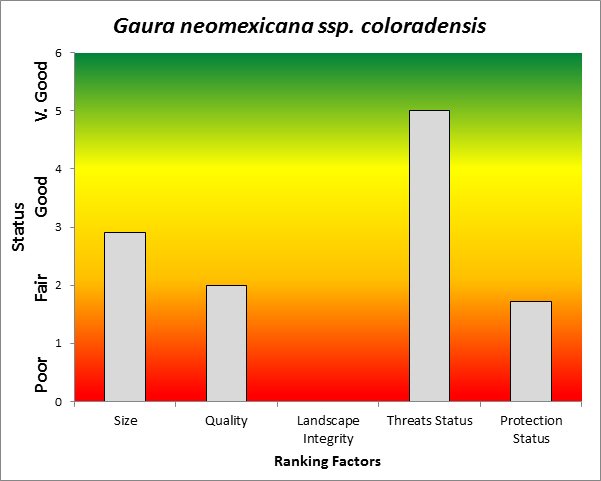
Summary results of an analysis of the status of Oenothera coloradensis based on several ranking factors. This species was concluded to be "weakly conserved. From Rondeau et al. 2011. |
References
- Ackerfield, J. 2012. The Flora of Colorado. Colorado State University Herbarium. 433 pp.
- Colorado Natural Heritage Program (CNHP). 2025. Climate Change Vulnerability Assessment of Colorado Tier 1 and Tier 2 Plant Species of Greatest Conservation Need (SCGN) for the 2025 Colorado State Wildlife Action Plan. Colorado Natural Heritage Program, Colorado State University, Fort Collins.
- Culver, D.R. and J.M. Lemly. 2013. Field Guide to Colorado's Wetland Plants; Identification, Ecology and Conservation. Colorado Natural Heritage Program, Colorado State University, Fort Collins, 694 pp.
- Fertig, W. 1994. Status report on Gaura neomexicana ssp. coloradensis, a Candidate Threatened species. Unpublished report prepared for the US Fish and Wildlife Service, Region 6.
- Fertig, W., C. Refsdal, and J. Whipple. 1994. Wyoming rare plant field guide. Wyoming Rare Plant Technical Committee, Cheyenne. No pagination.
- Floyd, S.K. 1995a. Population structure, dynamics, and genetics of GAURA NEOMEXICANA SSP. COLORADENSIS (Onagraceae), a rare semelparous perennial. Masters Thesis, Department of Environmental, Population, and Organismic Biology, University of Colorado, Boulder, Colorado. 90 pp.
- Floyd, S.K. 1995c. Experimental control of Canadian thistle within the GAURA NEOMEXICANA SSP. COLORADENSIS Research Natural Area on F.E. Warren Air Force Base and recommendations for continued monitoring of the GAURA population. Report to the Wyoming Nature Conservancy. 19 pp.
- Handwerk, J., L. Grunau, and S. Panjabi. 2015. Colorado Wildlife Action Plan: 2015 Rare Plant Addendum. Colorado Natural Heritage Program, Colorado State University, Fort Collins, Colorado, USA.
- Hild, A.L., D. Kazmer, and T. Whitson. 1998. Regeneration of Colorado butterfly plant (GAURA NEOMEXICANA SSP. COLORADENSIS) on F.E. Warren Air Force Base and recommendations for management. Proposal submitted to F.E. Warren Air Force Base by the departments of Renewable Resources and Plant Sciences, University of Wyoming, Laramie, Wyoming.
- Jennings, M., H. Marriott, and W. Fertig. 1997. Colorado butterfly plant (GAURA NEOMEXICANA SSP. COLORADENSIS) draft recovery plan. U.S. Fish and Wildlife Service, Cheyenne, Wyoming.
- Neely, B., S. Panjabi, E. Lane, P. Lewis, C. Dawson, A. Kratz, B. Kurzel, T. Hogan, J. Handwerk, S. Krishnan, J. Neale, and N. Ripley. 2009. Colorado Rare Plant Conservation Strategy, Developed by the Colorado Rare Plant conservation Initiative. The Nature Conservancy, Boulder, Colorado, 117 pp.
- O'Kane, S.L. 1988. Colorado's rare flora. Great Basin Naturalist 48(4): 434-484.
- Raven, P. and Gregory, D. 1972. A revision of the genus GAURA (ONAGRACEAE). Memoirs of the Torrey Botany Club 23(1):1-96.
- Rocky Mountain Society of Botanical Artists. 2009. RARE Imperiled Plants of Colorado, a traveling art exhibition. Exhibition catalogue developed by the Denver Botanic Gardens and Steamboat Art Museum.
- Rondeau, R., K. Decker, J. Handwerk, J. Siemers, L. Grunau, and C. Pague. 2011. The state of Colorado's biodiversity 2011. Prepared for The Nature Conservancy. Colorado Natural Heritage Program, Colorado State University, Fort Collins, Colorado.
- Spackman, S., B. Jennings, J. Coles, C. Dawson, M. Minton, A. Kratz, and C. Spurrier. 1997. Colorado rare plant field guide. Prepared for Bureau of Land Management, U.S. Forest Service and U.S. Fish and Wildlife Service by Colorado Natural Heritage Program.
- U.S. Fish and Wildlife Service (USFWS). 1998. Endangered and threatened wildlife and plants: proposed threatened status for the plant Gaura neomexicana ssp. coloradensis. Federal Register 63(56):14060.14065.
- U.S. Fish and Wildlife Service (USFWS). 2018. Removing Oenothera coloradensis (Colorado Butterfly Plant) from the Federal List of Endangered and Threatened Plants. Proposed Rule. Federal Register 83(111): 26623-26640.
- USDA, NRCS. 2013. The PLANTS Database. National Plant Data Team, Greensboro, NC 27401-4901 USA.
- USDA, NRCS. 2022. The PLANTS Database. National Plant Data Team, Greensboro, NC 27401-4901 USA.
- Wagner W.L., K.N. Krakos, and P.C. Hoch. 2013. Taxonomic changes in Oenothera sections Gaura and Calylophus (Onagraceae). PhytoKeys 28: 61-72.