

Scientific Name : Penstemon gibbensii
Author : Dorn NatureServe Explorer
Common Name : Gibbens' Beardtongue
 Current Research Activities
 1997 profile


☰ Click link below for details.
Taxonomy
Plantaginaceae (plantain family)
Ackerfield (2015, 2022) places this genus in the Plantaginaceae family.
Ranks and Status
State Rank : S1
State Rank Reason : Penstemon gibbensii is known only from three occurrences in northwest Colorado (USA) where it is confined to sandstone and siltstone outcrops of the Browns Park Formation. This species is vulnerable to soil disturbances caused by off road vehicle activity and livestock grazing. Noxious weed invasion and long term drought also threaten this species. Penstemon gibbensii is considered extremely vulnerable to climate change.
U.S. Endangered Species Act : none
Colorado Threatened and Endangered List : none
Other Statuses : BLM, SWAP Tier 1
Description and Phenology
General Description:
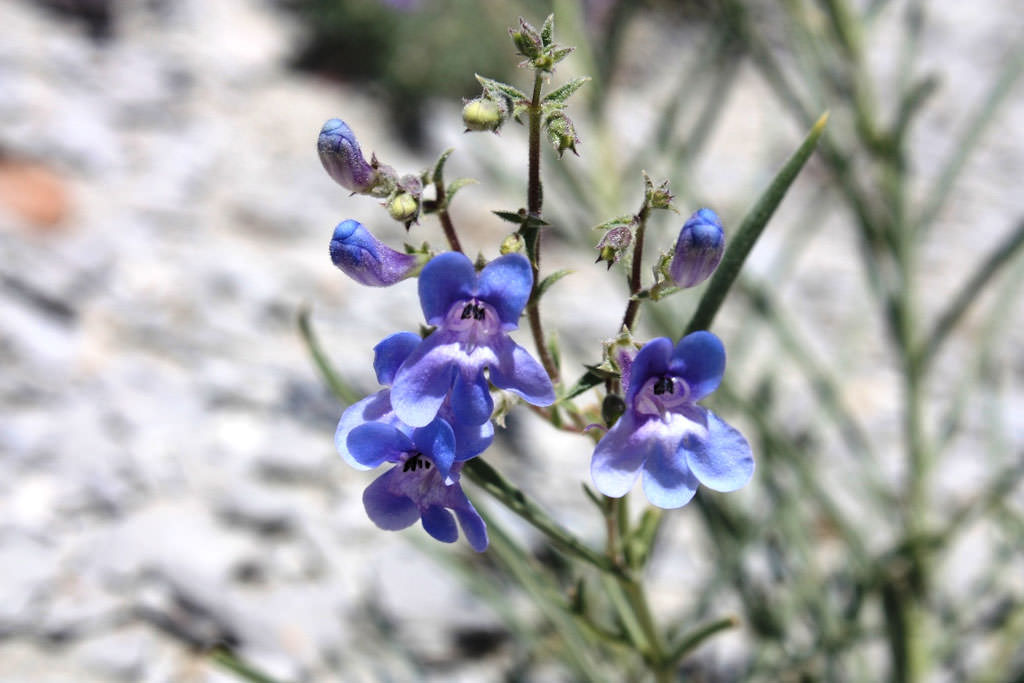
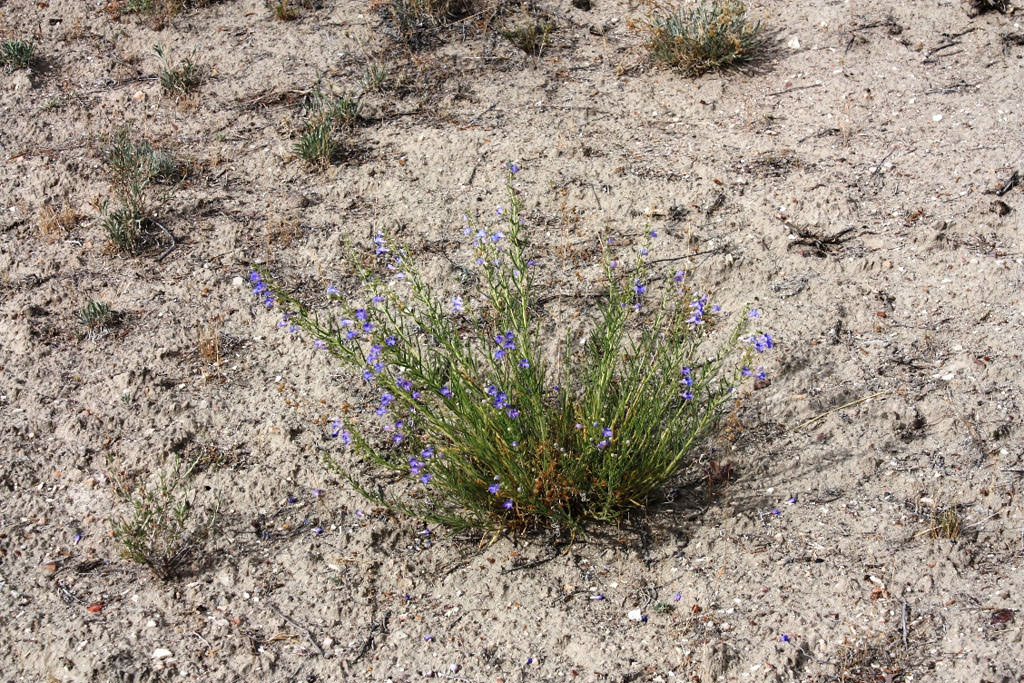
Perennial plants 10-20 cm tall, with pubescent stems. Stem leaves are narrow (5 mm wide) and are often folded. Basal leaves tend to be narrow and deciduous. Flowers are blue-purple, and glandular hairy. Anther sacs are villous on side opposite dehiscence. Staminode is sparsely white-bearded, usually just at the tip (Ackerfield 2012, Spackman et al. 1997, Fertig and Neighbours 1996, Dorn 1990).
Look Alikes:
Penstemon saxosorum has leaves over 5 mm wide and glabrous stems and sepals. Penstemon fremontii and P. glaber have non-glandular inflorescences and wider leaves (Spackman et al. 1997).
Phenology:
June-September (Spackman et al. 1997).
Habitat
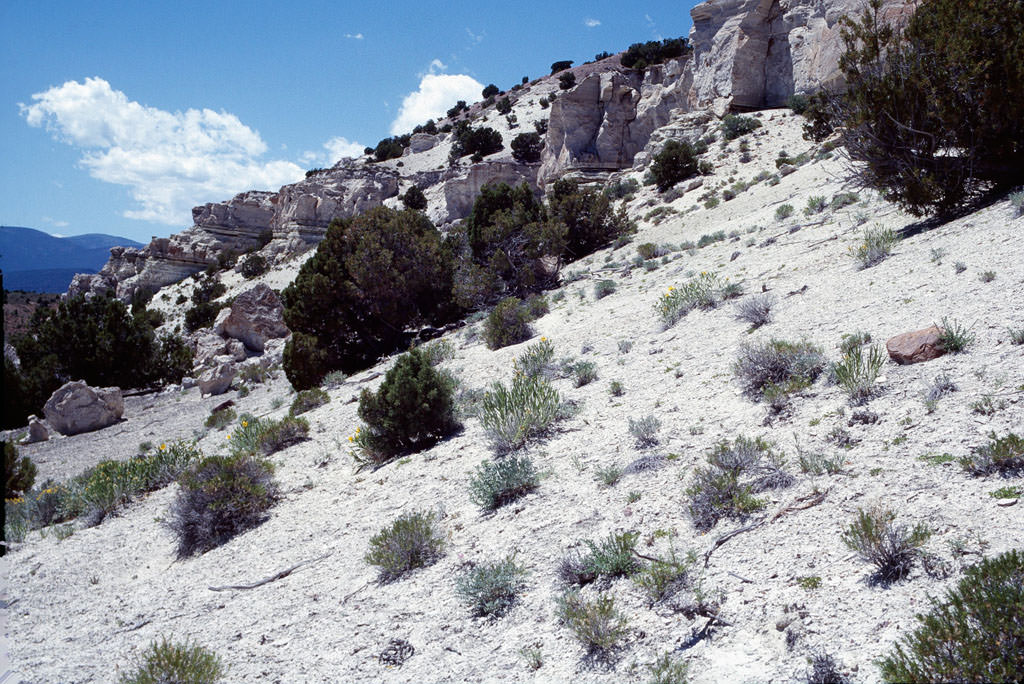
This species occurs on barren outcrops of white shale and sandstone of the Brown's Park Formation. It is commonly growing in very fine textured sandy clay soils with gravel and cobbles, and is often associated with cryptobiotic crusts. It is predominantly found on steep slopes that are highly susceptible to erosion. Plant cover is never more than 20% in the vicinity of the occurrences. Associated taxa include Wyethia scabra, Chrysothamnus viscidifloris, Stanleya pinnata, Asclepias cryptoceras, Astragalus kentrophyta, Hymenopappus filifolia, Oryzopsis hymenoides, Hedysarum boreale, Oxytropis lambertii, Tetradymia canescens, Euphorbia sp., Phlox sp., Lesquerella sp., Gallium sp., and Cryptantha spp. It is sometimes found among scattered pinyons and junipers (Pinus edulis and Juniperus osteosperma).
click on image to enlarge
 |
Elevation Range:
5,407 - 6,292 feet (1,648 - 1,918 meters)
Distribution
Colorado Endemic:
No
Range:
Penstemon gibbensii is known from extreme northwestern Moffat County in Colorado, USA. The estimated range extent of 228 square kilometers was calculated in GeoCAT using occurrence data provided by the Colorado Natural Heritage Program (2022). This species is also known from Utah and Wyoming.
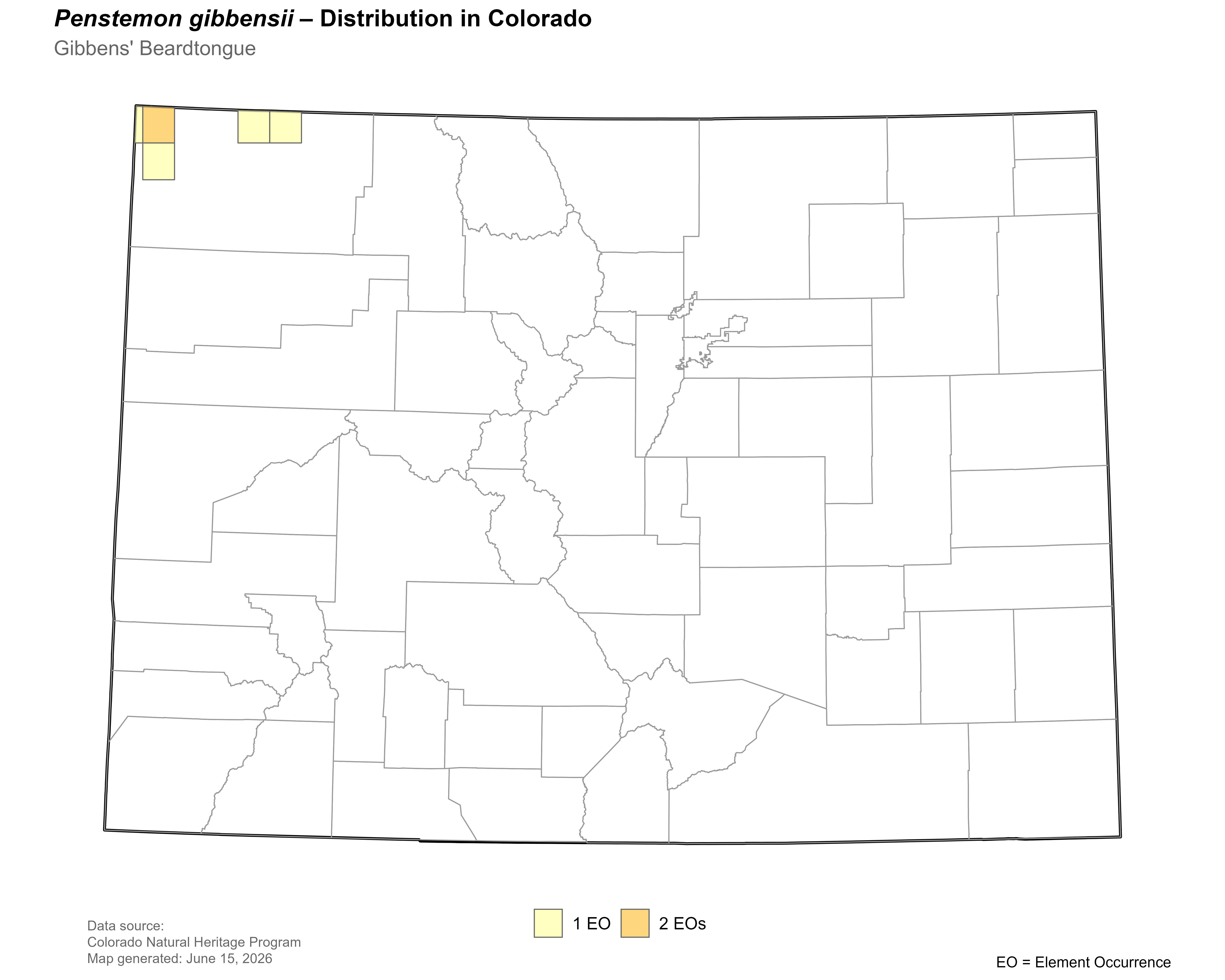
Click on map to enlarge |
Threats and Management Issues
The use of off-road vehicles, inappropriate livestock grazing, and noxious weed invasion are threats to this species in Colorado. (Spackman and Anderson 1999, CNHP 2022, BLM 2023). The non-native plants species; Bromus tectorum (cheatgrass) and Salsola tragus (Russian thistle) have been reported adjacent to or within all occurrences. Livestock use has disturbed the fragile soils on which P. gibbensii is found at several sites (CNHP 2022). This species is considered to have low adaptive capacity and is expected to be highly to extremely vulnerable to climate change under both RCP 4.5 and 8.5 scenarios, as assessed for the 2025 Colorado State Wildlife Action Plan (CNHP 2025).
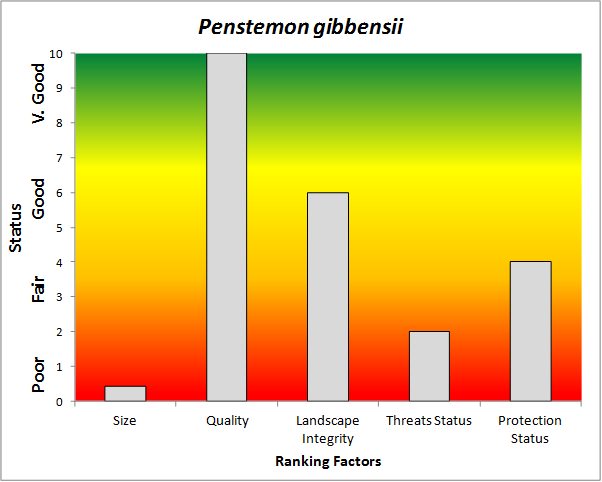
Summary results of an analysis of the status of Penstemon gibbensii based on several ranking factors. This species was concluded to be weakly conserved. From Rondeau et al. 2011. |
References
- Ackerfield, J. 2015. Flora of Colorado. BRIT Press, Botanical Research Institute of Texas, Fort Worth, TX. 818 pp.
- Ackerfield, J. 2022. Flora of Colorado. Second Edition. Bot. Misc. 60. BRIT Press, Fort Worth Botanic Garden/Botanical Research Institute of Texas, U.S.A. 861 pp.
- Atwood, D., J. Holland, R. Bolander, B. Frnaklin, D. E. House, L. Armstrong, K. Thorne, and L. England. 1991. Utah Threatened, Endangered, and Sensitive Plant Field Guide. US Forest Service Intermountain Region, National Park Service, Bureau of Land Management, Utah Natural Heritage Program, US Fish and Wildlife Service, Environmental Protection Agency, Navajo Nation, and Skull Valley Goshute Tribe.
- Bureau of Land Management (BLM). 2023. BLM Colorado Sensitive Species List (signed by state director on August 24). https://www.blm.gov/sites/default/files/docs/2023-09/BLM%20CO%20Sensitive%20Species%20List_2023.pdf
- Colorado Natural Heritage Program (CNHP). 2022. Biodiversity Tracking and Conservation System (Biotics 5). Colorado Natural Heritage Program, Colorado State University, Fort Collins.
- Colorado Natural Heritage Program (CNHP). 2025. Climate Change Vulnerability Assessment of Colorado Tier 1 and Tier 2 Plant Species of Greatest Conservation Need (SCGN) for the 2025 Colorado State Wildlife Action Plan. Colorado Natural Heritage Program, Colorado State University, Fort Collins.
- Dorn, R.D. 1982. A new species of Penstemon (Scrophulariaceae) from Wyoming. Brittonia 34(3): 334-335.
- Dorn, R.D. 1989. Report on the status of Penstemon gibbensii, a candidate Threatened species. Unpublished report prepared for the U.S. Fish and Wildlife Service. 23 pp.
- Dorn, R.D. 1990. Report on the status of Penstemon gibbensii, a candidate threatened species. Unpublished.
- Fertig, W., and M. Neighbours. 1996. Status report on Penstemon gibbensii in south-central Wyoming. Unpublished report prepared for the Bur. Land Management, Wyoming State Office and Rawlins District by the Wyoming Natural Diversity Database, Laramie. 66 pp.
- Fertig, W., C. Refsdal, and J. Whipple. 1994. Wyoming rare plant field guide. Wyoming Rare Plant Technical Committee, Cheyenne. No pagination.
- Handwerk, J., L. Grunau, and S. Panjabi. 2015. Colorado Wildlife Action Plan: 2015 Rare Plant Addendum. Colorado Natural Heritage Program, Colorado State University, Fort Collins, Colorado, USA.
- Heidel, B. 2021. Monitoring Penstemon gibbensii (Gibbens’ penstemon) in south-central Wyoming – 2016-2021. Prepared for the Bureau of Land Management. Wyoming Natural Diversity Database, Laramie, WY. Online. Available: https://www.uwyo.edu/wyndd/_files/docs/reports/WYNDDReports/21hei08.pdf (Accessed 2022).
- Heidel, B., M. Andersen, J. Handley, and G. Beauvais. 2014. Evaluating Potential Threats to Wyoming, Threatened, Endangered and Sensitive Plant Species. Wyoming Natural Diversity Database, University of Wyoming, Laramie, WY. Online. Available: https://www.uwyo.edu/wyndd/_files/docs/reports/wynddreports/u14hei05wyus.pdf (accessed 2022).
- Neely, B., S. Panjabi, E. Lane, P. Lewis, C. Dawson, A. Kratz, B. Kurzel, T. Hogan, J. Handwerk, S. Krishnan, J. Neale, and N. Ripley. 2009. Colorado Rare Plant Conservation Strategy, Developed by the Colorado Rare Plant conservation Initiative. The Nature Conservancy, Boulder, Colorado, 117 pp.
- Rondeau, R., K. Decker, J. Handwerk, J. Siemers, L. Grunau, and C. Pague. 2011. The state of Colorado's biodiversity 2011. Prepared for The Nature Conservancy. Colorado Natural Heritage Program, Colorado State University, Fort Collins, Colorado.
- Southwest Environmental Information Network (SEINet). 2022. Collections Databases. Online. Available: https://swbiodiversity.org/seinet/collections/index.php (accessed 2022).
- Spackman, S. and D. Anderson. 1999. Field Survey and Protection Recommendations for the Globally Imperiled Gibben's Beardtongue, Penstemon gibbensii Dorn in Colorado. Unpublished report for the Colorado Natural Areas Program. 36pp.
- Spackman, S., B. Jennings, J. Coles, C. Dawson, M. Minton, A. Kratz, and C. Spurrier. 1997. Colorado rare plant field guide. Prepared for Bureau of Land Management, U.S. Forest Service and U.S. Fish and Wildlife Service by Colorado Natural Heritage Program.
- Stevens, M., S. Love, and T. McCammon. 2020. The Heart of Penstemon Country: A Natural History of Penstemons in the Utah Region. Sweetgrass Books. Helena, MT.
- Tilini, K.L., S.E. Meyer, and P.S. Allen. 2016. Breaking primary seed dormancy in Gibbens' beardtongue (Penstemon gibbensii) and blowout penstemon (Penstemon haydenii). Native Plants Journal 17(3):256-265.
- USDA, NRCS. 2022. The PLANTS Database. National Plant Data Team, Greensboro, NC 27401-4901 USA.