Scientific Name : Eutrema penlandii
Author : Rollins NatureServe Explorer
Common Name : Mosquito Range Mustard
 Current Research Activities
 1997 profile


☰ Click link below for details.
Taxonomy
Brassicaceae (mustard family)
This taxon represents one of only two species of Eutrema in North America, and the only Eutrema in the lower 48 states. Listed as Eutrema penlandii in Ackerfield (2015, 2022) and Eutrema edwardsii in Weber and Wittmann (2012). Flora of North America (Vol 7) lists this as Eutrema edwardsii with the synonyms E. penlandii, E. edwardsii ssp. penlandii, and E. labradoricum.
Ranks and Status
State Rank : S2
State Rank Reason : Eutrema penlandii is endemic to a 40 km stretch of the Continental Divide in Colorado (USA) where the Divide trends east-west, rather than north-south, and where a unique set of habitat conditions exist, including perennially wet, primarily calcareous soils at very high elevations. The occurrences are in close proximity to mines and are threatened by mineral extraction activities, especially ditching, which could alter the hydrology of the area, and drainage from mine tailings, which could acidify the sites. Recreational use is also a threat, especially from off-road vehicles and hikers. This species is considered to be extremely vulnerable to the effects of climate change.
U.S. Endangered Species Act : ESA Threatened
Colorado Threatened and Endangered List : none
Other Statuses : SWAP Tier 1
Description and Phenology
General Description:
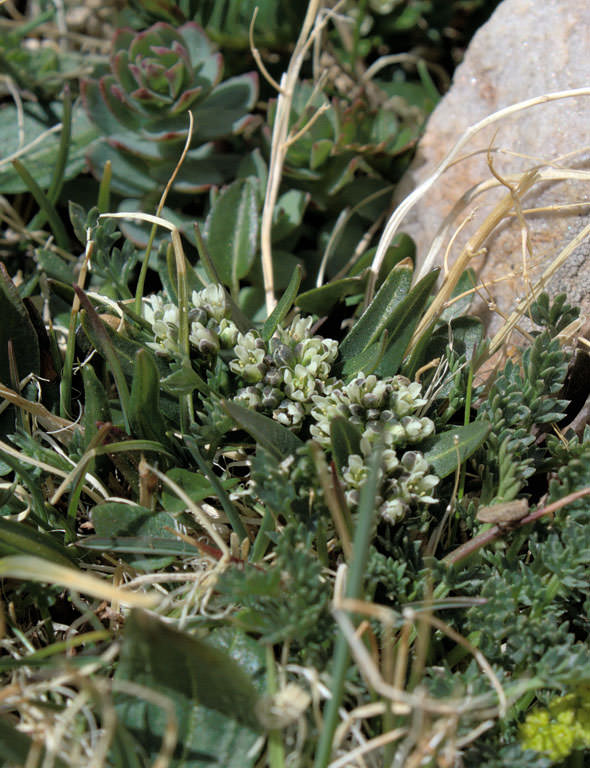
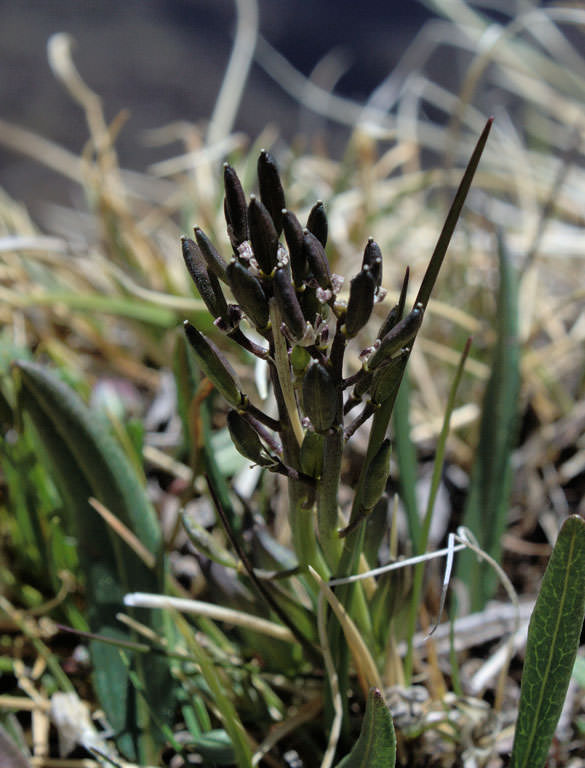
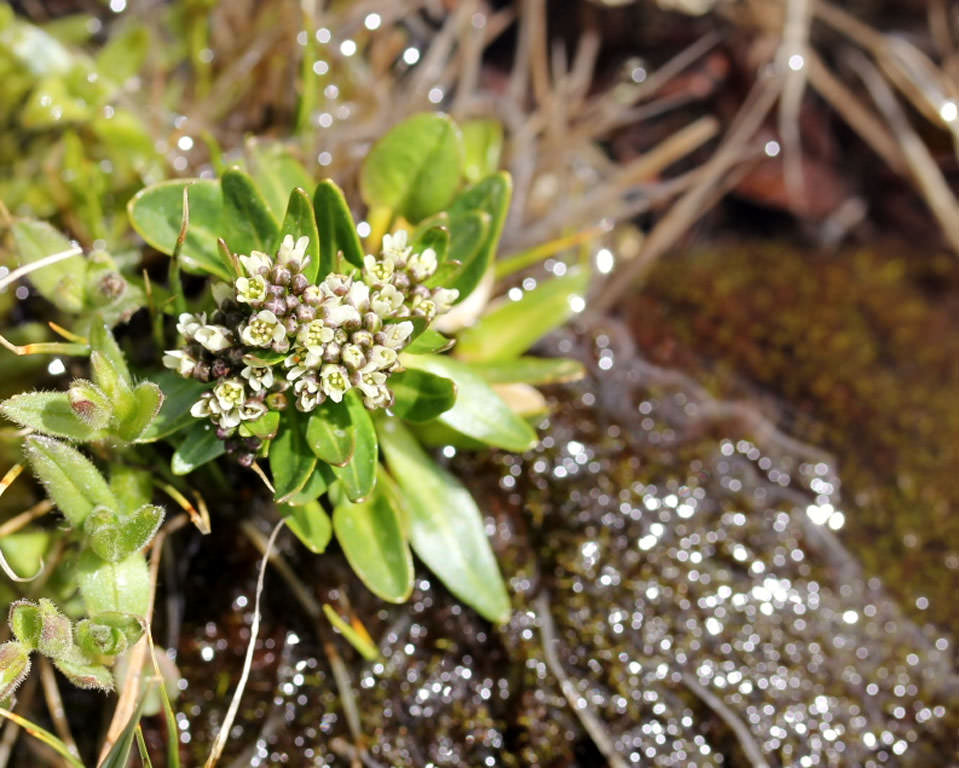
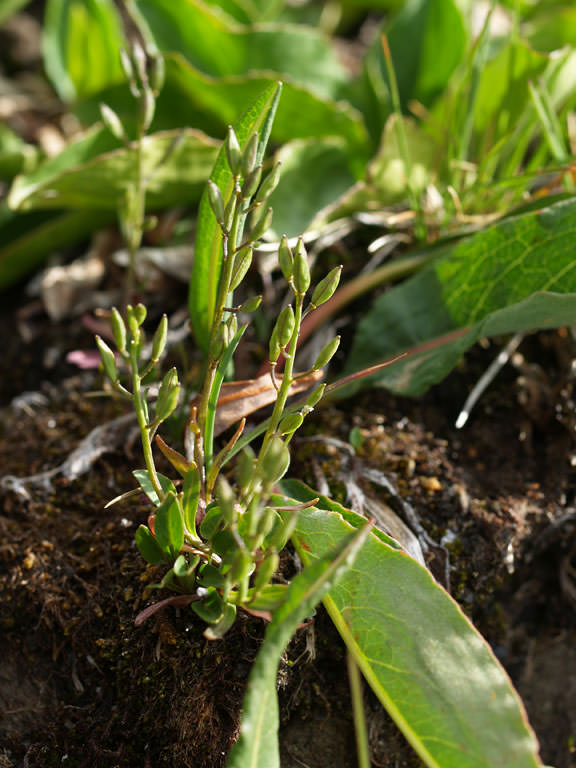
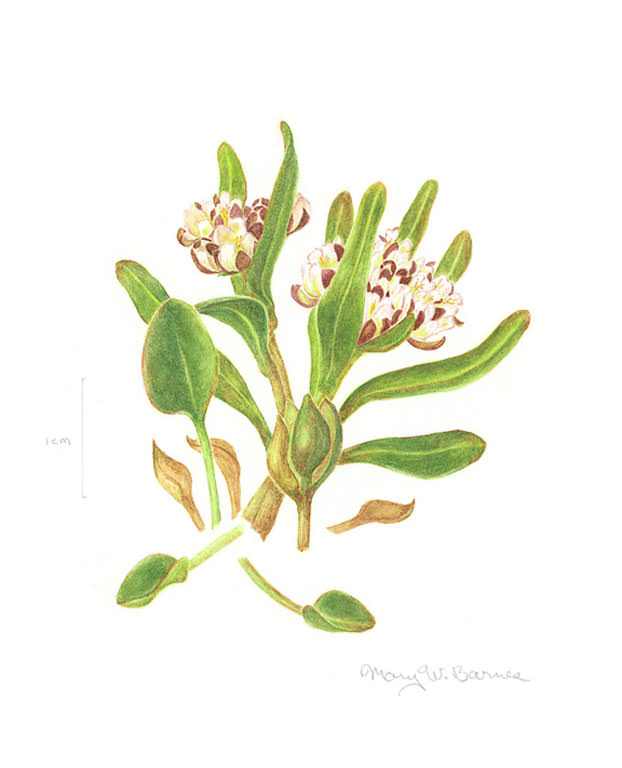
Small herbaceous perennial from 1 to 15 cm tall. Plants are glabrous and have clusters of white, four petalled flowers at the top of each stem. Leaves are dimorphic: shiny and oval along the stem, and shovel-shaped at the base of the plant. Fruit are eliptical, with styles so small they are barely evident (Spackman et al. 1997).
Look Alikes:
This species is not conspicuous in the field although the fruits and basal leaves are distinctive. The flowers are more apparent than the leaves, but look similar to several Draba species (Naumann 1988). Noccaea montana has obcordate fruits, broadest at the apex, and long-styled (1-3mm), as opposed to the elliptical fruits and barely evident style of Eutrema. Draba borealis, D. cana, D. porsildii, and D. lonchocarpa, which occur in the same area but in drier sites, are all pubescent (Spackman et al. 1997).
Phenology:
Peak flower is likely in late June through early July depending on snow melt. Plants produce fruits in July and dehisce in August (Naumann 1988).
 |
Habitat
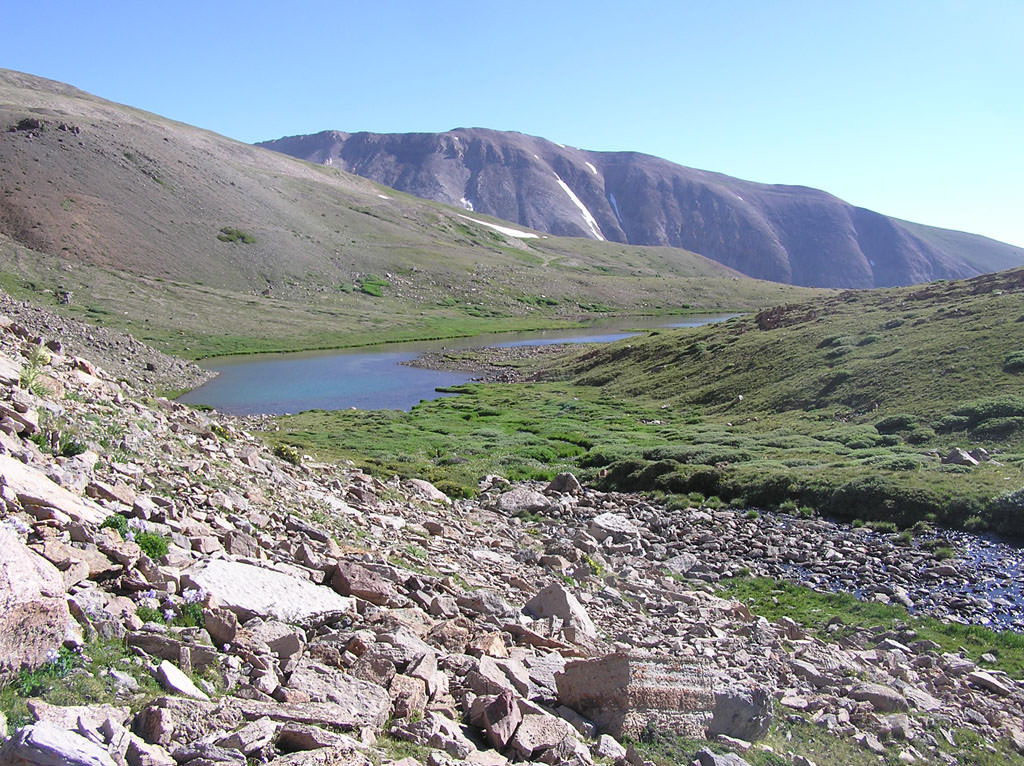
Alpine tundra above 3700 m elevation and downslope from snowfields, which provide melt water all summer. The plants are usually found on south- and east-facing flat to gently sloping benches with steep walls that provide some protection from snow-melting winds. On these wet benches, the plants are found in moss-covered peat fens, bogs, or marshes. Most of the populations are on limestone substrates, which have created unusually basic wetland soils, but it is not certain that the species is restricted to calcareous substrates.
click on image to enlarge
 |
Elevation Range:
11,654 - 13,829 feet (3,552 - 4,215 meters)
Distribution
Colorado Endemic:
Yes
Range:
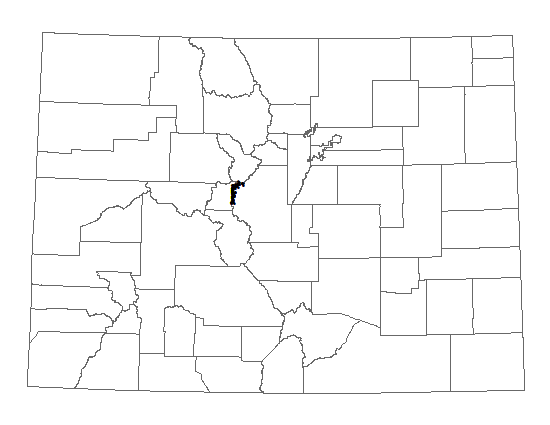
Eutrema penlandii is a Colorado (USA) endemic that is limited to a 40 km stretch of the Continental Divide, above 12,000 feet in Lake, Park and Summit counties. This species is disjunct by 1000 miles to its nearest relative Eutrema edwardsii, an arctic circumpolar species. The estimated range in Colorado is 242 square kilometers, calculated in GeoCAT by the Colorado Natural Heritage Program (2023).
 Click on map to enlarge |
Threats and Management Issues
The primary threats to Eutrema penlandii at this time appear to be hydrological alterations and mining. Activities that would impact surface water flow include anything from roads, trails, ruts from vehicles, footpaths, ruts, mining construction or any activity of this nature that draws water away from the peat fen habitat (USFWS no date, Plant Profile). Mineral extraction could have a significant impact on this taxon. The mining companies contested the Mosquito Range Research Natural Area; mining remains a big threat to plants in the Mosquito Range because of the thousands of mining claims - a change in the economic viability of mining could cause mining to increase there (Colorado Natural Heritage Program 2004). Also, as mentioned ditching associated with mining could affect the delicate hydrology and could cause water pollution, both of which would adversely affect the species. Recreational use is also a threat including trampling by ORV's and hikers. Any activity that directly or indirectly alters the surface or ground water supply and alters the wetland habitat required by this species could pose a significant threat. In one occurrence, Jeeps and ATVs were parked directly on top of Eutrema plants (Colorado Natural Heritage Program, Element Occurrence data). The impacts of this seemingly benign activity can destroy large areas of this sensitive bog habitat. Another threat to this species are random events that might wipe-out large parts of the already small populations, such as fungal blight, drought, or insect infestations (USFWS no date, Plant Profile). On a larger scale, global warming potentially threatens this and other alpine species. This species is considered to have moderate adaptive capacity and is expected to be slightly to moderately vulnerable to climate change under both RCP 4.5 and 8.5 scenarios, as assessed for the 2025 Colorado State Wildlife Action Plan (CNHP 2025).
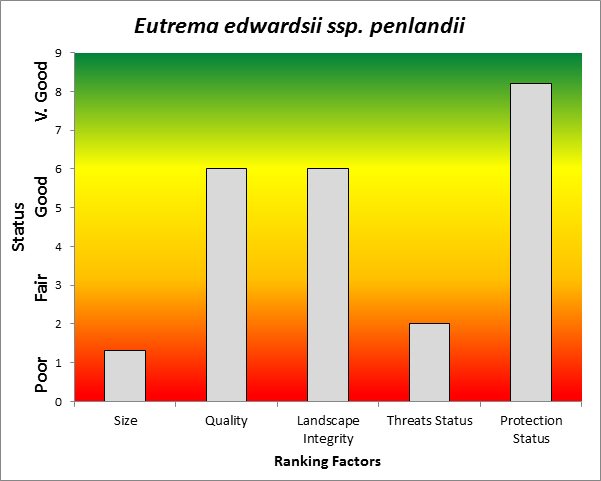 Summary results of an analysis of the status of Eutrema penlandii based on several ranking factors. This species was concluded to be "moderately conserved. From Rondeau et al. 2011. |
References
- Ackerfield, J. 2015. Flora of Colorado. BRIT Press, Botanical Research Institute of Texas, Fort Worth, TX. 818 pp.
- Al-Shehbaz, I. A. and S. I. Warwick. 2005a. A synopsis of Eutrema. Harvard Papers in Botany 10 (2): 129-135.
- Colorado Native Plant Society. 1989. Rare plants of Colorado. Rocky Mountain Nature Association, Colorado Native Plant Society, Estes Park, Colorado. 73 pp.
- Colorado Natural Heritage Program (CNHP). 2025. Climate Change Vulnerability Assessment of Colorado Tier 1 and Tier 2 Plant Species of Greatest Conservation Need (SCGN) for the 2025 Colorado State Wildlife Action Plan. Colorado Natural Heritage Program, Colorado State University, Fort Collins.
- Flora of North America Editorial Committee (FNA). 2010. Flora of North America north of Mexico. Vol. 7. Magnoliophyta: Salicaceae to Brassicaceae. Oxford University Press, New York. xxii + 797 pp.
- Handwerk, J., L. Grunau, and S. Panjabi. 2015. Colorado Wildlife Action Plan: 2015 Rare Plant Addendum. Colorado Natural Heritage Program, Colorado State University, Fort Collins, Colorado, USA.
- Krening, P. 2022. Mosquito Range mustard (Eutrema penlandii) Population trend monitoring summary – 2022. Prepared for the Colorado State Office - Bureau of Land Management, U.S. Department of the Interior.
- Krening, P. 2023. Mosquito Range mustard (Eutrema penlandii) Population Trend Monitoring Survey. Bureau of Land Management unpublished report.
- Naumann, T. S. 1988. Revised Status Report for Eutrema penlandii Rollins. Unpublished report prepared for the Colorado Natural Areas Program, Denver, CO.
- Neely, B., S. Panjabi, E. Lane, P. Lewis, C. Dawson, A. Kratz, B. Kurzel, T. Hogan, J. Handwerk, S. Krishnan, J. Neale, and N. Ripley. 2009. Colorado Rare Plant Conservation Strategy, Developed by the Colorado Rare Plant conservation Initiative. The Nature Conservancy, Boulder, Colorado, 117 pp.
- Rocky Mountain Society of Botanical Artists. 2009. RARE Imperiled Plants of Colorado, a traveling art exhibition. Exhibition catalogue developed by the Denver Botanic Gardens and Steamboat Art Museum.
- Rollins, R.C. 1993. The Cruciferae of Continental North America:Systematics of the Mustard Family from the Arctic to Panama. Stanford University Press. Stanford, CA.
- Roy, G., S. Kelso, and A. Tonnesen. 1993. Habitat characteristics of Eutrema penlandii (Brassicaceae) in the Colorado Rockies: A study of alpine endemism. Madroño 40(4):236-245.
- Ryke, N., D. Winters, L. McMartin and S. Vest. 1994. Threatened, Endangered and Sensitive Species of the Pike and San Isabel National Forests and Comanche and Cimarron National Grasslands. May 25, 1994.
- Spackman, S., B. Jennings, J. Coles, C. Dawson, M. Minton, A. Kratz, and C. Spurrier. 1997. Colorado rare plant field guide. Prepared for Bureau of Land Management, U.S. Forest Service and U.S. Fish and Wildlife Service by Colorado Natural Heritage Program.
- U.S. Fish and Wildlife Service (USFWS). 1993. The plant Eutrema penlandii (Penland alpine fen mustard) determined to be a threatened species. Federal Register 58(143): 40539-40547.
- U.S. Fish and Wildlife Service. 2022. Recovery Plan for the Mosquito Range mustard (Eutrema penlandii). U.S. Fish and Wildlife Service, Mountain-Prairie Region. Denver, Colorado. 23 pages.
- USDA, NRCS. 2022. The PLANTS Database. National Plant Data Team, Greensboro, NC 27401-4901 USA.
- Weber, W. A. and R. C. Wittmann. 2012. Colorado Flora, Eastern Slope, A Field Guide to the Vascular Plants, Fourth Edition. Boulder, Colorado. 555 pp.
- Weber, W. A. and R. C. Wittmann. 2012. Colorado Flora, Western Slope, A Field Guide to the Vascular Plants, Fourth Edition. Boulder, Colorado. 532 pp.