


Scientific Name : Physaria vitulifera
Author : Rydb. NatureServe Explorer
Common Name : Fiddleleaf Twinpod
 Current Research Activities
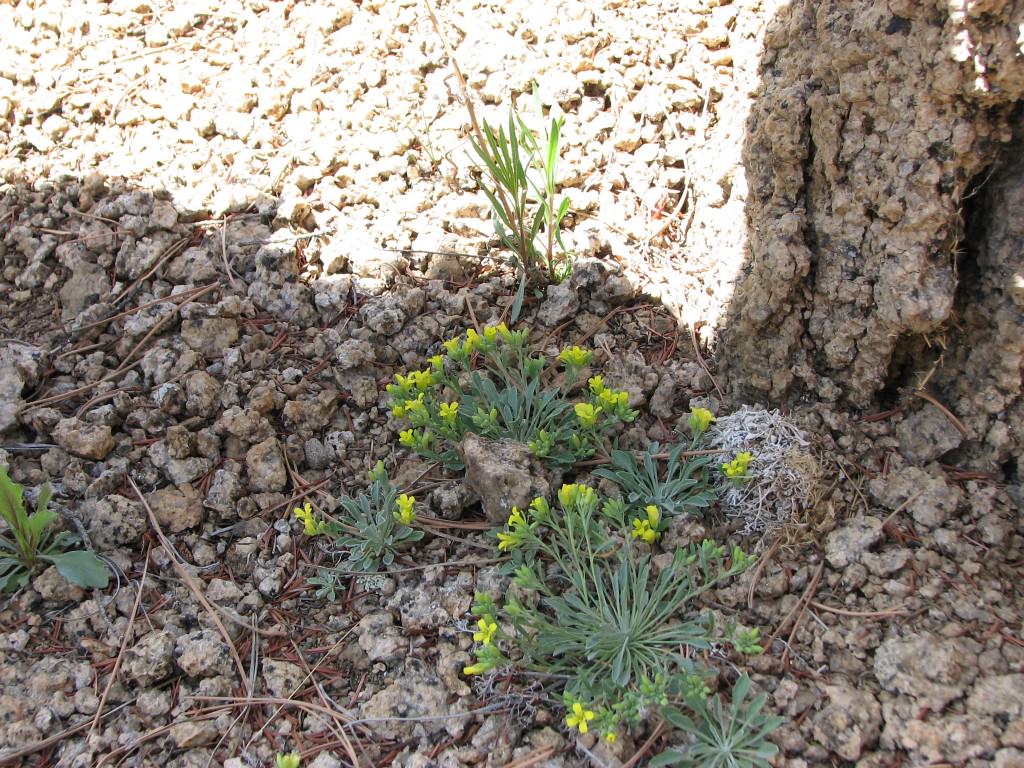
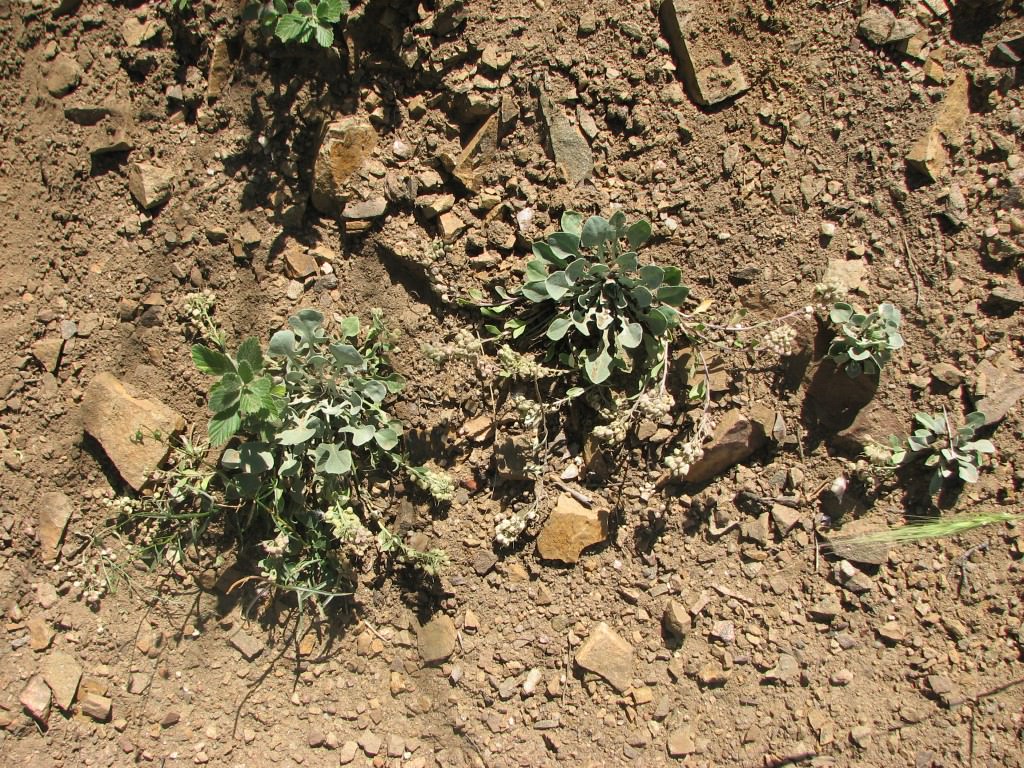
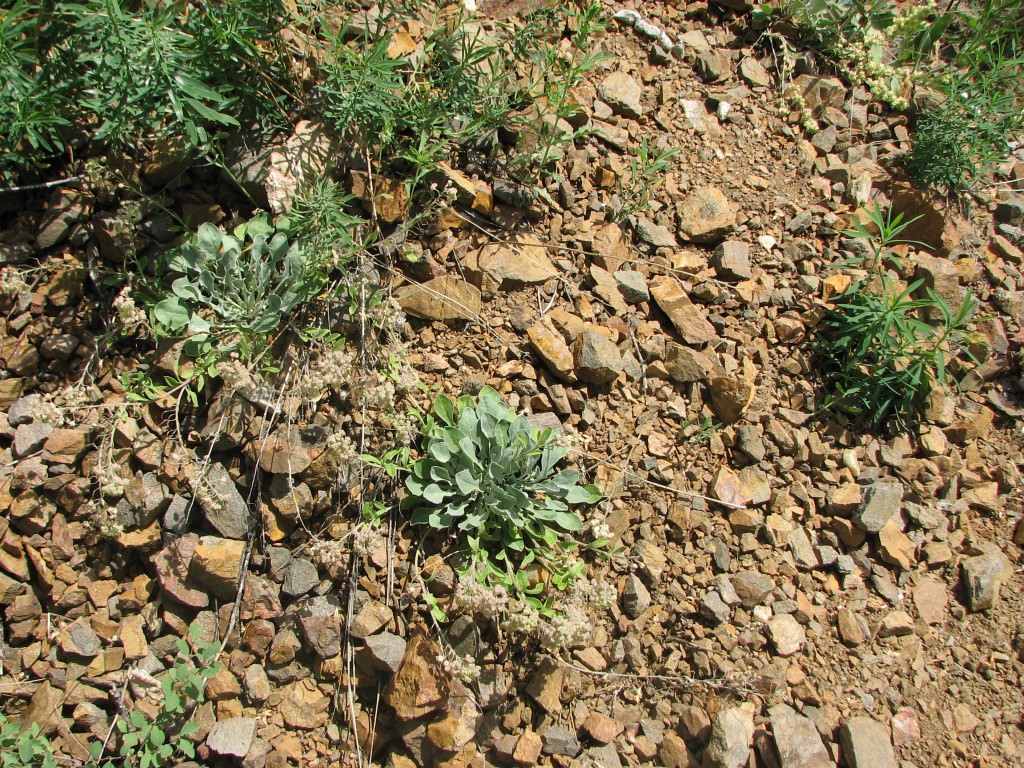


☰ Click link below for details.
Taxonomy
Brassicaceae (mustard family)
Ranks and Status
State Rank : S3
State Rank Reason : Physaria vitulifera is endemic to central Colorado, primarily along the Front Range. The primary threat at this time is considered to habitat loss and fragmentation from housing/urban development. This species may also be threatened by road and utility line maintenance, non-motorized recreation, the encroachment of exotic species and the effects of climate change, including prolonged drought.
U.S. Endangered Species Act : none
Colorado Threatened and Endangered List : none
Other Statuses : SWAP Tier 2
Description and Phenology
General Description:
Herbaceous perennials with leaves forming a rosette. The plants have characteristic fiddle-shaped leaves, with deeply incised margins. The fruits are irregular shaped and angular with prominent sinuses at the top and very small sinuses at the bottom.
Look Alikes:
This species could be confused with Physaria bellii. Physaria vitulifera has larger, fiddle shaped leaves, and the constriction separating the locules of the fruit is much deeper above than below. The basal leaf margins on P. bellii are not incised, while they are deeply and broadly incised on P. vitulifera (Ackerfield 2022).
Habitat
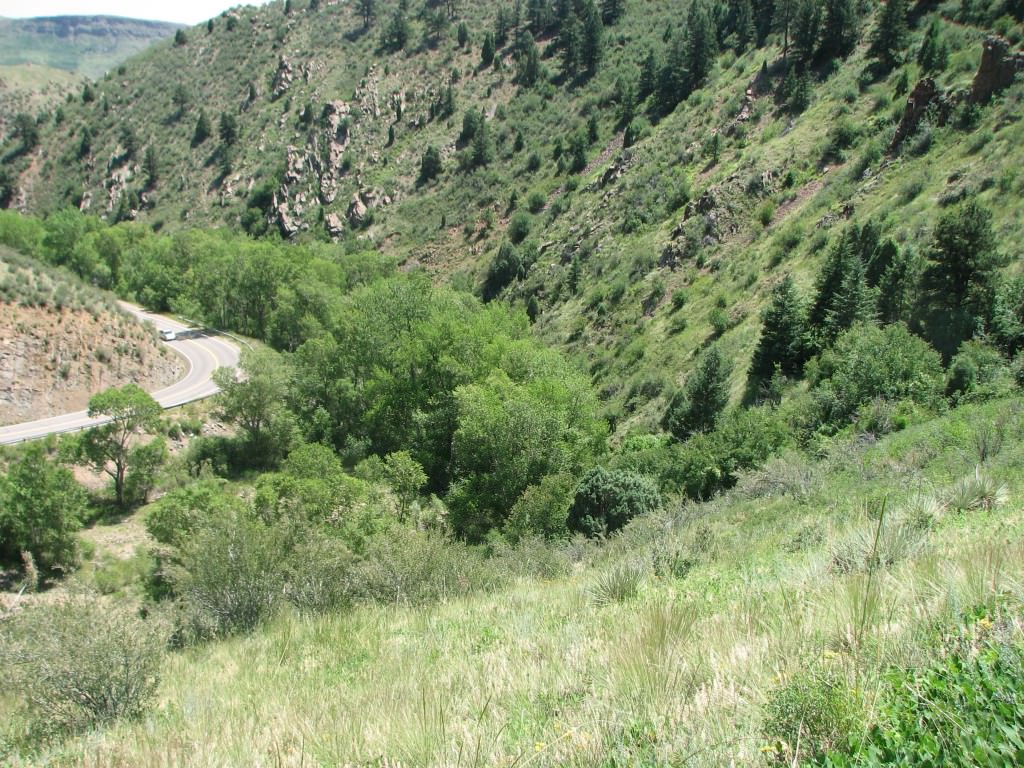
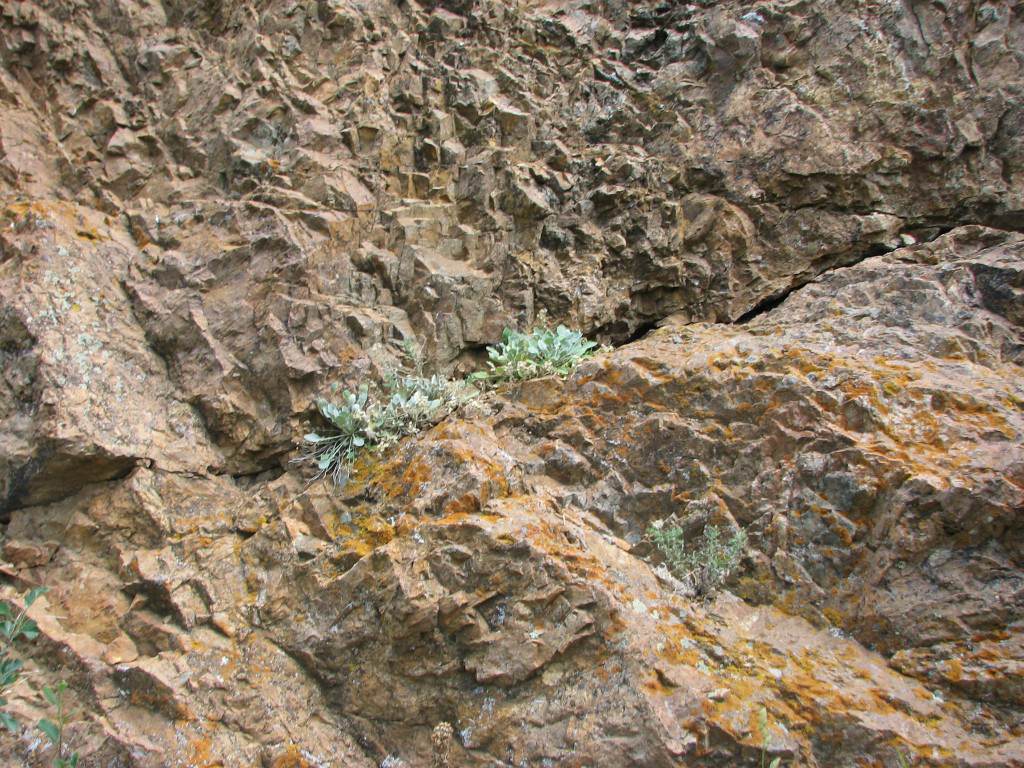
This species is found on rocky slopes and dry hillsides (Ackerfield 2015), often on decaying granite. Associated species include Artemisia frigida, A. ludoviciana, Astragalus parryi, Lupinus argentea, Oenothera caespitosa, Opuntia polycantha, Oxybaphus linearis, Penstemon secundiflorus, Ciliaria austromontana, Pentaphylloides floribunda, and Festuca brachyphylla ssp. coloradensis.
click on image to enlarge
 |
 |
Elevation Range:
5,787 - 10,232 feet (1,764 - 3,119 meters)
Distribution
Colorado Endemic:
Yes
Range:
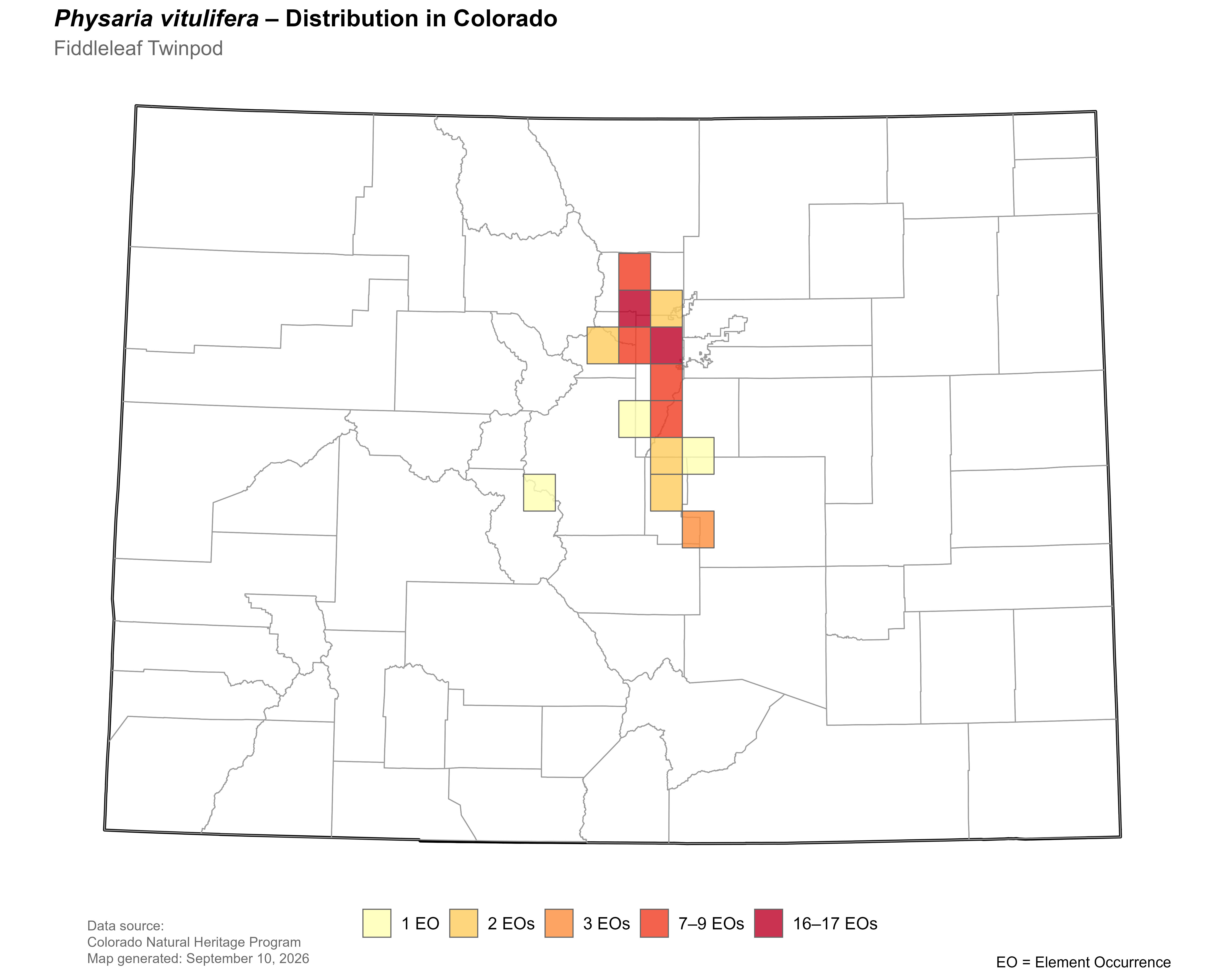
Physaria vitulifera is reported as an endemic of central Colorado, USA, in the Flora of North America (FNA Vol. 7). It is known from Boulder, Clear Creek, Douglas, El Paso, Gilpin, Jefferson, Park and Teller counties. Estimated range extent in Colorado of 9,149 square kilometers was calculated in GeoCAT using occurrence data provided by the Colorado Natural Heritage Program (2025). There are 17 specimens from southeast Wyoming attributed to Physaria vitulifera, which are in fact Physaria acutifolia (Jennings 2004; Kothera et al. 2007).
Click on map to enlarge |
Threats and Management Issues
The primary threat at this time is considered to be housing/urban development. Observations from the element occurrence records indicate this species may also be threatened by road and utility line maintenance, recreational uses, and noxious weed invasions. Residential and commercial development is occurring rapidly along the entire eastern edge of the species range, fragmenting habitat and introducing non-native species. Additional fragmentation of habitat by roads, pipelines or utility lines has been noted at 11% of occurrences. Competition from non-native invasive plants including Bromus tectorum (cheatgrass), Centaurea diffusa (diffuse knapweed), Verbascum thapsus (common mullein) and Linaria dalmatica (dalmation toadflax) has been documented at 32% of the occurrences. Human intrusions from non-motorized recreation and work activities have been documented at 15% of the occurrences. Other low level threats include fragmentation of habitat by mining, fire mitigation, and potential reservoir expansion. Long-term drought throughout the species' range is also a concern.This species is considered to have moderate adaptive capacity and is expected to be moderately vulnerable to climate change under both RCP 4.5 and 8.5 scenarios, as assessed for the 2025 Colorado State Wildlife Action Plan (CNHP 2025).
References
- Ackerfield, J. 2015. Flora of Colorado. BRIT Press, Botanical Research Institute of Texas, Fort Worth, TX. 818 pp.
- Ackerfield, J. 2022. Flora of Colorado. Second Edition. Bot. Misc. 60. BRIT Press, Fort Worth Botanic Garden/Botanical Research Institute of Texas, U.S.A. 861 pp.
- Colorado Natural Heritage Program (CNHP). 2025. Biodiversity Tracking and Conservation System (Biotics 5). Colorado Natural Heritage Program, Colorado State University, Fort Collins.
- Colorado Natural Heritage Program (CNHP). 2025. Climate Change Vulnerability Assessment of Colorado Tier 1 and Tier 2 Plant Species of Greatest Conservation Need (SCGN) for the 2025 Colorado State Wildlife Action Plan. Colorado Natural Heritage Program, Colorado State University, Fort Collins.
- Colorado Natural Heritage Program and the Geospatial Centroid. 2017. The Colorado Ownership and Protection Map (COMaP). Colorado State University, Ft. Collins, CO.
- Flora of North America Editorial Committee. 2010. Flora of North America North of Mexico, Vol. 7, Magnoliophyta: Salicaceae to Brassicaceae. Oxford University Press, New York.
- Jennings, W.F. 2004. The Status of Physaria vitulifera in Wyoming.
- Kothera, L., S. M. Ward, and S. E. Carney. 2007. Assessing the threat from hybridization to the rare endemic Physaria bellii Mulligan (Brassicaceae). Biological Conservation 140: 110-118.
- USDA, NRCS. 2022. The PLANTS Database. National Plant Data Team, Greensboro, NC 27401-4901 USA.
- Weber, W. A. and R. C. Wittmann. 2012. Colorado Flora, Eastern Slope, A Field Guide to the Vascular Plants, Fourth Edition. Boulder, Colorado. 555 pp.