

Scientific Name : Penstemon mensarum
Author : Pennell NatureServe Explorer
Common Name : Grand Mesa Penstemon
 Current Research Activities


☰ Click link below for details.
Taxonomy
Plantaginaceae (plantain family)
Many authors now place this genus in the Plantaginaceae, the Plantain Family (e.g., Ackerfield 2015, 2022).
Ranks and Status
State Rank : S3
State Rank Reason : Penstemon mensarum is endemic to western Colorado (USA). It is known from approximately 40 occurrences in five counties. However, 30 of the occurrences are known only from historical observations or are of unknown viability; there are only nine occurrences with good or excellent viability. Road maintenance and competition from invasive plant species are potential threats to this species. Incompatible grazing and recreation may also present management issues. This species is considered to be slightly to moderately vulnerable to the effects of climate change.
U.S. Endangered Species Act : none
Colorado Threatened and Endangered List : none
Other Statuses : SWAP Tier 2, USFS GMUG
Description and Phenology
General Description:
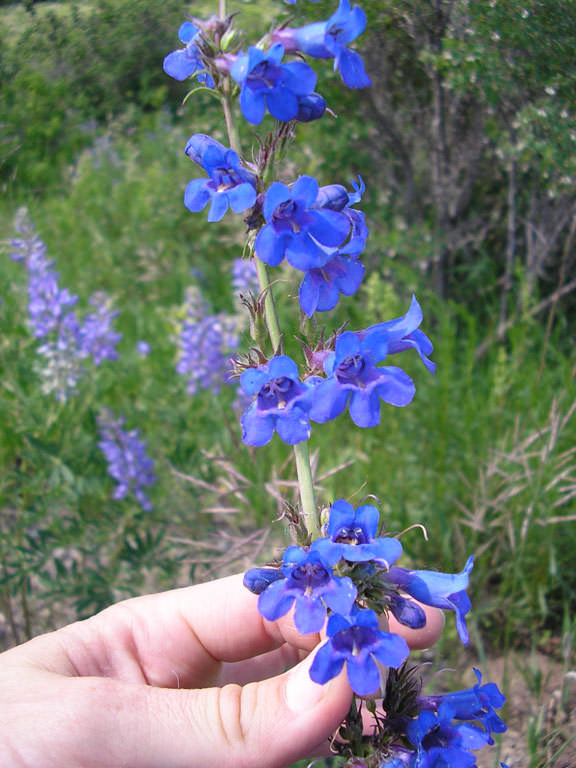
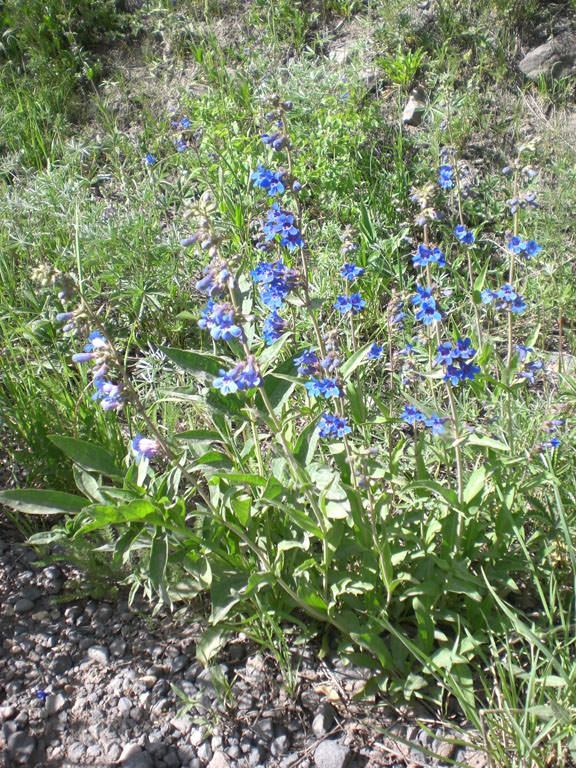
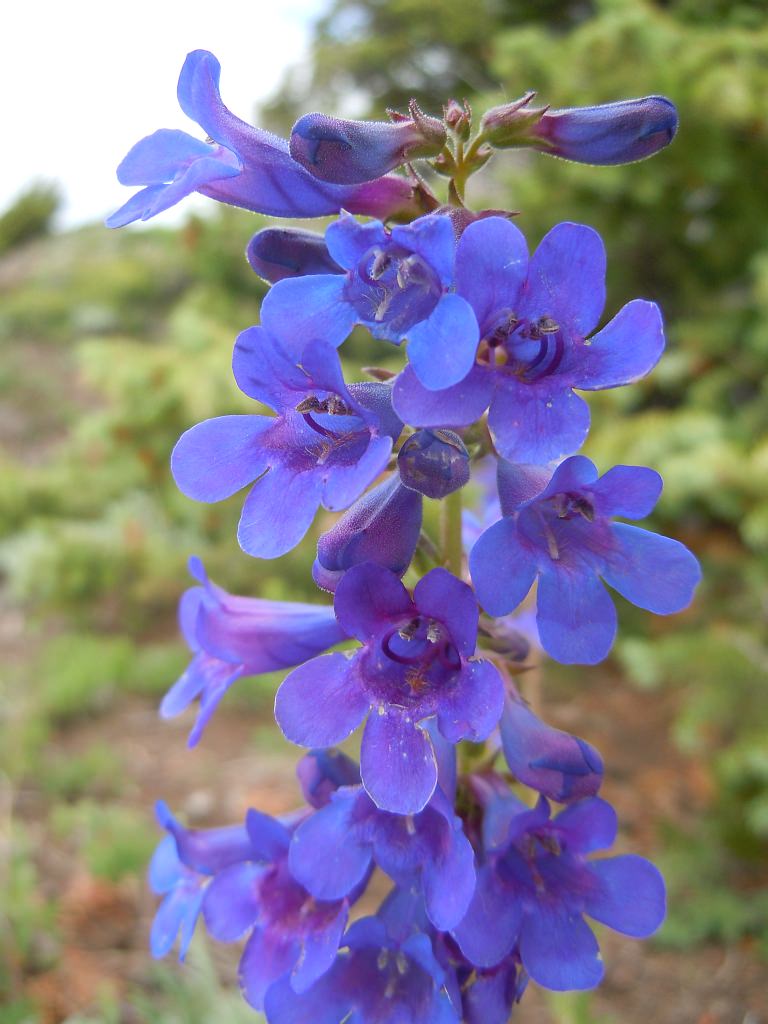
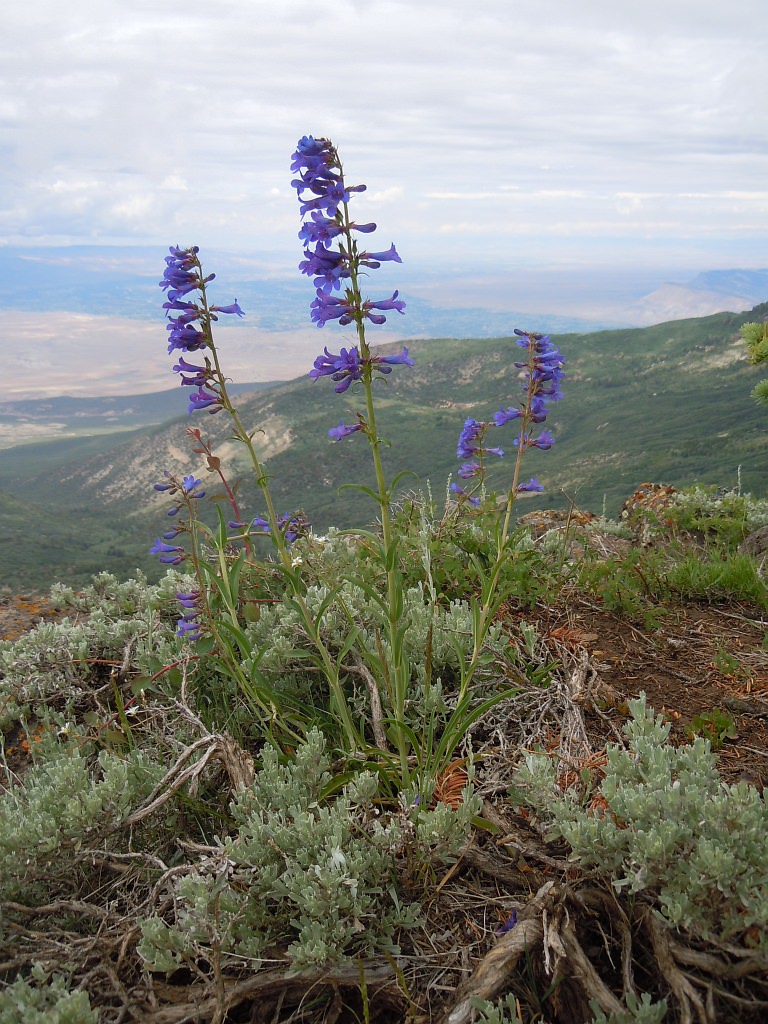
Plants 4-10 dm tall, with one to few, erect stems, glabrous up to the glandular inflorescence. Leave are entire, glabrous. Basal leaves are long, elliptic. Cauline leaves are sessile and oblanceolate. Inflorescence is elongate, slender. Calyx is glandular pubescent, 3-5 mm long. Corolla is dark blue or blue tinged with purple, 14-20 mm long, glandular-pubescent externally, glabrous within. Staminode is included within the corolla throat, and is bearded most of its length. Anther sacs are short-hairy on the side opposite dehiscence (Harrington 1954; Ackerfield 2012).
Look Alikes:
Similar to P. strictus although the corollas are shorter. It is also similar to P. alpinus. The lobes are intermediate between those of P. strictus and P. alpinus, the calyx is covered with a glandular puberulence that extends in a lesser degree to the corolla itself.
Phenology:
Flowers in late June through July, and sets fruit in early August (Colorado Natural Heritage Program 2012).
Habitat
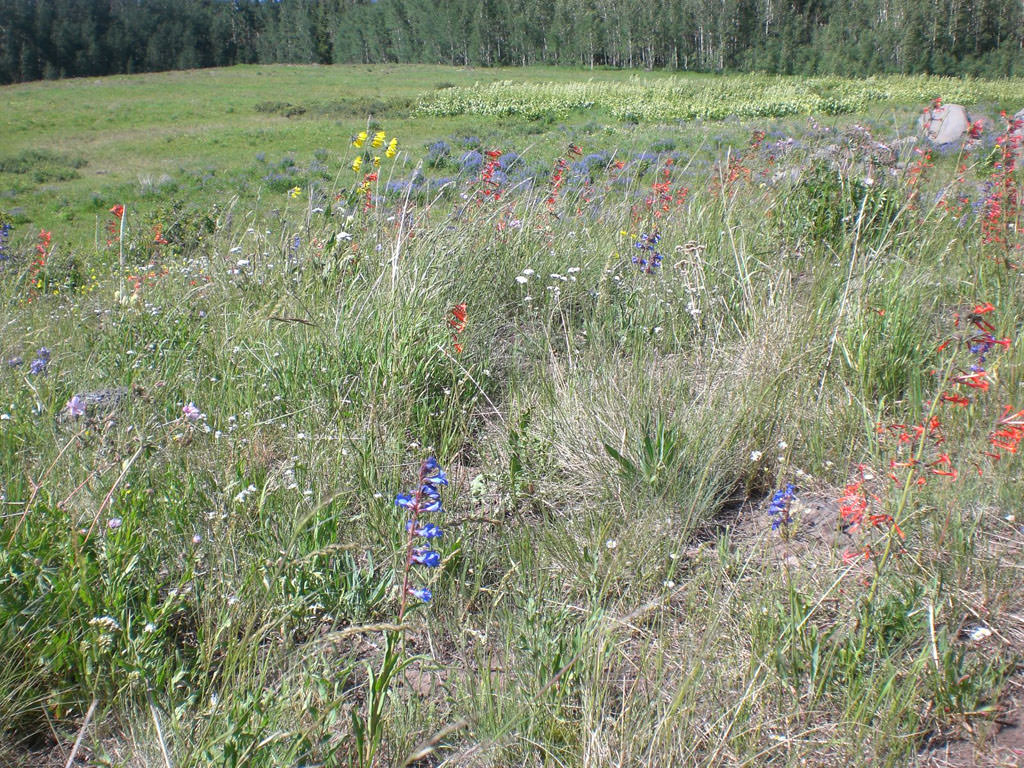
Occurs among oaks, aspens, sagebrush, and in meadows; and thrives in disturbed areas along roads and trails (Harrington 1954, Darrow 2006). Often found in deep clayey loam soils. Associated species include: Rosa woodsii, Cirsium scariosum, Helianthella quinquenervis, Lupinus argenteus, Festuca thurberi, Ipomopsis aggregata, Geranium viscosissimum, Castilleja linarifolia, Geranium richardsonii, Padus virginiana, Rubus parviflora, Symphoricarpos rotundifolious, Potentilla pulcherrima, and Phacelia sericea.
click on image to enlarge
 |
 |
Elevation Range:
6,589 - 11,817 feet (2,008 - 3,602 meters)
Distribution
Colorado Endemic:
Yes
Range:
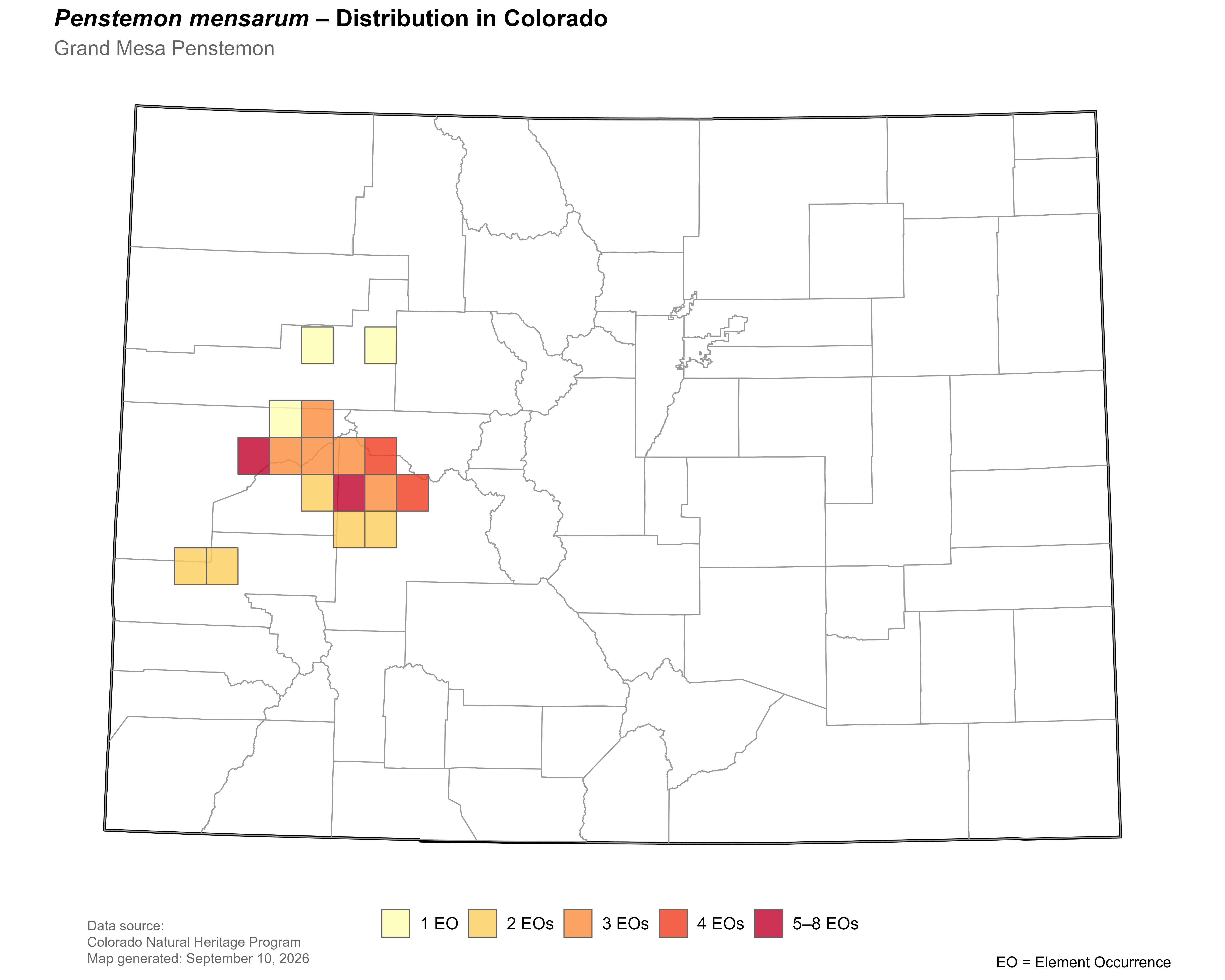
Penstemon mensarum is endemic to Delta, Garfield, Gunnison, Mesa and Montrose counties in western Colorado, USA. Estimated range extent in Colorado of 11,570 square kilometers was calculated in GeoCAT using occurrence data provided by the Colorado Natural Heritage Program (2024).
Click on map to enlarge |
Threats and Management Issues
Road maintenance and competition from invasive plant species are considered to be the primary threats to this species. Incompatible grazing and recreation may also present management issues. Most occurrence records do not report threats. This species is considered to have moderate adaptive capacity and is expected to be slightly to moderately vulnerable to climate change under both RCP 4.5 and 8.5 scenarios, as assessed for the 2025 Colorado State Wildlife Action Plan (CNHP 2025).
References
- Ackerfield, J. 2015. Flora of Colorado. BRIT Press, Botanical Research Institute of Texas, Fort Worth, TX. 818 pp.
- Ackerfield, J. 2022. Flora of Colorado. Second Edition. Bot. Misc. 60. BRIT Press, Fort Worth Botanic Garden/Botanical Research Institute of Texas, U.S.A. 861 pp.
- Colorado Natural Heritage Program (CNHP). 2025. Climate Change Vulnerability Assessment of Colorado Tier 1 and Tier 2 Plant Species of Greatest Conservation Need (SCGN) for the 2025 Colorado State Wildlife Action Plan. Colorado Natural Heritage Program, Colorado State University, Fort Collins.
- Darrow, K. 2006. Wild About Wildflowers; Extreme Botanizing in Crested Butte, Wildflwer Capital of Colorado. WildKat Publishing Co., Glendale, AZ. 224 pp.
- Handwerk, J., L. Grunau, and S. Panjabi. 2015. Colorado Wildlife Action Plan: 2015 Rare Plant Addendum. Colorado Natural Heritage Program, Colorado State University, Fort Collins, Colorado, USA.
- Nold, Robert. 1999. Penstemons. Timber Press, Portland OR. 259 pp.
- Southwest Environmental Information Network (SEINet). 2023. Collections Databases. Online. Available: https://swbiodiversity.org/seinet/collections/index.php (accessed 2023).
- USDA, NRCS. 2022. The PLANTS Database. National Plant Data Team, Greensboro, NC 27401-4901 USA.
- Weber, W. A. and R. C. Wittmann. 2012. Colorado Flora, Western Slope, A Field Guide to the Vascular Plants, Fourth Edition. Boulder, Colorado. 532 pp.