

Scientific Name : Telesonix jamesii
Author : (Torr.) Raf. NatureServe Explorer
Common Name : James' Telesonix
 Current Research Activities


☰ Click link below for details.
Taxonomy
Saxifragaceae (saxifrage family)
Harrington (1954) lists this species under Saxifraga jamesii Torrey. Other synonyms that have been used for the species are Boykinia jamesii (Torrey) Engler and Therofon jamesii (Torrey) Wheelock (Flora of North America Editorial Committee, 1993+). An alternate common name that is used is James' false saxifrage. Until recently, Telesonix heucheriformis has been recognized as a variety of T. jamesii (Beatty, et al., 2004; Flora of North America Editorial Committee, 1993+). That species has violet-purple petals, petals 1.3 times the length of the sepals (1.75 times in T. jamesii), and styles connate for half their length (3/4 in T. jamesii). It is also distributed to the north and west of Colorado (Flora of North America Editorial Committee, 1993+).
Ranks and Status
State Rank : S3
State Rank Reason : There are about 40 occurrences of Telesonix jamesii within five Front Range counties in Colorado, USA. The occurrences are scattered sporadically in the crevices of granite rock faces and talus of the eastern central Rocky Mountains. It is considered extremely vulnerable to the effects of climate change. However, the species habitat affords protection from many anthropogenic threats and some of the occurrences have at least some protection on public lands. Threats to this species vary from site to site depending on land use and access.
U.S. Endangered Species Act : none
Colorado Threatened and Endangered List : none
Other Statuses : none
Description and Phenology
General Description:
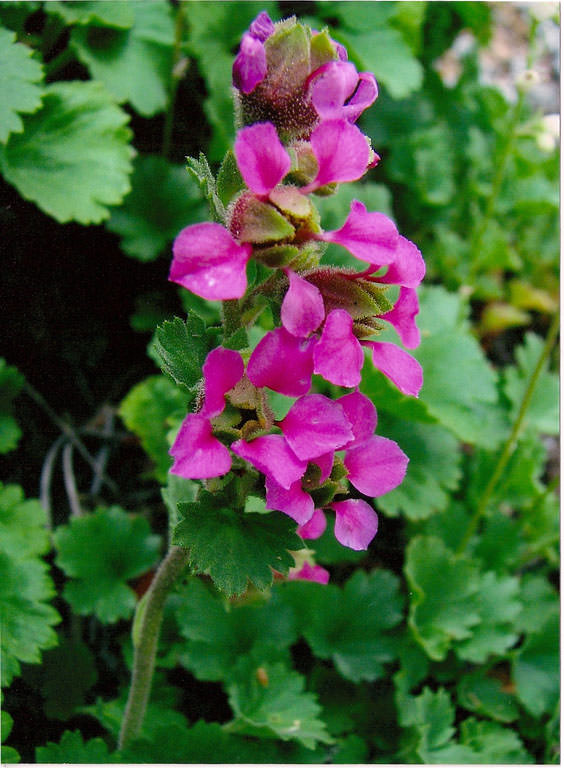
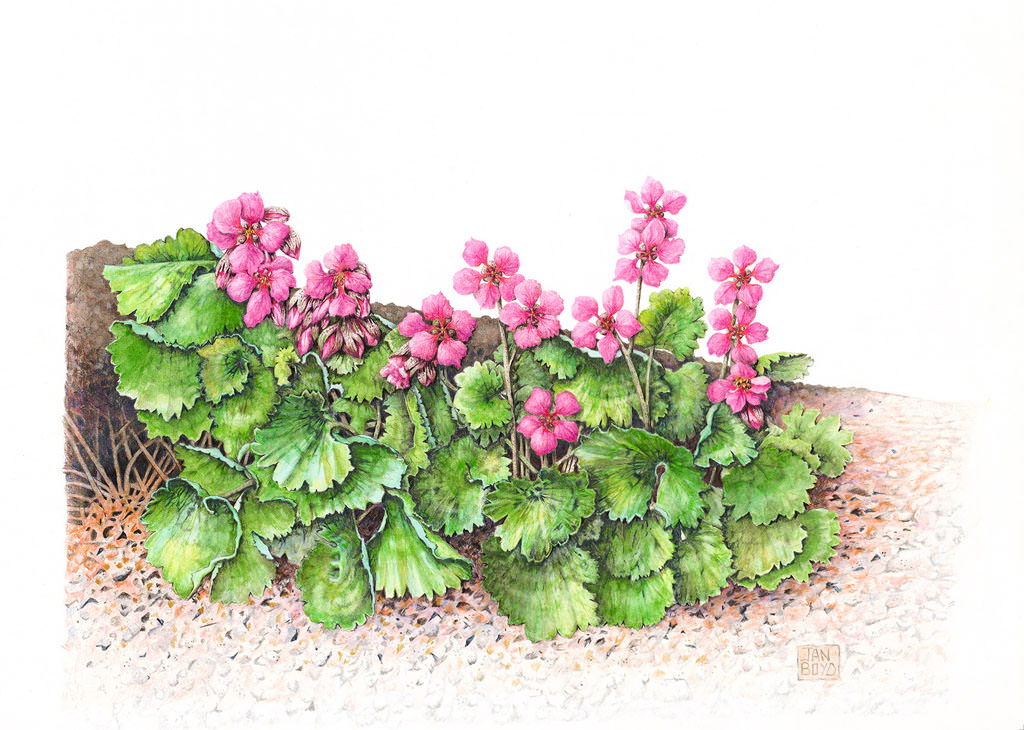
Telesonix jamesii is a perennial herb arising from a scaly, branched rhizome (Beatty, et al., 2004; Flora of North America Editorial Committee, 2009). Leaves in the basal rosette may be up to 70mm (2.75 inches) long and 55mm (2.16 inches) wide. These have long petioles and cordate bases, are kidney-shaped (reniform) or wedge-shaped (broadly cuneate), and have shallow, rounded lobes with rounded marginal teeth (doubly crenate). The alternately arranged stem leaves are similar, but smaller and have shorter petioles. The leaves and stems are glandular pubescent. The flowering stems (scapes) are up to 25.4cm (10 inches) tall (pers. obs. S. Olson), although 18cm (7.1 inches) is the tallest noted in most available manuals. The general appearance of individual flowers is round to about 1cm (0.39 in.) in diameter (Kelso, et al., 2010). Individual flowers have five petals that are 7 to 11mm (0.28 to 0.43 inch) by 4 to 7 mm (0.15 to 0.28 inch) with a narrow stalk (claw) at their base up to 3mm (0.12 inch) long. Their color is described as crimson-purple in FNA (2009), but has been called rosy to magenta pink (Kelso, et al., 2010). Flowers are arranged in paniculate cymes, appearing crowded and cylindrical. Fruit is an ovoid capsule containing 50 to 100 brown, smooth, oblong seeds (Beatty, et al., 2004).
Look Alikes:
Telesonix jamesii is not likely to be confused with other taxa when it is in flower. A few other saxifrages have dark green foliage, but lack the glandular pubescence and distinct leaf shape of this species.
Phenology:
Annual growth begins between late April and early June depending on elevation (pers. comm. S. Olson). Flowers appear in July and August (Beatty, et al., 2004). Fruits are present from August through October.
 |
Habitat
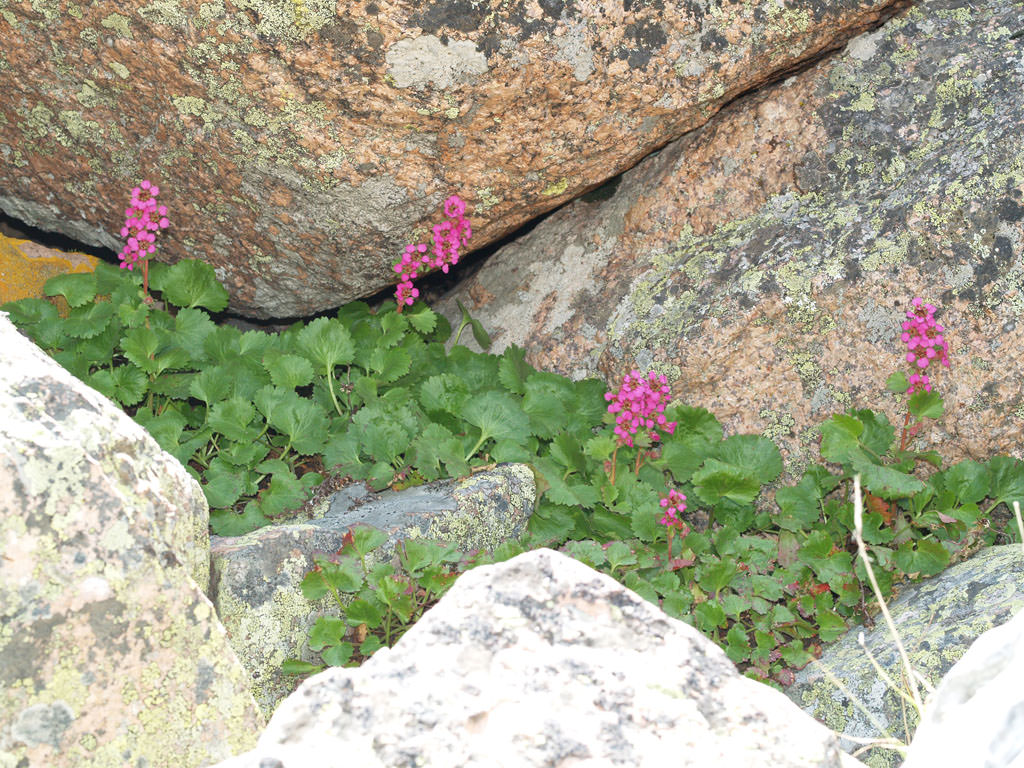
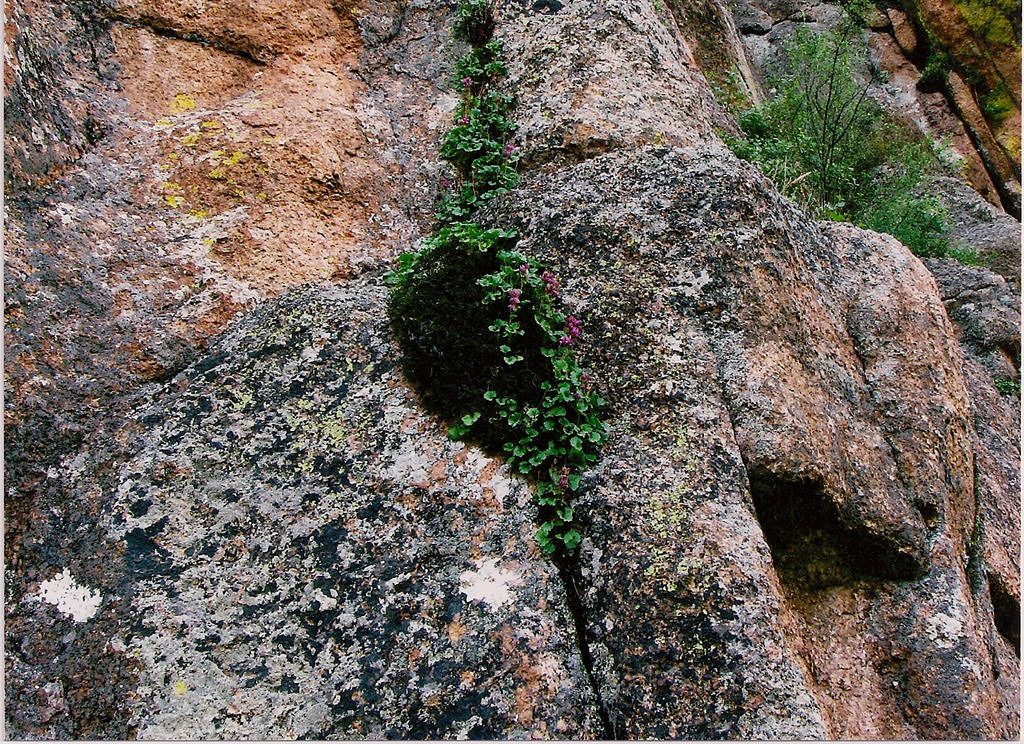
Telesonix jamesii occurs from montane to alpine climate zones. It is found on cliffs, ledges, rock outcrops, boulders and scree slopes. Plants have been observed on all aspects, and on flat to vertical slopes (cliffs). Populations occur in alpine areas and in coniferous or aspen forests with varying amounts of shade (Beatty, et al., 2004). Most sites are on Pikes Peak granite, but the few populations in Rocky Mountain National Park are on Precambrian gneisses and schist. The local moisture regimes can be mesic to xeric. In wooded areas, this species has been found under limber pine (Pinus flexilis), lodgepole pine (P. contorta), bristlecone pine (P. aristata), ponderosa pine (P. ponderosa), Engelmann spruce (Picea engelmannii), and Douglas-fir (Pseudotsuga menziesii). Shrubby associates include fivepetal cliffbush (Jamesia americana), wax currant (Ribes cereum), common juniper (Juniperus communis), and shrubby cinquefoil (Dasiphora fruticosa ssp. floribunda). Graminoids associating with Telesonix include curly sedge (Carex rupestris), Bellardi bog sedge (Kobresia myosuroides), spike trisetum (Trisetum spicatum), and alpine fescue (Festuca brachyphylla). A wide variety of forbs may associate with Telesonix as well, including Hall's beardtongue (Penstemon hallii), Colorado blue columbine (Aquilegia coerulea), Front Range alumroot (Heuchera hallii), Fendler's sandwort (Arenaria fendleri), and Ross' avens (Geum rossii) (Colorado Natural Heritage Program 2012; Clark, et al., 2010).
click on image to enlarge
 |
Elevation Range:
6,734 - 13,727 feet (2,052 - 4,184 meters)
Distribution
Colorado Endemic:
No
Range:
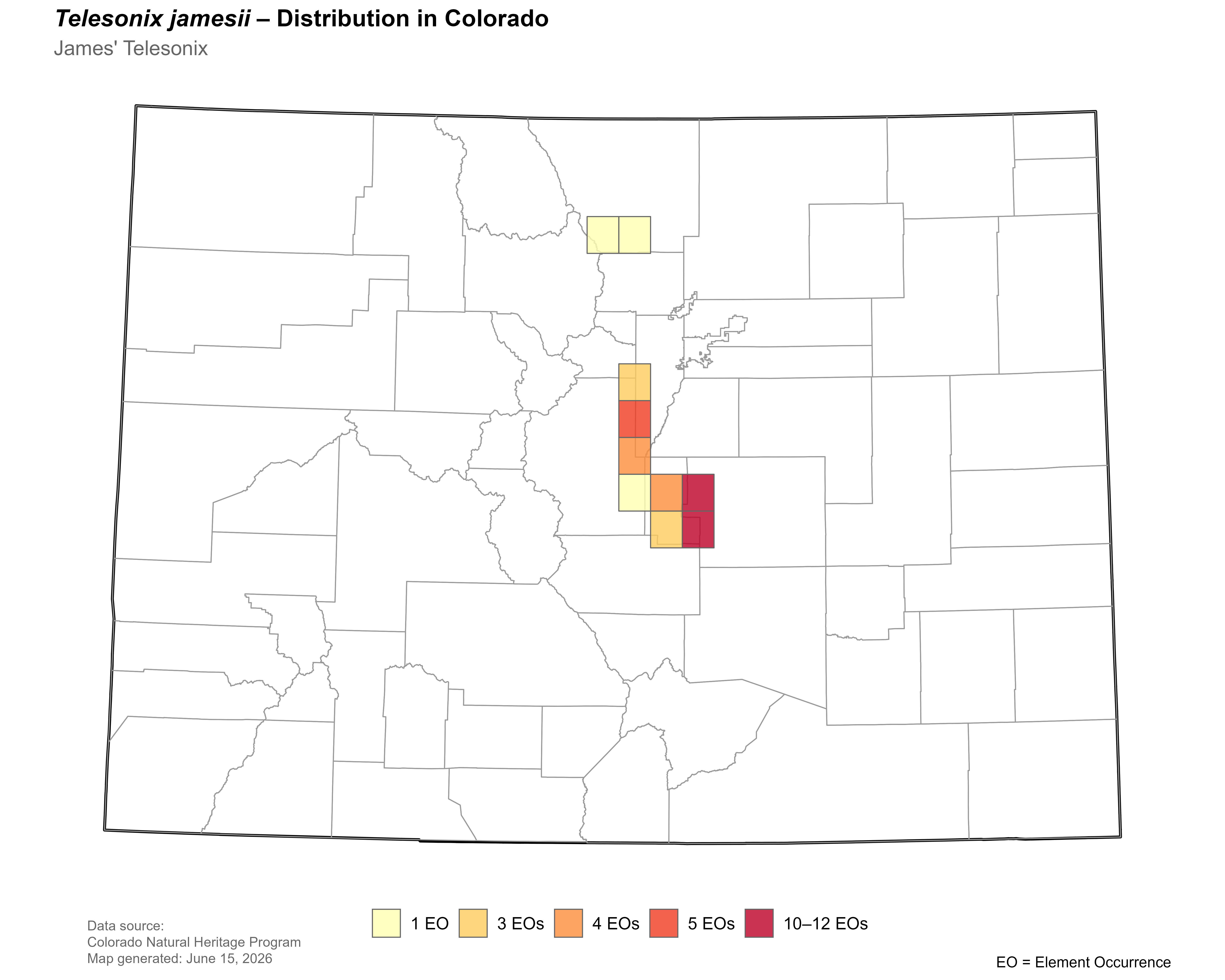
Telesonix jamesii is known from El Paso, Jefferson, Larimer, Park, and Teller counties in Colorado, USA. Estimated range extent in Colorado of 5817 square kilometers was calculated in GeoCAT using occurrence data provided by the Colorado Natural Heritage Program (2026) and research grade unobscured observations from iNaturalist (2026). This species can also be found in New Mexico, USA.
Click on map to enlarge |
Threats and Management Issues
Overall, most of the Colorado occurrences are within fairly pristine settings in mostly protected (granite outcrops) habitats on public lands, where threats are relatively low (Rondeau et al. 2011). Some occurrences are on private land where development or expansion of reservoirs could impact the species negatively. Human-related activities such as off-road vehicle (ORVs) and off trail recreation (climbers, hikers), trail or road construction and maintenance, changes to natural disturbance regimes resulting in succession, invasive species introduction, and horticultural collection threaten Telesonix jamesii populations and habitat. Those populations closest to roads, trails, or other human-related structures (e.g.., radio towers, reservoirs) are likely at the most risk, due to erosion and sedimentation, rock slides, and alterations to site hydrology. Potential environmental or biological threats to populations or habitats of T. jamesii could include excessive herbivory, inadequate pollination, genetic isolation, and genetic interaction with cultivated varieties of this species (Beatty et al. 2004). Telesonix jamesii is considered extremely vulnerable to climate change effects as documented in the Colorado State Wildlife Action Plan (Colorado Parks and Wildlife 2015; Handwerk et al. 2015).
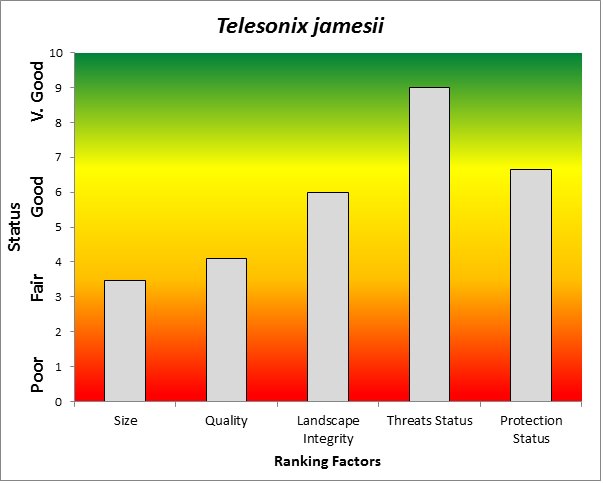
Summary results of an analysis of the status of Telesonix jamesii based on several ranking factors. This species was concluded to be Effectively Conserved. From Rondeau et al. 2011. |
References
- Ackerfield, J. 2012. The Flora of Colorado. Colorado State University Herbarium. 433 pp.
- Ackerfield, J. 2015. Flora of Colorado. BRIT Press, Botanical Research Institute of Texas, Fort Worth, TX. 818 pp.
- Beatty, B.L., W.F. Jennings, and R.C. Rawlinson. 2004b. Telesonix jamesii (Torr.) Raf. (James' telesonix): a technical conservation assessment. USDA Forest Service, Rocky Mountain Region. Online. Available: http://www.fs.fed.us/r2/projects/scp/assessments/telesonixjamesii.pdf (Accessed 2006).
- Clark, D., L. Yeatts, and M. Gellner. 2010. 2009 floristic inventory of the Alpine Lab site on Windy Point, and neighboring environs on Pikes Peak. Report submitted to Pike-San Isabel National Forests from Kathryn Kalmbach Herbarium, Denver Botanic Garden, Denver, CO. 13 pp. + appendices.
- Colorado Natural Heritage Program. 2021. Biodiversity Tracking and Conservation System (BIOTICS). Colorado Natural Heritage Program, Colorado State University, Fort Collins.
- Colorado Parks and Wildlife (CPW). 2015. Colorado's 2015 State Wildlife Action Plan.
- Cronquist, A., A.H. Holmgren, N.H. Holmgren, J.L. Reveal, P.K. Holmgren. 1997. Intermountain Flora, Volume 3, Part A Subclass Rosidae (except Fabales). The New York Botanical Gardens. Bronx, New York. 446 pp.
- Flora of North America Editorial Committee (FNA). 2009. Flora of North America north of Mexico. Vol. 8. Magnoliophyta: Paeoniaceae to Ericaceae. Oxford University Press, New York. xxiv + 585 pp.
- Handwerk, J., L. Grunau, and S. Panjabi. 2015. Colorado Wildlife Action Plan: 2015 Rare Plant Addendum. Colorado Natural Heritage Program, Colorado State University, Fort Collins, Colorado, USA.
- Harrington, H.D. 1954. Manual of the plants of Colorado. Sage Press, Chicago. 666 pp.
- Kelso, T., A. Markstein, and G. Maentz. 2010. Flora of the Pikes Peak region: volume 9. Department of Biology, Colorado College, Colorado Springs, CO. 58 pp.
- Lavender, A.E., M.M. Fink, S.E. Linn, D.M. Theobald. 2011. Colorado Ownership, Management, and Protection v9 Database. Colorado Natural Heritage Program and Geospatial Centroid, Colorado State University, Fort Collins, CO. (30 September).
- Neely, B., S. Panjabi, E. Lane, P. Lewis, C. Dawson, A. Kratz, B. Kurzel, T. Hogan, J. Handwerk, S. Krishnan, J. Neale, and N. Ripley. 2009. Colorado Rare Plant Conservation Strategy, Developed by the Colorado Rare Plant conservation Initiative. The Nature Conservancy, Boulder, Colorado, 117 pp.
- Rondeau, R., K. Decker, J. Handwerk, J. Siemers, L. Grunau, and C. Pague. 2011. The state of Colorado's biodiversity 2011. Prepared for The Nature Conservancy. Colorado Natural Heritage Program, Colorado State University, Fort Collins, Colorado.
- Southwest Environmental Information Network (SEINet). 2021. Collections Databases. Online. Available: https://swbiodiversity.org/seinet/collections/index.php (accessed 2021).
- USDA, NRCS. 2022. The PLANTS Database. National Plant Data Team, Greensboro, NC 27401-4901 USA.
- Weber, W. A. and R. C. Wittmann. 2012. Colorado Flora, Eastern Slope, A Field Guide to the Vascular Plants, Fourth Edition. Boulder, Colorado. 555 pp.