

Scientific Name : Potentilla rupincola
Author : Osterhout NatureServe Explorer
Common Name : Rocky Mountain Cinquefoil
 Current Research Activities
 1997 profile
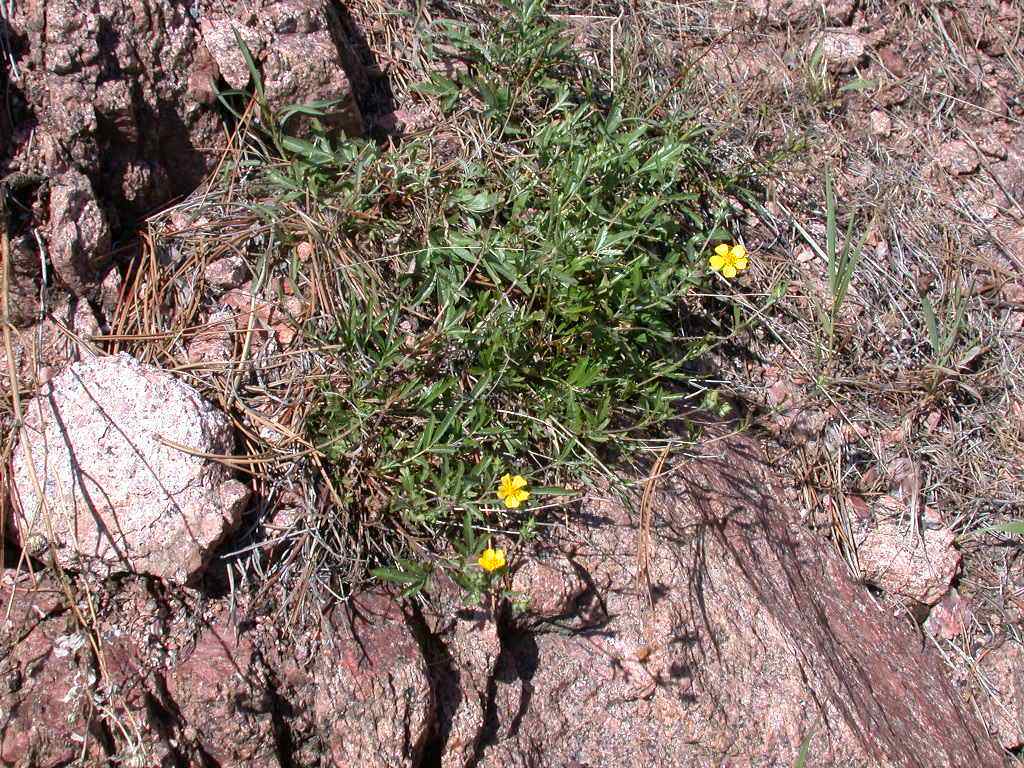
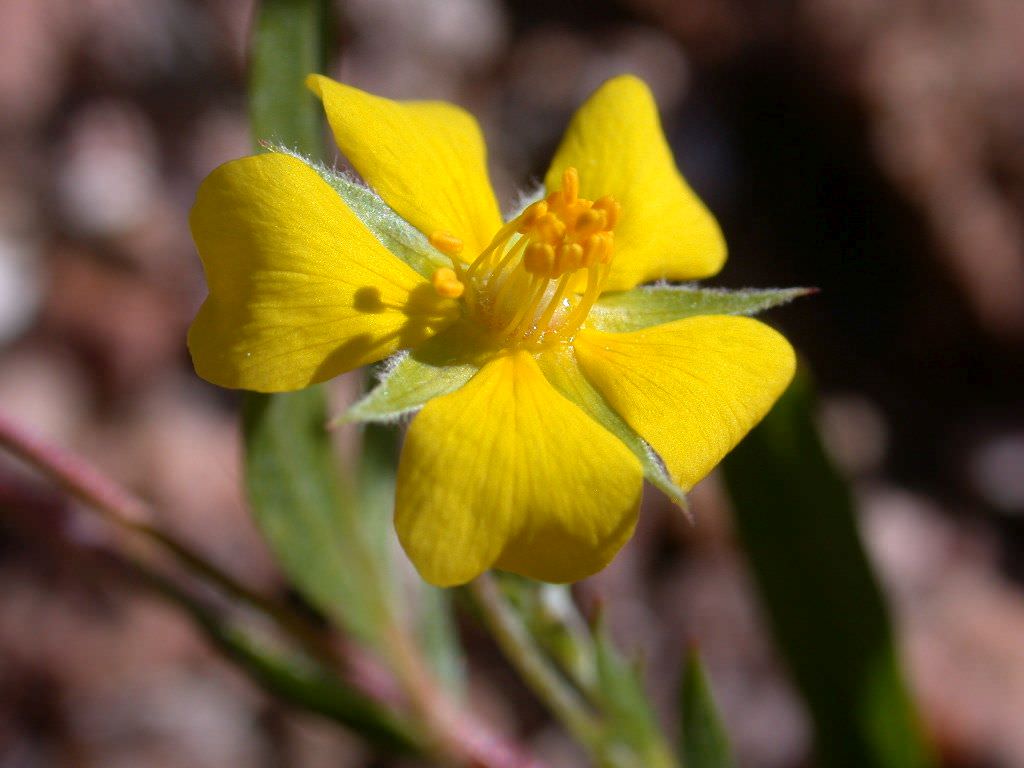


☰ Click link below for details.
Taxonomy
Rosaceae (rose family)
Ackerfield (2015, 2022) and Weber and Wittmann (2012) list this taxon as Potentilla rupincola Osterhout. The Flora of North America (1993+) lists this as P. effusa var. rupincola. Potentilla rupincola may hybridize with P. effusa when they are found together (Weber and Wittmann 2012).
Ranks and Status
State Rank : S2
State Rank Reason : Potentilla rupincola is considered endemic to the northern Front Range of Colorado, USA. Although it is known from 31 occurrences, 18 are of unknown viability or have not been observed in over 20 years. Threats include incompatible livestock grazing, recreational use, fragmentation from roads and road maintenance, hybridization with other Potentilla sp. and competition from non-native plant species, however, Potentilla rupincola is afforded some protections from these threats due to the inaccessibility of its habitat, and the unsuitability of its habitat for development and grazing. Potentilla rupincola is considered to be slightly to moderately vulnerable to the effects of climate change.
U.S. Endangered Species Act : none
Colorado Threatened and Endangered List : none
Other Statuses : SWAP Tier 1, USFS
Description and Phenology
General Description:
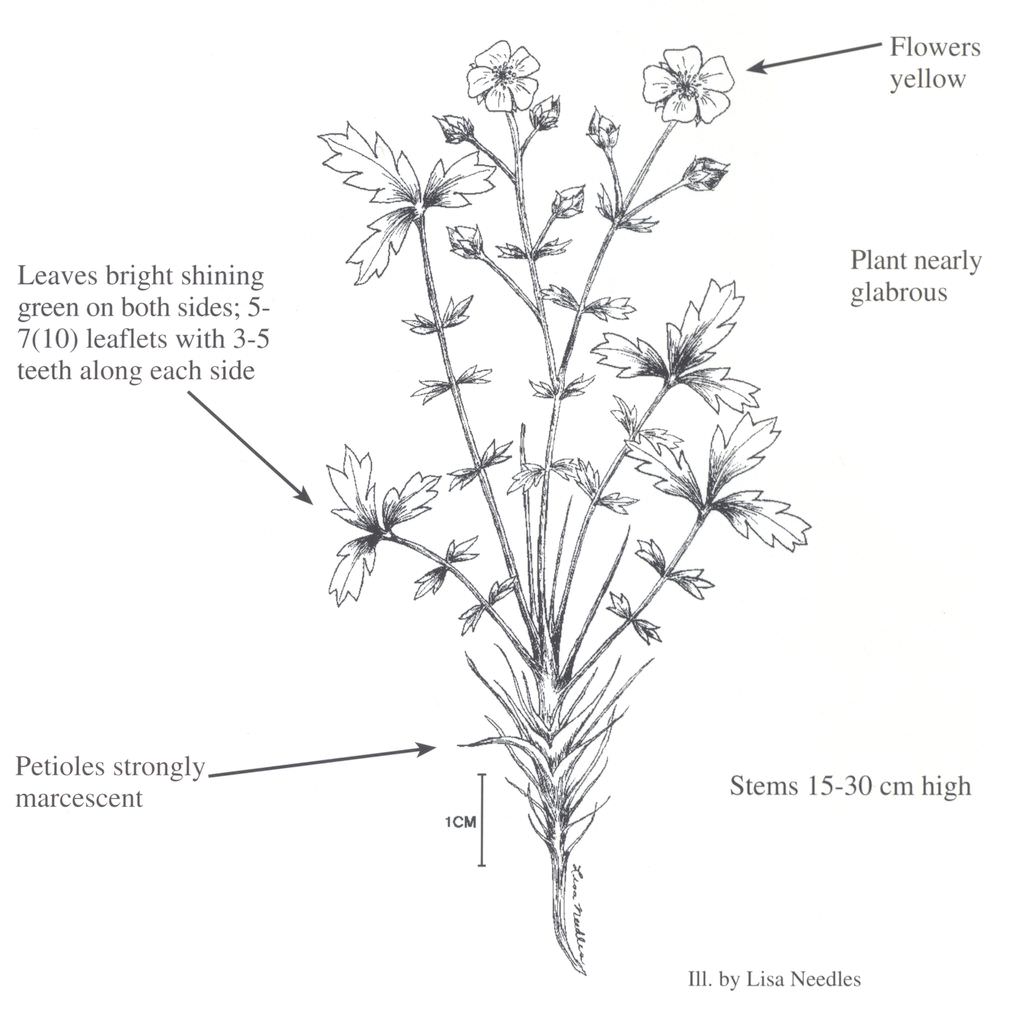
Leaflets ± green, teeth 25 per side, abaxial surfaces sparsely to moderately long-hairy at least on veins, not or sparsely cottony, adaxial glabrous or sparsely long-hairy and/or cottony. Flowers: epicalyx bractlets and sepals mostly glabrate or glabrous except proximally; anthers 0.50.6(0.7) mm (Flora of North America 1993+). Positive identification can be made by examining style attachment in relation to ovary. P. effusa var. rupincola has the style attachment near the apex. However, identification may also be made by vegetative characteristics. Glabrous characteristics may distinguish rupincola from effusa. Rupincola also has bright green leaves as opposed to effusa's light green leaves. P. effusa var. rupincola represents the end of a series leading to rockier, better-drained habitats (Johnston 1980).
Look Alikes:
Except for the near lack of tomentum or other pubescence, P. rupincola greatly resembles in all other characters the typical form of P. effusa; it represents the end of a series in pubescence density from the typical form through the light-green form (coloradensis) to rupincola. It should also be noted that rupincola represents the end of a series leading to rockier, better-drained habitats (Johnston 1980).
Phenology:
Flowering occurs from mid-June until late August.
 |
Habitat
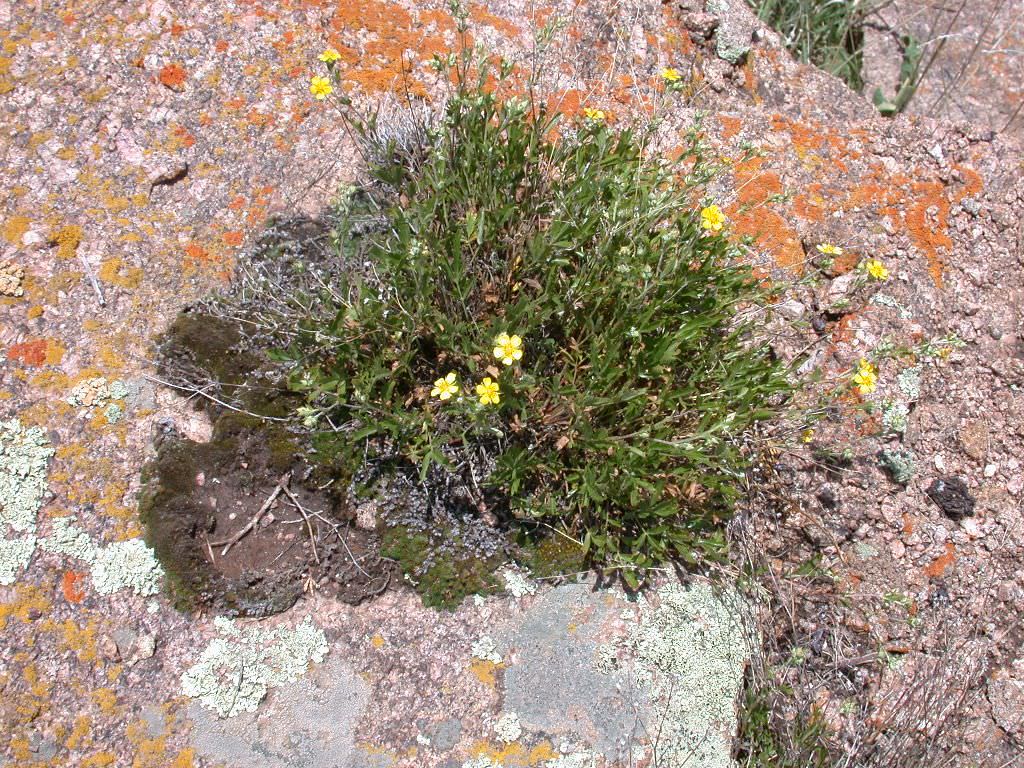
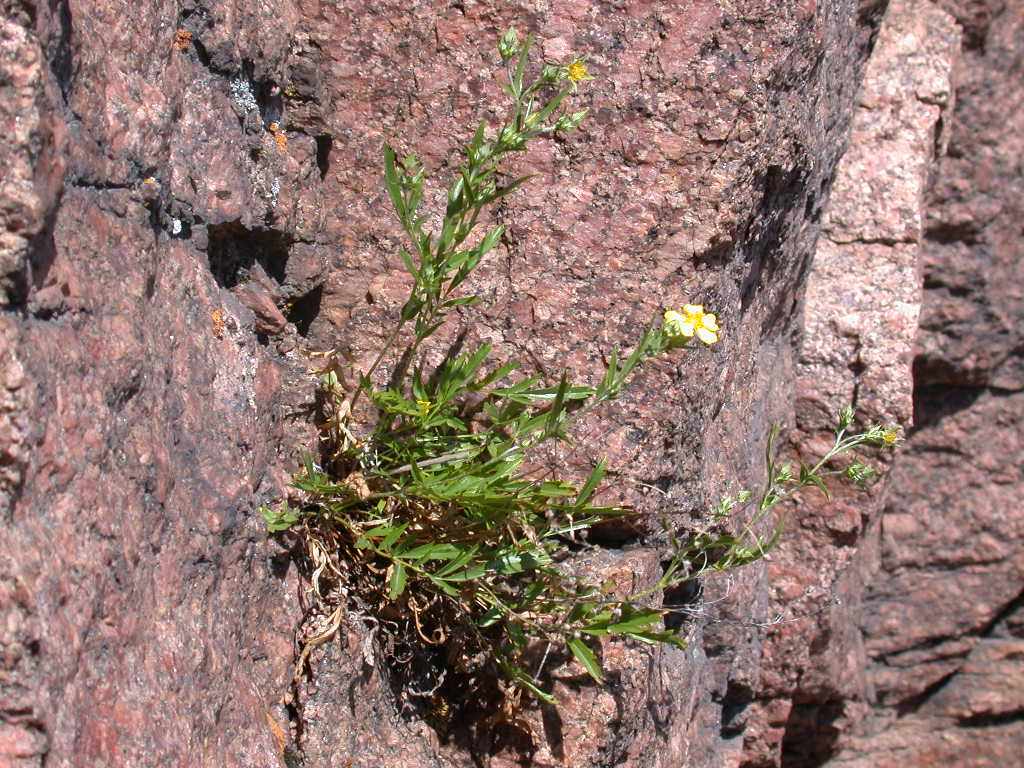
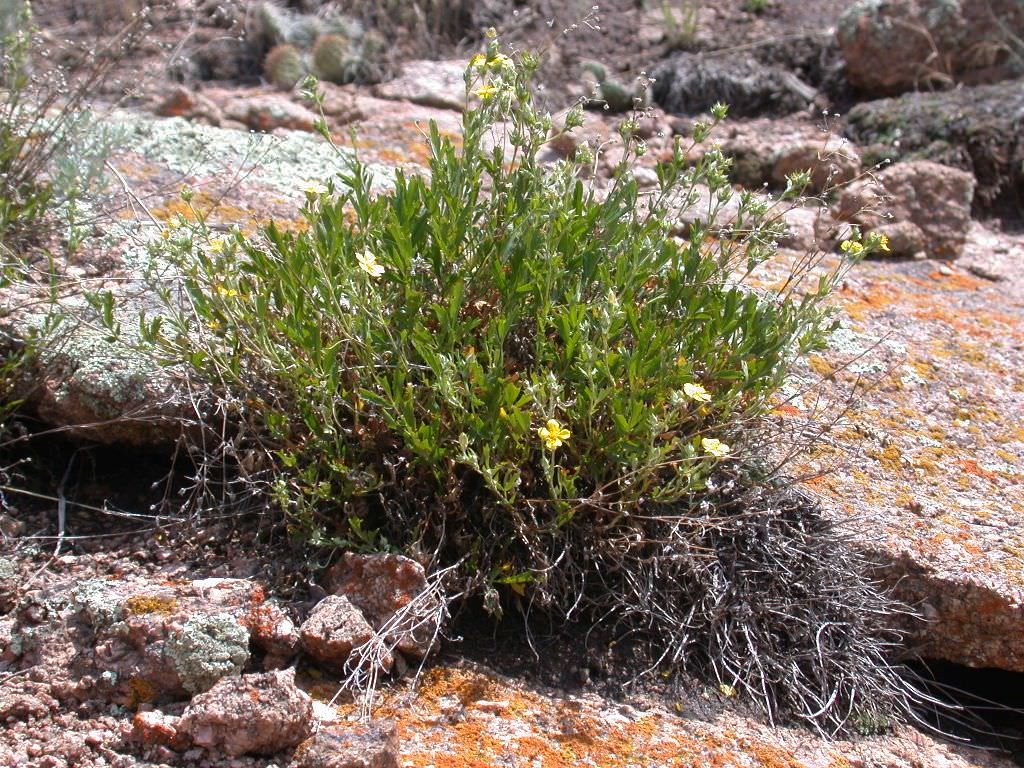
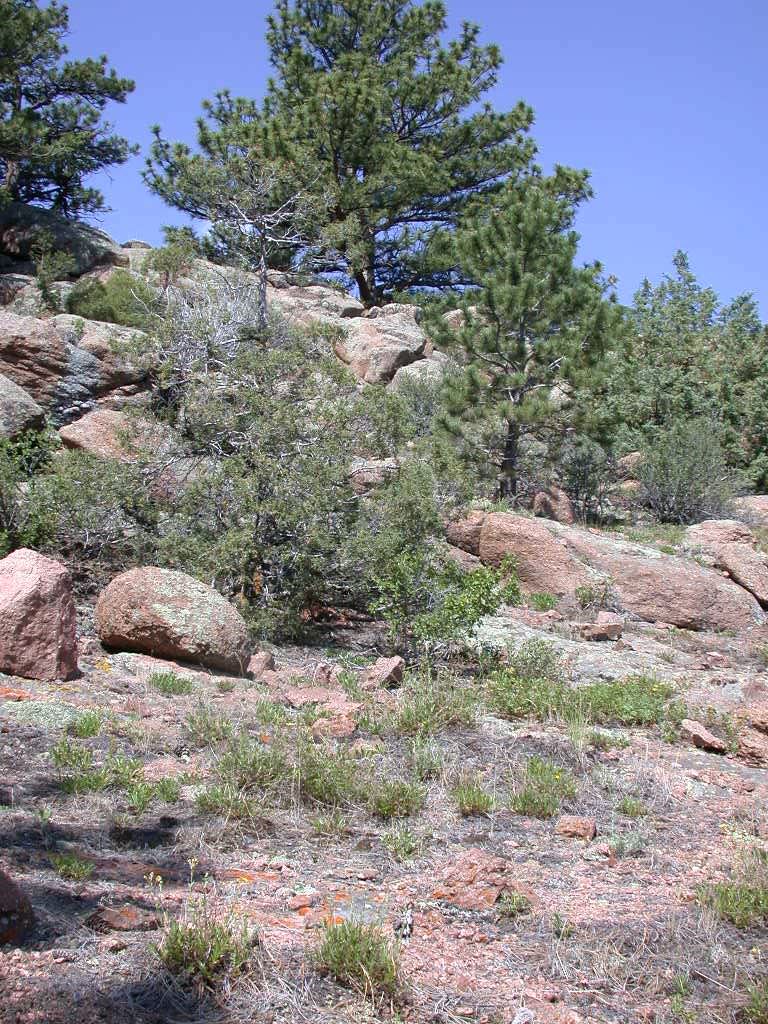
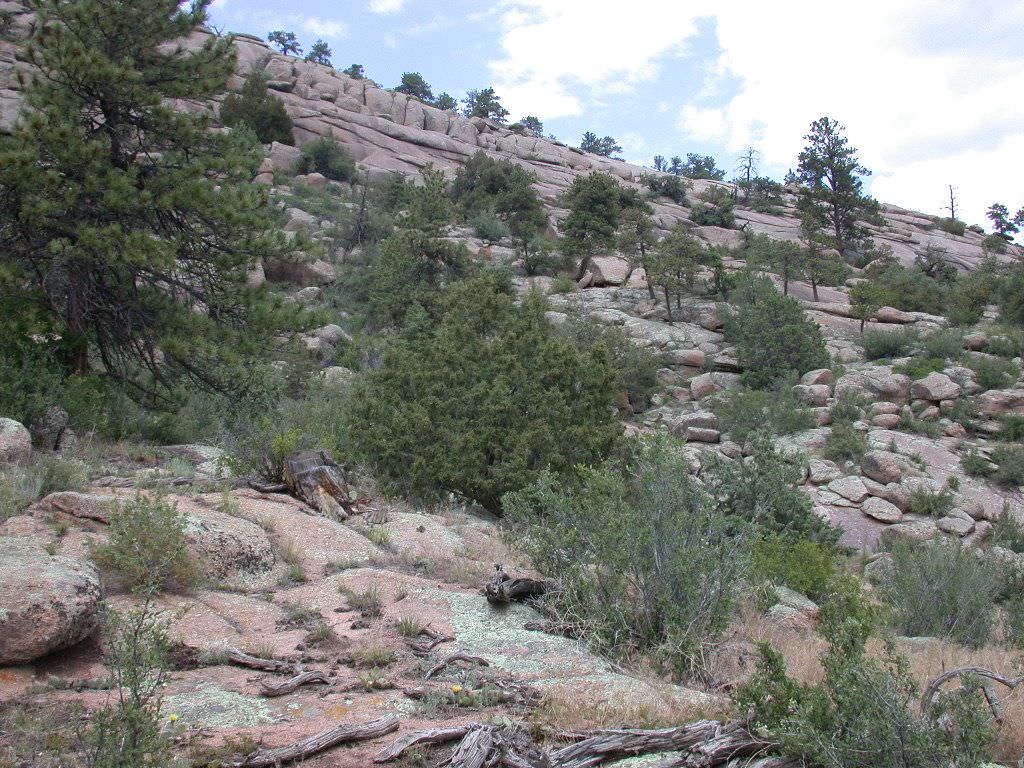
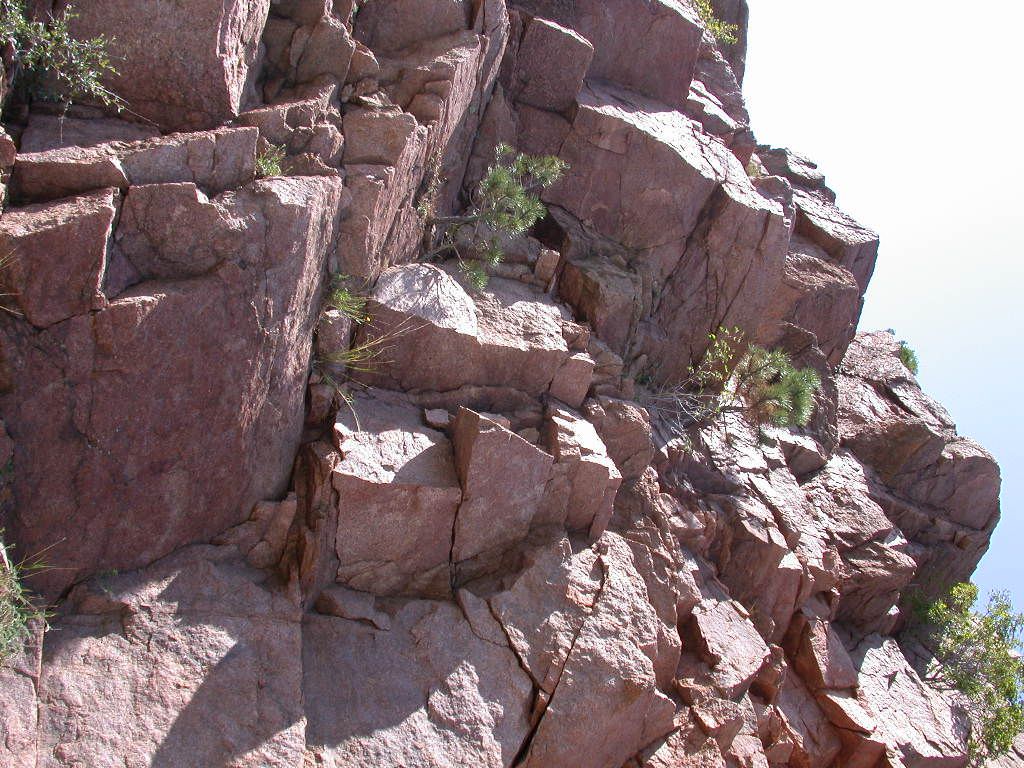
Generally found on granite shelves, in crevices of granite rock outcrops, and on cliff faces. Almost exclusively on granite or metamorphic rocks with composition similar to granite (e.g., schist), or in shallow (<25 cm) soils derived from such rocks, within small soil patches on or adjacent to outcrops. Soil when present is coarse (loamy sand or sandy loam, often gravelly), and is dry and excessively drained. Plants are also sometimes found in sparsely forested sites with thin soil, most often on the margin of forests in areas too rocky to support trees rather than within the forests. Sites are typically exposed and windswept (often west or north exposure), supporting open forests or parklands of Pinus flexilis (limber pine), Pinus ponderosa (ponderosa pine), or Pinus aristata (bristlecone pine). Plants most often grow in open sites accompanied by few other vascular plant species, but they are also found in the shade of trees and shrubs. Also documented on roadcuts. Lower montane foothills to subalpine sites near treeline. Associated species include Aletes humilis, Drymocallis fissa, Potentilla effusa, Jamesia americana, Amerosedum lanceolatum, Ribes sp. Penstemon virens, Heuchera sp., Ranunculus ranunculinus, Physocarpus monogynus, Leucopoa kingii, Poa fernaldicina, Pseudotsuga menziesii, Juniperus communis, Artemisia frigida, Geranium caespitosum, Harbouria trachypleura, Arctostaphylos uva-ursi, Purshia tridentata, Oreocarya virgata, Achillea millefolium, Muhlenbergia montana, M. fuliculmis. Draba streptocarpa, Ciliaria austromontana, and Gilia pinnatifida.
click on image to enlarge
 |
 |
 |
Elevation Range:
6,461 - 10,926 feet (1,969 - 3,330 meters)
Distribution
Colorado Endemic:
Yes
Range:
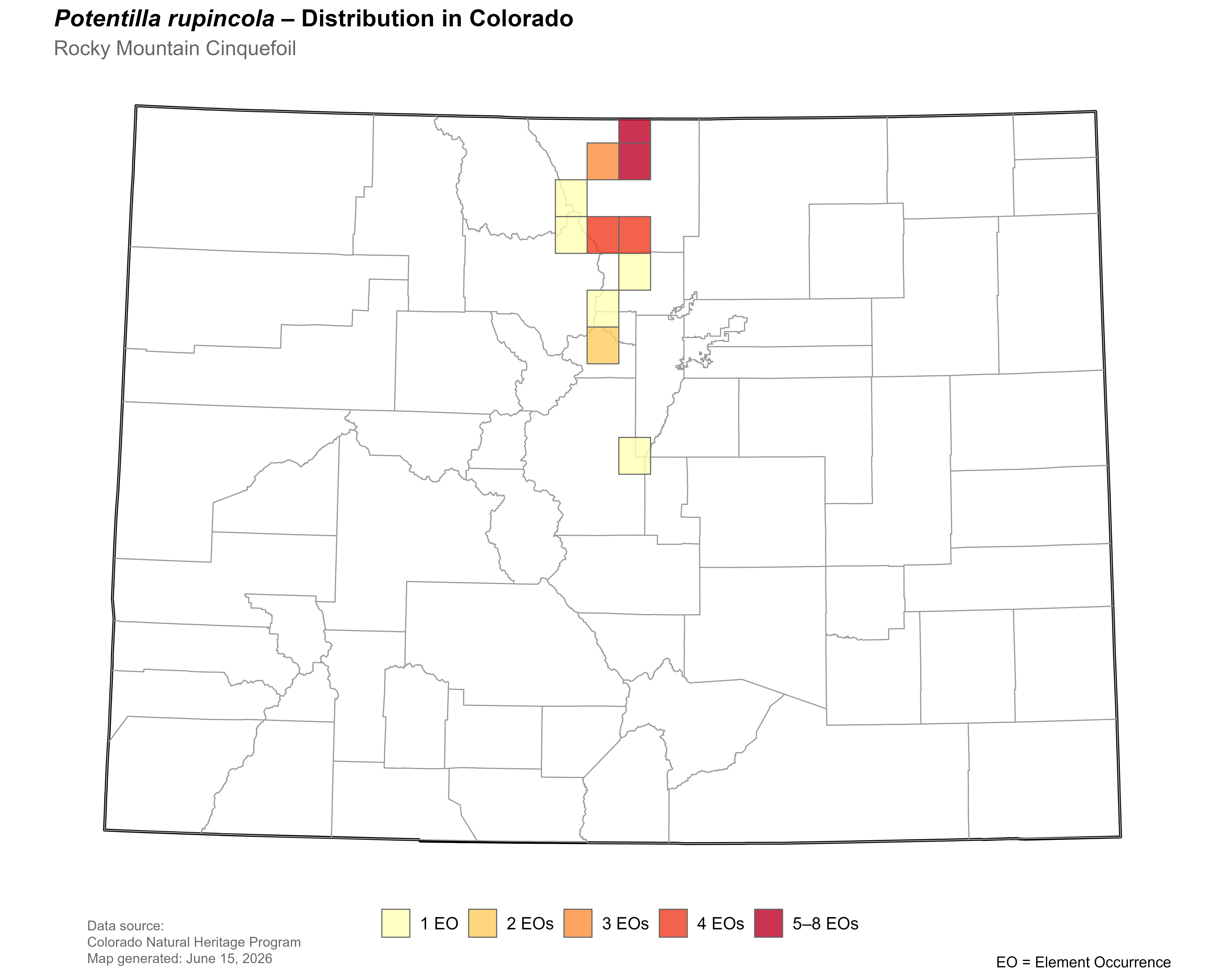
Potentilla rupincola is a Colorado (USA) endemic; known from Boulder, Clear Creek, Larimer and Park counties. Estimated range extent in Colorado of 5314 square kilometers was calculated in GeoCAT using occurrence data provided by the Colorado Natural Heritage Program (2023).
Click on map to enlarge |
Threats and Management Issues
Observed threats include incompatible livestock grazing, recreational use, fragmentation from roads and road maintenance, hybridization with other Potentilla sp. and competition from non-native plant species. Invasive plant species including Bromus tectorum and Cirsium arvense have been documented at several of the occurrences. Nearly 25% of occurrences report hybridization with P. effusa. Other localized threats include mining of moss rock and residential development. In general, threats to Potentilla rupincola resulting from human activities are minor due to the inaccessibility of its habitat, the lack of mineral resources at known occurrences, and the unsuitability of its habitat for development and grazing (Anderson 2004). This species is considered to have moderate adaptive capacity and is expected to be slightly to moderately vulnerable to climate change under both RCP 4.5 and 8.5 scenarios, as assessed for the 2025 Colorado State Wildlife Action Plan (CNHP 2025).
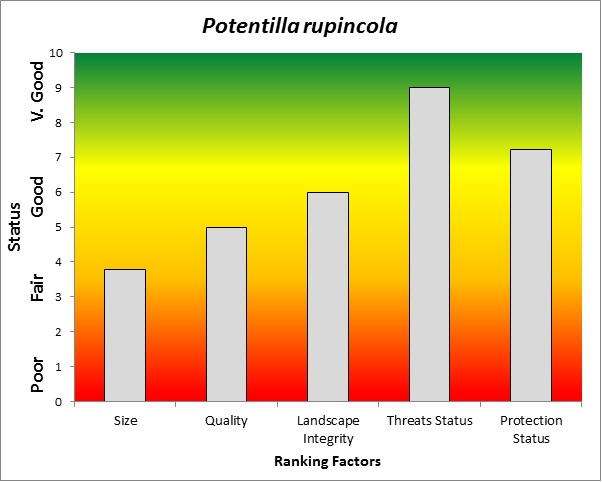
Summary results of an analysis of the status of Potentilla rupincola based on several ranking factors. This species was concluded to be Effectively Conserved. From Rondeau et al. 2011. |
References
- Ackerfield, J. 2015. Flora of Colorado. BRIT Press, Botanical Research Institute of Texas, Fort Worth, TX. 818 pp.
- Ackerfield, J. 2022. Flora of Colorado. Second Edition. Bot. Misc. 60. BRIT Press, Fort Worth Botanic Garden/Botanical Research Institute of Texas, U.S.A. 861 pp.
- Anderson, D.G. 2004. Potentilla rupincola Osterhout (rock cinquefoil): a technical conservation assessment. USDA Forest Service, Rocky Mountain Region. Online. Available: http://www.fs.fed.us/r2/projects/scp/assessments/potentillarupincola.pdf (Accessed 2006).
- Colorado Natural Heritage Program (CNHP). 2023. Biodiversity Tracking and Conservation System (Biotics 5). Colorado Natural Heritage Program, Colorado State University, Fort Collins.
- Colorado Natural Heritage Program (CNHP). 2025. Climate Change Vulnerability Assessment of Colorado Tier 1 and Tier 2 Plant Species of Greatest Conservation Need (SCGN) for the 2025 Colorado State Wildlife Action Plan. Colorado Natural Heritage Program, Colorado State University, Fort Collins.
- Flora of North America Editorial Committee, ed. (FNA). 1993+. Flora of North America North of Mexico. Oxford Univ. Press, New York, Oxford.
- Flora of North America Editorial Committee. 2014. Flora of North America North of Mexico. Vol. 9. Magnoliophyta: Picramniaceae to Rosaceae. Oxford University Press, New York. xxiv + 713 pp.
- Handwerk, J., L. Grunau, and S. Panjabi. 2015. Colorado Wildlife Action Plan: 2015 Rare Plant Addendum. Colorado Natural Heritage Program, Colorado State University, Fort Collins, Colorado, USA.
- Johnston, B.C. 1980. Studies of population variability leading to a new classification of Potentilla sect. Multijugae (Rosaceae). MS Thesis, University of Colorado, Boulder, CO.
- Johnston, B.C. 1980. Studies of population variability leading to a new classification of Potentilla sect. Multijugae (Rosaceae). MS Thesis, University of Colorado, Boulder, CO.
- Neely, B., S. Panjabi, E. Lane, P. Lewis, C. Dawson, A. Kratz, B. Kurzel, T. Hogan, J. Handwerk, S. Krishnan, J. Neale, and N. Ripley. 2009. Colorado Rare Plant Conservation Strategy, Developed by the Colorado Rare Plant conservation Initiative. The Nature Conservancy, Boulder, Colorado, 117 pp.
- O'Kane, S. L. 1988. Colorado's Rare Flora. Great Basin Naturalist. 48(4):434-484.
- Osterhout, G.E. 1899. New plants from Colorado. Bull. Torr. Botany Club 26: 256-257.
- Osterhout, G.E. 1899. New plants from colorado. Bull. Torr. Botany club. V. 26. Pgs. 256-257.
- Rondeau, R., K. Decker, J. Handwerk, J. Siemers, L. Grunau, and C. Pague. 2011. The state of Colorado's biodiversity 2011. Prepared for The Nature Conservancy. Colorado Natural Heritage Program, Colorado State University, Fort Collins, Colorado.
- Spackman, S., B. Jennings, J. Coles, C. Dawson, M. Minton, A. Kratz, and C. Spurrier. 1997. Colorado rare plant field guide. Prepared for Bureau of Land Management, U.S. Forest Service and U.S. Fish and Wildlife Service by Colorado Natural Heritage Program.
- USDA, NRCS. 2022. The PLANTS Database. National Plant Data Team, Greensboro, NC 27401-4901 USA.
- Weber, W. A. and R. C. Wittmann. 2012. Colorado Flora, Eastern Slope, A Field Guide to the Vascular Plants, Fourth Edition. Boulder, Colorado. 555 pp.