

Scientific Name : Physaria pruinosa
Author : (Greene) O'Kane & Al-Shehbaz NatureServe Explorer
Common Name : Pagosa Bladderpod
 Current Research Activities
 1997 profile


☰ Click link below for details.
Taxonomy
Brassicaceae (mustard family)
=Lesquerella pruinosa
Ranks and Status
State Rank : S2
State Rank Reason : Physaria pruinosa is a regional endemic known from Archuleta and Hinsdale counties in Colorado, and adjacent Rio Arriba County in New Mexico (USA). Habitat destruction from residential and commercial development is considered the primary threat to the species. Some occurrences may be vulnerable to the effects of livestock grazing, off-road vehicle recreation, other recreational activities, energy resource development, competition from exotic species and the use of herbicides and pesticides for weed management and range improvement. Physaria pruinosa is also considered moderately to extremely vulnerable to the effects of climate change.
U.S. Endangered Species Act : none
Colorado Threatened and Endangered List : none
Other Statuses : SWAP Tier 1, USFS
Description and Phenology
General Description:
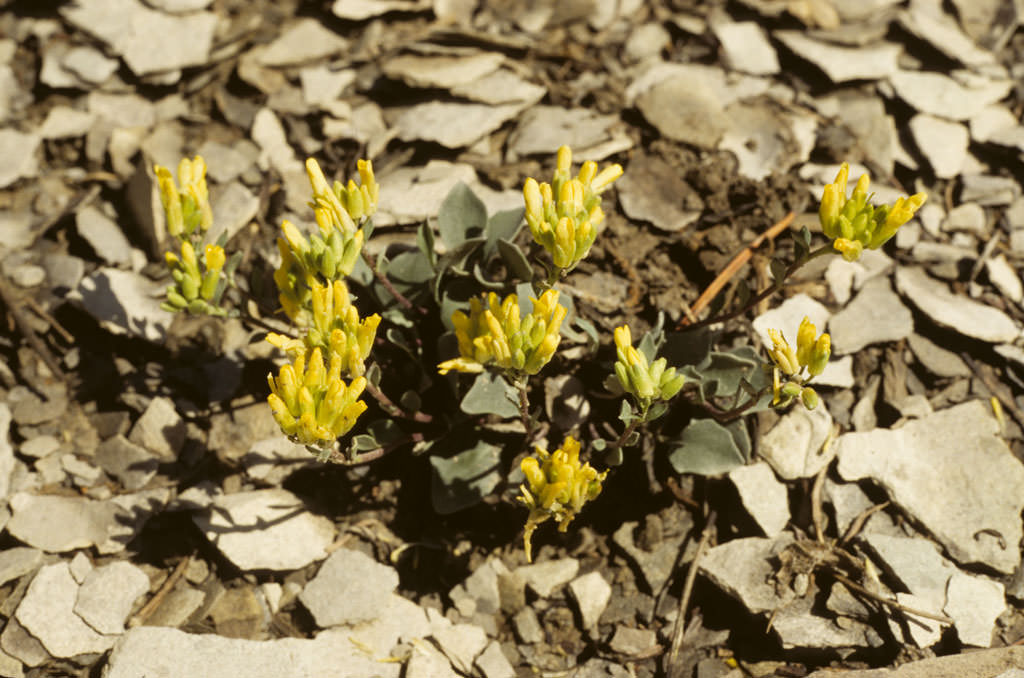
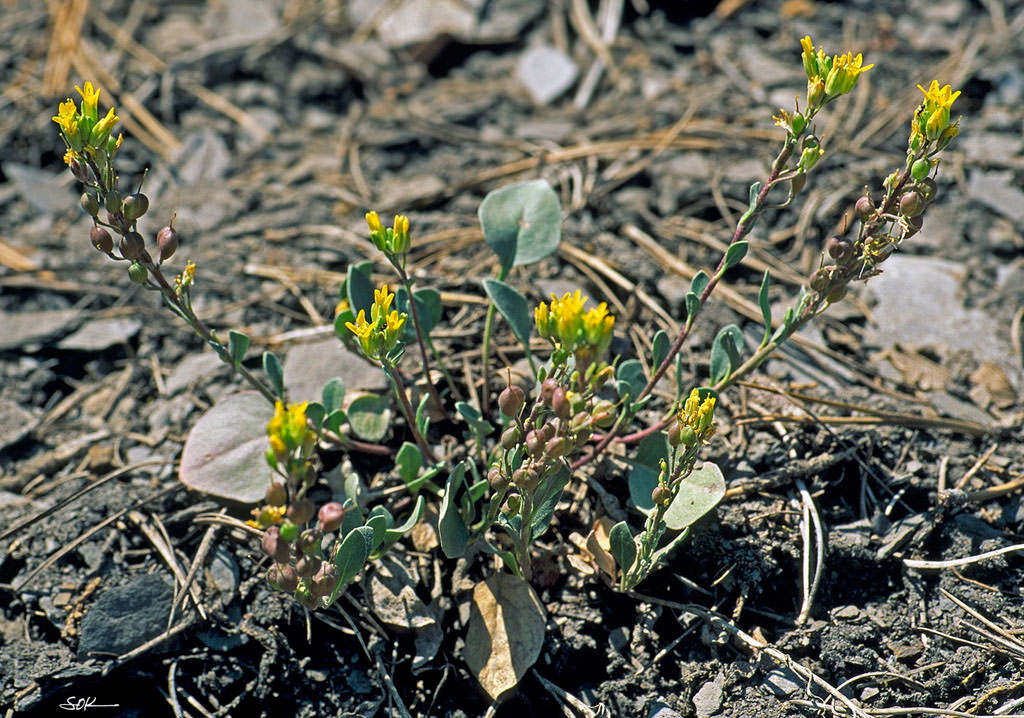
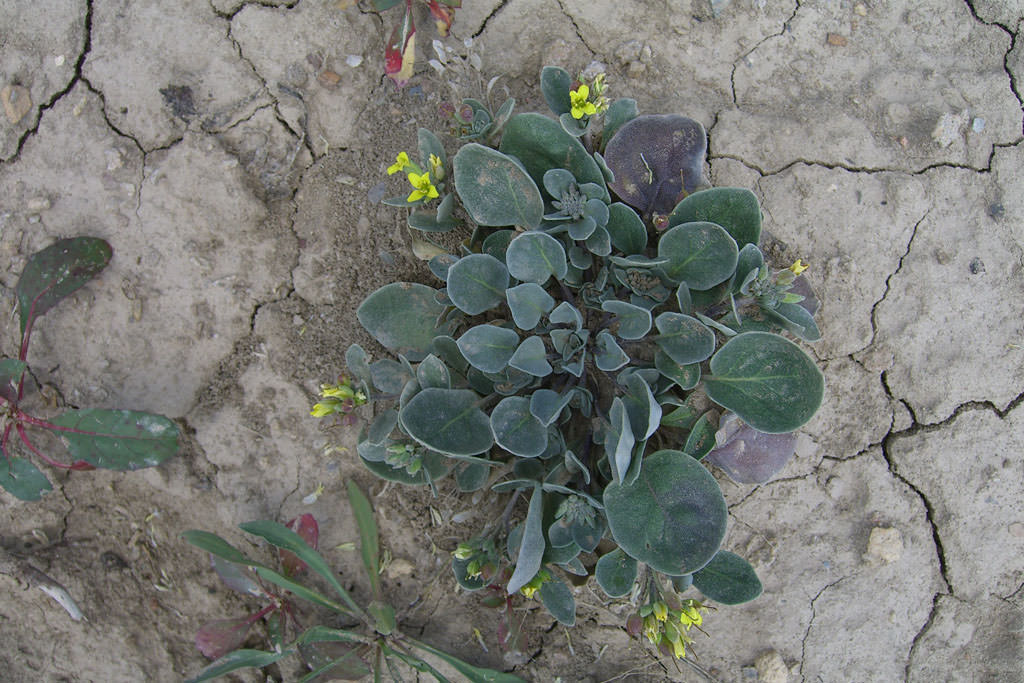
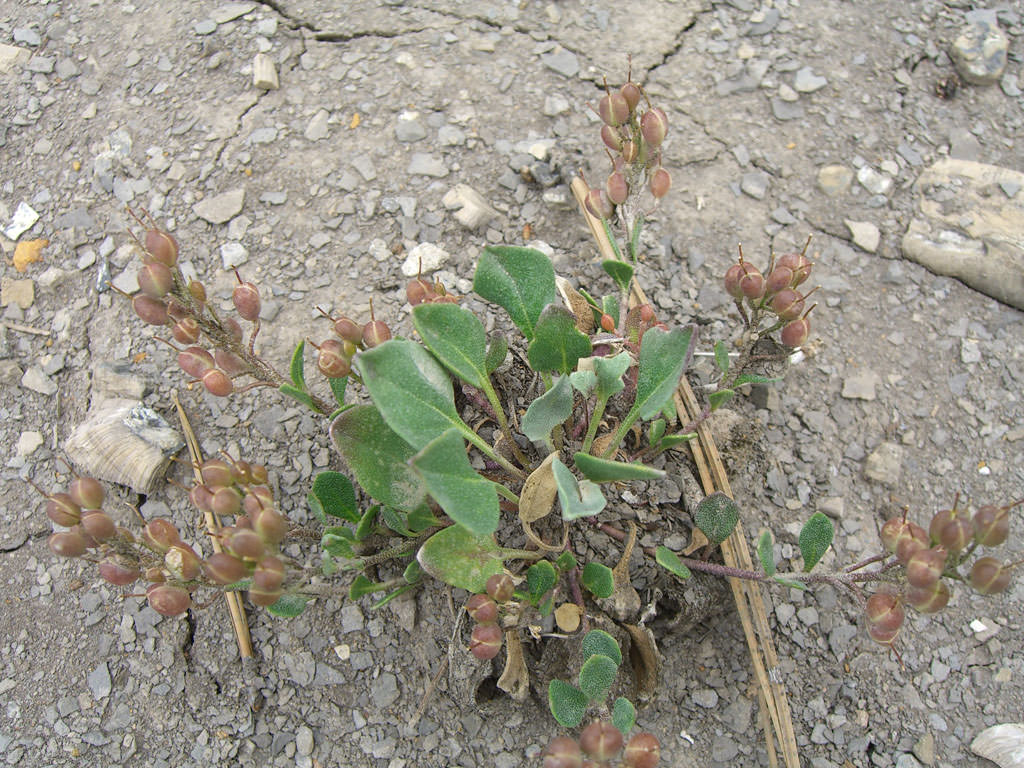
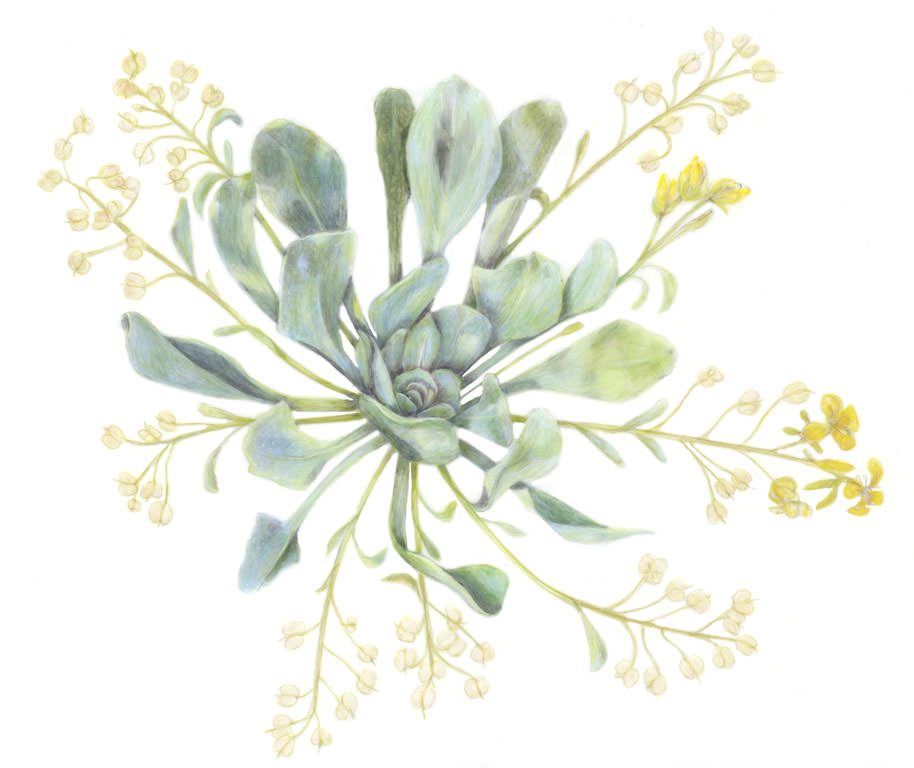
The stems, 10 to 20 cm long, can be decumbent or erect and arise out of a simple or woody caudex. The basal leaves are 4-8 cm long with suborbicular or obovate blades which can be entire to sinuate or shallowly toothed. The cauline leaves, 0.8-2.3 cm long, are obovate to rhombic and can be entire or shallowly toothed. The flowers are small and yellow with petals spatulate and expanded at the base. The fruiting inflorescence (infructescences) are dense and elongated. The pedicels are 8-11 mm long and sigmoid. The siliques, 6-9 mm long, are sessile or substipitate and globose to ellipsoid. The seeds are not winged or margined (Rollins and Shaw 1973).
Look Alikes:
None (pers. comm. Minton and Spackman, 1994).
Phenology:
Physaria pruinosa begins to flower by mid May with fruiting time depending on elevation. Plants at lower elevations are in late stages of fruiting by the beginning of June, whereas plants at higher elevations are only in early stages of fruiting at that time (Rouse 1981). Plants have been observed with a few flowers as late as the last week of August (Anderson 1988).
 |
Habitat
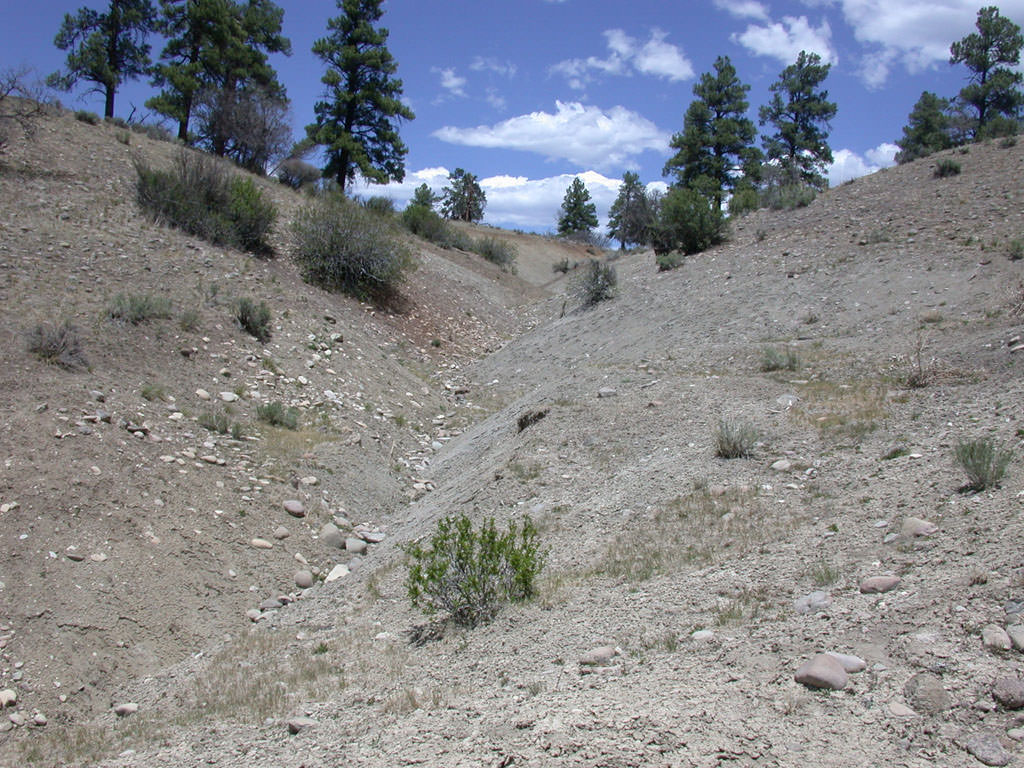
Physaria pruinosa occurs on Mancos Shale, open clay barrens surrounded by montane grasslands, sometimes in open Pinus ponderosa stands with Quercus gambelii, it can also be associated with Douglas fir and Englemann spruce communities at the upper limits of its range (Rouse 1981). Commonly associated species include: Pinus ponderosa, Quercus gambellii, Mahonia repens, Commandra umbellatum, Townsendia glabella, Astragalus lonchocarpus, and Penstemon linarioides (Anderson 1988).
click on image to enlarge
 |
Elevation Range:
6,832 - 8,510 feet (2,082 - 2,594 meters)
Distribution
Colorado Endemic:
No
Range:
Physaria pruinosa is known from Archuleta County, and the extreme southern portion of Hinsdale County in southern Colorado, USA. Estimated range extent in Colorado of 2047 square kilometers was calculated in GeoCAT using occurrence data provided by the Colorado Natural Heritage Program (2023). This species is also known from northern New Mexico (Rio Arriba County), USA.
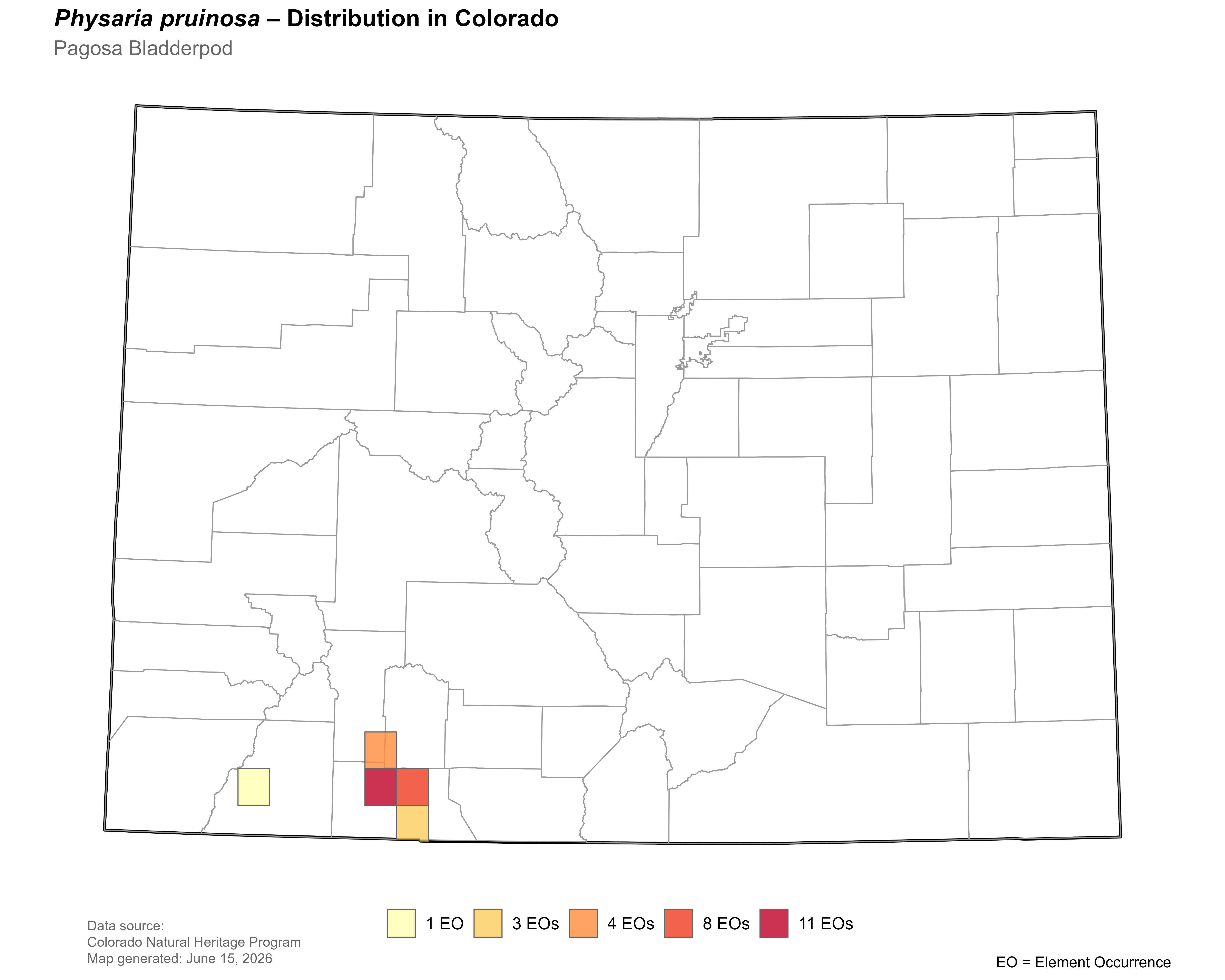
Click on map to enlarge |
Threats and Management Issues
Residential and commercial developments are considered to be the primary threats to the species at this time (Rondeau et al. 2011). The city of Pagosa Springs lies within the plant's range. Residential growth, development of resort homes, and increased tourism due to the development of a proposed ski resort 20 miles east of Pagosa Springs threaten occurrences. Archuleta County is one of the fastest growing counties in the United States, and future land use plans that have been drafted by Archuleta County do not include adequate provisions for the protection of P. pruinosa (Anderson 2006). Populations in the Piedra Valley may be vulnerable to the effects of livestock grazing. Though cattle pose a minimum threat of grazing the plants (they contain chemicals which render the plants unpalatable), cattle grazing tends to promote erosion and up-rooting where plants occur on slopes by severely disturbing the soil (Anderson 1988). These populations are at risk mainly where cattle trails traverse the shale barrens (Neely 1990). Physaria pruinosa is also threatened by off-road vehicle recreation, other recreational activities, energy resource development, exotic species invasions, use of herbicides and pesticides for weed management and range improvement, effects of small population size, prairie dog herbivory, fire, global climate change, and pollution (Anderson 2006). This species is considered to have low adaptive capacity and is expected to be moderately to extremely vulnerable to climate change under both RCP 4.5 and 8.5 scenarios, as assessed for the 2025 Colorado State Wildlife Action Plan (CNHP 2025).
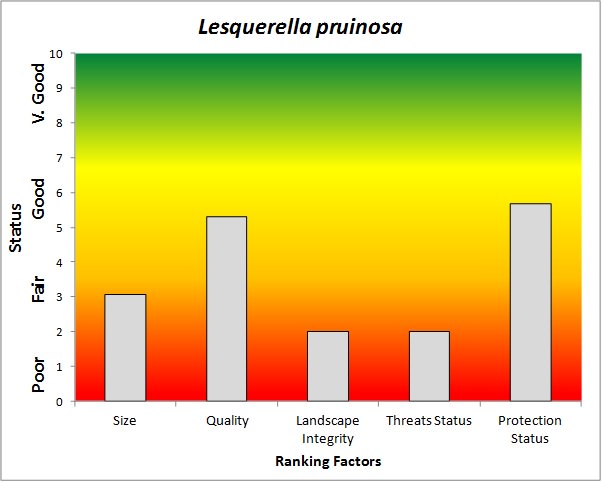
Summary results of an analysis of the status of Physaria pruinosa based on several ranking factors. This species was concluded to be moderately conserved. From Rondeau et al. 2011. |
References
- Ackerfield, J. 2015. Flora of Colorado. BRIT Press, Botanical Research Institute of Texas, Fort Worth, TX. 818 pp.
- Al-Shehbaz, I. A., and S. L. O'Kane. 2002. Lesquerella is united with Physaria (Brassicaceae). Novon 12:319-329.
- Anderson, D.G. 2006. Lesquerella pruinosa Greene (Pagosa bladderpod): a technical conservation assessment. [Online]. USDA Forest Service, Rocky Mountain Region. Available: http://www.fs.fed.us/r2/projects/scp/assessments/lesquerellapruinosa.pdf [January 2007].
- Anderson, J.L. 1988. USFWS. Status report for Lesquerella pruinosa.
- Colorado Native Plant Society. 1989. Rare Plants of Colorado. Published jointly by Rocky Mountain Nature Association and Colorado Native Plant Society, Estes Park, CO.
- Colorado Natural Heritage Program (CNHP). 2023. Biodiversity Tracking and Conservation System (Biotics 5). Colorado Natural Heritage Program, Colorado State University, Fort Collins.
- Colorado Natural Heritage Program (CNHP). 2025. Climate Change Vulnerability Assessment of Colorado Tier 1 and Tier 2 Plant Species of Greatest Conservation Need (SCGN) for the 2025 Colorado State Wildlife Action Plan. Colorado Natural Heritage Program, Colorado State University, Fort Collins.
- Flora of North America Editorial Committee (FNA). 2010. Flora of North America north of Mexico. Vol. 7. Magnoliophyta: Salicaceae to Brassicaceae. Oxford University Press, New York. xxii + 797 pp.
- Handwerk, J., L. Grunau, and S. Panjabi. 2015. Colorado Wildlife Action Plan: 2015 Rare Plant Addendum. Colorado Natural Heritage Program, Colorado State University, Fort Collins, Colorado, USA.
- Heil, K.D., S.L. O'Kane Jr., L.M. Reeves, and A. Clifford, 2013. Flora of the Four Corners Region, Vascular Plants of the San Juan River Drainage; Arizona, Colorado, New Mexico, and Utah. Missouri Botanical Garden Press, St. Louis, Missouri. 1098 pp.
- Jakubos, B. 1985. A comparison of Lesquerella pruinosa densities under varying habitat site factors. Unpublished report on file at The Nature Conservancy, Colorado Field Office, Boulder, Colorado.
- Neely, B., S. Panjabi, E. Lane, P. Lewis, C. Dawson, A. Kratz, B. Kurzel, T. Hogan, J. Handwerk, S. Krishnan, J. Neale, and N. Ripley. 2009. Colorado Rare Plant Conservation Strategy, Developed by the Colorado Rare Plant conservation Initiative. The Nature Conservancy, Boulder, Colorado, 117 pp.
- O'Kane, S. L. 1988. Colorado's Rare Flora. Great Basin Naturalist. 48(4):434-484.
- Rondeau, R., K. Decker, J. Handwerk, J. Siemers, L. Grunau, and C. Pague. 2011. The state of Colorado's biodiversity 2011. Prepared for The Nature Conservancy. Colorado Natural Heritage Program, Colorado State University, Fort Collins, Colorado.
- Rouse, L. 1981. Element stewardship abstract for Lesquerella pruinosa. Unpublished report prepared for the Nature Conservancy, Colorado Field Office, Boulder, CO.
- Spackman, S., B. Jennings, J. Coles, C. Dawson, M. Minton, A. Kratz, and C. Spurrier. 1997. Colorado rare plant field guide. Prepared for Bureau of Land Management, U.S. Forest Service and U.S. Fish and Wildlife Service by Colorado Natural Heritage Program.
- USDA, NRCS. 2022. The PLANTS Database. National Plant Data Team, Greensboro, NC 27401-4901 USA.
- Weber, W. A. and R. C. Wittmann. 2012. Colorado Flora, Eastern Slope, A Field Guide to the Vascular Plants, Fourth Edition. Boulder, Colorado. 555 pp.
- Weber, W. A. and R. C. Wittmann. 2012. Colorado Flora, Western Slope, A Field Guide to the Vascular Plants, Fourth Edition. Boulder, Colorado. 532 pp.