


Scientific Name : Aliciella stenothyrsa
Author : (Gray) J.M. Porter NatureServe Explorer
Common Name : Uinta Basin Gilia
 Current Research Activities
 1997 profile


☰ Click link below for details.
Taxonomy
Polemoniaceae (phlox family)
Ackerfield (2015, 2022) lists this as Aliciella stenothyrsa (A. Gray) J.M. Porter. Weber and Wittmann (2012) list this as Gilia stenothyrsa Jones.
Ranks and Status
State Rank : S2
State Rank Reason : Aliciella stenothyrsa is known from from less than 10 occurrences in Rio Blanco and Mesa counties, Colorado, USA. Potential threats to the species include transmission line construction, oil and gas development, impacts from current and historic livestock grazing and competition from invasive plant species. The effects of climate change are unknown.
U.S. Endangered Species Act : none
Colorado Threatened and Endangered List : none
Other Statuses : BLM, SWAP Tier 2
Description and Phenology
General Description:
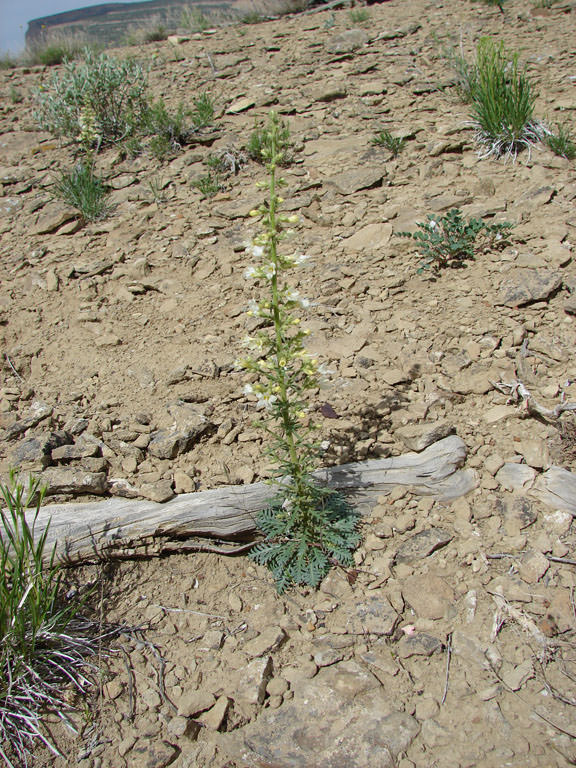
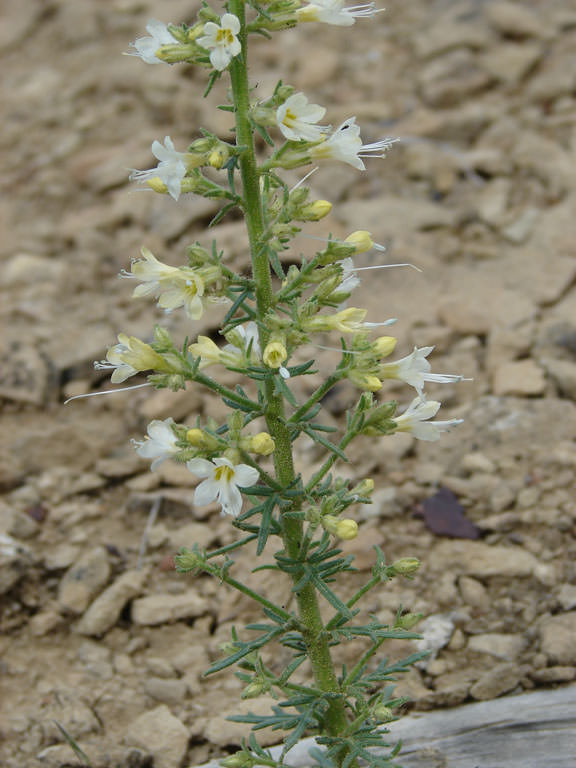
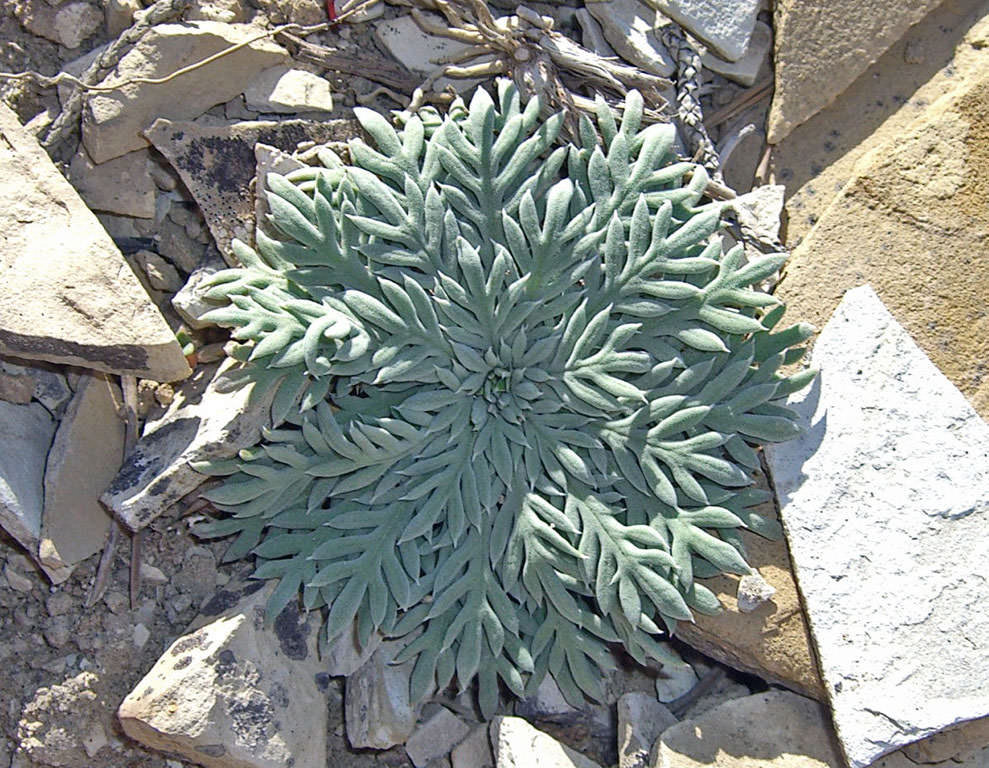
Unbranched, biennial plants with glandular stems, mostly 1.5 - 6 dm tall. Leaves deeply dissected. Cauline leaves reduces upward. Flowers white to pale cream, or pale purple, tubular corolla, 5-lobed. Stamens exserted at full anthesis, anthers rapidly dehiscing (Spackman et al. 1997, Ackerfield 2015).
Look Alikes:
Aliciella stenothyrsa is the only Aliciella with cream-colored flowers (Spackman et al. 1997).
Phenology:
Flowering occurs in late May to June (Ackerfield 2015); fruiting is from late June to early July (Anderson et al. 1982).
Habitat
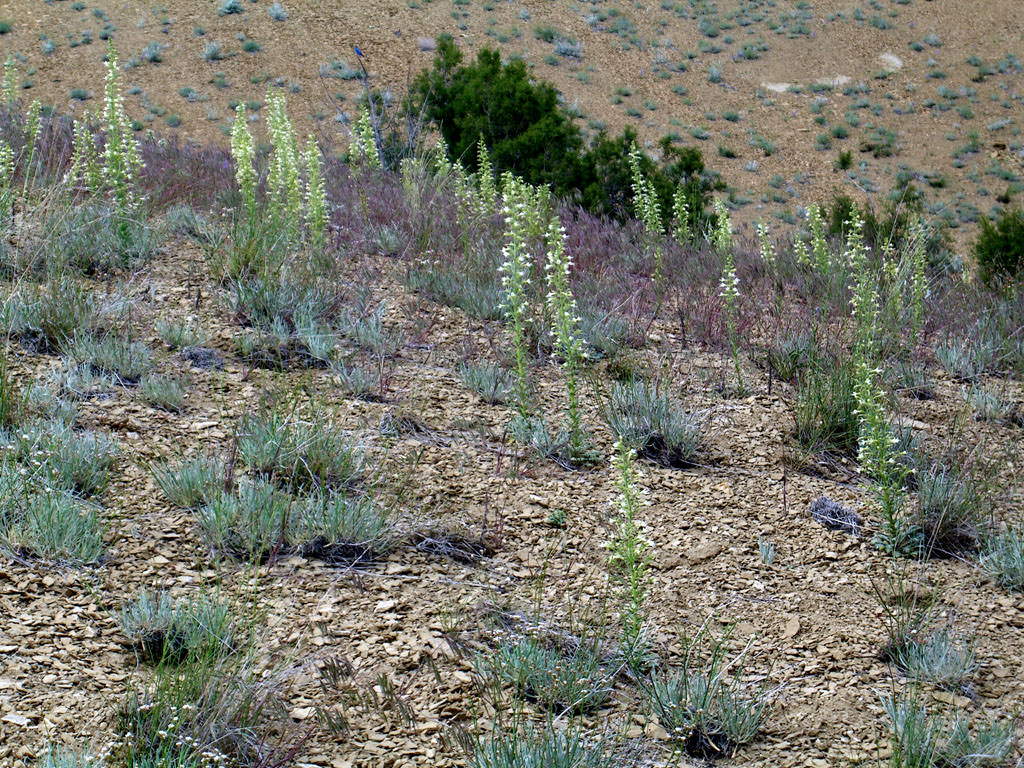
Silty to gravelly loam soils derived from the Green River or Uinta formations. In grassland, sagebrush, mountain-mahogany or pinyon-juniper communities (Spackman et al. 1997). Areas with the Aliciella are sparsely vegetated, with some of the following associated species: Artemisia frigida, A. wyomingensis, Asclepias cryptocerus, Astragalus lutosus, Atriplex confertifolia, Chaetopappa ericoides, Chorispora tenella, Chrysothamnus nauseosus, Cirsium barnebyi, Cryptantha stricta, Eriogonum lonchophyllum, Gilia congesta, Gutierrezia sarothrae, Ipomopsis aggregata, Lappula redowskii, Machaeranthera grindelioides, Mentzelia muticaulis, Oenothera caespitosa, Opuntia polyacantha, Achnatherum hymenoides, Penstemon caespitosa, Petradoria pumila, Phlox hoodii, Phlox longifolia, Physaria acutifolia, Pseudoroegneria spicata, Sabina osteosperma, Senecio neomexicana, Streptanthus cordatus, and Tetradymia canescens.
click on image to enlarge
 |
Elevation Range:
4,823 - 6,811 feet (1,470 - 2,076 meters)
Distribution
Colorado Endemic:
No
Range:
This species is known from Rio Blanco and Mesa counties in Colorado, USA. It is also known from Carbon, Duchesne, Emery and Uintah counties, Utah (Welsh et al. 2003). The estimated range extent in Colorado of 4757 square kilometers was calculated in GeoCAT using occurrence data provided by the Colorado Natural Heritage Program (2023).
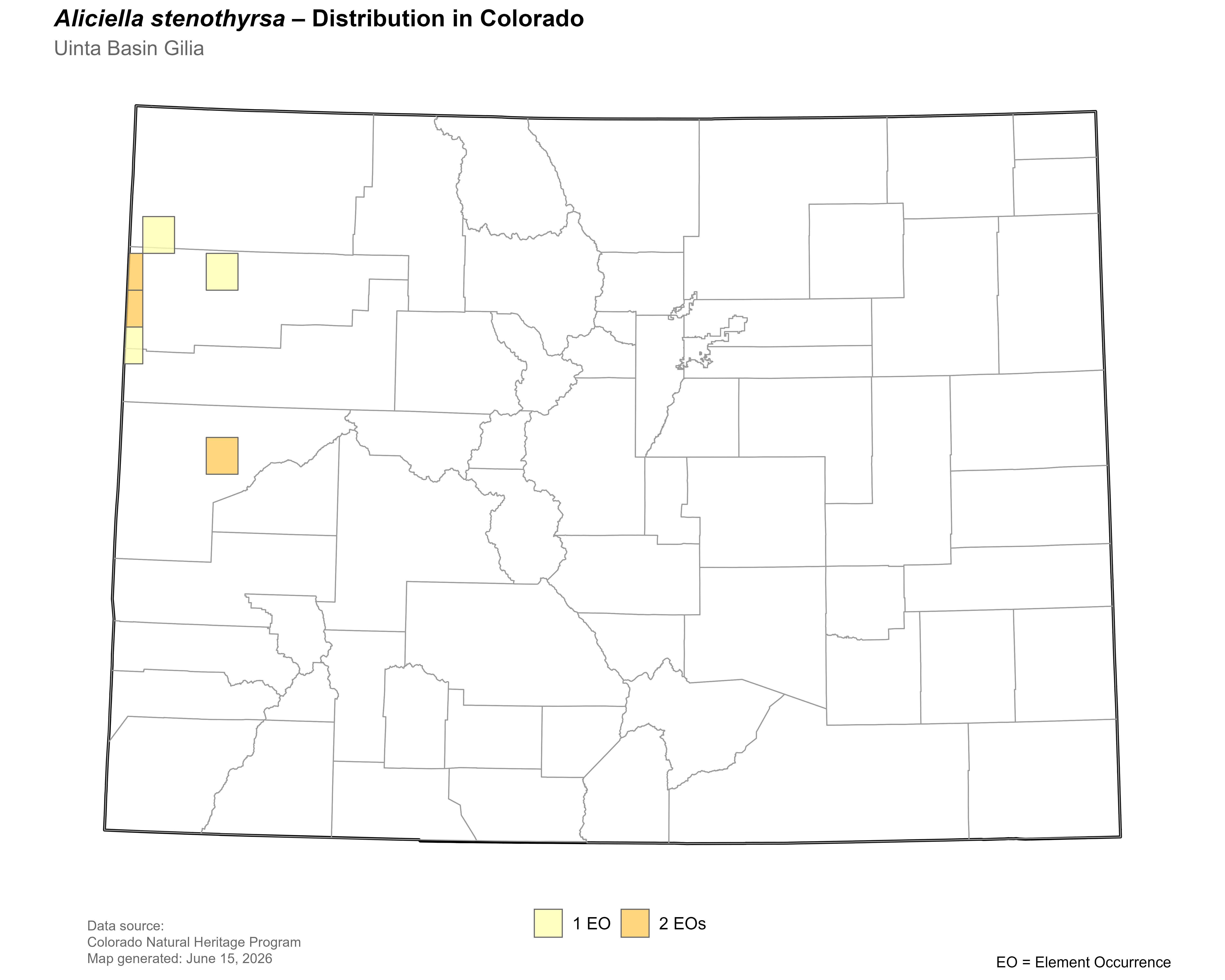
Click on map to enlarge |
Threats and Management Issues
As of 2023, 50% of the occurrences are found in habitat with moderate to high levels of landscape disturbance, and 50% are in areas with minimal to low levels of landscape disturbance (CNHP 2021, 2023). At the local level transmission line construction, oil and gas development, impacts from current and historic livestock grazing and competition from invasive plant species are threats. One occurrence will be directly impacted by transmission line construction, two of the occurrences are within active areas of oil and gas development and nearly all occurrences report the presence of cheatgrass in the species habitat. Evidence of past and current livestock grazing has been reported at half of the occurrences (CNHP 2023). This species is considered to have moderate adaptive capacity and is expected to be moderately vulnerable to climate change under both RCP 4.5 and 8.5 scenarios, as assessed for the 2025 Colorado State Wildlife Action Plan (CNHP 2025).
References
- Ackerfield, J. 2015. Flora of Colorado. BRIT Press, Botanical Research Institute of Texas, Fort Worth, TX. 818 pp.
- Ackerfield, J. 2022. Flora of Colorado. Second Edition. Bot. Misc. 60. BRIT Press, Fort Worth Botanic Garden/Botanical Research Institute of Texas, U.S.A. 861 pp.
- Anderson, J.S. and W.L. Baker. 1982. Inventory of the Piceance basin. Vol. I: Final report.
- Colorado Natural Heritage Program (CNHP). 2025. Climate Change Vulnerability Assessment of Colorado Tier 1 and Tier 2 Plant Species of Greatest Conservation Need (SCGN) for the 2025 Colorado State Wildlife Action Plan. Colorado Natural Heritage Program, Colorado State University, Fort Collins.
- Cronquist, A., A.H. Holmgren, N.H. Holmgren, J.L. Reveal, and P.K. Holmgren. 1984. Intermountain Flora: Vascular Plants of the Intermountain West, U.S.A. Vol. 4, Subclass Asteridae (except Asteraceae). New York Botanical Garden, Bronx. 573 pp.
- Goodrich, S., and E. Neese. 1986. Uinta Basin flora. U.S. Forest Service, Intermountain Region, Ogden, Utah. 320 pp.
- Kartesz, J.T. 1994. A synonymized checklist of the vascular flora of the United States, Canada, and Greenland. 2nd edition. 2 vols. Timber Press, Portland, OR.
- Spackman, S., B. Jennings, J. Coles, C. Dawson, M. Minton, A. Kratz, and C. Spurrier. 1997. Colorado rare plant field guide. Prepared for Bureau of Land Management, U.S. Forest Service and U.S. Fish and Wildlife Service by Colorado Natural Heritage Program.
- The Colorado Native Plant Society. 1997. Rare Plants of Colorado, second edition. Falcon Press Publishing Co.,Inc. Helena, Montana. 105pp.
- USDA, NRCS. 2022. The PLANTS Database. National Plant Data Team, Greensboro, NC 27401-4901 USA.
- Weber, W. A. and R. C. Wittmann. 2012. Colorado Flora, Western Slope, A Field Guide to the Vascular Plants, Fourth Edition. Boulder, Colorado. 532 pp.
- Welsh, S.L., N.D. Atwood, S. Goodrich and L.C. Higgins. (Eds.) 2003. A Utah Flora. 3rd edition. Brigham Young University, Provo, Utah, U.S.A. 912 pp.