

Scientific Name : Lomatium latilobum
Author : (Rydb.) Mathias NatureServe Explorer
Common Name : Canyonlands Aletes
 Current Research Activities
 1997 profile


☰ Click link below for details.
Taxonomy
Apiaceae (carrot family)
=Aletes latilobus
Ranks and Status
State Rank : S1S2
State Rank Reason : There are six documented occurrences of Lomatium latilobum from a narrow range in the canyon lands of Western Colorado and adjacent Utah, USA. This species is relatively well protected by its inaccessible habitat although it is considered to be extremely vulnerable to climate change.
U.S. Endangered Species Act : none
Colorado Threatened and Endangered List : none
Other Statuses : BLM, SWAP Tier 1
Description and Phenology
General Description:
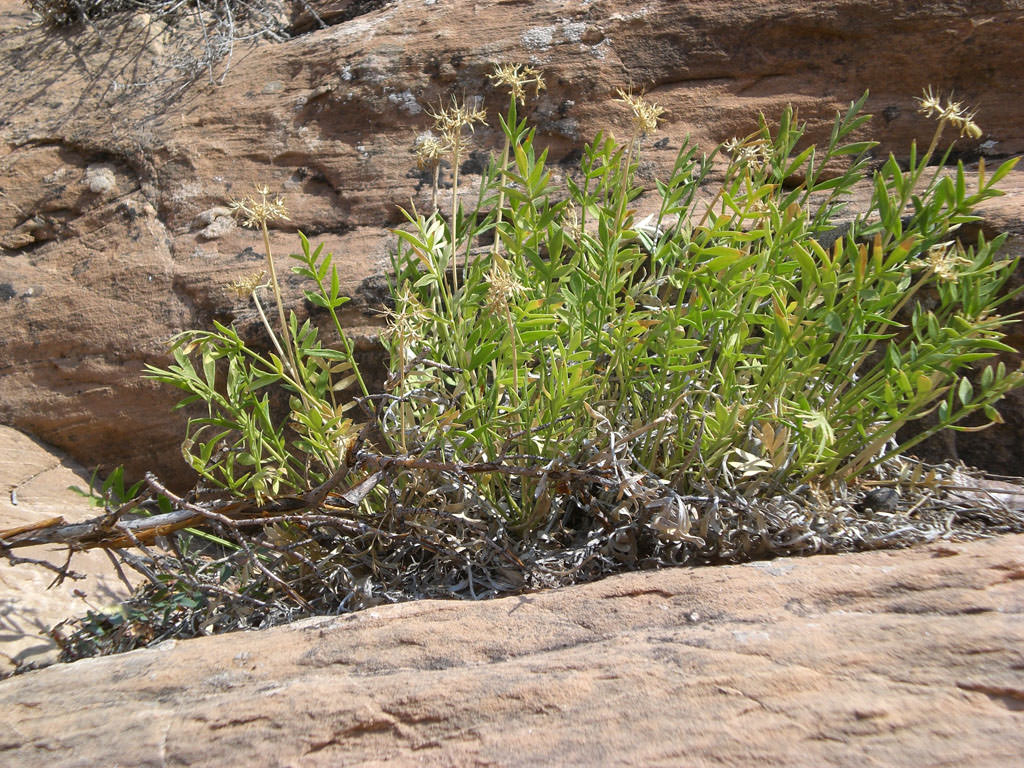
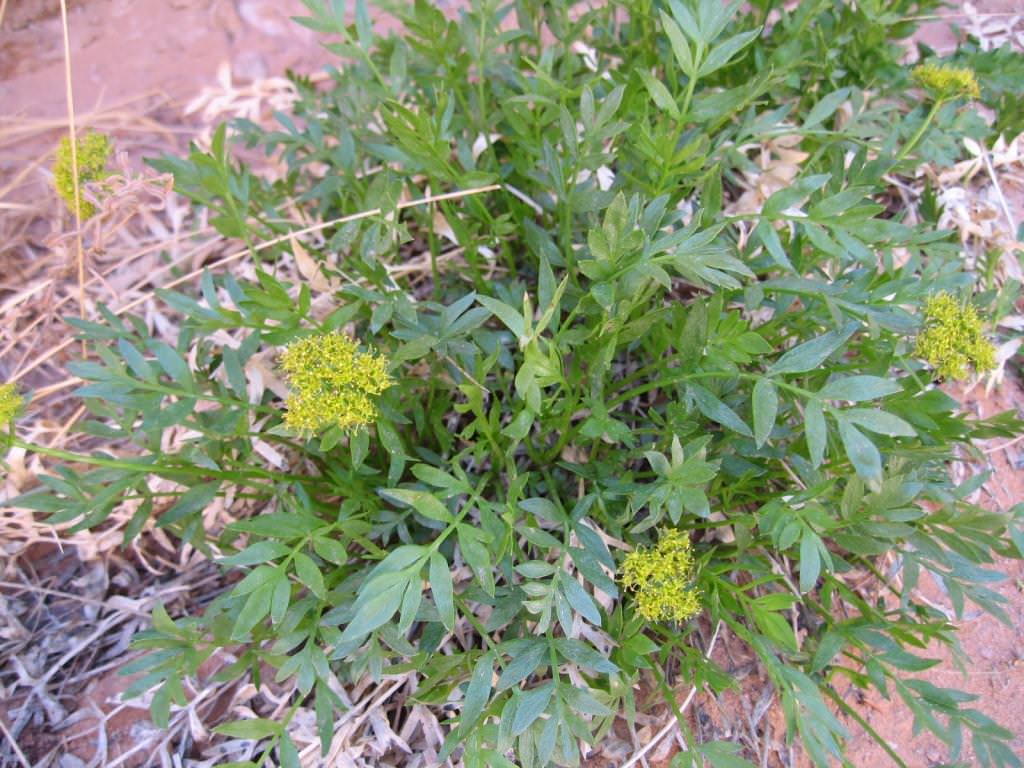
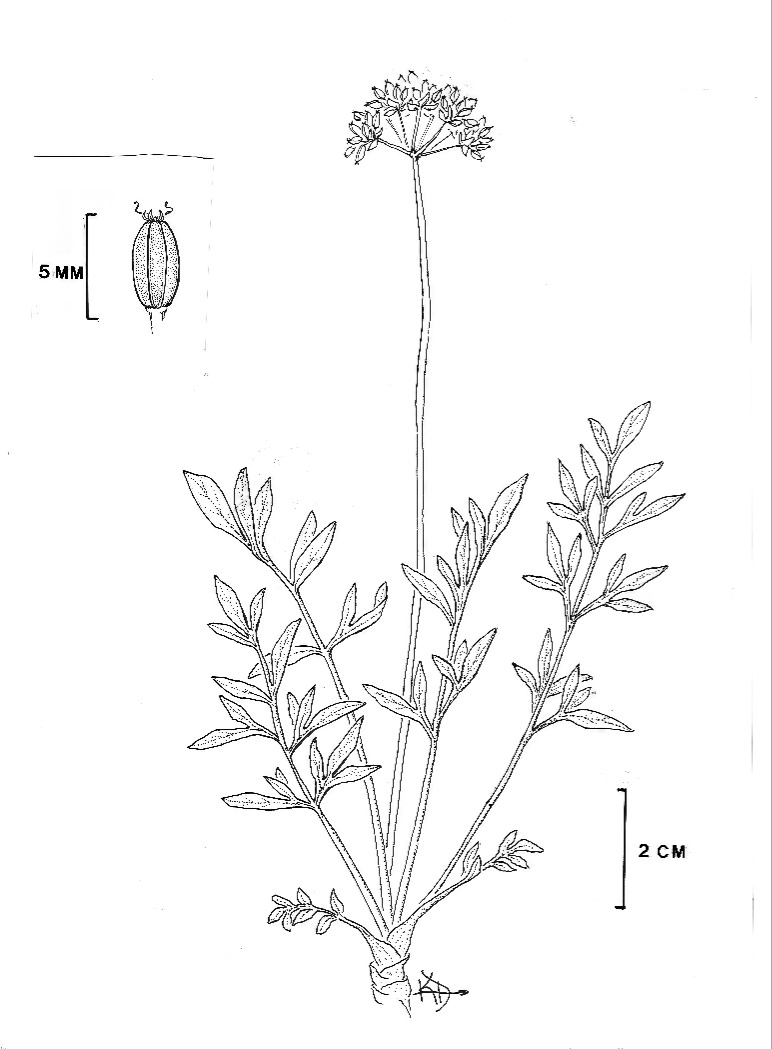
Perennial plants over 10 cm tall. Plants form broad mats with numberous short caudices. Plants are acaulescent; leaves are all basal. Leaves are once pinnately compound with lanceolate leaflets 5-40 mm long and over 5 mm wide. Flowers are yellow. Involucel bractlets are conspicuous and longer than the flowers, 5-10 mm in length. Strong lemony or anise scent (Colorado Native Plant Society 1997, Spackman et al. 1997, Ackerfield 2012, Weber and Wittmann 2012).
Look Alikes:
Other species in the genus Aletes have narrower leaflets.
Phenology:
In Colorado this species is known to flower in April and produce fruits in May (Colorado Natural Heritage Program 2012).
 |
Habitat
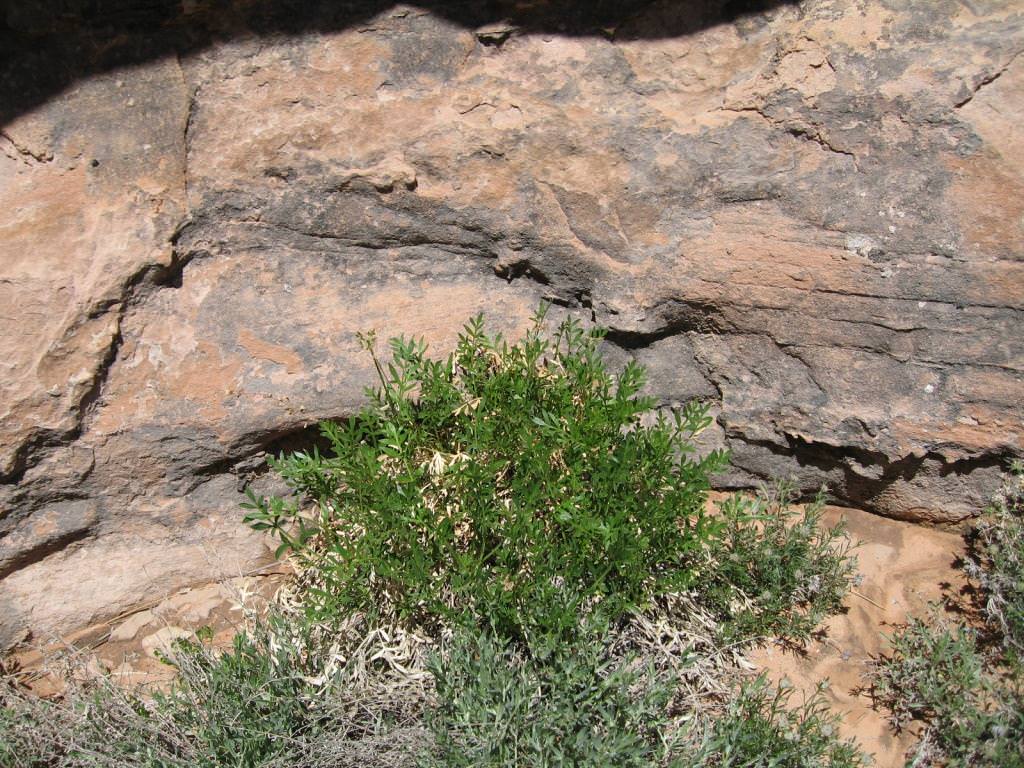
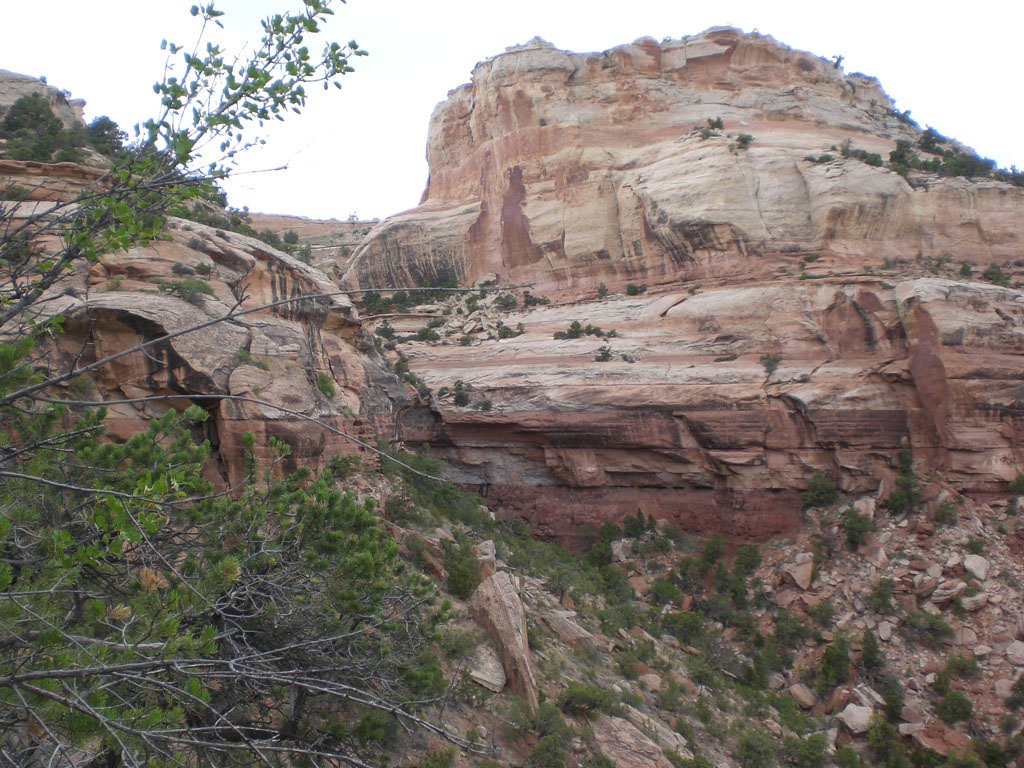
Found in canyonlands in pinyon-juniper and desert shrub communities; on sandstone ledges and in sandy soils derived from the Entrada Formation or the contact point of the Wingate and Chinle Formations (Spackman et al. 1997, Ackerfield 2012, Weber and Wittmann 2012).
click on image to enlarge
 |
Elevation Range:
4,541 - 5,806 feet (1,384 - 1,770 meters)
Distribution
Colorado Endemic:
No
Range:
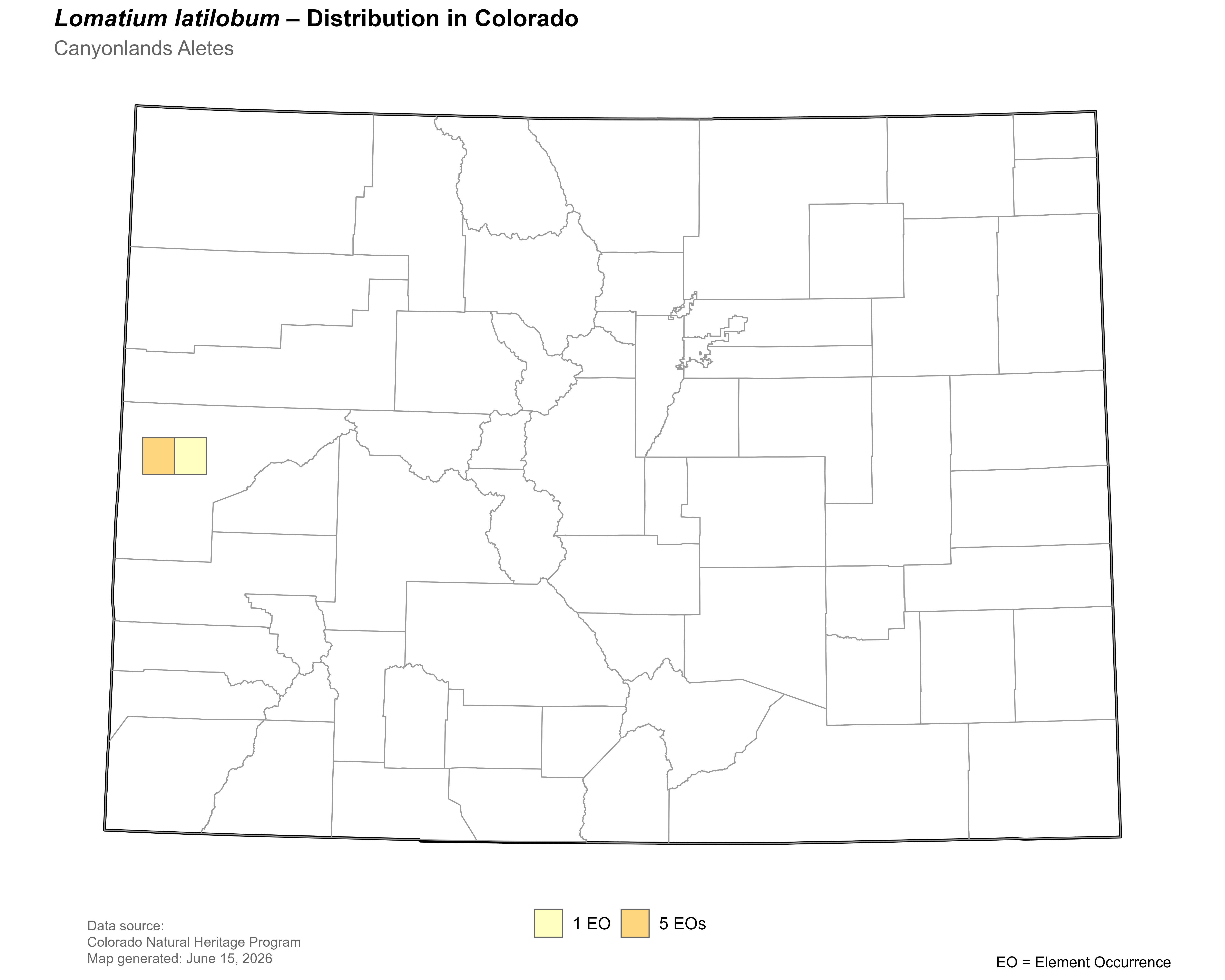
Lomatium latilobum is known from Mesa County in Colorado, USA. The estimated range extent in Colorado of 43 square kilometers was calculated in GeoCAT using occurrence data provided by the Colorado Natural Heritage Program (2023). This taxon is also known to be in Utah.
Click on map to enlarge |
Threats and Management Issues
This species is relatively well protected by its inaccessible habitat. The primary threat is likely potential trampling by hikers/climbers (Rondeau et al. 2011) and impacts have been observed at some sites. Recreation could be managed to minimize impacts further. The invasive plant species Bromus tectorum and Lepidium perfoliatum have been observed within occupied habitat. This species is considered to have low adaptive capacity and is expected to be extremely vulnerable to climate change under both RCP 4.5 and 8.5 scenarios, as assessed for the 2025 Colorado State Wildlife Action Plan (CNHP 2025).
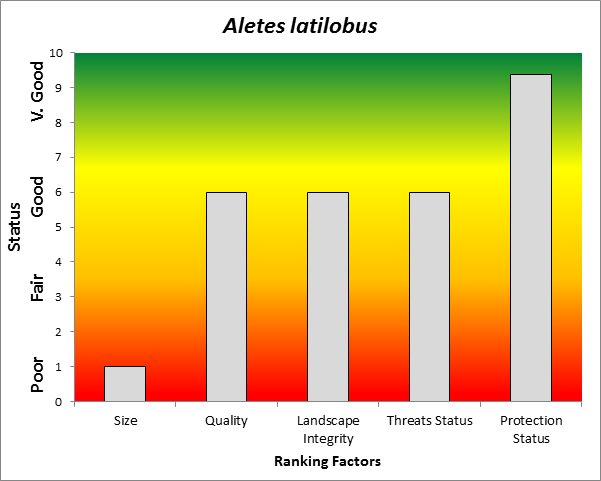
Summary results of an analysis of the status of Aletes latilobus based on several ranking factors. This species was concluded to be effectively conserved. From Rondeau et al. 2011. |
References
- Ackerfield, J. 2015. Flora of Colorado. BRIT Press, Botanical Research Institute of Texas, Fort Worth, TX. 818 pp.
- Colorado Native Plant Society. 1989. Rare plants of Colorado. Rocky Mountain Nature Association, Colorado Native Plant Society, Estes Park, Colorado. 73 pp.
- Colorado Natural Heritage Program (CNHP). 2023. Biodiversity Tracking and Conservation System (Biotics 5). Colorado Natural Heritage Program, Colorado State University, Fort Collins.
- Colorado Natural Heritage Program (CNHP). 2025. Climate Change Vulnerability Assessment of Colorado Tier 1 and Tier 2 Plant Species of Greatest Conservation Need (SCGN) for the 2025 Colorado State Wildlife Action Plan. Colorado Natural Heritage Program, Colorado State University, Fort Collins.
- Handwerk, J., L. Grunau, and S. Panjabi. 2015. Colorado Wildlife Action Plan: 2015 Rare Plant Addendum. Colorado Natural Heritage Program, Colorado State University, Fort Collins, Colorado, USA.
- Neely, B., S. Panjabi, E. Lane, P. Lewis, C. Dawson, A. Kratz, B. Kurzel, T. Hogan, J. Handwerk, S. Krishnan, J. Neale, and N. Ripley. 2009. Colorado Rare Plant Conservation Strategy, Developed by the Colorado Rare Plant conservation Initiative. The Nature Conservancy, Boulder, Colorado, 117 pp.
- O'Kane, S. L. 1988. Colorado's Rare Flora. Great Basin Naturalist. 48(4):434-484.
- Rondeau, R., K. Decker, J. Handwerk, J. Siemers, L. Grunau, and C. Pague. 2011. The state of Colorado's biodiversity 2011. Prepared for The Nature Conservancy. Colorado Natural Heritage Program, Colorado State University, Fort Collins, Colorado.
- Spackman, S., B. Jennings, J. Coles, C. Dawson, M. Minton, A. Kratz, and C. Spurrier. 1997. Colorado rare plant field guide. Prepared for Bureau of Land Management, U.S. Forest Service and U.S. Fish and Wildlife Service by Colorado Natural Heritage Program.
- Spahr, R., L. Armstrong, D. Atwood, and M. Rath. 1991. Threatened, endangered, and sensitive species of the Intermountain Region. U.S. Forest Service, Intermountain Region, Ogden, UT.
- Utah Native Plant Society. 2003-2011. Utah rare plant guide. A.J. Frates editor/coordinator. Salt Lake City, UT. Utah Native Plant Society. Online. Available: http://www.utahrareplants.org (accessed 2011).
- Weber, W. A. and R. C. Wittmann. 2012. Colorado Flora, Western Slope, A Field Guide to the Vascular Plants, Fourth Edition. Boulder, Colorado. 532 pp.
- Welsh, S.L., N.D. Atwood, S. Goodrich, and L.C. Higgins (eds.) 1993. A Utah flora. 2nd edition. Brigham Young Univ., Provo, Utah. 986 pp.