

Scientific Name : Amsonia jonesii
Author : Woods. NatureServe Explorer
Common Name : Jones Blue Star
 Current Research Activities


☰ Click link below for details.
Taxonomy
Apocynaceae (dogbane family)
Ranks and Status
State Rank : S2
State Rank Reason : Amsonia jonesii is known from 14 occurrences in southwest Colorado, USA. Competition from invasive plant species and disturbance from off-road vehicle use are potential threats to this species. This species is considered to be moderately vulnerable to the effects of climate change.
U.S. Endangered Species Act : none
Colorado Threatened and Endangered List : none
Other Statuses : BLM, SWAP Tier 2
Description and Phenology
General Description:
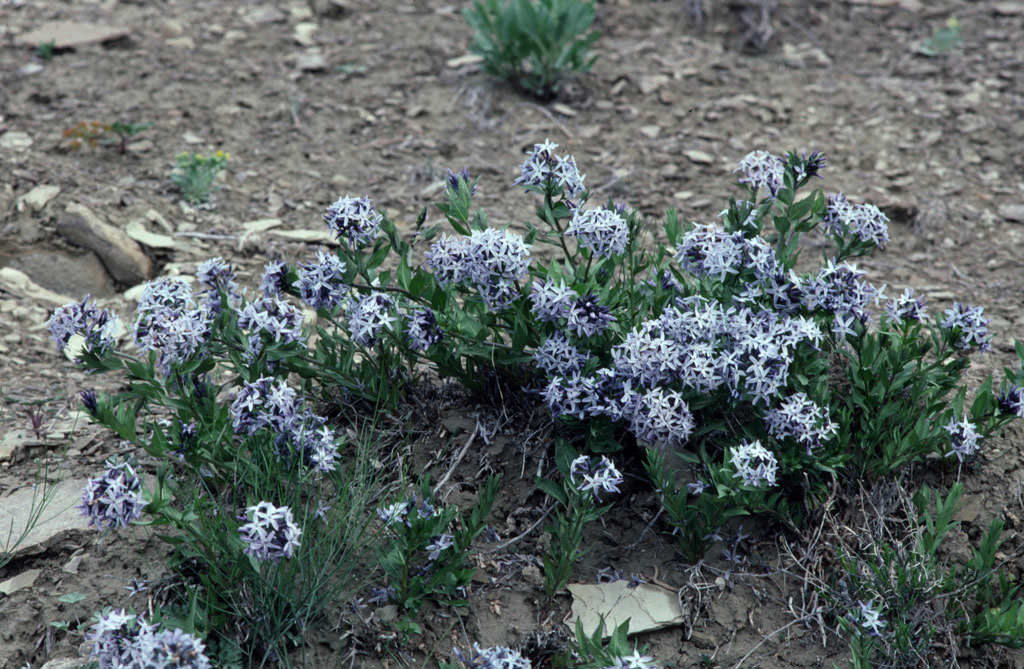
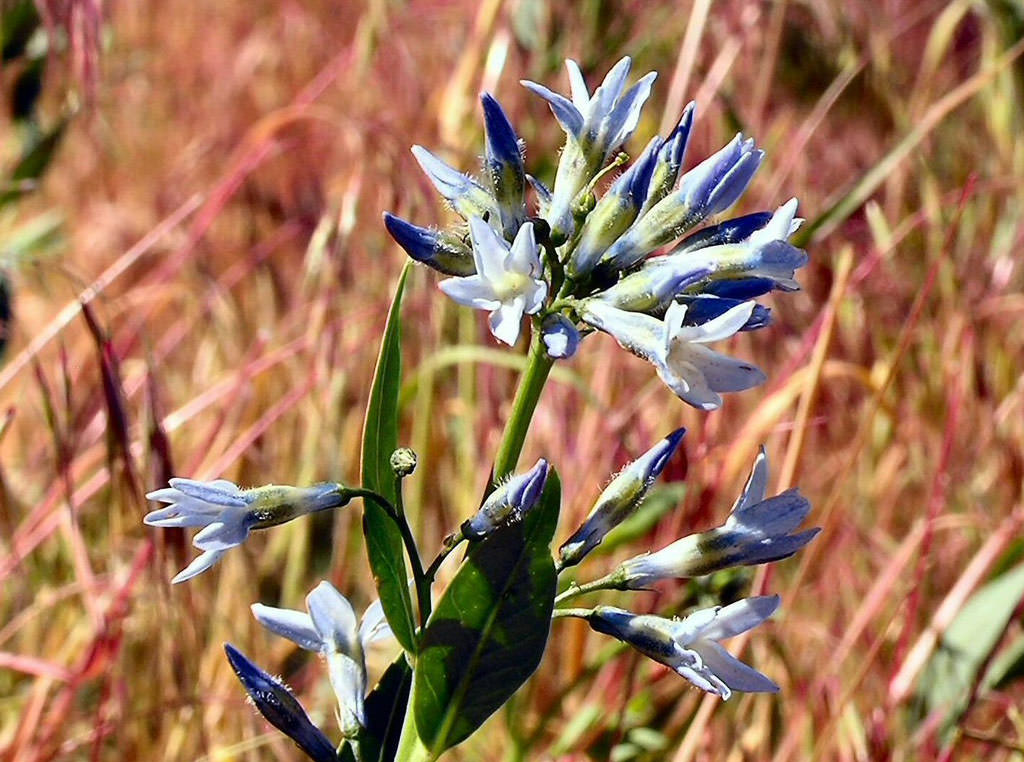
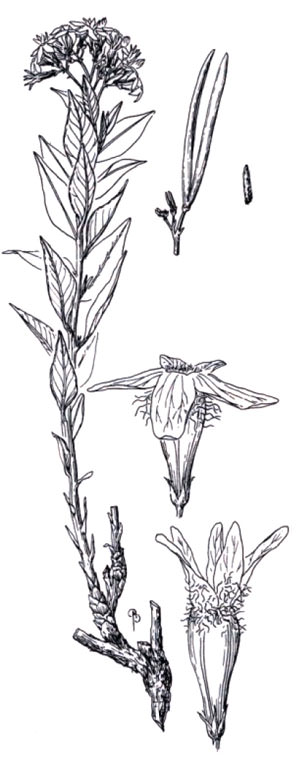
Flowers tubular, powder-blue; corolla with 5 lobes united at the base, and with stiff inpointing hairs; leaves alternate; stems 1.5-5 dm tall, usually much branched from the base; plants with milky juice; tap rooted perennial.
Look Alikes:
Not likely to be confused with other species in this habitat in Colorado.
Phenology:
Flowers in late April and May (Colorado Natural Heritage Program 2012).
 |
Habitat
In dry, open areas with clay, sandy, or gravelly soils, in desert-steppe, rocky gorges and canyons. Associated species include pinyon pine, juniper, Hilaria jamesii, Forsellesia meionandra, Penstemon utahensis, Cercocarpus montanus, Purshia stansburiana, Amelanchier utahensis, Rhus trilobata, Fraxinus anomala, Artemisia tridentata ssp. tridentata, Linum lewisii, and Chrysothamnus nauseosus.
click on image to enlarge
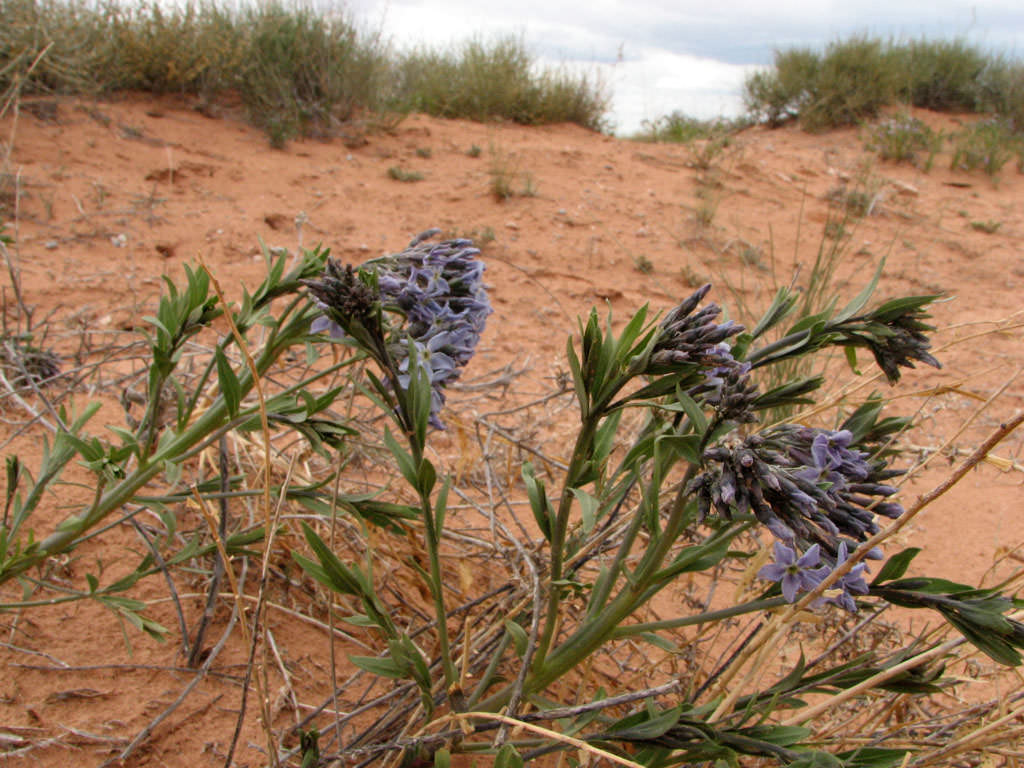 | 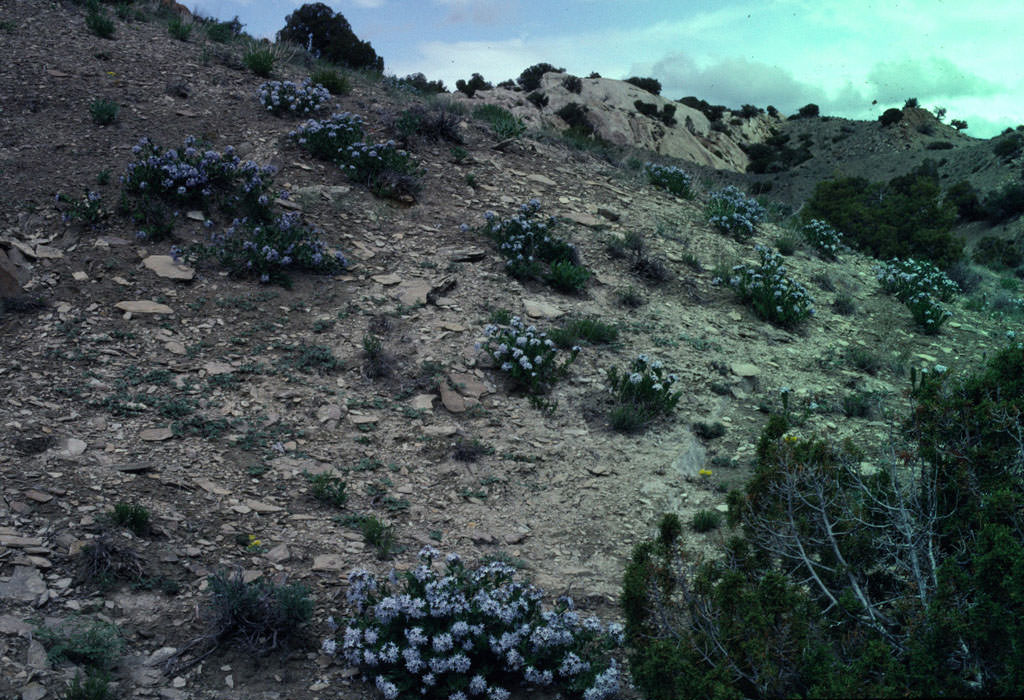 |
Elevation Range:
4,437 - 5,788 feet (1,352 - 1,764 meters)
Distribution
Colorado Endemic:
No
Range:
Amsonia jonesii is known from Mesa and Montezuma counties in Colorado, USA. This species is to be sought in Moffat County, Colorado. Estimated range extent in Colorado of 7,047 square kilometers was calculated in GeoCAT using occurrence data provided by the Colorado Natural Heritage Program (2023). This species can also be found in Arizona, New Mexico, and Utah, USA.
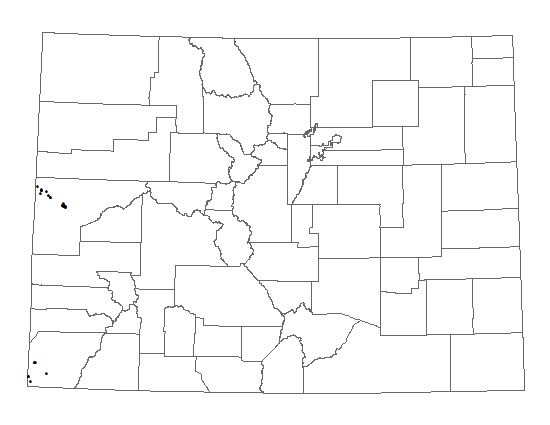 Click on map to enlarge |
Threats and Management Issues
Threats to this species are poorly documented, however, two occurrences indicate disturbance from recreation along trails as a concern, with nearby disturbed areas dominated by exotics: Halogeton glomeratus, Eremopyrum triticeum, Bromus tectorum, Erodium cicutarium. Portions of one occurrence are reported to be under imminent threat of development. Amsonia jonesii is considered to have moderate adaptive capacity and is expected to be moderately vulnerable to climate change under both RCP 4.5 and 8.5 scenarios, as assessed for the 2025 Colorado State Wildlife Action Plan (CNHP 2025).
References
- Ackerfield, J. 2015. Flora of Colorado. BRIT Press, Botanical Research Institute of Texas, Fort Worth, TX. 818 pp.
- Colorado Natural Heritage Program (CNHP). 2023. Biodiversity Tracking and Conservation System (Biotics 5). Colorado Natural Heritage Program, Colorado State University, Fort Collins.
- Colorado Natural Heritage Program (CNHP). 2025. Climate Change Vulnerability Assessment of Colorado Tier 1 and Tier 2 Plant Species of Greatest Conservation Need (SCGN) for the 2025 Colorado State Wildlife Action Plan. Colorado Natural Heritage Program, Colorado State University, Fort Collins.
- Cronquist, A., A.H. Holmgren, N.H. Holmgren, J.L. Reveal, and P.K. Holmgren. 1984. Intermountain Flora: Vascular Plants of the Intermountain West, U.S.A. Vol. 4, Subclass Asteridae (except Asteraceae). New York Botanical Garden, Bronx. 573 pp.
- Harrington, H.D. 1954. Manual of the plants of Colorado. Sage Press, Chicago. 666 pp.
- Heil, K.D., S.L. O'Kane Jr., L.M. Reeves, and A. Clifford, 2013. Flora of the Four Corners Region, Vascular Plants of the San Juan River Drainage; Arizona, Colorado, New Mexico, and Utah. Missouri Botanical Garden Press, St. Louis, Missouri. 1098 pp.
- K. Decker, L. Grunau, J. Handwerk, and J. Siemers, editors. 2015. Climate Change Vulnerability Assessment for Colorado Bureau of Land Management. Colorado Natural Heritage Program, Colorado State University, Fort Collins, Colorado.
- Kartesz, J.T. 1994. A synonymized checklist of the vascular flora of the United States, Canada, and Greenland. 2nd edition. 2 vols. Timber Press, Portland, OR.
- Lavender, A.E., M.M. Fink, S.E. Linn, D.M. Theobald. 2011. Colorado Ownership, Management, and Protection v9 Database. Colorado Natural Heritage Program and Geospatial Centroid, Colorado State University, Fort Collins, CO. (30 September).
- Naumann, T. S. 1990. Inventory of Plant Species of Special Concern and the General Flora of Dinosaur National Monument 1987-1989. Unpublished report prepared for the National Park Service Report, Denver, CO.
- USDA, NRCS. 2022. The PLANTS Database. National Plant Data Team, Greensboro, NC 27401-4901 USA.
- Weber, W. A. and R. C. Wittmann. 2012. Colorado Flora, Western Slope, A Field Guide to the Vascular Plants, Fourth Edition. Boulder, Colorado. 532 pp.
- Welsh, S.L., N.D. Atwood, L.C. Higgins, and S. Goodrich, eds. 1987. A Utah Flora. Great Basin Naturalist Memoir 9: 1- 894. Brigham Young University, Provo, Utah. 894 pp.