

Scientific Name : Lupinus crassus
Author : Payson NatureServe Explorer
Common Name : Payson Lupine
 Current Research Activities
 1997 profile
☰ Click link below for details.
Taxonomy
Fabaceae (pea family)
Ranks and Status
State Rank : S1S2
State Rank Reason : Lupinus crassus is endemic to southwestern Colorado, USA, where it is known only from Montrose County. Livestock grazing and invasion of weedy species pose moderate threats to Lupinus crassus habitat. Long term drought is widespread throughout the species range and it is expected to be highly vulnerable to climate change.
U.S. Endangered Species Act : none
Colorado Threatened and Endangered List : none
Other Statuses : BLM, SWAP Tier 1
Description and Phenology
General Description:
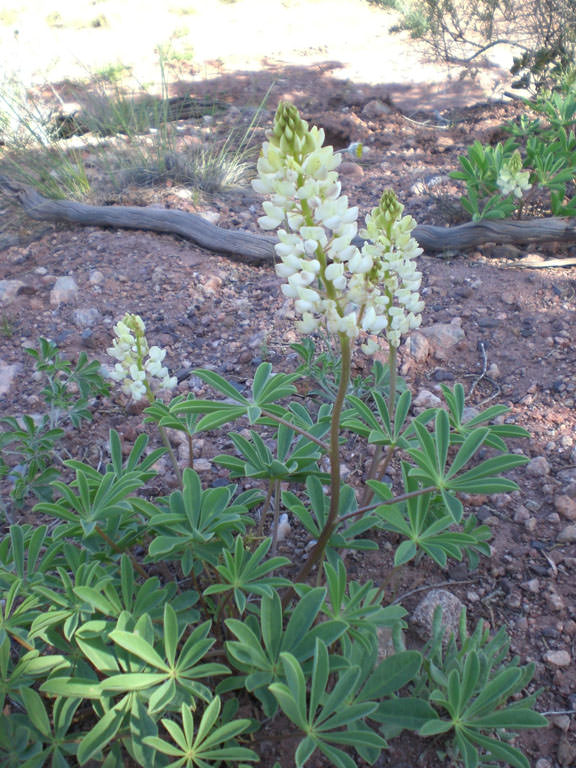
Tall herbaceous perennial. The leaves are succulent, appressed puberulent to glabrate. The caudex is branched, forming a dense mat from which arise many decumbent stems. The inflorescence is erect. Flowers are white to pinkish with purple tips. The banner is reflexed at or near the midpoint, leaving a relatively wide gap above the wings (Spackman et al. 1997).
Look Alikes:
L. ammophilus leaves have pilose pubescence (Spackman et al. 1997).
Phenology:
Flowers in May to early June, fruiting in June.
Habitat
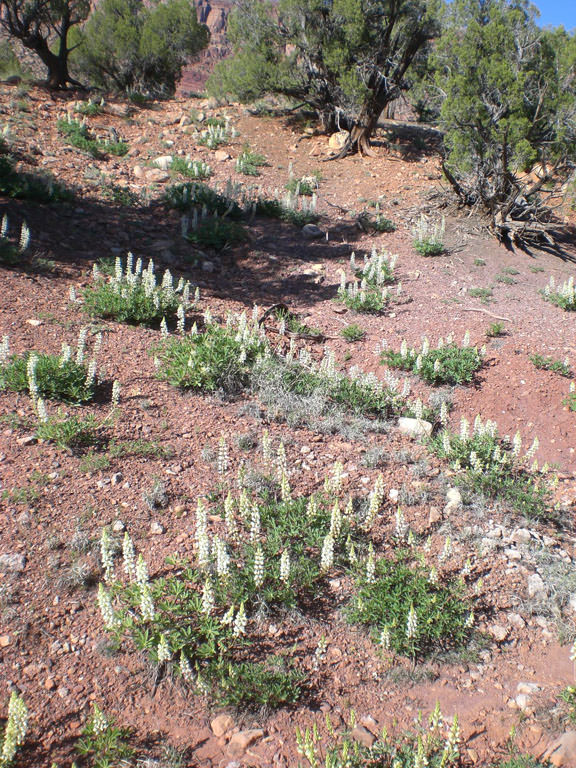
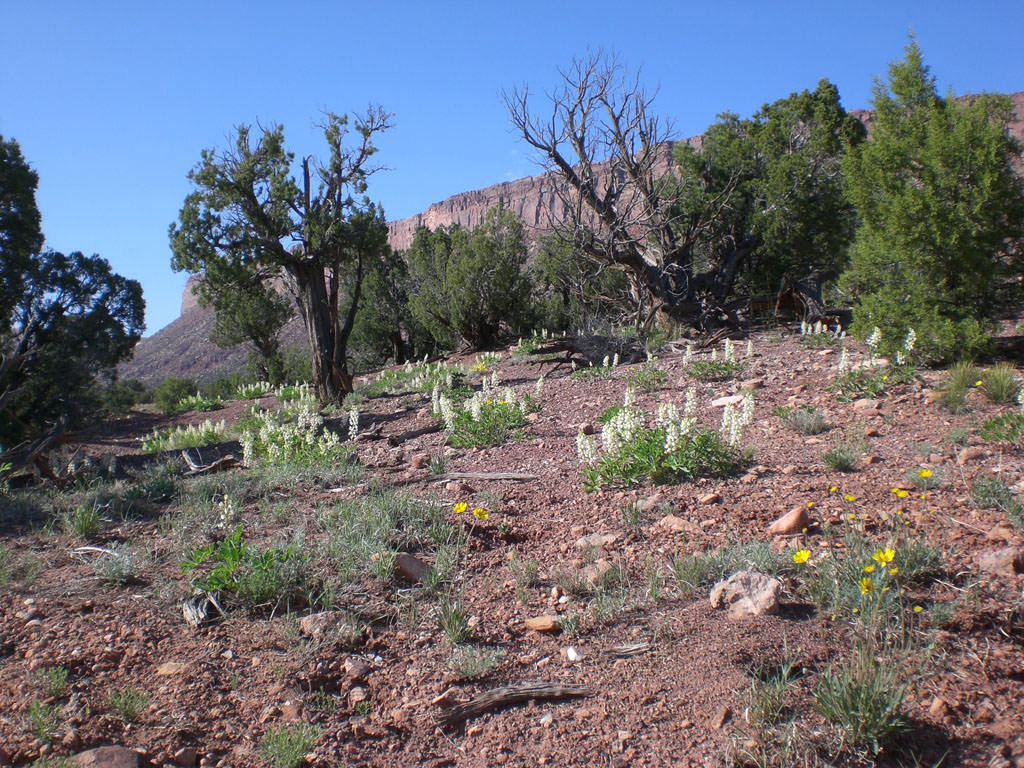
Pinyon-juniper woodland; on Mancos shale derived soils in the Naturita area; on quaternary alluvium derived from the Chinle Formation in the Paradox Valley; on sparsely vegetated soil, particularly in draws and dry hillsides (Peterson 1983); occasionally found on loamy to clayey soils and even on adobe hill (O'Kane 1988).
click on image to enlarge
 |
 |
Elevation Range:
5,070 - 6,300 feet (1,545 - 1,920 meters)
Distribution
Colorado Endemic:
Yes
Range:
Lupinus crassus is thought to be endemic to Montrose County in southwestern Colorado, USA; however, there is a historical collection from Uintah County, Utah at Missouri Botanical Garden herbarium (SEINet 2023) that is likely erroneous as it is over 100 miles north of the known populations in Colorado. Estimated range extent in Colorado of 512 square kilometers was calculated in GeoCAT using occurrence data provided by the Colorado Natural Heritage Program (2025).
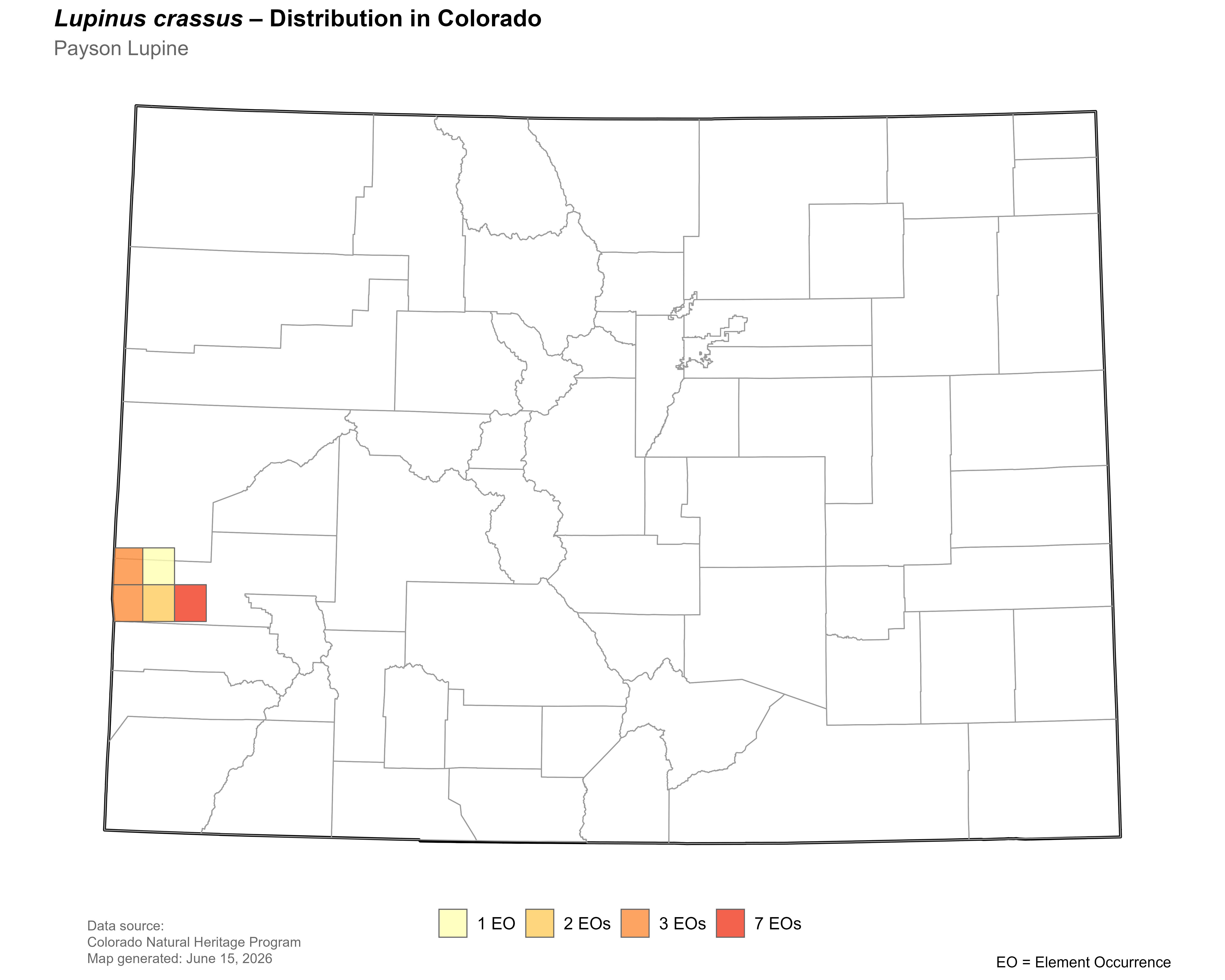
Click on map to enlarge |
Threats and Management Issues
As of 2022, 64% of the occurrences are found in habitat with minimal to low levels of landscape disturbance, the remainder are in areas with moderate to high levels of landscape disturbance (CNHP 2021). At the local level incompatible grazing is still considered to be the primary threat to the species. Over half of the occurrences are also threatened by cheatgrass and other invasive exotic plant species (NatureServe 2021; CNHP 2022). Occurrences are also slightly to moderately threatened by powerlines, road construction and maintenance, motorized recreation and past mining activities. In addition one occurrence is found at a dump site (Peterson 1983). This species is considered to have moderate adaptive capacity and is expected to be highly vulnerable to climate change under both RCP 4.5 and 8.5 scenarios, as assessed for the 2025 Colorado State Wildlife Action Plan (CNHP 2025).
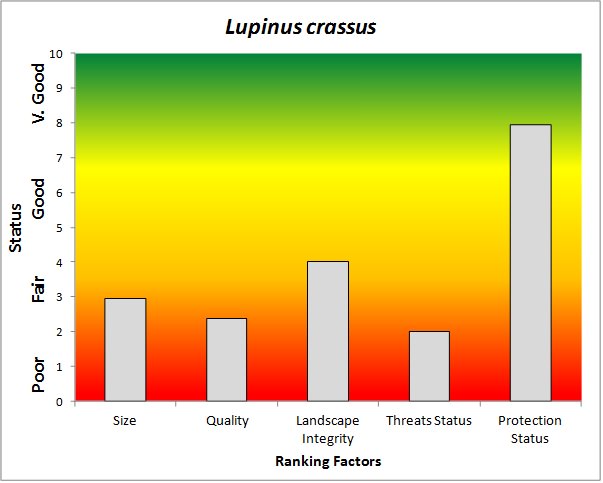
Summary results of an analysis of the status of Lupinus crassus based on several ranking factors. This species was concluded to be weakly conserved. From Rondeau et al. 2011. |
References
- Ackerfield, J. 2015. Flora of Colorado. BRIT Press, Botanical Research Institute of Texas, Fort Worth, TX. 818 pp.
- Atwood, D., J. Holland, R. Bolander, B. Frnaklin, D. E. House, L. Armstrong, K. Thorne, and L. England. 1991. Utah Threatened, Endangered, and Sensitive Plant Field Guide. US Forest Service Intermountain Region, National Park Service, Bureau of Land Management, Utah Natural Heritage Program, US Fish and Wildlife Service, Environmental Protection Agency, Navajo Nation, and Skull Valley Goshute Tribe.
- Colorado Natural Heritage Program (CNHP). 2025. Biodiversity Tracking and Conservation System (Biotics 5). Colorado Natural Heritage Program, Colorado State University, Fort Collins.
- Colorado Natural Heritage Program (CNHP). 2025. Climate Change Vulnerability Assessment of Colorado Tier 1 and Tier 2 Plant Species of Greatest Conservation Need (SCGN) for the 2025 Colorado State Wildlife Action Plan. Colorado Natural Heritage Program, Colorado State University, Fort Collins.
- Colorado Natural Heritage Program. 2021. Landscape Disturbance Index Layer for Colorado. Edition 04_2021. Raster Digital Data Set. Colorado Natural Heritage Program, Fort Collins, CO. April 21, 2021.
- Handwerk, J., L. Grunau, and S. Panjabi. 2015. Colorado Wildlife Action Plan: 2015 Rare Plant Addendum. Colorado Natural Heritage Program, Colorado State University, Fort Collins, Colorado, USA.
- Neely, B., S. Panjabi, E. Lane, P. Lewis, C. Dawson, A. Kratz, B. Kurzel, T. Hogan, J. Handwerk, S. Krishnan, J. Neale, and N. Ripley. 2009. Colorado Rare Plant Conservation Strategy, Developed by the Colorado Rare Plant conservation Initiative. The Nature Conservancy, Boulder, Colorado, 117 pp.
- O'Kane, S.L. 1988. Colorado's rare flora. Great Basin Naturalist 48(4): 434-484.
- Payson, Edwin. New and Noteworthy Plants from Southwestern Colorado. Botanical Gazette. 60:374.
- Peterson, J.S. 1983. Status report for Lupinus crassus. Unpublished report prepared for the Colorado Natural Heritage, Ft. Collins, CO.
- Rondeau, R., K. Decker, J. Handwerk, J. Siemers, L. Grunau, and C. Pague. 2011. The state of Colorado's biodiversity 2011. Prepared for The Nature Conservancy. Colorado Natural Heritage Program, Colorado State University, Fort Collins, Colorado.
- Southwest Environmental Information Network (SEINet). 2021. Collections Databases. Online. Available: https://swbiodiversity.org/seinet/collections/index.php (accessed 2021).
- Spackman, S., B. Jennings, J. Coles, C. Dawson, M. Minton, A. Kratz, and C. Spurrier. 1997. Colorado Rare Plant Field Guide. Prepared for the Bureau of Land Management, the U.S. Forest Service and the U.S. Fish and Wildlife Service by the Colorado Natural Heritage Program.
- USDA, NRCS. 2022. The PLANTS Database. National Plant Data Team, Greensboro, NC 27401-4901 USA.
- Weber, W. A. and R. C. Wittmann. 2012. Colorado Flora, Western Slope, A Field Guide to the Vascular Plants, Fourth Edition. Boulder, Colorado. 532 pp.