


Scientific Name : Phacelia formosula
Author : Osterhout NatureServe Explorer
Common Name : North Park Phacelia
 Current Research Activities
 1997 profile
☰ Click link below for details.
Taxonomy
Hydrophyllaceae (waterleaf family)
Phacelia formosula was first discovered by George Osterhout in Jackson County, Colorado in 1918 and was published as a species in 1919 (Osterhout 1919). More recently, two morphologically similar populations of Phacelia were discovered in Larimer and Grand counties, Colorado (P. scullyi [not published] and P. gina-glenneae, respectively) (Atwood and Welsh 2013, Neale et al. 2014). Since their discoveries in 2004 and 2010 genetic and morphologic research of the Phacelia populations has been on-going. Initial results indicated that there was no distinction between the Jackson and Larimer county populations (Riser et al. 2020), and that the Grand County population of P. gina-glenneae (Atwood and Welsh 2013) was a separate entity. However, additional studies conclude that taxonomic separation of the three Phacelia groups in Larimer, Jackson, and Grand counties is not warranted and that P. gina-glenneae and P. scullyi should be subsumed into Phacelia formosula (Naibauer and McGlaughlin 2022). We consider the concept of P. formosula to include the Larimer and Jackson populations and maintain the concept of P. gina-glenneae until recent research has been published (CNHP 2022).
Ranks and Status
State Rank : S2
State Rank Reason : Phacelia formosula is a small, annual or biennial plant species that is endemic to North Park and the Laramie River Valley in Jackson and Larimer counties of Colorado, USA. There are 11 extant occurrences (12 if the species concept includes P. gina-glenneae). Phacelia formosula's growth habit leads to extreme annual fluctuations in population size, this combined with genetic isolation of the populations makes the species highly vulnerable to stochastic events. The species and its habitat are threatened by livestock grazing, competition from invasive plant species, recreation use, oil and gas development, drought and habitat shifting and alteration associated with climate change.
U.S. Endangered Species Act :
Colorado Threatened and Endangered List : none
Other Statuses : BLM, SWAP Tier 1
Description and Phenology
General Description:
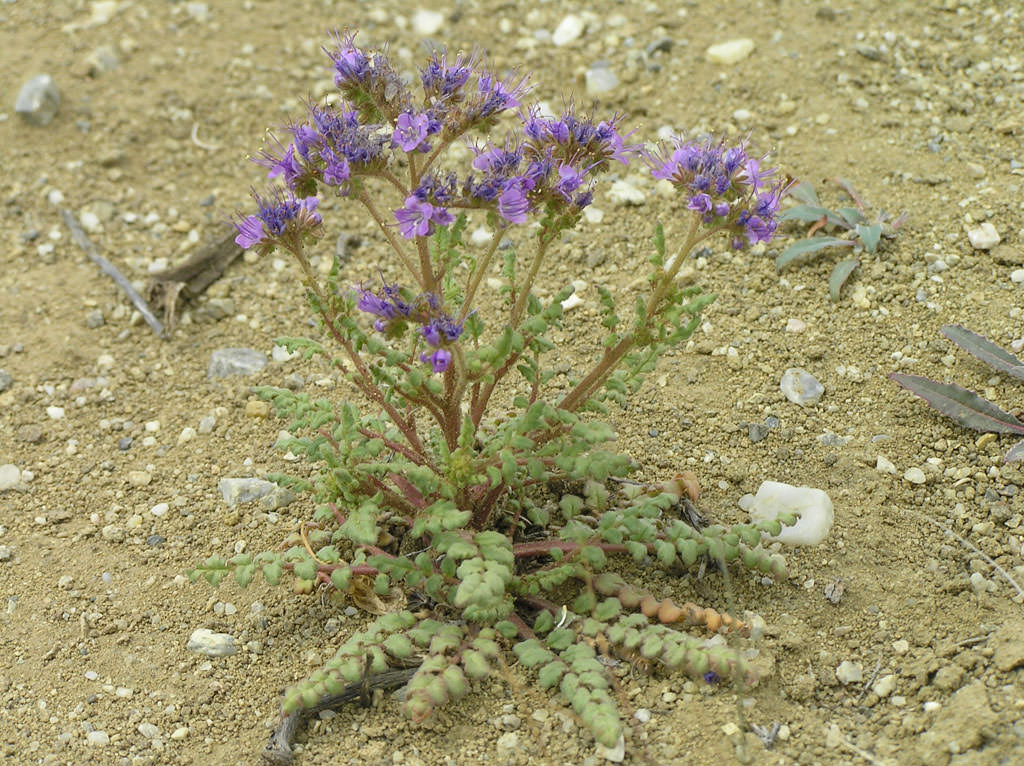
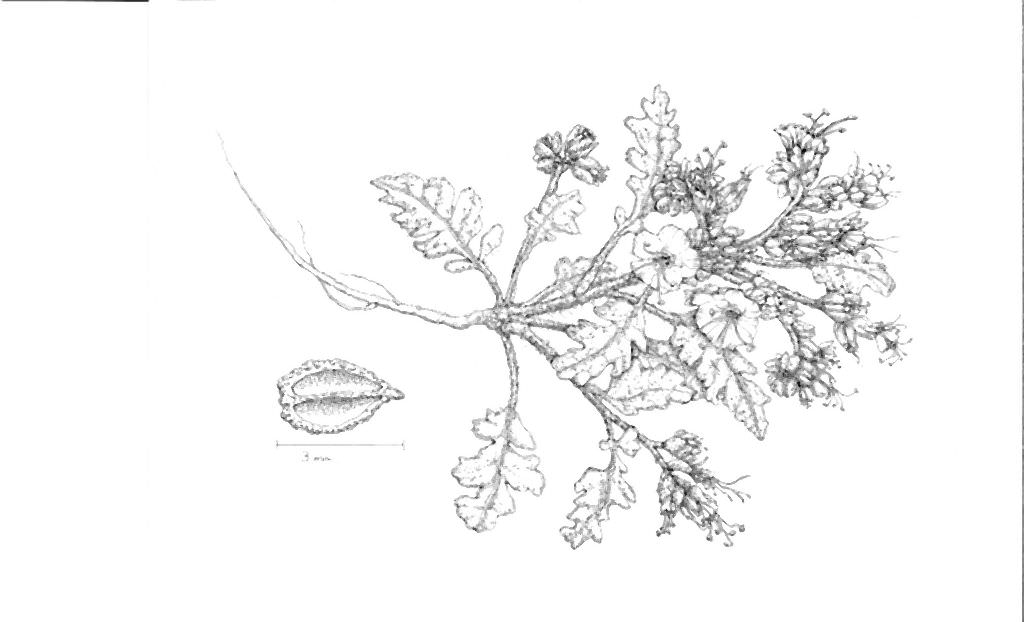
Herbaceous biennial up to 22 cm tall; much branched, erect to spreading. Inflorescence is a helicoid cyme. Flowers are purple, stamens and styles are exserted. Leaves are pinnately dissected, lanceolate or elliptical. Plants appear somewhat grayish; glandular and hirsute (Spackman et al. 1997).
Look Alikes:
Species cannot be confused on site (Wiley-Eberle 1979), it is distinctive in rosette and flowering forms (pers. comm. Coles 1994). P. formosula appears to be most closely related to P. glandulosa, but can be distinguished from that species by its usually much-branched, erect to spreading habit, less exserted stamens and style, darker seeds, narrower calyx lobes, and more pubescence style (Peterson 1986). P. glandulosa is allopatric, growing on oil shale (Coles pers. comm. 1994).
Phenology:
Flowering late June occassionally through October in favorable years. In fruit July through November (Coles pers. comm. 1994). Flowering in July to early August and fruiting in August (Wiley-Eberle 1979). Plants bloom from late June to early October (Warren 1990).
 |
Habitat
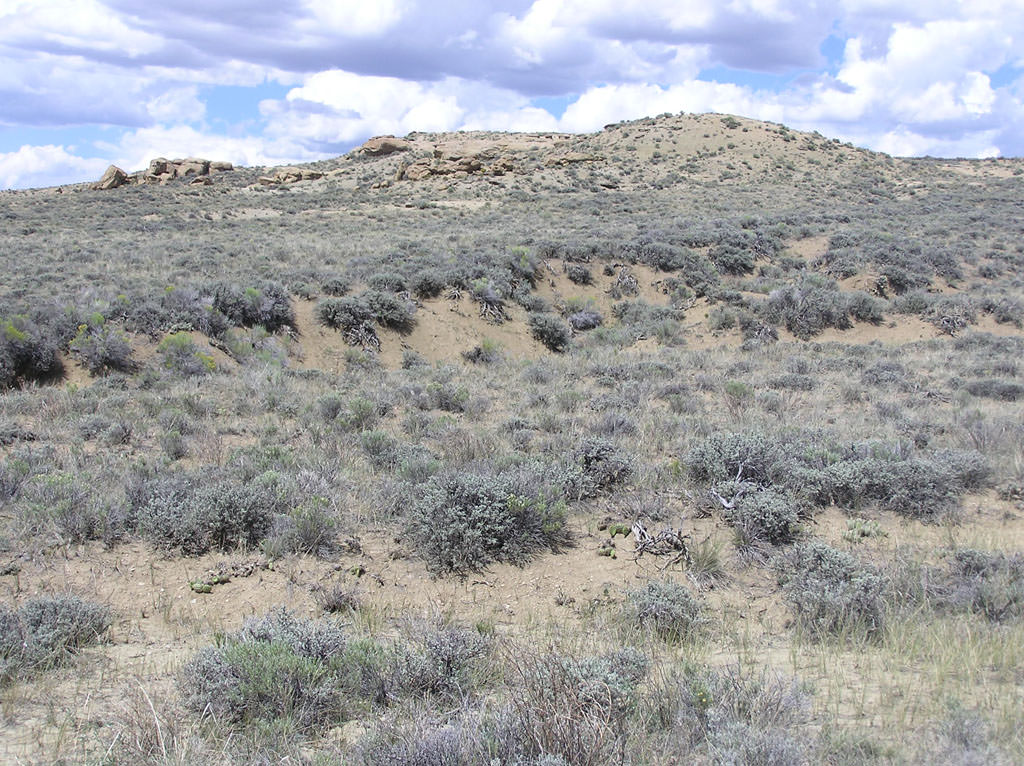
Sparsely vegetated exposures of the Coalmont Formation in North Park in Jackson County no steep-sided ravines, low sandy hills and bluffs (Spackman et al. 1997). Outcrops of Niobrara shale in Larimer County (USFWS 2023). Associated taxa include: Chrysothamnus, Artemisia, Oryzopsis hymenoides, Chaenactis douglasii, Chamaerhodos erecta, Gilia pinnatifida, Ipomopsis congesta, Stipa sp., Tetradymia canescens, Eriogonum exilifolum, E. umbellatum, E. pauciflorum, E. cernuum, Artemisia frigida, Lupinus sp., Astragalus kentrophyta, Opuntia polyacantha and Comandra umbellata.
click on image to enlarge
 |
Elevation Range:
7,830 - 8,289 feet (2,387 - 2,526 meters)
Distribution
Colorado Endemic:
Yes
Range:
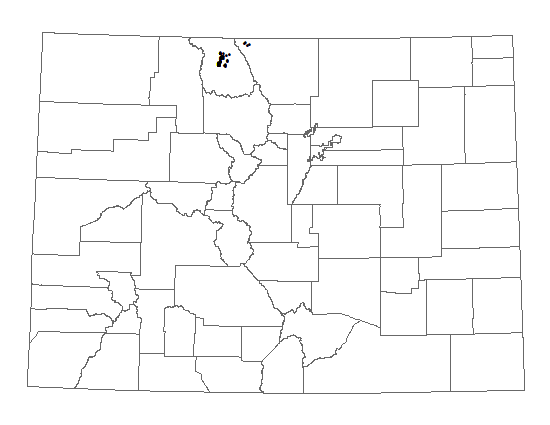
Phacelia formosula is endemic to Jackson and Larimer counties in north central Colorado (USA); it is found on the Coalmont Formation in Jackson County and the Niobrara Formation in Larimer County. When the species concept includes P. gina-glenneae the range is 1853 square kilometers and extends south into Grand County (CNHP 2025). If the species concept does not include P. gina-glenneae then the estimated range extent in Colorado is 525 square kilometers (2025).
 Click on map to enlarge |
Threats and Management Issues
Threats to Phacelia formosula include motorized recreation, inappropriate livestock grazing, competition from invasive plant species, and road and powerline maintenance. Off highway vehicle use has been reported from 45% (5 of 11) extant occurrences (CNHP 2022). Invasive species, primarily Salsola (Russian thistle) are also reported from 45% of the extant occurrences, an increase of 18% since 2019 (CNHP 2022). Livestock grazing is reported as the predominant land use within 81% of the occurrences, and cattle trailing and trampling have been observed within several occurrences (CNHP 2022). Two occurrences have a powerline passing through P. formosula habitat, and just over 50% of the occurrences are along or near roads where fugitive dust and road maintenance activities may impact the species. This species is considered to have low adaptive capacity and is expected to be extremely vulnerable to climate change under both RCP 4.5 and 8.5 scenarios, as assessed for the 2025 Colorado State Wildlife Action Plan (CNHP 2025).
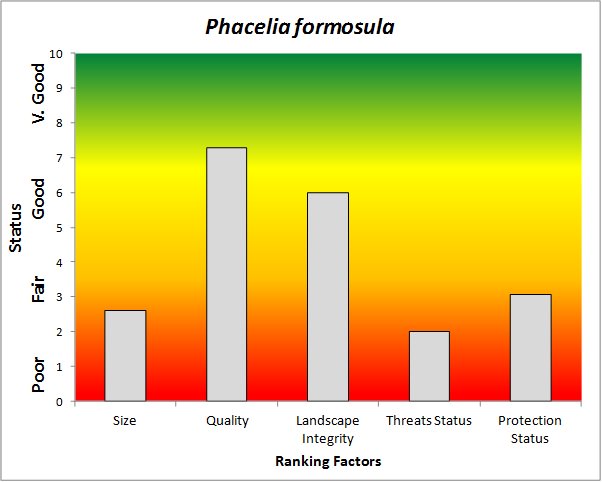 Summary results of an analysis of the status of Phacelia formosula based on several ranking factors. This species was concluded to be "weakly conserved. From Rondeau et al. 2011. |
References
- Ackerfield, J. 2012. The Flora of Colorado. Colorado State University Herbarium. 433 pp.
- Atwood, D. 2010. Progress Report for Phacelia formosula Osherhout in North Park, Jackson County, Colorado and the Scully Phacelia in Larimer County, Colorado; prepared for USFWS.
- Atwood, N.D. and S.L. Welsh. 2013. New plant taxa from Colorado, New Mexico, and Arizona. Western North American Naturalist 73(1): 113-115.
- Colorado Native Plant Society. 1989. Rare plants of Colorado. Rocky Mountain Nature Association, Colorado Native Plant Society, Estes Park, Colorado. 73 pp.
- Colorado Natural Heritage Program (CNHP). 2025. Biodiversity Tracking and Conservation System (Biotics 5). Colorado Natural Heritage Program, Colorado State University, Fort Collins.
- Colorado Natural Heritage Program (CNHP). 2025. Climate Change Vulnerability Assessment of Colorado Tier 1 and Tier 2 Plant Species of Greatest Conservation Need (SCGN) for the 2025 Colorado State Wildlife Action Plan. Colorado Natural Heritage Program, Colorado State University, Fort Collins.
- Geo. E. Osterhout. (1919). Additions to the Flora of Colorado. Bulletin of the Torrey Botanical Club, 46(2), 53–56. https://doi.org/10.2307/2479602
- Krening, P. 2023. North Park Phacelia (Phacelia formosula) Population Trend Monitoring Summary - 2023. Prepared for the Colorado State Office - Bureau of Land Management (BLM), U.S. Department of the Interior.
- Krening, P. 2024. North Park phaceila (Phacelia formosula), Population Trend Monitoring Summary - 2024. Bureau of Land Management, CO State Office. Lakewood, CO.
- Naibauer, S. and M. McGlaughlin. 2022. Genetic investigation of Phacelia formosula Osterhout (Hydrophyllaceae), North Park Phacelia, and disjunct Phacelia groups in Northern Colorado; Status Report - October, 2022.
- Neale, J., A. Schwabe, M. Islam, M. DePrenger-Levin, and D. Atwood. 2014. Phacelia formosula: Surveys, Population Assessment, and Assessment of Genetic Diversity. US Fish and Wildlife Final Report. Denver Botanic Gardens and Brigham Young University.
- Neely, B., S. Panjabi, E. Lane, P. Lewis, C. Dawson, A. Kratz, B. Kurzel, T. Hogan, J. Handwerk, S. Krishnan, J. Neale, and N. Ripley. 2009. Colorado Rare Plant Conservation Strategy, Developed by the Colorado Rare Plant conservation Initiative. The Nature Conservancy, Boulder, Colorado, 117 pp.
- Peterson, J. Scott and K.L. Wiley-Eberle. 1986. North Park Phacelia Recovery Plan. USFWS, Denver, CO. 28pp.
- Riser, J. P. II, J. Ramp Neale, M. DePrenger-Levin, M. B. Islam, and A. L. Schwabe. 2020. Phacelia formosula (Boraginaceae) genetic research: Executive Summary of Research conducted by Denver Botanic Gardens.
- Rocky Mountain Society of Botanical Artists. 2009. RARE Imperiled Plants of Colorado, a traveling art exhibition. Exhibition catalogue developed by the Denver Botanic Gardens and Steamboat Art Museum.
- Rondeau, R., K. Decker, J. Handwerk, J. Siemers, L. Grunau, and C. Pague. 2011. The state of Colorado's biodiversity 2011. Prepared for The Nature Conservancy. Colorado Natural Heritage Program, Colorado State University, Fort Collins, Colorado.
- Spackman, S., B. Jennings, J. Coles, C. Dawson, M. Minton, A. Kratz, and C. Spurrier. 1997. Colorado rare plant field guide. Prepared for Bureau of Land Management, U.S. Forest Service and U.S. Fish and Wildlife Service by Colorado Natural Heritage Program.
- U.S. Fish and Wildlife Service (USFWS). 1982. Determination that Phacelia formosula is an endangered species. Federal Register 47(170): 38540-38543.
- U.S. Fish and Wildlife Service. 2023. Species Status Assessment Report for North Park Phacelia (Phacelia formosula). Version 1.1, Grand Junction, Colorado. 78 pp.
- USDA, NRCS. 2022. The PLANTS Database. National Plant Data Team, Greensboro, NC 27401-4901 USA.
- Warren, K.D. 1990. A Comparative Study of the Reproductive Biology of a Rare and a Common Phacelia Species. Unpublished thesis.
- Weber, W. A. and R. C. Wittmann. 2012. Colorado Flora, Eastern Slope, A Field Guide to the Vascular Plants, Fourth Edition. Boulder, Colorado. 555 pp.
- Wiley-Eberle, K.L. 1979. Status report for Phacelia formosula. Unpublished report prepared for the Bureau of Land Management.