

Scientific Name : Pediomelum aromaticum
Author : (Payson) W.A. Weber NatureServe Explorer
Common Name : Paradox Breadroot
 Current Research Activities
☰ Click link below for details.
Taxonomy
Fabaceae (pea family)
=Psoralea aromatica
Ranks and Status
State Rank : S2
State Rank Reason : As of 2022 there are 10 known occurrences in western Colorado, USA, however most of them are based on historical observations. Threats to the species include incompatible grazing, competition from non-native plants and motorized recreation. Long term drought is occurring throughout the range of this species in Colorado, and it is expected to be moderately to extremely vulnerable to the effects of climate change.
U.S. Endangered Species Act : none
Colorado Threatened and Endangered List : none
Other Statuses : BLM, SWAP Tier 2
Description and Phenology
General Description:
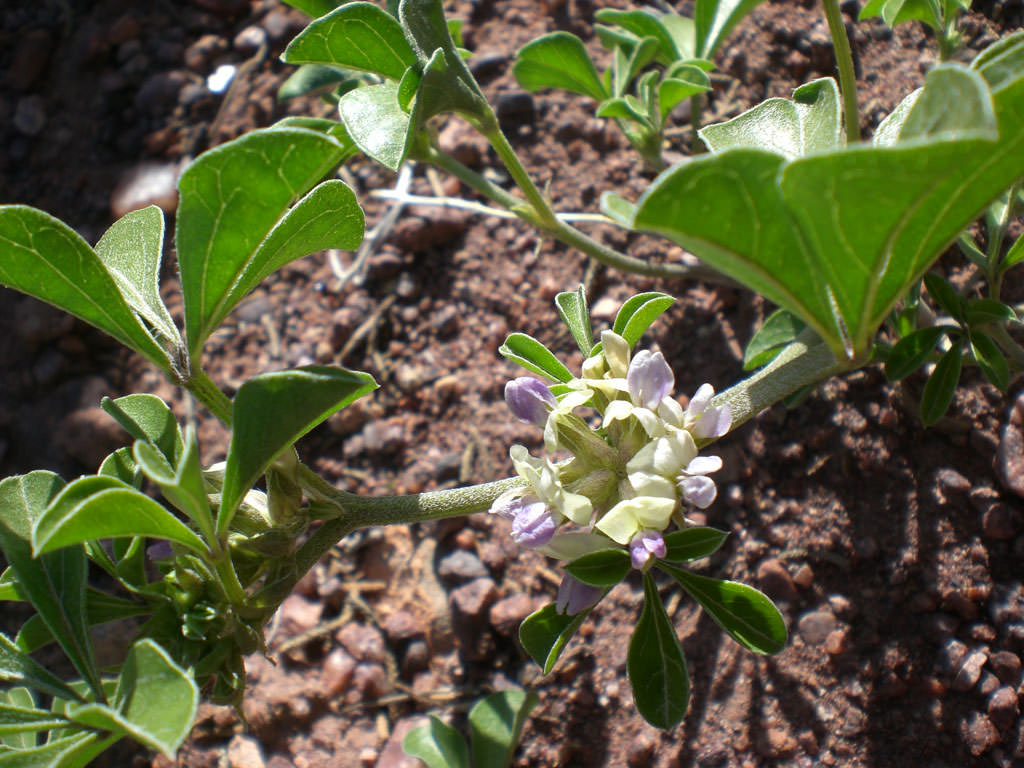
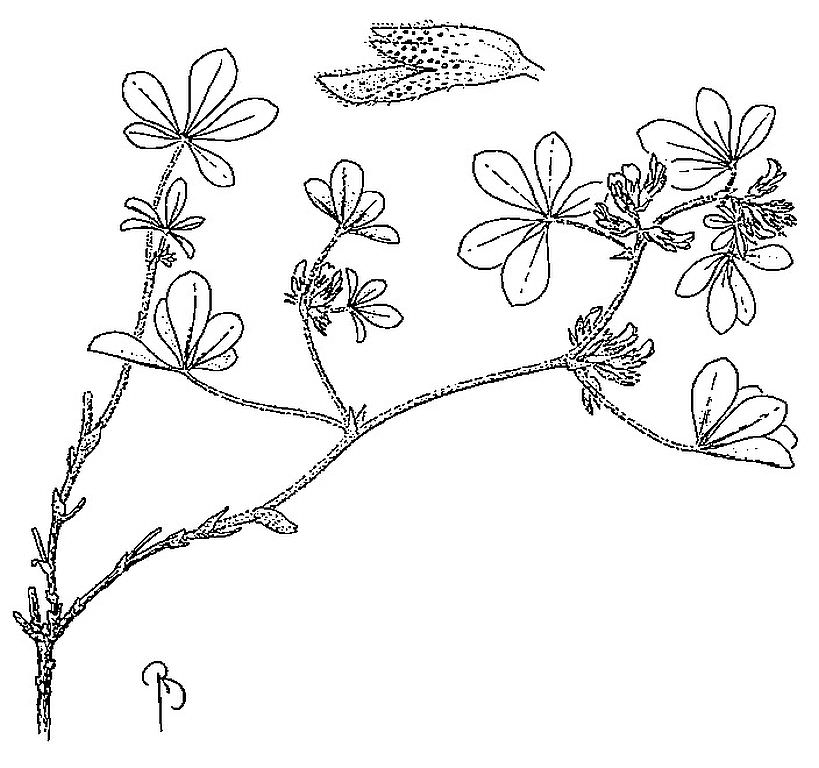
Pediomelum aromaticum is a perennial herb with cream/white and light purple flowers that are 8-14 mm long. Leaves are green, and palmate with (3) 5-7 leaflets; not forming a basal rosette. Stems are 15-30 cm tall; and much-branched.
Look Alikes:
Pediomelum megalanthum has larger flowers (15-20 mm long), gray pubescent leaves forming a basal rosette, and very short stems.
Phenology:
Flowers May through June, fruit in June (Cronquist 1989, Colorado Natural Heritage Program 2012).
 |
Habitat
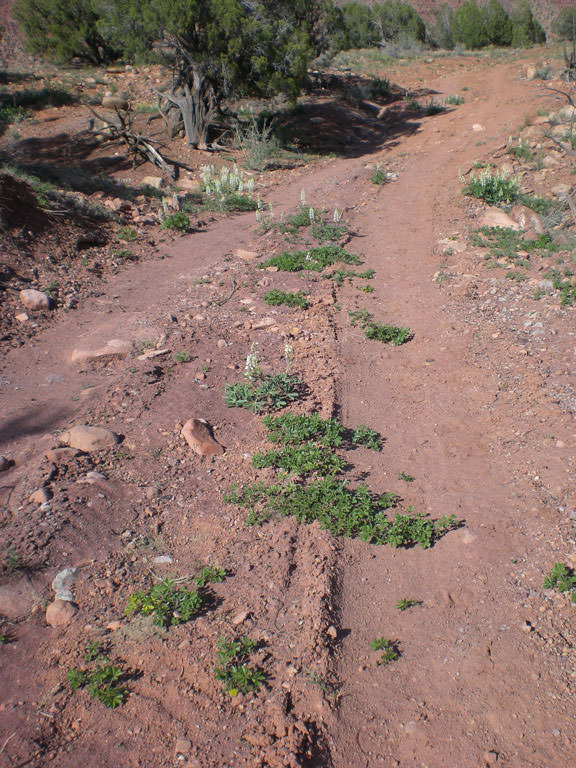
Open pinyon-juniper woodlands, in sandy soils or adobe hills. Associated species include Juniperus osteosperma, Aristida purpurea, Lupinus crassus, Eriogonum lonchophyllum, Gutierrezia sarothrae, Astragalus bisulcatus, Tetraneuris iavesiana, Achnatherum hymenoides, Bouteloua gracilis, Arabis pulchra, Cryptantha flava, and Erysimum capitatum (Colorado National Heritage Program 2012).
click on image to enlarge
 |
Elevation Range:
4,696 - 6,167 feet (1,431 - 1,880 meters)
Distribution
Colorado Endemic:
No
Range:
Pediomelum aromaticum is known from Mesa, Montrose and Montezuma counties in Colorado, USA. Estimated range extent in Colorado of 3609 square kilometers was calculated in GeoCAT using occurrence data provided by the Colorado Natural Heritage Program (2022). This species can also be found in Arizona and Utah. USA.
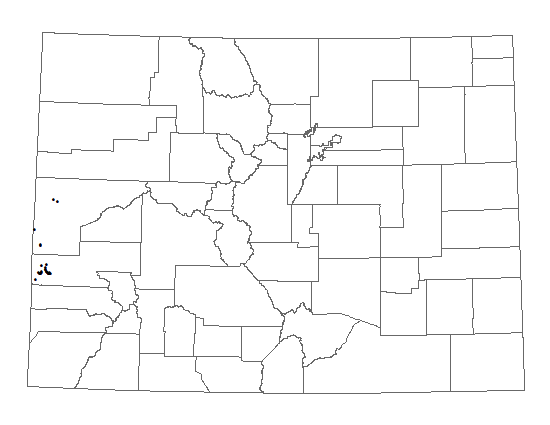 Click on map to enlarge |
Threats and Management Issues
As of 2022, 70% of the occurrences are found in habitat with minimal to low levels of landscape disturbance, the remainder are in areas with moderate to high levels of landscape disturbance (CNHP 2021). At the local level recent observations indicate that several occurrences are threatened by livestock grazing, invasive nonnative species, and OVH activities. Additionally, long term drought is occurring throughout the range of this species. This species is considered to have moderate adaptive capacity and is expected to be moderately to extremely vulnerable to climate change under both RCP 4.5 and 8.5 scenarios, as assessed for the 2025 Colorado State Wildlife Action Plan (CNHP 2025).
References
- Ackerfield, J. 2012. The Flora of Colorado. Colorado State University Herbarium. 433 pp.
- Colorado Natural Heritage Program (CNHP). 2022. Biodiversity Tracking and Conservation System (Biotics 5). Colorado Natural Heritage Program, Colorado State University, Fort Collins.
- Colorado Natural Heritage Program (CNHP). 2025. Climate Change Vulnerability Assessment of Colorado Tier 1 and Tier 2 Plant Species of Greatest Conservation Need (SCGN) for the 2025 Colorado State Wildlife Action Plan. Colorado Natural Heritage Program, Colorado State University, Fort Collins.
- Colorado Natural Heritage Program. 2021. Landscape Disturbance Index Layer for Colorado. Edition 04_2021. Raster Digital Data Set. Colorado Natural Heritage Program, Fort Collins, CO. April 21, 2021.
- Cronquist A. 1989. Intermountain Flora Vascular Plants of the Intermountain West, USA. Vol. 3, Part B. New York Botanical Garden, Bronx, NY.
- Harrington, H. D. 1954. Manual of the Plants of Colorado. Sage Books, Denver, CO. 666 pp.
- Lavender, A.E., M.M. Fink, S.E. Linn, D.M. Theobald. 2011. Colorado Ownership, Management, and Protection v9 Database. Colorado Natural Heritage Program and Geospatial Centroid, Colorado State University, Fort Collins, CO. (30 September).
- Ockendon, D.J. (1965). Southwest. Nat. 10:105-106.
- Payson, E. 1915. New and noteworthy plants from southwestern Colorado. Botanical Gazette 60:374-376.
- USDA, NRCS. 2022. The PLANTS Database. National Plant Data Team, Greensboro, NC 27401-4901 USA.
- Weber, W. A. and R. C. Wittmann. 2012. Colorado Flora, Western Slope, A Field Guide to the Vascular Plants, Fourth Edition. Boulder, Colorado. 532 pp.
- Welsh, S.L, N.D. Atwood, S. Goodrich, and L.C. Higgins. 1993. A Utah Flora, second edition, revised. Brigham Young University, Provo, UT.