

Scientific Name : Spiranthes diluvialis
Author : Sheviak NatureServe Explorer
Common Name : Ute Ladies' Tresses
 Current Research Activities
 1997 profile


☰ Click link below for details.
Taxonomy
Orchidaceae (orchid family)
Ranks and Status
State Rank : S2
State Rank Reason : Spiranthes diluvialis has a fairly wide range in Colorado (USA) where it is found in riparian areas on both the east and west slope of the Rocky Mountains. However, it is known from only 23 occurrences, over half of which are of poor viability or historical. The primary threats to the species are hydrologic alterations and trampling by livestock or non-motorized recreation. Wetland and riparian area management activities may be detrimental or beneficial depending on the timing and frequency. Spiranthes diluvialis is also considered to be moderately to extremely vulnerable to the effects of climate change.
U.S. Endangered Species Act :
Colorado Threatened and Endangered List : none
Other Statuses : SWAP Tier 1
Description and Phenology
General Description:
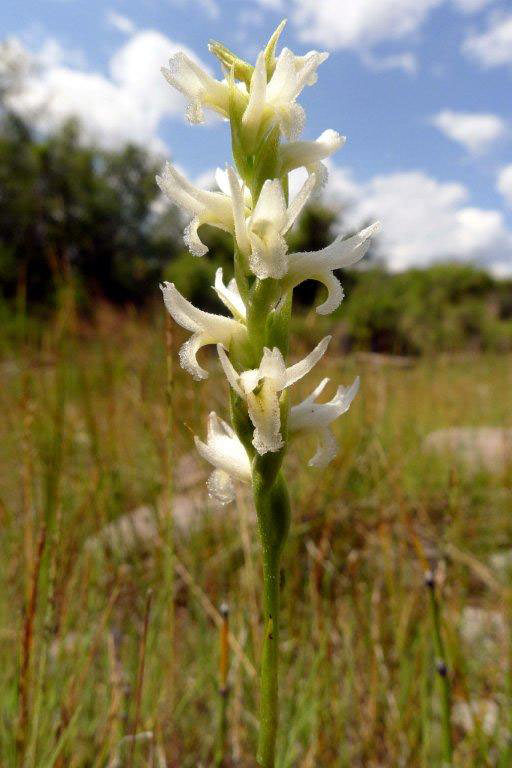
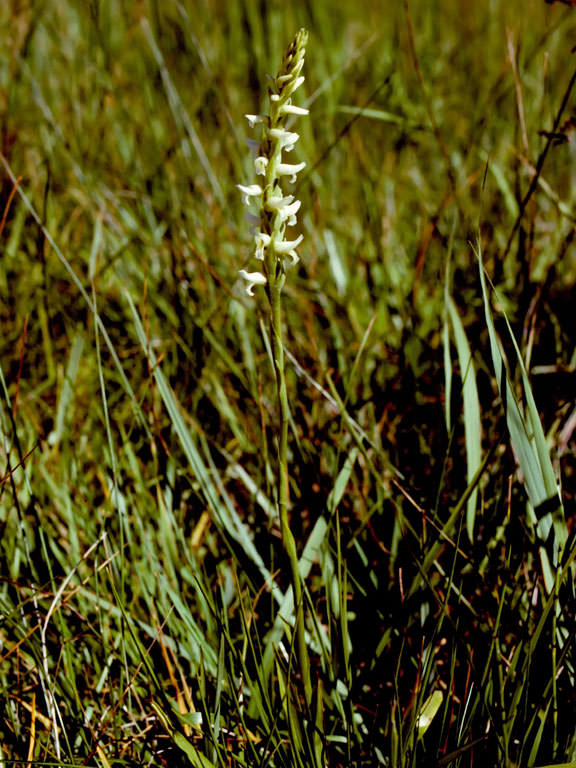
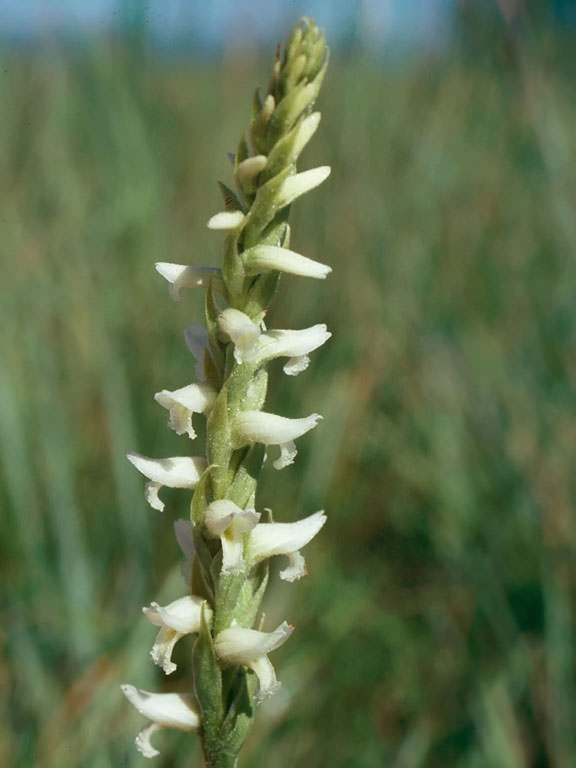
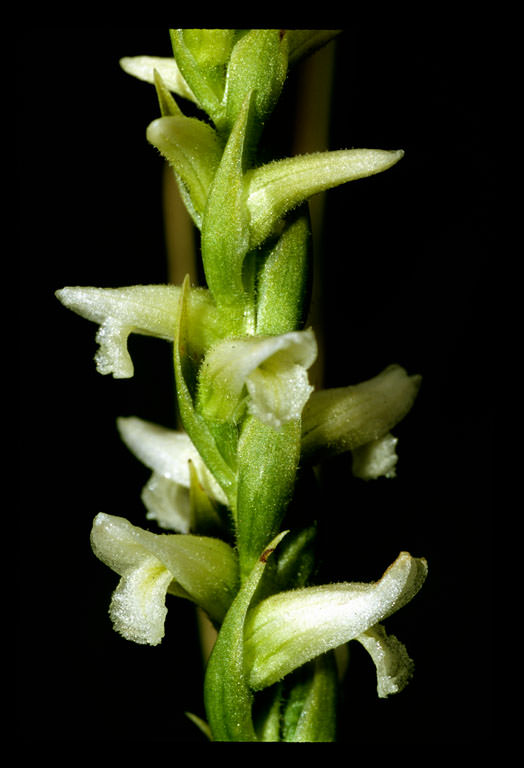
Ute Ladies' Tresses is a perennial orchid with usually 1 stem that is 20-50 cm tall and arising from tuberously thickened roots. Its narrow leaves are 1 cm wide, can reach 28 cm long, are longest at their base, and persist during flowering. The inflorescence consists of few to many white or ivory flowers clustered in a spike of 3-rank spirals at the top of the stem. The sepals and petals are ascending or perpendicular to the stem. The lateral sepals often spread abruptly from the base of the flower, and sepals are free or only slightly connate at the base. The lip petal is somewhat constricted at the median.
Look Alikes:
Spiranthes romanzoffiana lip petals are deeply constricted in the middle, and have an erose tip; tepals form a hood above the lip, and the inflorescence is densely congested so the rachis is usually not visible (Weber and Wittmann 2012, Ackerfield 2012, Spackman et al. 1997). Spiranthes romanzoffiana also usually occurs at higher elevations (Spackman et al. 1997).
Phenology:
New growth begins in October, remains dormant through the winter. In the spring, the new growth should continue to grow and flower (Coyner 1990). Known to flower between July and September in Colorado, depending on the year (Spackman et al. 1997).
Habitat
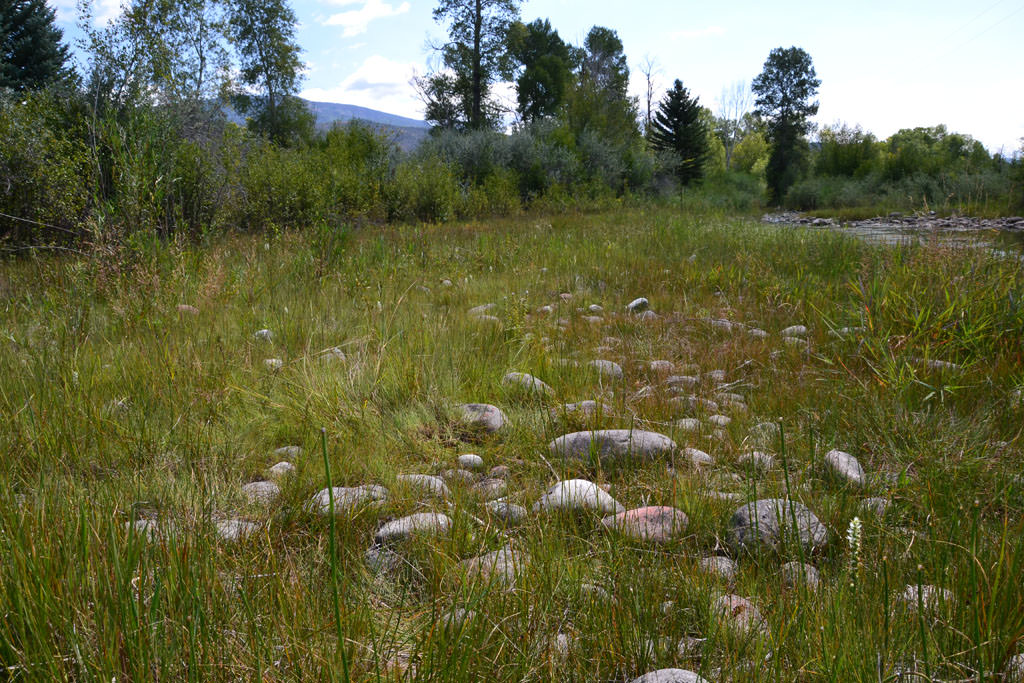
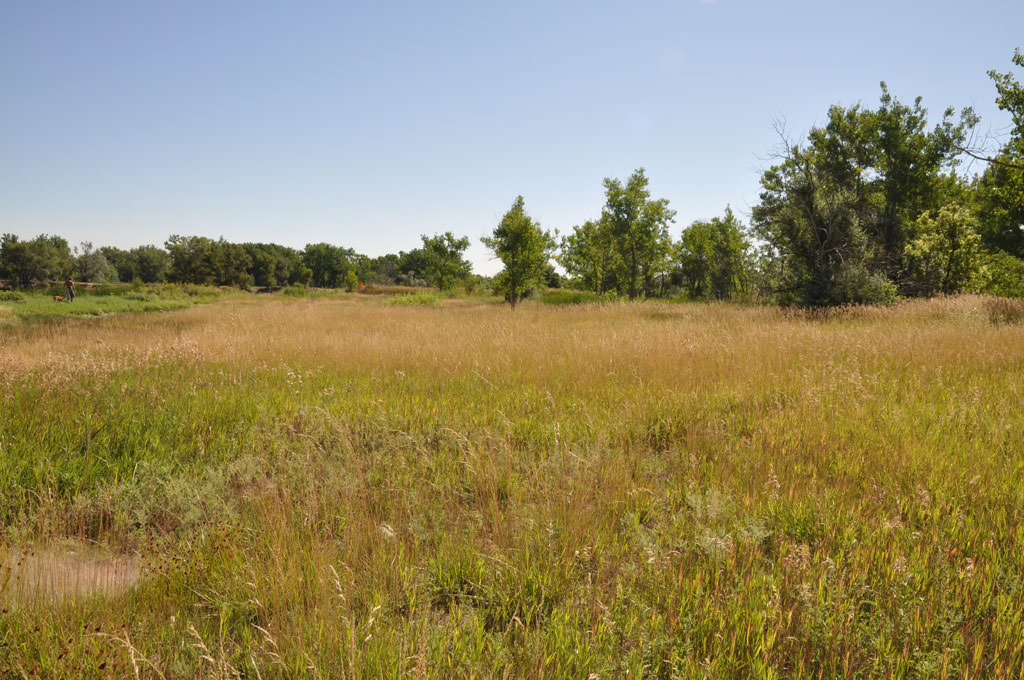
Along streams and open seepage areas in cottonwoods. Moist meadows at moderate elevations, usually occurring on floodplains in the vicinity of abandoned stream channels and meanders where the vegetation is not too dense or overgrown. Soils are both sandy and stony (Jennings 1989). Subirrigated alluvial soils along streams and in open meadows in floodplains (Spackman et al. 1997). Associated species include horsetail, milkweed, verbena, lobelia, blue-eyed grass, carpet bentgrass, reed grass, golden rod and canada thistle (Jordan 1992).
click on image to enlarge
 |
 |
Elevation Range:
4,527 - 7,000 feet (1,380 - 2,134 meters)
Distribution
Colorado Endemic:
No
Range:
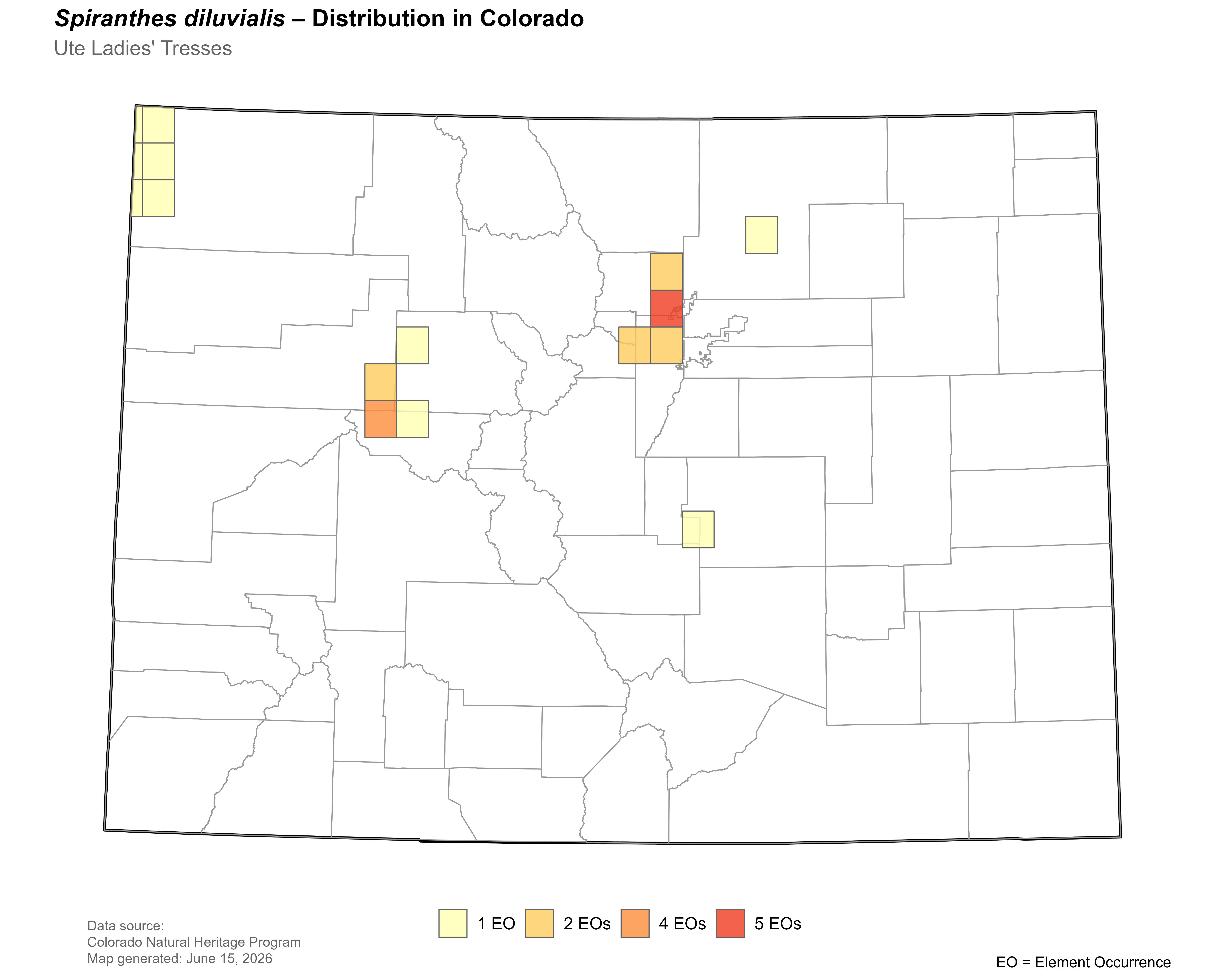
Spiranthes diluvialis is known from Boulder, Eagle, Garfield, Jefferson, Larimer, and Moffat counties in Colorado. The estimated range extent in Colorado of 36,189 square kilometers was calculated in GeoCAT using occurrence data provided by the Colorado Natural Heritage Program (2023). Poorly documented historical occurrences in Weld and El Paso counties are not included in this calculation. This species can also be found in Idaho, Montana, Nebraska, Nevada, Utah, Washington, and Wyoming, USA. Globally, this species can also be found in British Columbia, Canada.
Click on map to enlarge |
Threats and Management Issues
Spiranthes diluvialis is considered to be threatened throughout its range by many forms of water development, inappropriate livestock grazing, haying, exotic plant species invasion, habitat fragmentation and non-motorized recreation (e.g. trampling by fishermen) (CNHP 2023). The primary threat at this time is considered to be hydrologic alteration (Rondeau et al. 2011). Seed predation by voles also poses a potentially serious threat to the species long term viability, however, this appears only to be a problem in agricultural areas, not in more pristine riparian areas (Arft 1995). Wetland and riparian area modification may threaten the species, or may create new habitat, depending on how it is done. Similarly, mowing and burning may be beneficial or detrimental depending on timing, frequency, etc. (Arft 1995). This species is considered to have moderate adaptive capacity and is expected to be moderately to extremely vulnerable to climate change under both RCP 4.5 and 8.5 scenarios, as assessed for the 2025 Colorado State Wildlife Action Plan (CNHP 2025).
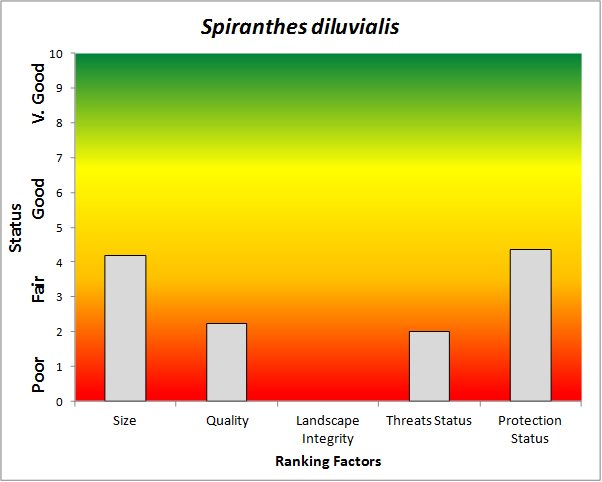
Summary results of an analysis of the status of Spiranthes diluvialis based on several ranking factors. This species was concluded to be "moderately conserved. From Rondeau et al. 2011. |
References
- Ackerfield, J. 2012. The Flora of Colorado. Colorado State University Herbarium. 433 pp.
- Arft, A. M. 1995. The genetics, demography, and conservation management of the rare orchid SPIRANTHES DILUVIALIS. Ph.D. dissertation. University of Colorado, Boulder. 170 pp.
- Arft, A.M. and T.A. Ranker. 1993. Population genetics and phylogenetic systematics of the rare orchid Spiranthes diluvialis: implications for conservation.
- Colorado Native Plant Society. 1989. Rare plants of Colorado. Rocky Mountain Nature Association, Colorado Native Plant Society, Estes Park, Colorado. 73 pp.
- Colorado Natural Heritage Program (CNHP). 2025. Climate Change Vulnerability Assessment of Colorado Tier 1 and Tier 2 Plant Species of Greatest Conservation Need (SCGN) for the 2025 Colorado State Wildlife Action Plan. Colorado Natural Heritage Program, Colorado State University, Fort Collins.
- Culver, D.R. and J.M. Lemly. 2013. Field Guide to Colorado's Wetland Plants; Identification, Ecology and Conservation. Colorado Natural Heritage Program, Colorado State University, Fort Collins, 694 pp.
- Fertig, W., R. Black, and P. Wolken. 2005. Rangewide status review of Ute Ladies'-Tresses (Spiranthes diluvialis). Prepared for the US Fish and Wildlife Service and Central Utah Water Conservancy District. 30 September 2005. Online. Available: http://www.fws.gov/mountain-prairie/species/plants/uteladiestress/SPDI_Status%20review_Fertig2005.pdf (Accessed 2008).
- Handwerk, J., L. Grunau, and S. Panjabi. 2015. Colorado Wildlife Action Plan: 2015 Rare Plant Addendum. Colorado Natural Heritage Program, Colorado State University, Fort Collins, Colorado, USA.
- Neely, B., S. Panjabi, E. Lane, P. Lewis, C. Dawson, A. Kratz, B. Kurzel, T. Hogan, J. Handwerk, S. Krishnan, J. Neale, and N. Ripley. 2009. Colorado Rare Plant Conservation Strategy, Developed by the Colorado Rare Plant conservation Initiative. The Nature Conservancy, Boulder, Colorado, 117 pp.
- O'Kane, S. L. 1988. Colorado's Rare Flora. Great Basin Naturalist. 48(4):434-484.
- Pierson, K., V.J. Tepedino, S. Sipes, and K. Kuta. 2001. Pollination ecology of the rare orchid, Spiranthes diluvialis: Implications for conservation. Pages 153-164 in: J. Maschinski and L. Holter, tech. eds. Southwestern rare and endangered plants: Proceedings of the Third Conference; 2000 September 25-28; Flagstaff, AZ. Proceedings RMRS-P-23. U.S. Department of Agriculture, Forest Service, Rocky Mountain Research Station, Fort Collins, CO.
- Rondeau, R., K. Decker, J. Handwerk, J. Siemers, L. Grunau, and C. Pague. 2011. The state of Colorado's biodiversity 2011. Prepared for The Nature Conservancy. Colorado Natural Heritage Program, Colorado State University, Fort Collins, Colorado.
- Sheviak, C.J. 1984. Spiranthes diluvialis (Orchidaceae); a new species from the western U.S. Brittonia 36(1): 8-14.
- Sipes, S. D. and V. J. Tepedino. 1995. Reproductive biology of the rare orchid, Spiranthes diluvialis: breeding system, pollination, and implications for conservation. Conservation Biology 9(4):929-938.
- Spackman, S., B. Jennings, J. Coles, C. Dawson, M. Minton, A. Kratz, and C. Spurrier. 1997. Colorado rare plant field guide. Prepared for Bureau of Land Management, U.S. Forest Service and U.S. Fish and Wildlife Service by Colorado Natural Heritage Program.
- Szalanski, A.L., G. Steinauer, R. Bischof, and J. Petersen. 2001. Origin and conservation genetics of the Threatened Ute ladies'-tresses, Spiranthes diluvialis (Orchidaceae). American Journal of Botany 88: 177-180.
- U.S. Fish and Wildlife Service (USFWS). 1990. Proposal to list the plant Spiranthes diluvialis (Ute ladies'-tresses) as a threatened species. Federal Register 55(219): 47347-47350.
- U.S. Fish and Wildlife Service (USFWS). 1992. Endangered and threatened wildlife and plants; final rule to list the plant SPIRANTHES DILUVIALIS (Ute ladies' tresses) as a threatened species. Federal Register 57(12):2048-2054.
- U.S. Fish and Wildlife Service. 1995. Ute ladies' tresses (SPIRANTHES DILUVIALIS) draft recovery plan. U.S. Fish and Wildlife Service, Denver, Colorado. 46 pp.
- USDA, NRCS. 2022. The PLANTS Database. National Plant Data Team, Greensboro, NC 27401-4901 USA.
- Weber, W. A. and R. C. Wittmann. 2012. Colorado Flora, Eastern Slope, A Field Guide to the Vascular Plants, Fourth Edition. Boulder, Colorado. 555 pp.
- Weber, W. A. and R. C. Wittmann. 2012. Colorado Flora, Western Slope, A Field Guide to the Vascular Plants, Fourth Edition. Boulder, Colorado. 532 pp.
- Welsh, S.L., N.D. Atwood, S. Goodrich, and L.C. Higgins (eds.) 1993. A Utah flora. 2nd edition. Brigham Young Univ., Provo, Utah. 986 pp.