

Scientific Name : Neottia convallarioides
Author : (Swartz) Richard NatureServe Explorer
Common Name : Broad- leaved Twayblade
 Current Research Activities


☰ Click link below for details.
Taxonomy
Orchidaceae (orchid family)
Listed as Neottia convallarioides (Sw.) Rich. in Ackerfield (2022) and Listera convallarioides (Sw.) Nutt. ex Elliott in Ackerfield (2015).
Ranks and Status
State Rank : S2
State Rank Reason : Neottia (Listera) convallarioides is known from 30 occurrences in the central Rocky Mountains in Colorado (USA), however one third of the occurrences are only known from historical observations. Potential threats to the species include alterations to hydrological setting, and adverse impacts from recreation, roads maintenance, plant collection, and competition from non-native plants. Effects from climate change are also a concern.
U.S. Endangered Species Act : none
Colorado Threatened and Endangered List : none
Other Statuses : none
Description and Phenology
General Description:
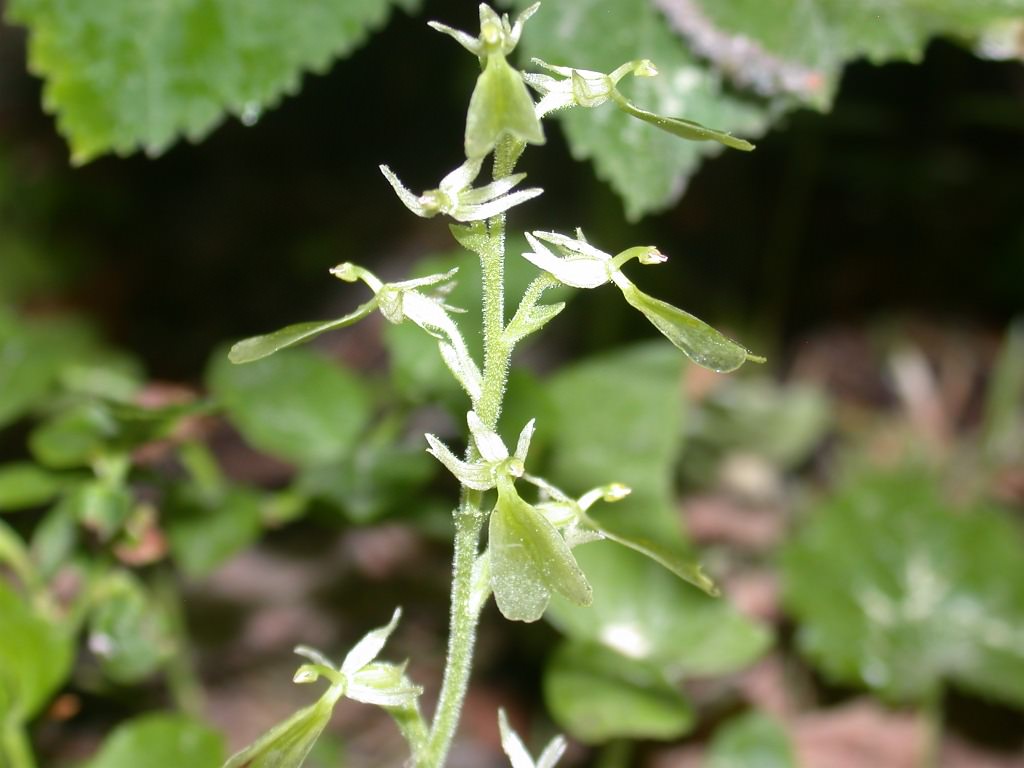
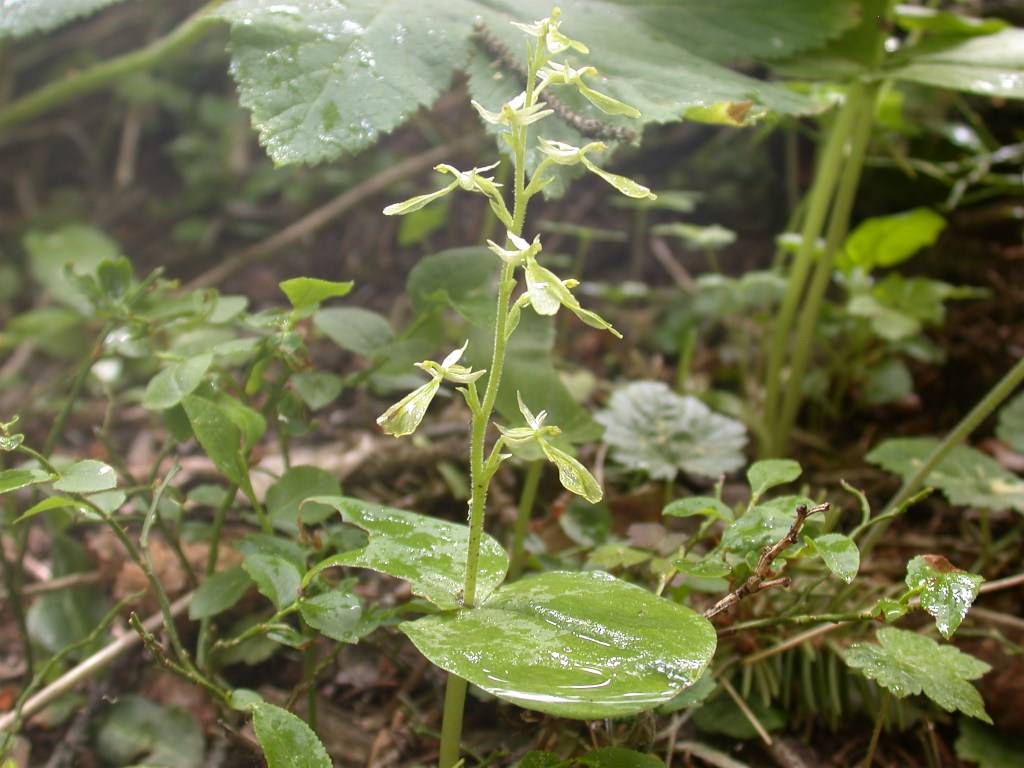
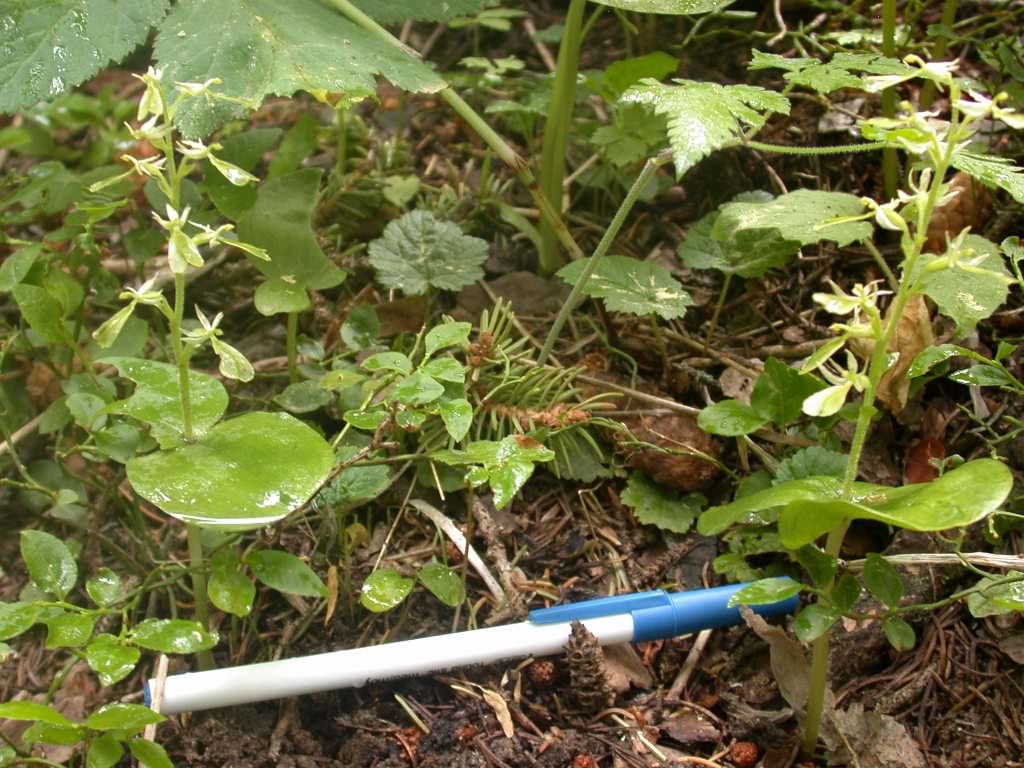
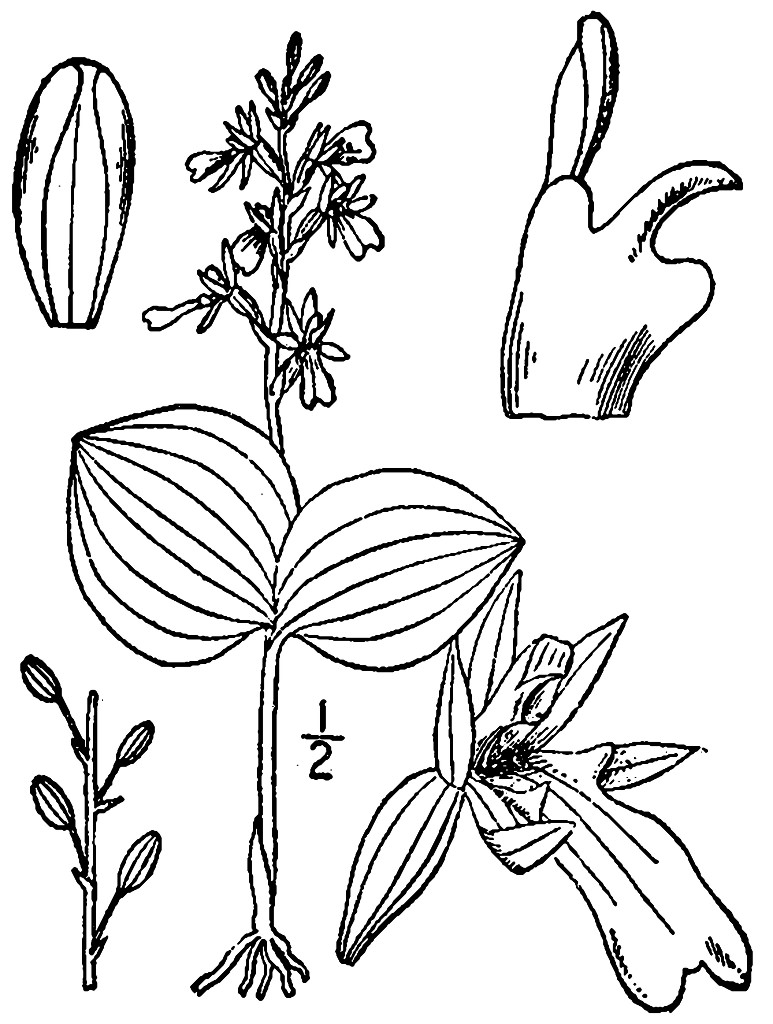
Broad-lipped twayblade is a small, inconspicuous perennial orchid, 5-37 cm tall with two, opposite, elliptic to nearly round, green leaves that are perpendicular to the stem, and 2-7 cm long. The stem above the leaves is whitish glandular hairy with up to 20 flowers, which are yellowish-green, faintly tinged with purple. Small green sepals and petals bend back from the dominant lip that is about 1.5 cm long, narrow at the base and wide at the tip. Two shallow lobes at the tip make the lip resemble the folded wings of an insect. Sometimes there is a small tooth between the lobes. Fruit capsules are ellipsoid, 8x5 mm, glabrous. Reproduction by runners sometimes produces large colonies of plants (Flora of North America 2002, Culver and Lemly 2013, Ackerfield 2015).
Look Alikes:
The round, opposite leaves, and lip petal that gradually narrows to the base distinguish this species from other local orchids (Culver and Lemly 2013, Ackerfield 2015).
Phenology:
Flowers June-August in Colorado (Ackerfield 2015).
 |
Habitat
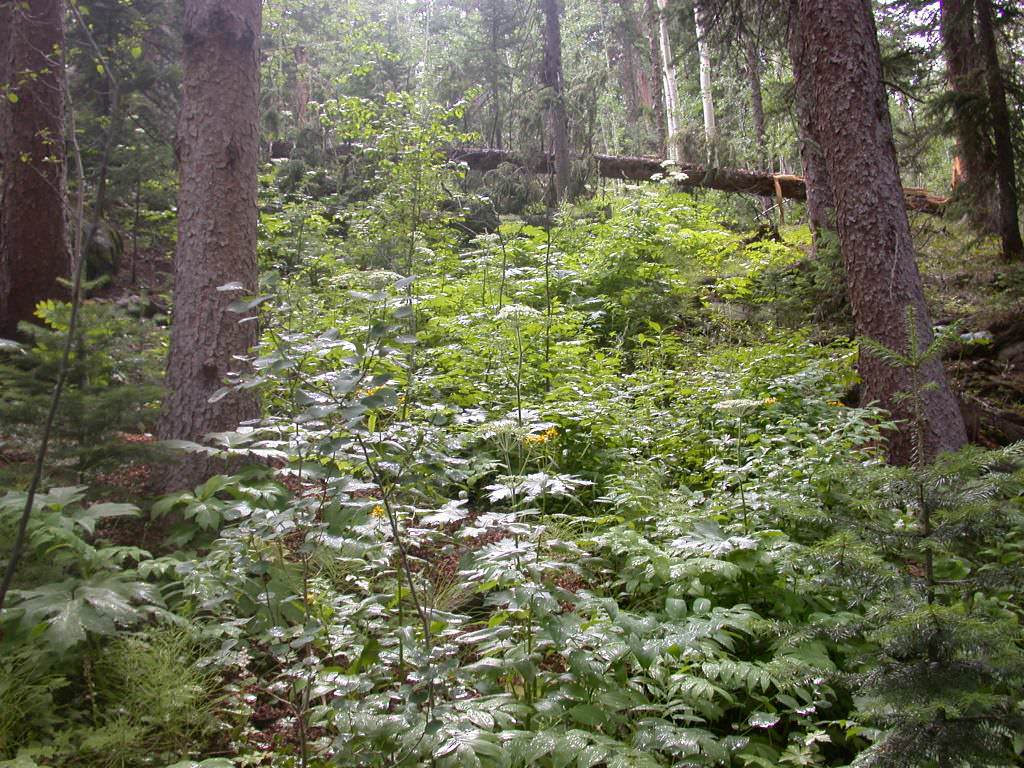
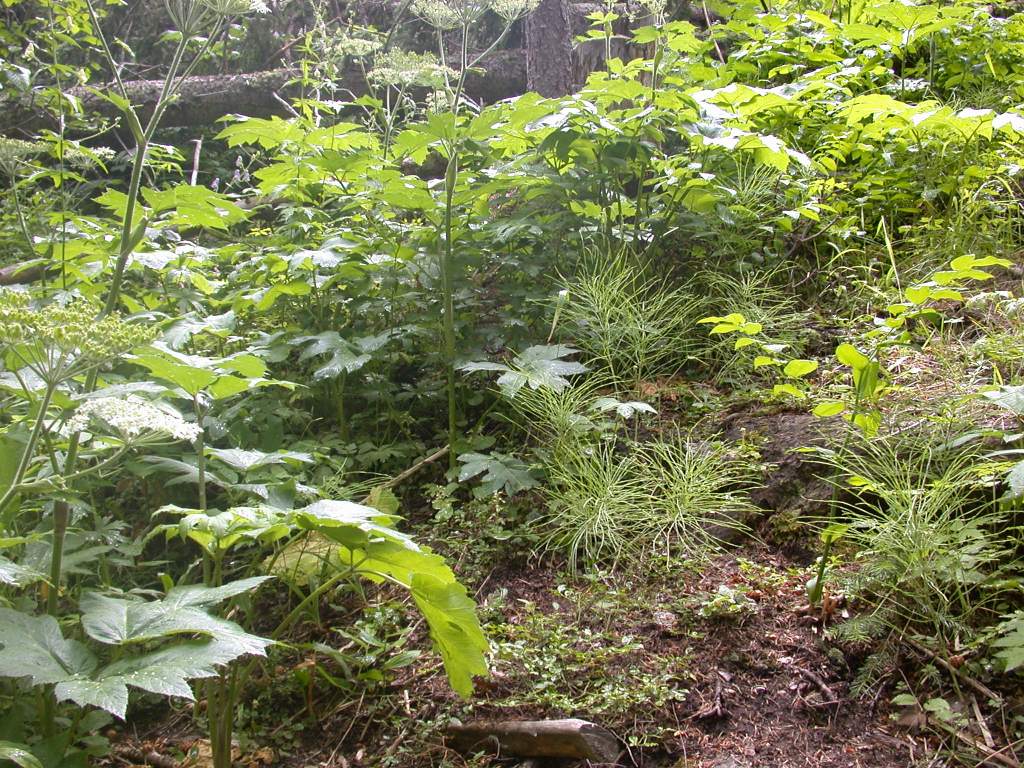
In Colorado, this species is found in shady, moist forests, and along streams (Culver and Lemly 2013, Ackerfield 2015). Associated taxa include: Picea engelmannii, Abies bifolia, Acer negundo, Populus tremuloides, Pseudotsuga menziesii, Betula occidentalis, Corylus cornuta, Lonicera involucrata, Rudbeckia spp., Cystopteris fragilis, Actaea rubra, Circaea alpina, Sanicula marilandica, Oryzopsis asperifolia, Streptopus amplexifolius, Botrychium virginianum, Rubus pubescens, Equisetum spp., Thalictrum fendleri, Corallorhiza maculatam, Glyceria elata, Smilacina stellata, Streptopus fassetti, Carex utriculata. Mertensia ciliata, Limnorchis sp., Acer glabrum, Glyceria elata, Maianthemum stellatum, moss.
click on image to enlarge
 |
 |
Elevation Range:
6,733 - 10,916 feet (2,052 - 3,327 meters)
Distribution
Colorado Endemic:
No
Range:
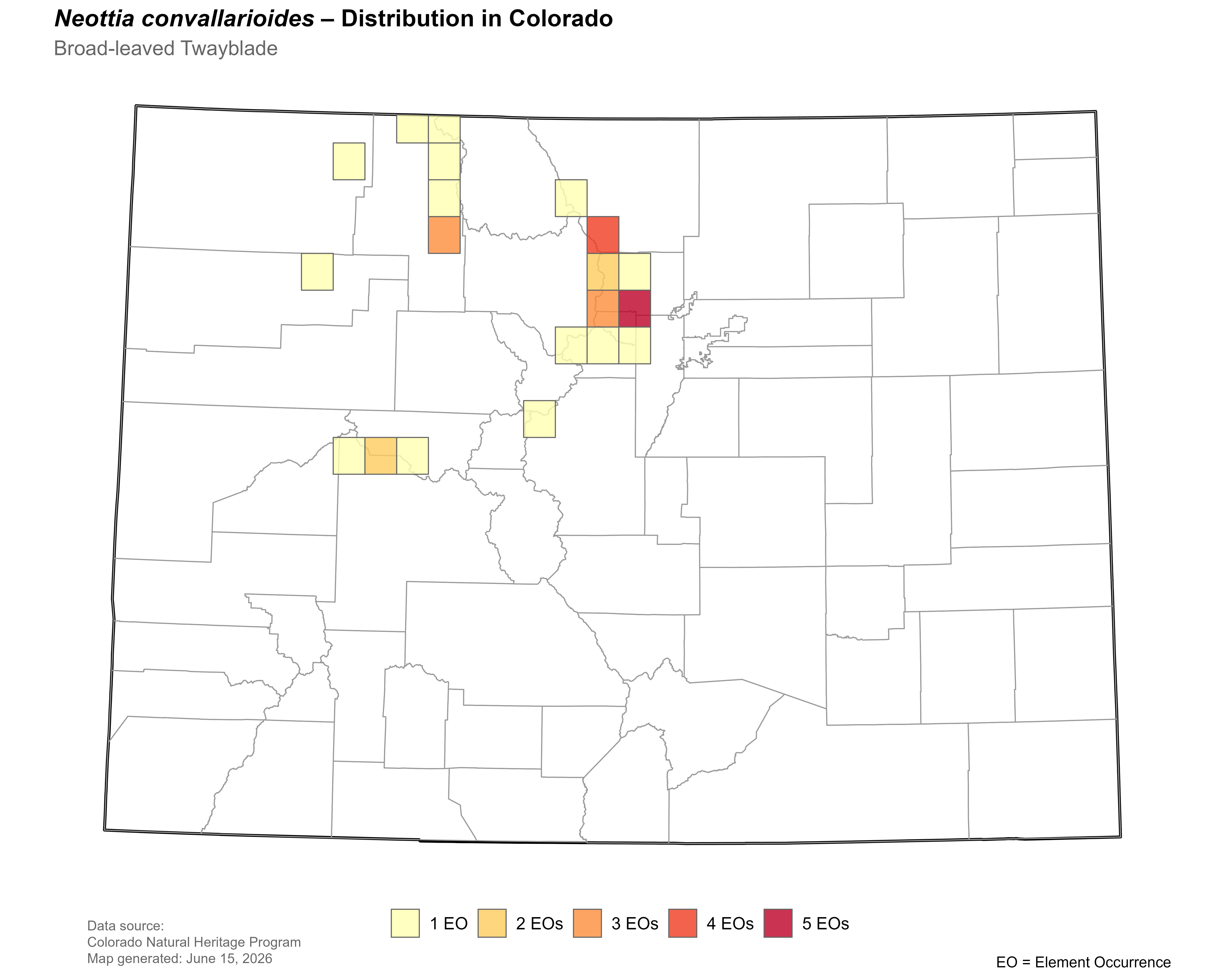
Neottia convallarioides is known from the following 12 counties in Colorado: Boulder, Clear Creek, Gilpin, Grand, Gunnison, Jackson, Larimer, Moffat, Pitkin, Rio Blanco, Routt, and Summit counties. Estimated range extent in Colorado of 28,645 square kilometers was calculated in GeoCAT using occurrence data provided by the Colorado Natural Heritage Program (2022). This species can also be found in Alaska, Arizona, California, Idaho, Maine, Michigan, Minnesota, Montana, Nevada, New Hampshire, New York, North Carolina, Oregon, South Dakota, Tennessee, Utah, Vermont, Washington, Wisconsin, and Wyoming, USA. Globally, this species can be found in Alberta, British Columbia, New Brunswick, Newfoundland, Nova Scotia, Ontario, Prince Edward Island, and Quebec, Canada (Flora of North America Editorial Committee 2002).
Click on map to enlarge |
Threats and Management Issues
Threats include alterations to hydrological setting, recreation, roads, collecting, mowing, and competition from non-native plants. Effects from climate change are also a concern.
References
- Ackerfield, J. 2015. Flora of Colorado. BRIT Press, Botanical Research Institute of Texas, Fort Worth, TX. 818 pp.
- Britton, N. L. and A. Brown. 1913. An Illustrated Flora of the Northern United States and Canada. 3 vol. Dover Publications, Inc., N. Y. 2052 pp.
- Colorado Native Plant Society. 1989. Rare plants of Colorado. Rocky Mountain Nature Association, Colorado Native Plant Society, Estes Park, Colorado. 73 pp.
- Colorado Natural Heritage Program and the Geospatial Centroid. 2017. The Colorado Ownership and Protection Map (COMaP). Colorado State University, Ft. Collins, CO.
- Cronquist, A., A. H. Holmgren, N. H. Holmgren, J. L. Reveal and P. K. Holmgren. 1977. Intermountain Flora Vascular Plants of the Intermountain West, USA: vol. 6. New York Botanical Garden, Bronx, NY.
- Culver, D.R. and J.M. Lemly. 2013. Field Guide to Colorado's Wetland Plants; Identification, Ecology and Conservation. Colorado Natural Heritage Program, Colorado State University, Fort Collins, 694 pp.
- Flora of North America Editorial Committee, ed. (FNA). 1993+. Flora of North America North of Mexico. Oxford Univ. Press, New York, Oxford.
- Harrington, H. D. 1954. Manual of the Plants of Colorado. Sage Books, Denver, CO. 666 pp.
- USDA, Natural Resources Conservation Service, PLANTS Database [USDA PLANTS]. http://plants.usda.gov/. Accessed 2017.
- USDA, NRCS. 2022. The PLANTS Database. National Plant Data Team, Greensboro, NC 27401-4901 USA.
- Weber, W. A. and R. C. Wittmann. 2012. Colorado Flora, Eastern Slope, A Field Guide to the Vascular Plants, Fourth Edition. Boulder, Colorado. 555 pp.
- Weber, W. A. and R. C. Wittmann. 2012. Colorado Flora, Western Slope, A Field Guide to the Vascular Plants, Fourth Edition. Boulder, Colorado. 532 pp.
- Welsh, S. L. 1974. Anderson's Flora of Alaska and Adjacent Canada. Brigham Young University Press, Provo, UT.