

Scientific Name : Castilleja puberula
Author : Rydb. NatureServe Explorer
Common Name : Downy Indian- paintbrush
 Current Research Activities
☰ Click link below for details.
Taxonomy
Orobanchaceae (broom-rape family)
Ackerfield (2015, 2022) places this genus in the Orobanchaceae family.
Ranks and Status
State Rank : S3
State Rank Reason : Castilleja puberula is known from approximately 30 occurrences in the mountains of central Colorado (USA). It was previously thought to be a Colorado endemic, but there are reports documenting the species in Montana from 2015. Reported threats include direct and indirect effects from off road vehicle use and mining roads but rangewide threats are largely unknown. Castilleja puberula is considered to be vulnerable to the effects of climate change.
U.S. Endangered Species Act : none
Colorado Threatened and Endangered List : none
Other Statuses : SWAP Tier 2, USFS RGNF
Description and Phenology
General Description:
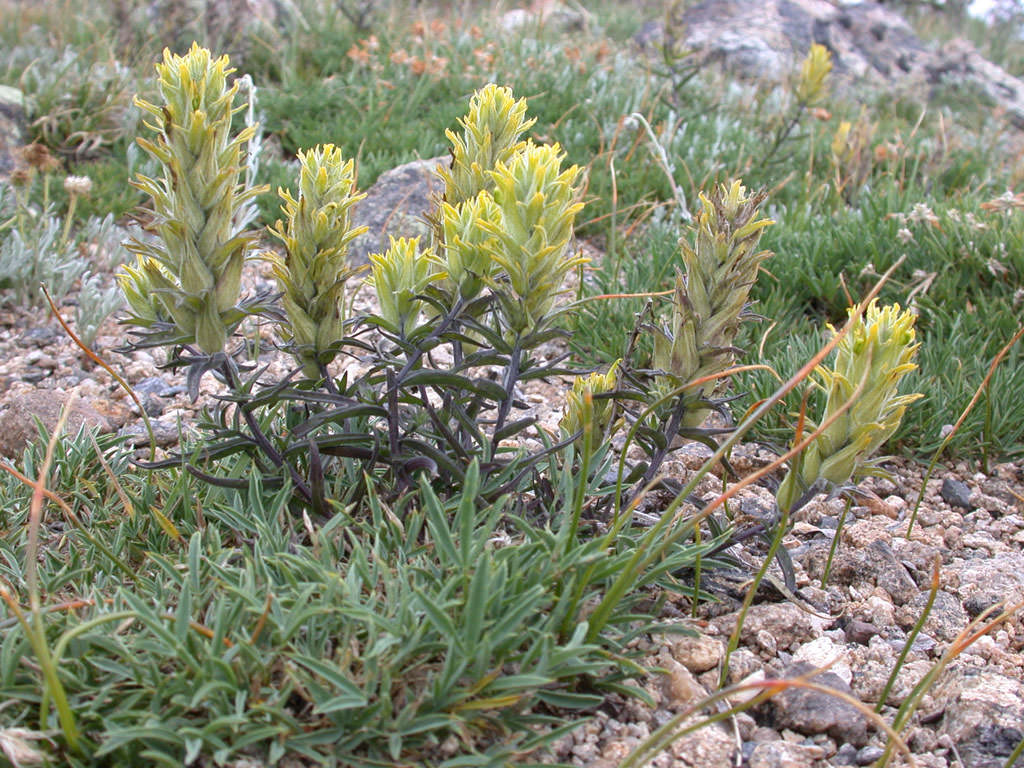
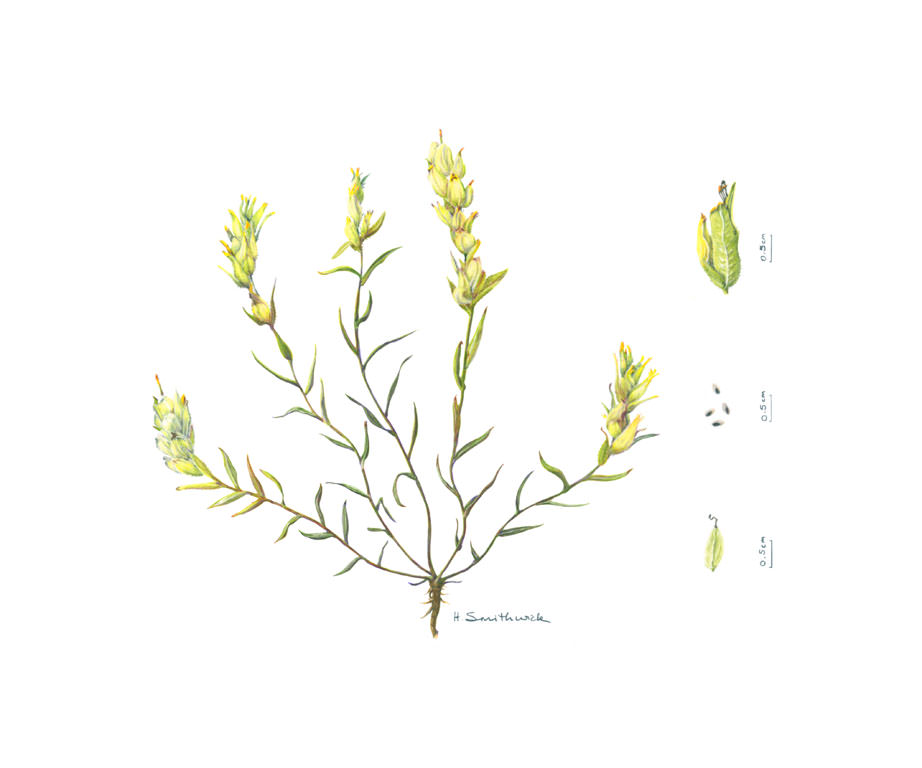
Perennial plants about 8-15 cm. tall. Inflorescence is yellowish and finely puberulent to short-tomentose. Bracts sometimes have reddish tips. Leaves are 2-3 cm. long, linear, entire or with lateral lobes, and finely puberulent (Harrington 1954, Ackerfield 2015).
Look Alikes:
Other yellow, alpine Castilleja are not as downy hairy.
Phenology:
Flowers July-August (Ackerfield 2012; Colorado Natural Heritage Program 2012).
 |
Habitat
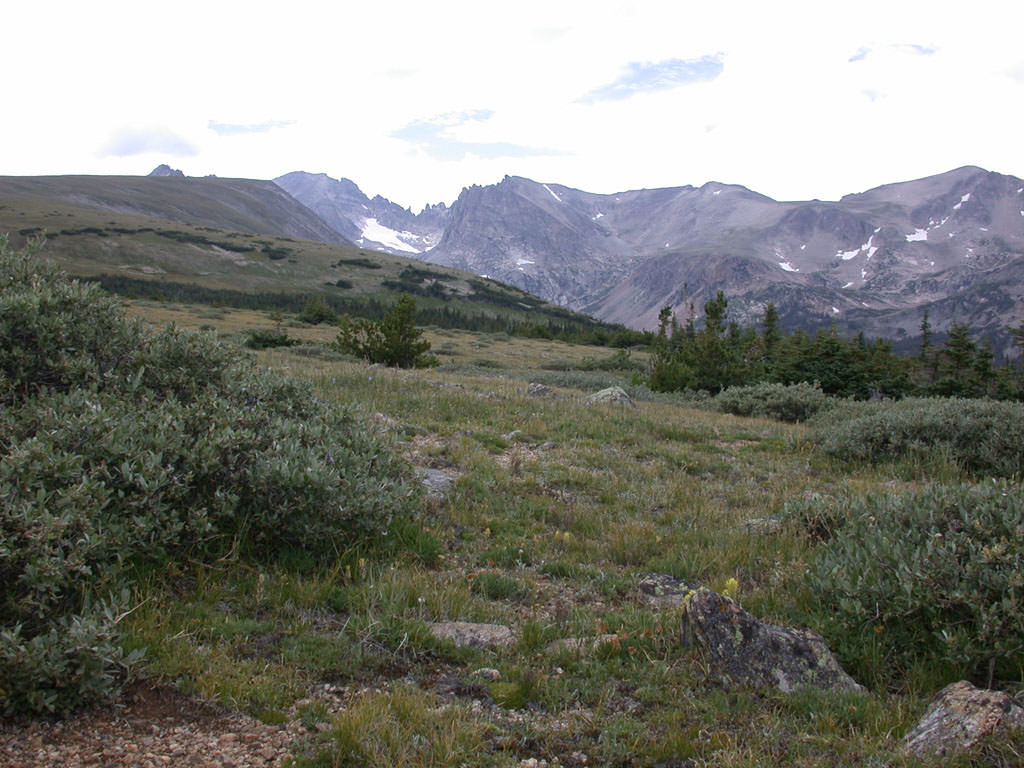
Rocky tundra, high peaks of the Continental Divide (Weber and Wittmann 2012). Associated species include Picea engelmannii (krumholtz), Salix brachycarpa, Dryas octopetala, Bistorta bistortoides, Castilleja occidentalis, Erigeron pinnatasectus, Trifolium dasyphyllum, Eremogone fendleri, and others.
click on image to enlarge
 |
Elevation Range:
8,617 - 13,007 feet (2,627 - 3,965 meters)
Distribution
Colorado Endemic:
No
Range:
Castilleja puberula is found on high peaks of the Continental Divide; known from Boulder, Clear Creek, Gilpin, Grand, Larimer, Park and Summit counties, Colorado (USA). Estimated range extent in Colorado of 3529 square kilometers was calculated in GeoCAT using occurrence data provided by the Colorado Natural Heritage Program (2023).This species has also been found in Montana, USA.
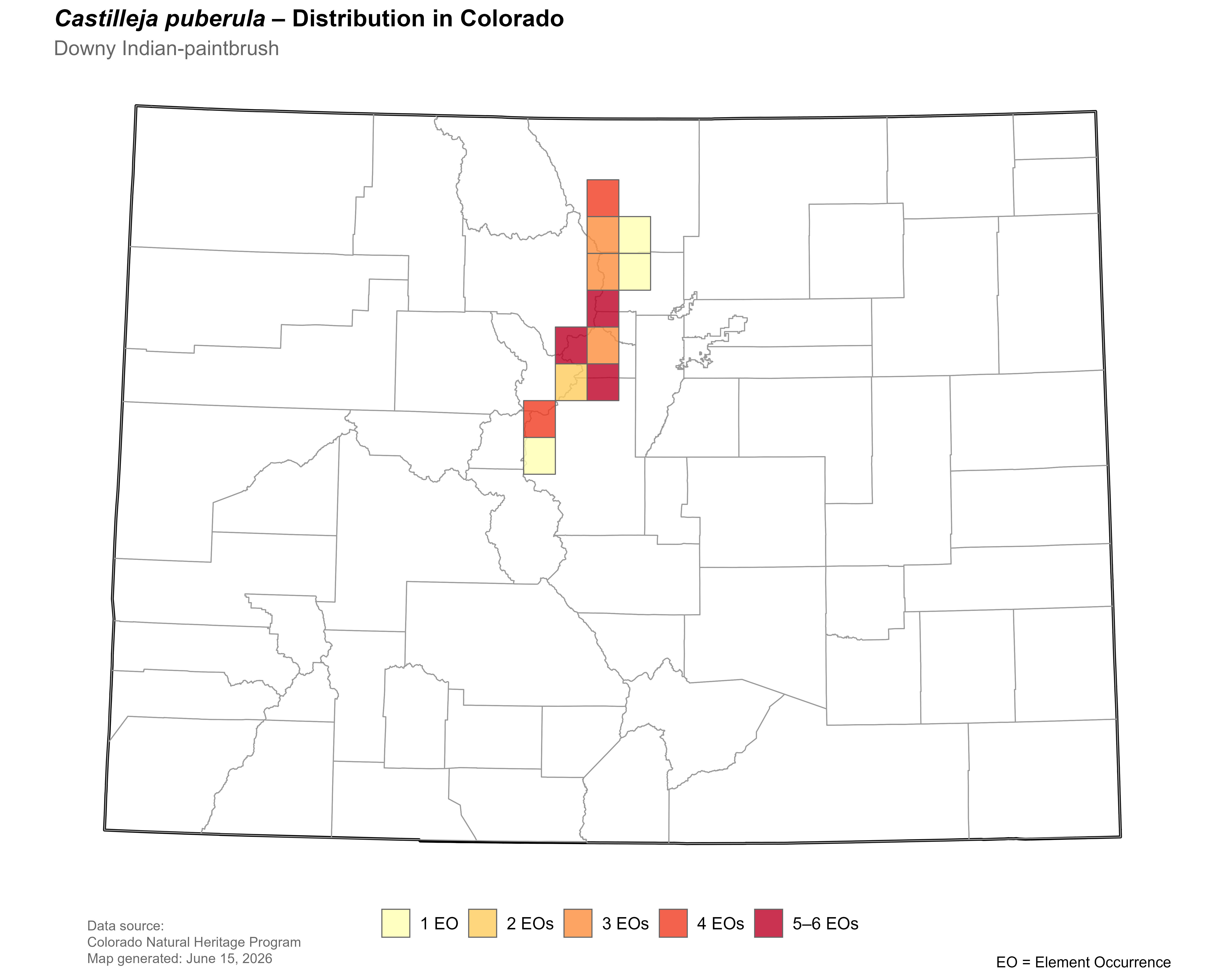
Click on map to enlarge |
Threats and Management Issues
Its alpine habitat is somewhat protected and inaccessible, so it likely has few serious threats, except from off-road-vehicle use. One population is bisected by an old mining road that receives heavy off-road-vehicle use, which has increased erosion. However, sufficient information on specific sites is not available to fully assess other potential threats and vulnerabilities. This species is considered to have moderate adaptive capacity and is expected to be slightly to moderately vulnerable to climate change under both RCP 4.5 and 8.5 scenarios, as assessed for the 2025 Colorado State Wildlife Action Plan (CNHP 2025).
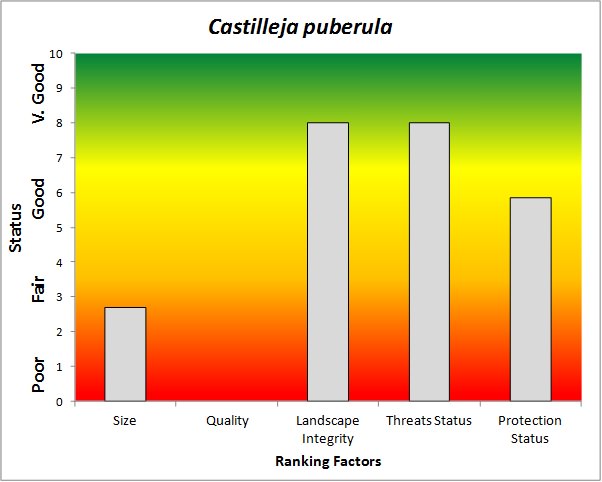
Summary results of an analysis of the status of Castilleja puberula based on several ranking factors. This species was concluded to be Effectively Conserved. From Rondeau et al. 2011. |
References
- Ackerfield, J. 2015. Flora of Colorado. BRIT Press, Botanical Research Institute of Texas, Fort Worth, TX. 818 pp.
- Ackerfield, J. 2022. Flora of Colorado. Second Edition. Bot. Misc. 60. BRIT Press, Fort Worth Botanic Garden/Botanical Research Institute of Texas, U.S.A. 861 pp.
- Colorado Natural Heritage Program (CNHP). 2025. Climate Change Vulnerability Assessment of Colorado Tier 1 and Tier 2 Plant Species of Greatest Conservation Need (SCGN) for the 2025 Colorado State Wildlife Action Plan. Colorado Natural Heritage Program, Colorado State University, Fort Collins.
- Colorado Natural Heritage Program. 2012. Biodiversity Tracking and Conservation System. Colorado State University, Fort Collins, CO.
- Egger, J.M. 2015. Range extension and first Montana records for Castilleja puberula Rydb. (Orobanchaceae). Phytoneuron 62: 1-8.
- Handwerk, J., L. Grunau, and S. Panjabi. 2015. Colorado Wildlife Action Plan: 2015 Rare Plant Addendum. Colorado Natural Heritage Program, Colorado State University, Fort Collins, Colorado, USA.
- Harrington, H.D. 1954. Manual of the plants of Colorado. Sage Press, Chicago. 666 pp.
- Lavender, A.E., M.M. Fink, S.E. Linn, D.M. Theobald. 2011. Colorado Ownership, Management, and Protection v9 Database. Colorado Natural Heritage Program and Geospatial Centroid, Colorado State University, Fort Collins, CO. (30 September).
- Neely, B., S. Panjabi, E. Lane, P. Lewis, C. Dawson, A. Kratz, B. Kurzel, T. Hogan, J. Handwerk, S. Krishnan, J. Neale, and N. Ripley. 2009. Colorado Rare Plant Conservation Strategy, Developed by the Colorado Rare Plant conservation Initiative. The Nature Conservancy, Boulder, Colorado, 117 pp.
- Rocky Mountain Society of Botanical Artists. 2015. RARE II Imperiled Plants of Colorado, a traveling art exhibition. Exhibition catalog.
- USDA, NRCS. 2022. The PLANTS Database. National Plant Data Team, Greensboro, NC 27401-4901 USA.
- Weber, W. A. and R. C. Wittmann. 2012. Colorado Flora, Eastern Slope, A Field Guide to the Vascular Plants, Fourth Edition. Boulder, Colorado. 555 pp.
- Weber, W. A. and R. C. Wittmann. 2012. Colorado Flora, Western Slope, A Field Guide to the Vascular Plants, Fourth Edition. Boulder, Colorado. 532 pp.