

Scientific Name : Physaria parviflora
Author : (Rollins) O'Kane & Al-Shehbaz NatureServe Explorer
Common Name : Piceance Bladderpod
 Current Research Activities
 1997 profile


☰ Click link below for details.
Taxonomy
Brassicaceae (mustard family)
Ranks and Status
State Rank : S2
State Rank Reason : Physaria parviflora is endemic to the shale barrens of northwestern Colorado, USA. While there are 36 occurrences, many are of poor-fair viability or known only from historical observations. Very few occurrences appear to be specifically protected and the potential for oil shale and natural gas development poses a significant threat. Additional threats to Physaria parviflora include competition from invasive plant species, livestock grazing, motorized and non-motorized recreation, and prolonged drought. This species is expected to be moderately vulnerable to climate change.
U.S. Endangered Species Act : none
Colorado Threatened and Endangered List : none
Other Statuses : BLM, SWAP Tier 1, USFS GMUG
Description and Phenology
General Description:
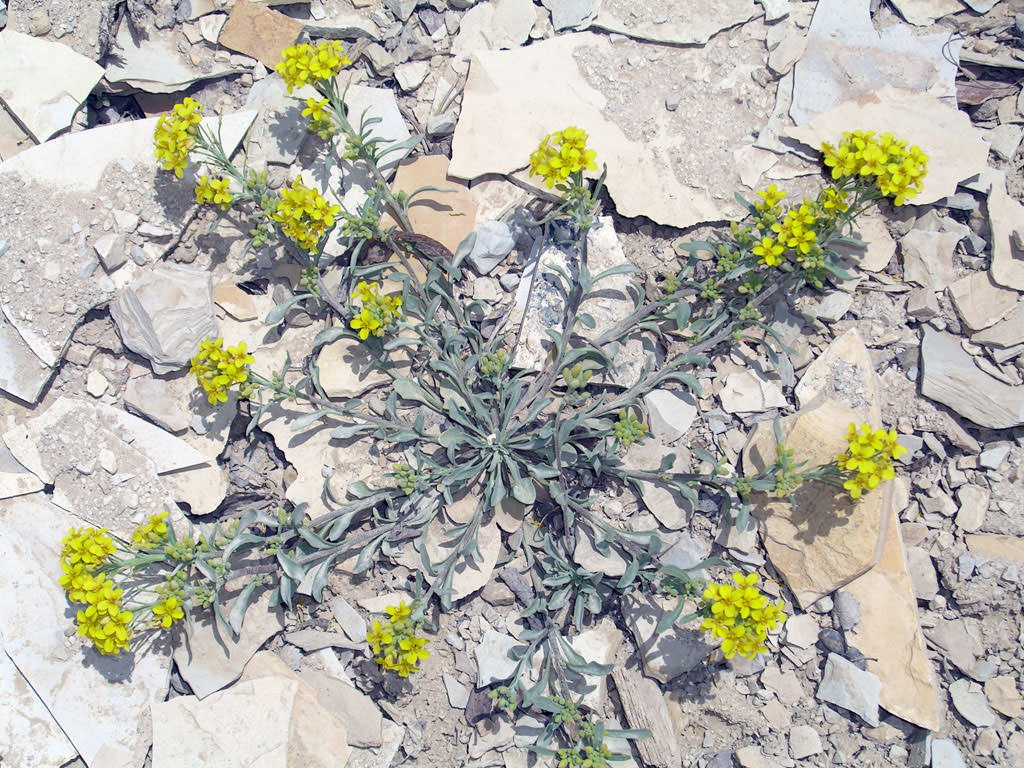
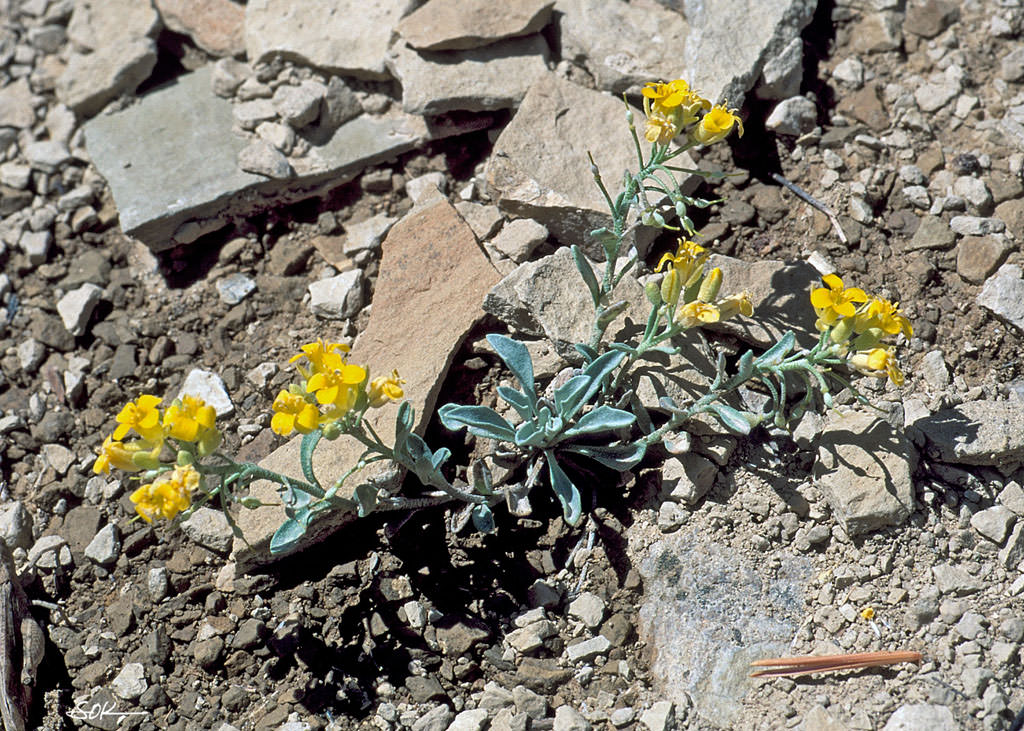
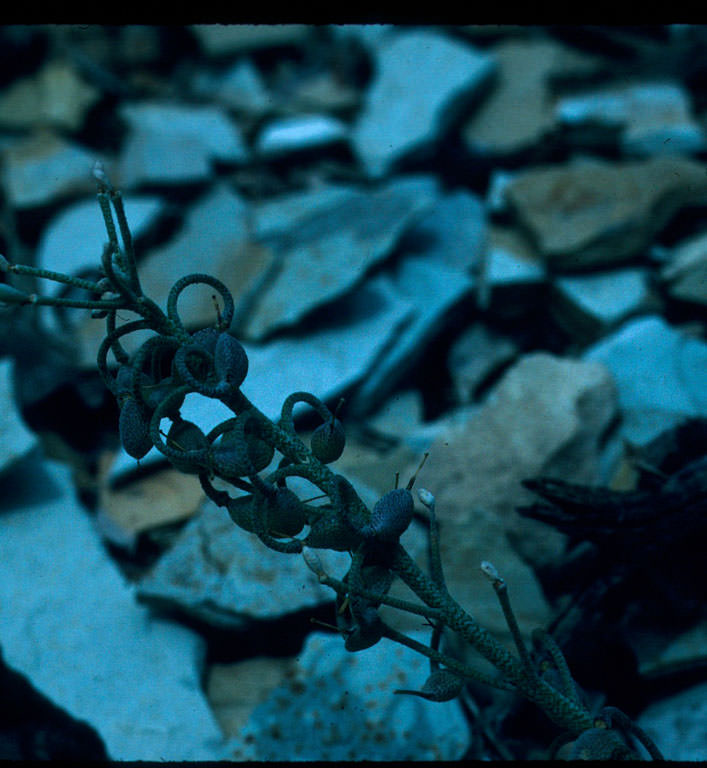
Annual or short-lived perennial herb with decumbent stems from low growing rosettes. Basal leaves flat and dentate to angular, covered in stellate hair giving a silver appearance. Golden yellow flowers are born on secund racemes; pendant siliques formed .
Look Alikes:
The recurved siliques and pedicels are similar to L. arenosa and L. ludoviciana. The fundamental differences are in the ovule number and the position of the funiculi on the replum of the silique. The basal leaves are more similar to those of L. ludoviciana. (Rollins 1983; more details included). L. parviflora racemes are usually secund (one sided). Basal leaves are usually flat and generally dentate or somewhat angular. L. ludoviciana racemes are not secund. Basal leaves on this species are involute and usually entire (pers. comm. Minton November 1994).
Phenology:
Flowers in June through early July; fruits in July (Peterson and Baker 1982; pers. comm. Jennings 1995).
Habitat
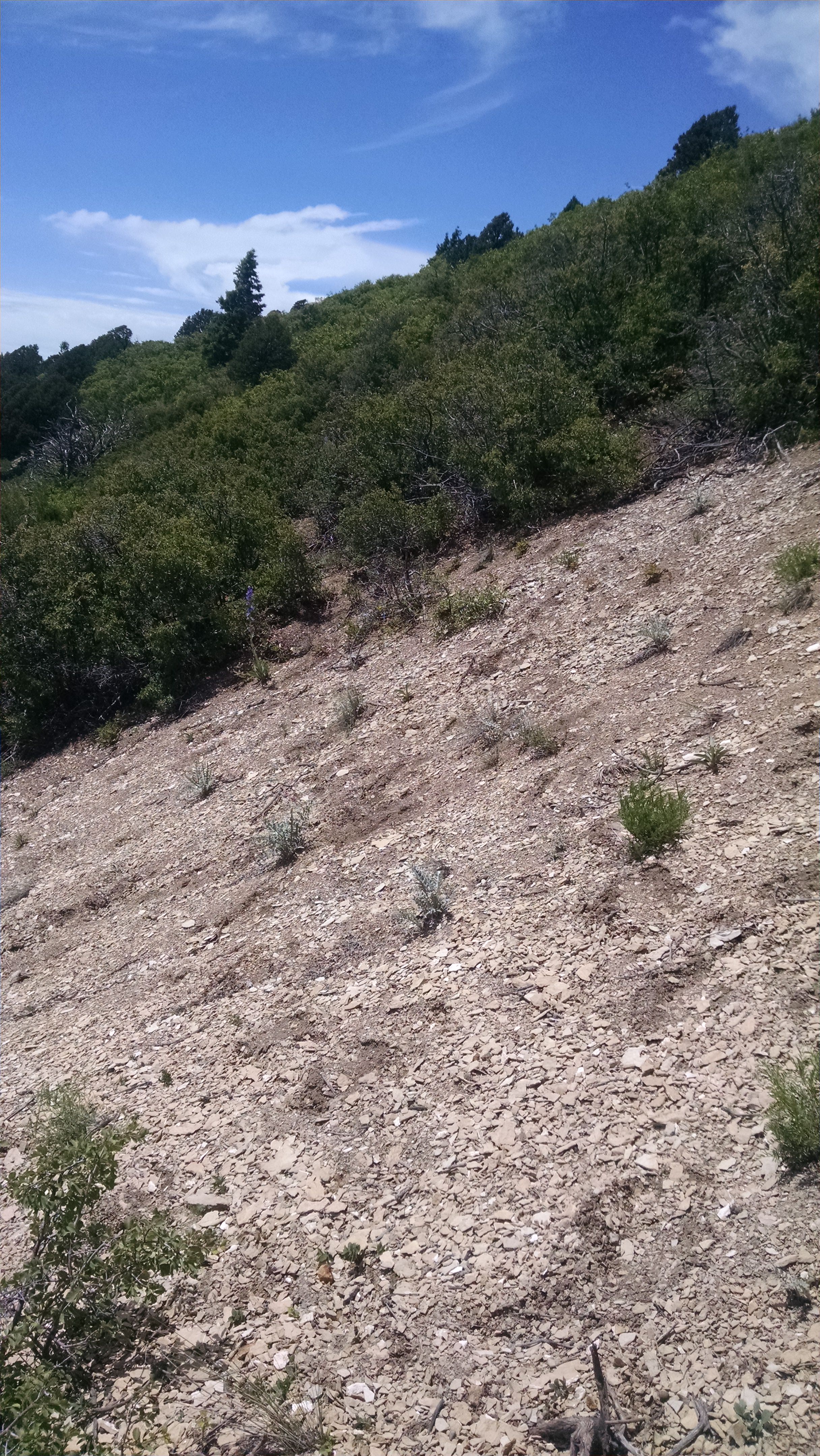
Endemic to outcrops of the Green River Shale Formation in the Piceance Basin. It grows on ledges and slopes of canyons in open areas of pinon juniper communities. The soils are Torriorthent Rock outcrop complex (Peterson and Baker 1982). Frequently associated species include Pinus edulis, Juniperus osteosperma, Eriogonum sp., Cirsium sp., Astragalus lutosus, Cercocarpus sp., Galium coloradense, Oryzopsis hymenoides, Penstemon sp., and Machaeranthera sp.
click on image to enlarge
 |
Elevation Range:
6,149 - 9,015 feet (1,874 - 2,748 meters)
Distribution
Colorado Endemic:
Yes
Range:
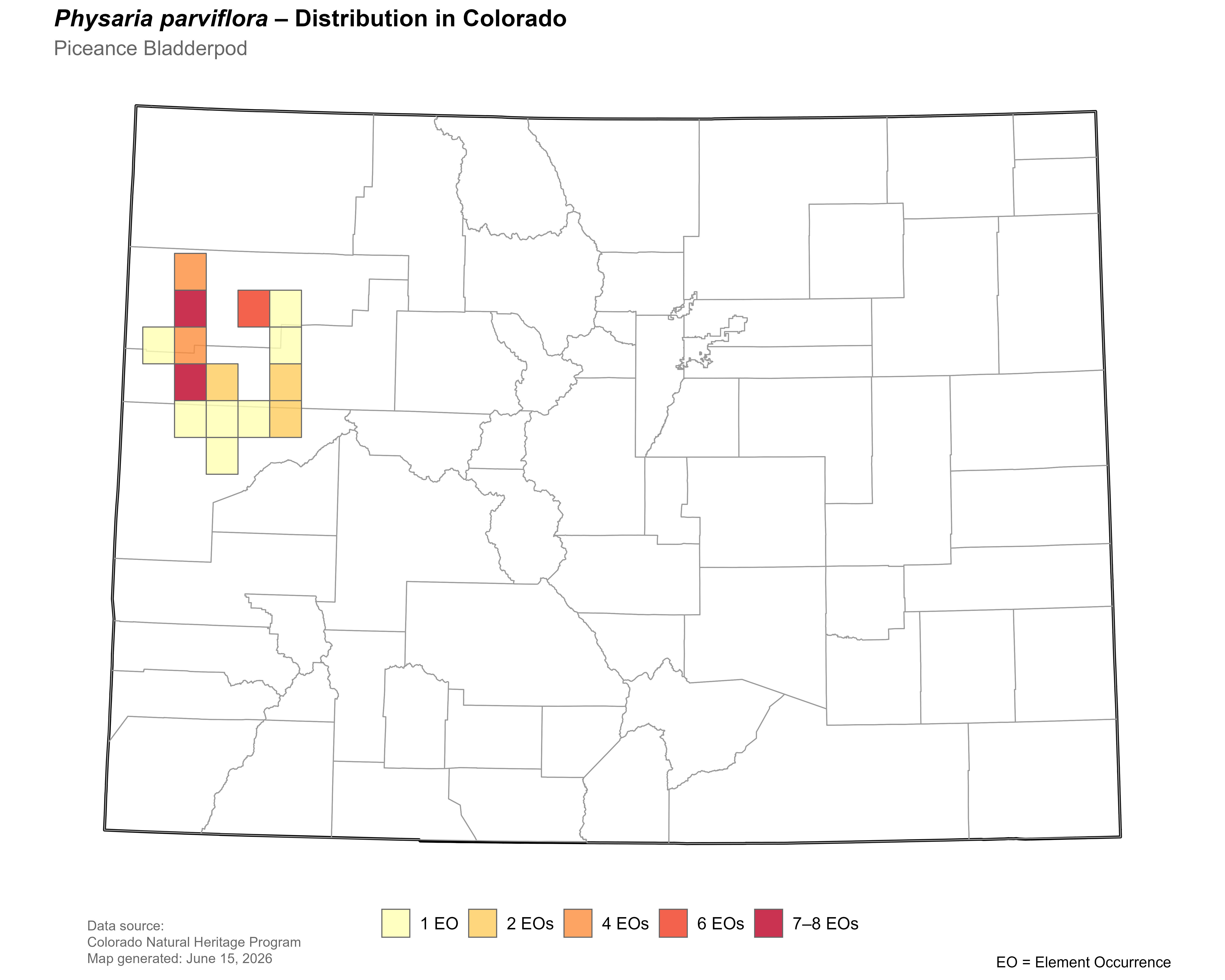
Physaria parviflora is endemic to Garfield, Mesa and Rio Blanco counties, in western Colorado, USA. The estimated range extent in Colorado of 5067 square kilometers was calculated in GeoCAT using occurrence data provided by the Colorado Natural Heritage Program (2022).
Click on map to enlarge |
Threats and Management Issues
Threats and management concerns have not been reported for all occurrences, but of the 19 occurrences that do document management concerns livestock grazing, energy development, competition from invasive non-native plant species and various recreation activities are mentioned as threats. Although livestock grazing has been observed in 42% of the occurrences where threats are noted, cattle do not typically venture down on to the steep, shale slopes occupied by P. parviflora and consequently there is little potential impact from cattle grazing. However, if grazing were to include sheep, threats and disturbance to both the habitat and the plants would increase greatly (CNHP 2022). Potential impacts from oil and gas development, oil shale and coal bed methane extraction were also reported from 42% of the occurrences where threats are noted, and one occurrence has been heavily impacted by pipeline construction. Invasive plants species, including cheatgrass (Bromus tectorum) and yellow sweet clover (Melilotus officinale) have been reported from five occurrences and may outcompete P. parviflora (CNHP 2022). Motorized and non-motorized recreation has fragmented habitat at several sites. This species is considered to have moderate adaptive capacity and is expected to be moderately vulnerable to climate change under both RCP 4.5 and 8.5 scenarios, as assessed for the 2025 Colorado State Wildlife Action Plan (CNHP 2025).
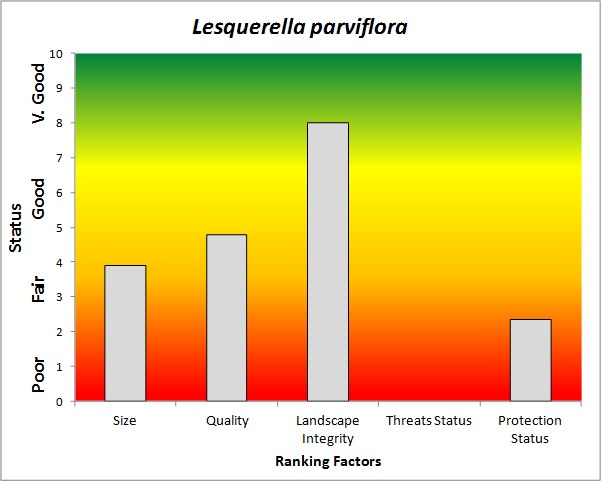
Summary results of an analysis of the status of Physaria parviflora based on several ranking factors. This species was concluded to be under conserved. From Rondeau et al. 2011. |
References
- Ackerfield, J. 2015. Flora of Colorado. BRIT Press, Botanical Research Institute of Texas, Fort Worth, TX. 818 pp.
- Al-Shehbaz, I. A., and S. L. O'Kane. 2002. Lesquerella is united with Physaria (Brassicaceae). Novon 12:319-329.
- Colorado Native Plant Society. 1989. Rare plants of Colorado. Rocky Mountain Nature Association, Colorado Native Plant Society, Estes Park, Colorado. 73 pp.
- Colorado Natural Heritage Program (CNHP). 2022. Biodiversity Tracking and Conservation System (Biotics 5). Colorado Natural Heritage Program, Colorado State University, Fort Collins.
- Colorado Natural Heritage Program (CNHP). 2025. Climate Change Vulnerability Assessment of Colorado Tier 1 and Tier 2 Plant Species of Greatest Conservation Need (SCGN) for the 2025 Colorado State Wildlife Action Plan. Colorado Natural Heritage Program, Colorado State University, Fort Collins.
- Elliott, B. A., S. Spackman Panjabi, B. Kurzel, B. Neely, R. Rondeau, M. Ewing. 2009. Recommended Best Management Practices for Plants of Concern. Practices developed to reduce the impacts of oil and gas development activities to plants of concern. Unpublished report prepared by the Rare Plant Conservation Initiative for the National Fish and Wildlife Foundation.
- Flora of North America Editorial Committee (FNA). 2010. Flora of North America north of Mexico. Vol. 7. Magnoliophyta: Salicaceae to Brassicaceae. Oxford University Press, New York. xxii + 797 pp.
- Handwerk, J., L. Grunau, and S. Panjabi. 2015. Colorado Wildlife Action Plan: 2015 Rare Plant Addendum. Colorado Natural Heritage Program, Colorado State University, Fort Collins, Colorado, USA.
- Kartesz, J.T. 1994. A synonymized checklist of the vascular flora of the United States, Canada, and Greenland. 2nd edition. 2 vols. Timber Press, Portland, OR.
- Neely, B., S. Panjabi, E. Lane, P. Lewis, C. Dawson, A. Kratz, B. Kurzel, T. Hogan, J. Handwerk, S. Krishnan, J. Neale, and N. Ripley. 2009. Colorado Rare Plant Conservation Strategy, Developed by the Colorado Rare Plant conservation Initiative. The Nature Conservancy, Boulder, Colorado, 117 pp.
- O'Kane, S. L. 1988. Colorado's Rare Flora. Great Basin Naturalist. 48(4):434-484.
- Peterson, J.S. and W.L. Baker. 1982. Inventory of the Piceance Basin, Colorado: Threatened and endangered plants, plant associations, and the general flora. Unpublished report prepared for the BLM, Craig District Office, by Colorado Natural Heritage.
- Rollins, R. C. 1983. Studies in the Cruciferae of Western North America. Journal of the Arnold Arboretum 64 (4).
- Rollins, R.C. 1993. The Cruciferae of Continental North America:Systematics of the Mustard Family from the Arctic to Panama. Stanford University Press. Stanford, CA.
- Rondeau, R., K. Decker, J. Handwerk, J. Siemers, L. Grunau, and C. Pague. 2011. The state of Colorado's biodiversity 2011. Prepared for The Nature Conservancy. Colorado Natural Heritage Program, Colorado State University, Fort Collins, Colorado.
- Spackman, S., B. Jennings, J. Coles, C. Dawson, M. Minton, A. Kratz, and C. Spurrier. 1997. Colorado rare plant field guide. Prepared for Bureau of Land Management, U.S. Forest Service and U.S. Fish and Wildlife Service by Colorado Natural Heritage Program.
- USDA, NRCS. 2022. The PLANTS Database. National Plant Data Team, Greensboro, NC 27401-4901 USA.
- Weber, W. A. and R. C. Wittmann. 2012. Colorado Flora, Eastern Slope, A Field Guide to the Vascular Plants, Fourth Edition. Boulder, Colorado. 555 pp.
- Weber, W. A. and R. C. Wittmann. 2012. Colorado Flora, Western Slope, A Field Guide to the Vascular Plants, Fourth Edition. Boulder, Colorado. 532 pp.