

Scientific Name : Townsendia strigosa
Author : Nutt. NatureServe Explorer
Common Name : Strigose Easter- daisy
 Current Research Activities
☰ Click link below for details.
Taxonomy
Asteraceae (sunflower family)
Ranks and Status
State Rank : S1S2
State Rank Reason : As of 2022 there are 6 known occurrences in northwest Colorado. SEINet 2022 collections indicate that there may be another 6 or so occurrences outside of Moffatt and Mesa counties, but they are are not verified and are not included in the CNHP database at this time. Threats to the species include livestock grazing, competition from invasive nonnative species, recreation, and energy development. Additionally, long term drought is concern for the species.
U.S. Endangered Species Act : none
Colorado Threatened and Endangered List : none
Other Statuses : BLM
Description and Phenology
General Description:
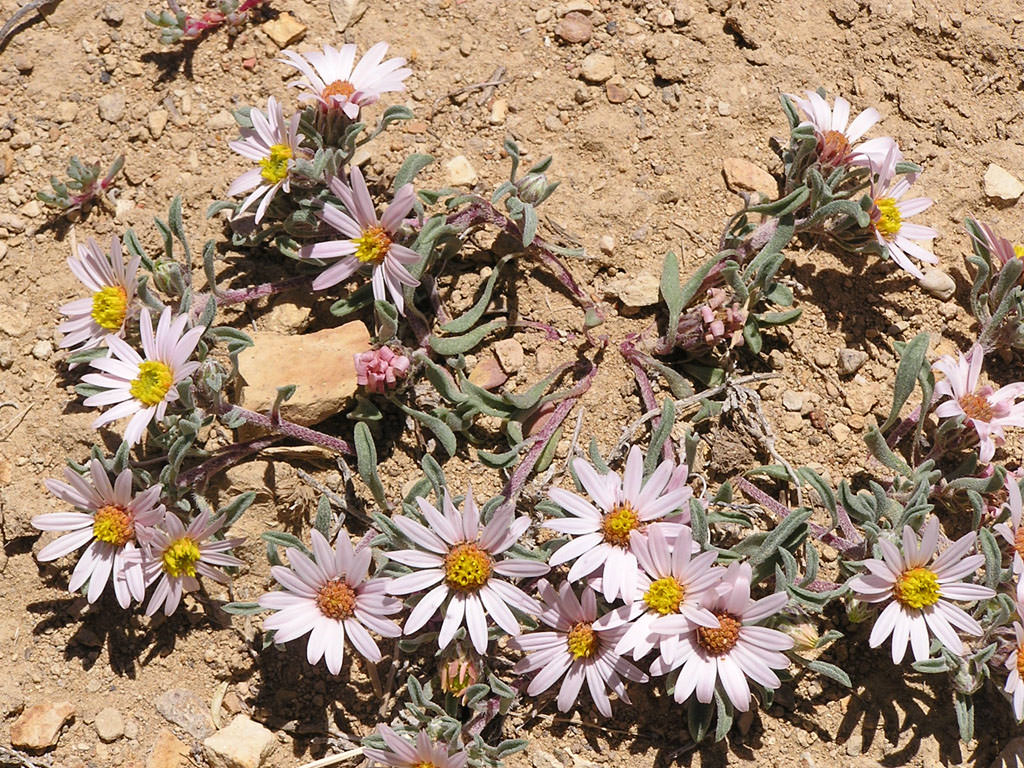
Biennial, (1-)3-10(-20) cm. Stems decumbent to erect; internodes 5-25 mm, pilose-strigose to strigillose (surfaces seldom hidden by hairs). Leaves basal and cauline, blades spatulate to oblanceolate or linear, 12-30(-50) × 2-7(-9) mm, not fleshy, faces more or less strigose to strigillose. Heads at tips of stems (usually surpassed by leaves). Involucres more or less campanulate, 5-20 mm diam. Phyllaries 20-24 in 3-4+ series, the longer sub- lance-ovate to lanceolate, 5-9 mm (l/w = 2.5-5), apices acute to acuminate, abaxial faces strigose. Ray florets 8-30+; corollas white or pinkish adaxially, laminae 5-14 mm, abaxially usually glabrous, sometimes glandular-puberulent. Disc florets (8-)20-80(-100+); corollas 3.5-5 mm. Cypselae 3-4 mm, faces hairy, hair tips glochidiform; pappi persistent; on ray cypselae 12-20+ lanceolate to subulate scales 0.5-1.5+ mm; on disc cypselae 20-35 subulate to setiform scales 3.5-5.5 mm (Flora of North America 2006).
Look Alikes:
Townsendia strigosa is distinguished from T. incana by its annual or biennial taproot, withered basal leaves, and green stems. Townsendia incana is perennial, without persistent basal leaves, and white stems (Weber and Wittmann 2012).
Phenology:
Flowers May through June (Colorado Natural Heritage Program 2012).
Habitat
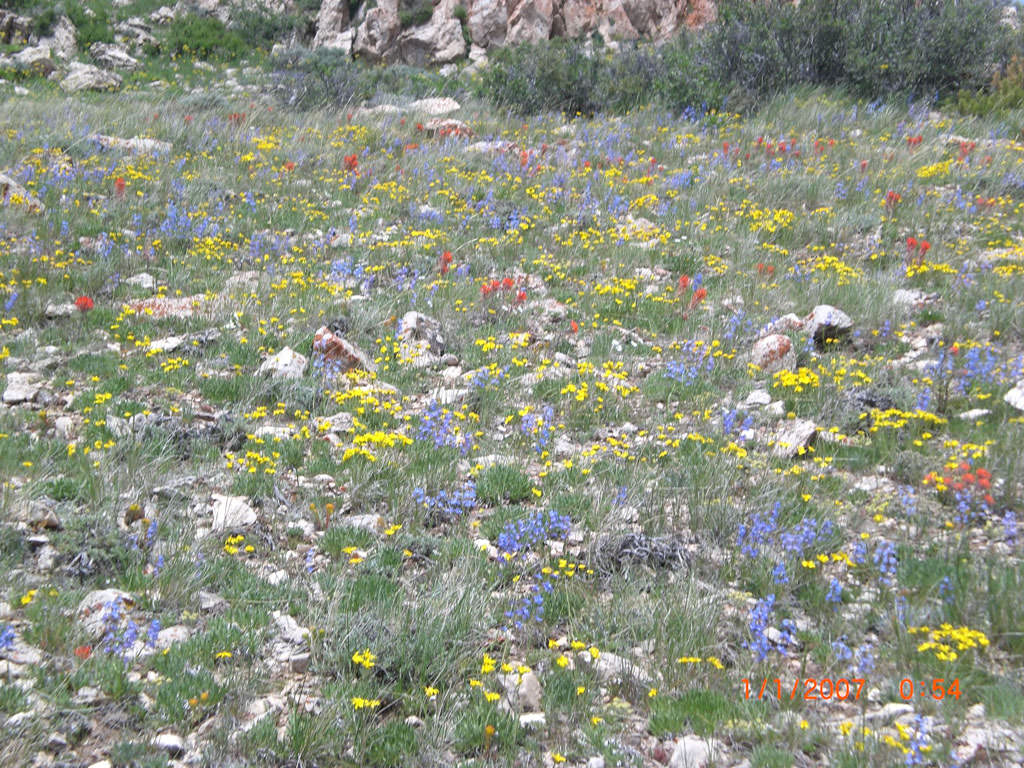
Townsendia strigosa is found in sandy or clay soil of dry, open places (Ackerfield 2012). Associated taxa include Atriplex, Artemisia, Allium, Stenotus acaulis, Phlox multiflora, Petrophyton caespitosum, Astragalus spatulatus, Tetraneuris acaulis, and Physaria subumbellata (Colorado Natural Heritage Program 2012).
click on image to enlarge
 |
Elevation Range:
4,986 - 7,002 feet (1,520 - 2,134 meters)
Distribution
Colorado Endemic:
No
Range:
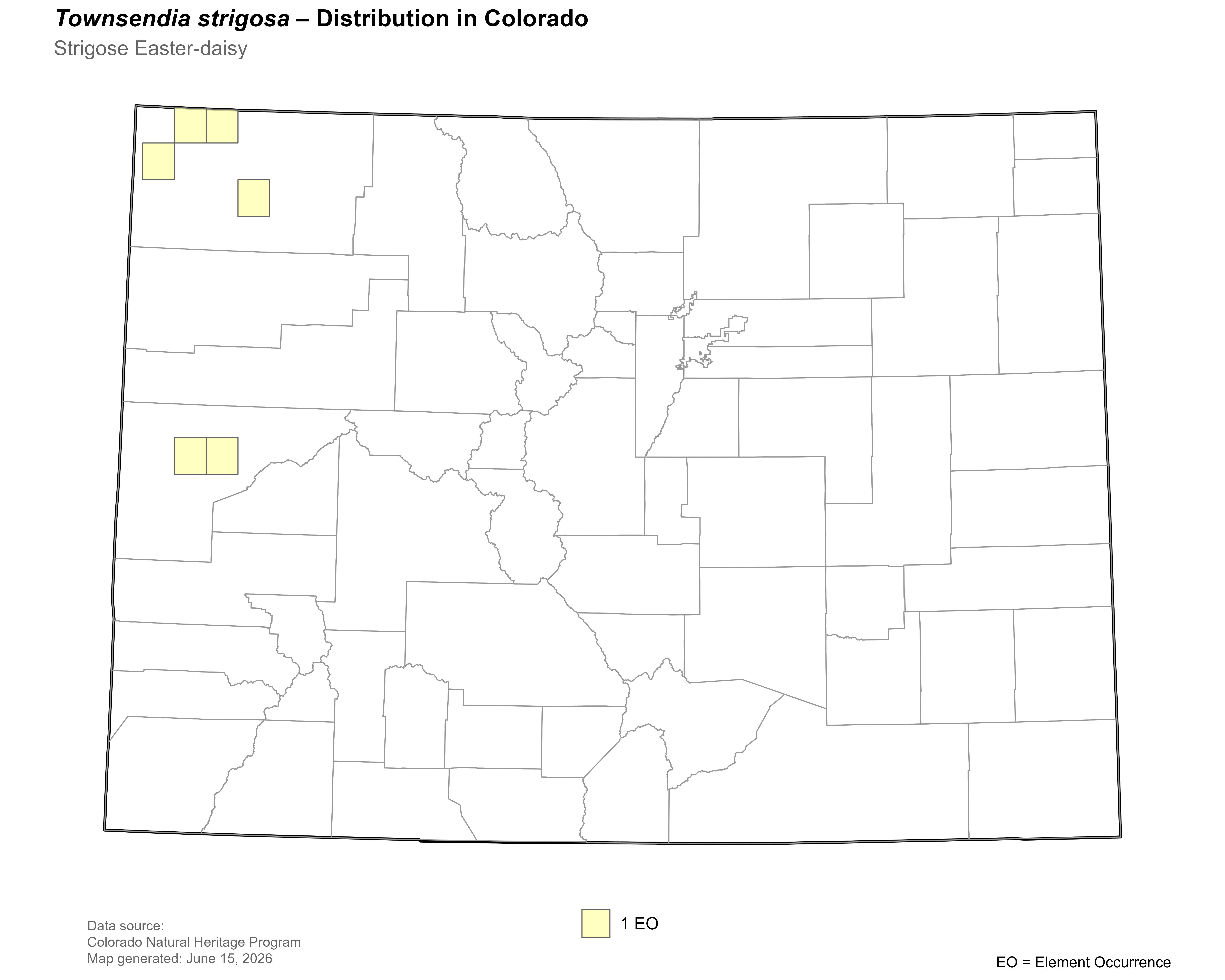
The Colorado Natural Heritage Program has records for Townsendia strigosa from Mesa and Moffat counties. Estimated range extent in Colorado of 6827 square kilometers was calculated in GeoCAT using occurrence data provided by the Colorado Natural Heritage Program (2022). SEINet (2022) also has collections from Archuleta, Chaffee, Clear Creek, Gunnison, Montezuma and Montrose counties, although several have been annotated to other species of Townsendia, and not all have been verified. A thorough review of the collections is warranted. Townsendia strigosa is also known from Arizona, New Mexico, Utah, and Wyoming, USA.
Click on map to enlarge |
Threats and Management Issues
As of 2022, 50% of the occurrences are found in habitat with minimal to low levels of landscape disturbance, and 50% are in areas with moderate to high levels of landscape disturbance (CNHP 2021). At the local level the majority of the occurrences are threatened by livestock grazing and competition from invasive nonnative species; OVH, oil and gas developement and road maintenance activities are a concern at several occurrences. Additionally, long term drought is occurring throughout the range of this species in Colorado.
References
- Ackerfield, J. 2012. The Flora of Colorado. Colorado State University Herbarium. 433 pp.
- Colorado Natural Heritage Program. 2021. Landscape Disturbance Index Layer for Colorado. Edition 04_2021. Raster Digital Data Set. Colorado Natural Heritage Program, Fort Collins, CO. April 21, 2021.
- Cronquist, A., A. H. Holmgren, N. H. Holmgren, J. L. Reveal, P. K. Holmgren. 1994. Intermountain Flora Vascular Plants of the Intermountain West, USA: Vol. 5. New York Botanical Garden, Bronx, NY.
- Dorn, R.D. 1988. Vascular plants of Wyoming. Mountain West Publishing, Cheyenne, WY. 340 pp.
- Flora of North America Editorial Committee, ed. (FNA). 1993+. Flora of North America North of Mexico. Oxford Univ. Press, New York, Oxford.
- Harrington, H.D. 1954. Manual of the plants of Colorado. Sage Press, Chicago. 666 pp.
- Lavender, A.E., M.M. Fink, S.E. Linn, D.M. Theobald. 2011. Colorado Ownership, Management, and Protection v9 Database. Colorado Natural Heritage Program and Geospatial Centroid, Colorado State University, Fort Collins, CO. (30 September).
- SEINet. 2022. Southwest Environmental Information Network; Regional Herbaria Network Collections Database. http://swbiodiversity.org/seinet/collections/index.php?catid=2 (accessed 28 Feb., 2022).
- The Colorado Native Plant Society. 1997. Rare Plants of Colorado, second edition. Falcon Press Publishing Co.,Inc. Helena, Montana. 105pp.
- USDA, NRCS. 2022. The PLANTS Database. National Plant Data Team, Greensboro, NC 27401-4901 USA.
- Weber, W. A. and R. C. Wittmann. 2012. Colorado Flora, Western Slope, A Field Guide to the Vascular Plants, Fourth Edition. Boulder, Colorado. 532 pp.
- Welsh, S.L., N.D. Atwood, S. Goodrich, and L.C. Higgins (eds.) 1993. A Utah flora. 2nd edition. Brigham Young Univ., Provo, Utah. 986 pp.