

Scientific Name : Townsendia fendleri
Author : Gray NatureServe Explorer
Common Name : Fendler's Townsend- daisy
 Current Research Activities


☰ Click link below for details.
Taxonomy
Asteraceae (sunflower family)
This taxon was described by Asa Gray in 1849 from a collection made by A. Fendler in 1847 during his Sante Fe expedition. The taxon was later collected in Colorado in the Sangre de Cristo Range and vicinity. However, this taxon is not treated in Weber (1987,1996) nor Weber and Wittmann (2001, 2012). Ackerfield (2015, 2022) recognizes this taxon as does Barkley et al. in Flora of North America (1993, 2006). Upon naming this E1species, Gray stated This species most resembles T. Fremonii, Toor. & Gray, but is more caulescent, with longer and narrower leaves, the pappus shorter and less denticulate; that of the ray much reduced, as in T. strigosa. (CNHP 2023).
Ranks and Status
State Rank : S3
State Rank Reason : Townsendia fendleri is known from a limited distribution in six counties in south central Colorado, USA. The primary threats appear to be motorized and non-motorized recreation and road maintenance activities such as noxious weed spraying, although rangewide threats are poorly understood. It is also considered to be extremely vulnerable to the effects of climate change.
U.S. Endangered Species Act : none
Colorado Threatened and Endangered List : none
Other Statuses : none
Description and Phenology
General Description:
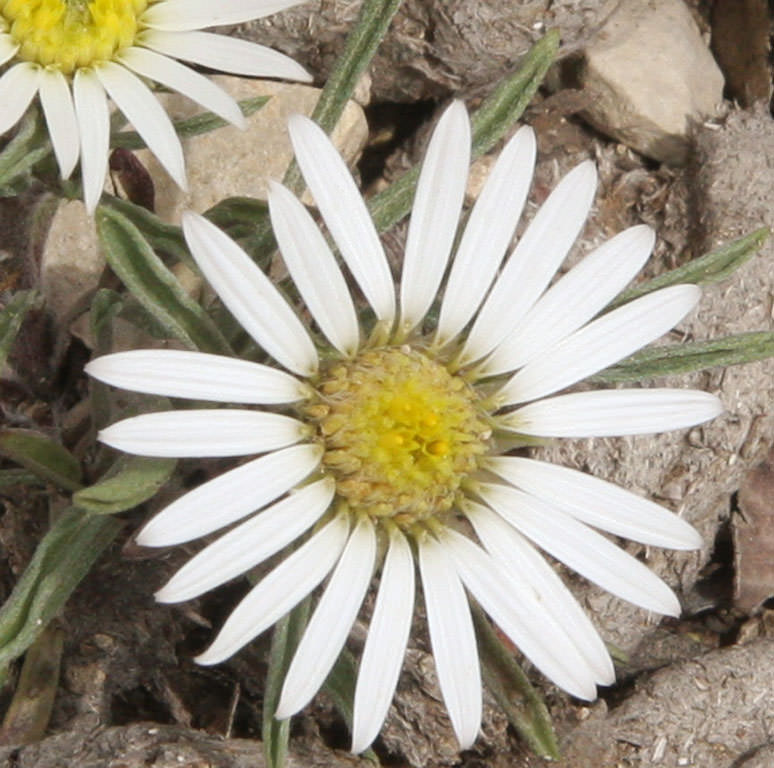
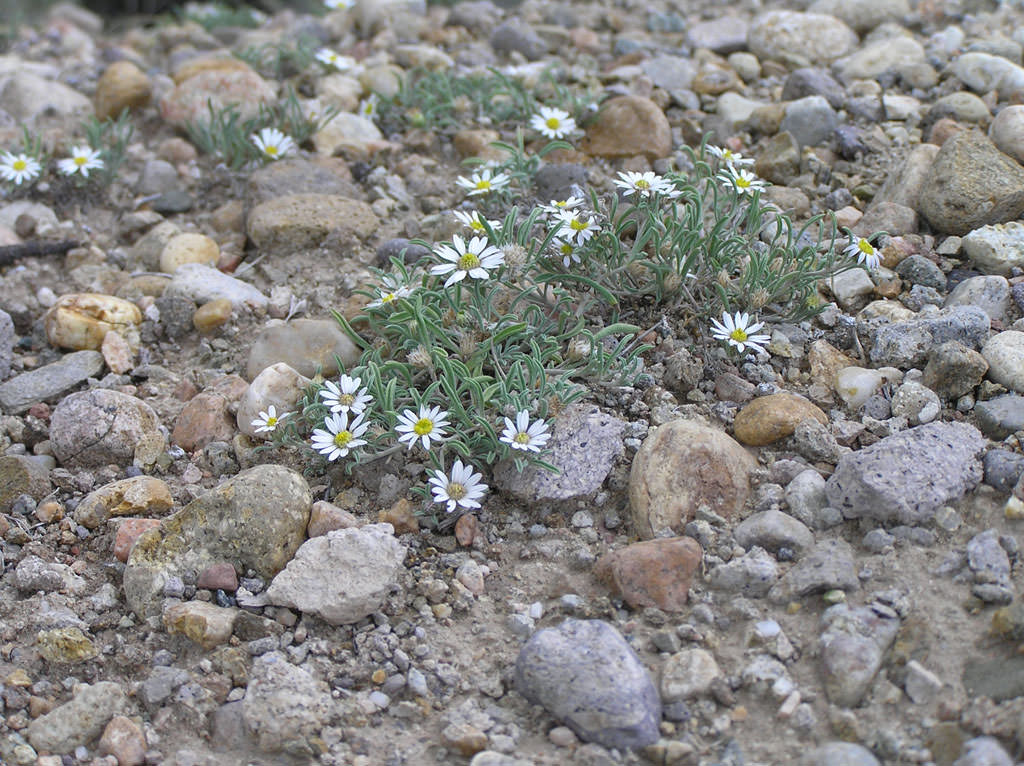
A perennial species with decumbent to erect, spreading, and much-branched stems. The ray flowers are white or pinkish, disk flowers are yellow, and the phyllaries have acute tips (Weber and Wittmann 2012, Flora of North America 1993+). The leaves of T. fendleri are usually nearly linear or sometimes narrowly oblanceolate (Ackerfield 2012).
Look Alikes:
The decumbent to erect stems, relatively smaller flowering heads, and acute phyllary tips distinguish this species from others in the genus Townsendia on Colorado's eastern slope. Townsendia grandiflora is sometimes confused with T. fendleri. Townsendia fendleri has smaller flowers and is known primarily from the Salida area in Colorado.
Phenology:
Flowers mid-June through early September (Colorado Natural Heritage Program 2012, Flora of North America 1993+).
Habitat
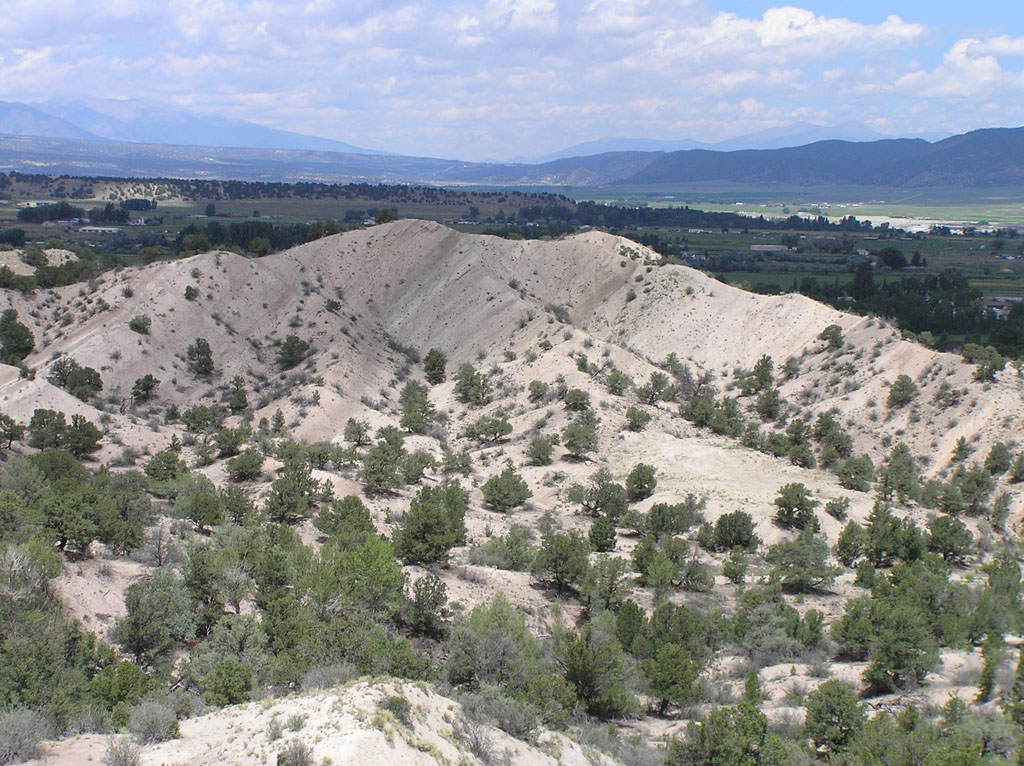
This species is found on sparsely vegetated badland slopes. The dominant plant community is characterized by Pinus edulis-Juniperus monosperma/Bouteloua gracilis or Pinus edulis-Cercocarpus montanus. Additional associated plant species include Chrysothamnus nauseosus, Chrysothamnus greenei, Tetradymia canescens, Guitierrezia sarothrae, Yucca glauca, Opuntia polyacantha, Eriogonum jamesii, Hymenoxys filifolia, Sphaeralcea coccinea, Chondrosum gracile, Aliciella pinnatifida, Heterotheca villosa, Artemisia frigida, Hesperostipa comata, and Achnatherum hymenoides. Two occurrences are found in association with occurrences of another globally rare plant, Eriogonum brandegeei (Colorado Natural Heritage Program 2012).
click on image to enlarge
 |
Elevation Range:
5,030 - 9,588 feet (1,533 - 2,923 meters)
Distribution
Colorado Endemic:
No
Range:
In Colorado, USA, this species has been documented in Chaffee, El Paso, Fremont, Huerfano, Park, and Pueblo counties. Estimated range extent in Colorado of 7905 square kilometers was calculated in GeoCAT using occurrence data provided by the Colorado Natural Heritage Program (2023). This species is also known from New Mexico, USA.
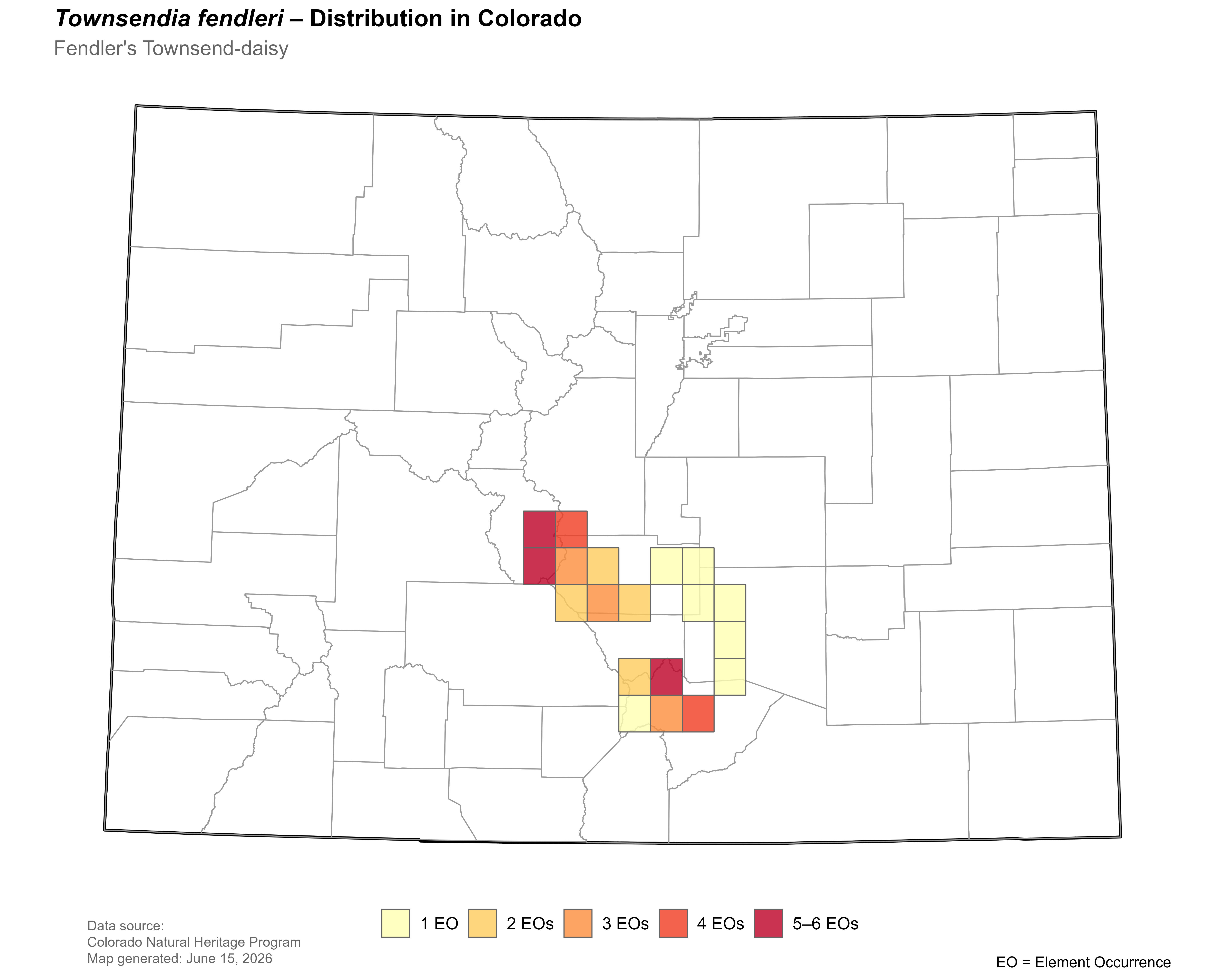
Click on map to enlarge |
Threats and Management Issues
The primary threats appear to be motorized and non-motorized recreation and road maintenance activities such as noxious weed spraying, although rangewide threats are poorly understood. Other documented threats include inappropriate livestock grazing and past mining activities. This species is also considered to be extremely vulnerable the effects of long-term drought and climate change (Handwerk et al. 2015).
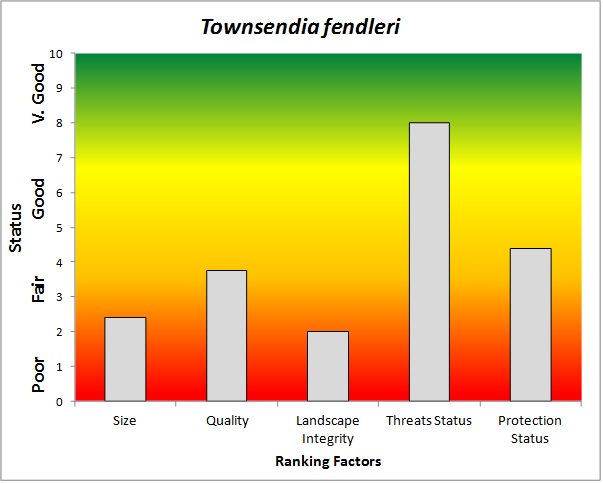
Summary results of an analysis of the status of Townsendia fendleri based on several ranking factors. This species was concluded to be Moderately Conserved. From Rondeau et al. 2011. |
References
- Ackerfield, J. 2015. Flora of Colorado. BRIT Press, Botanical Research Institute of Texas, Fort Worth, TX. 818 pp.
- Colorado Natural Heritage Program. 2012. Biodiversity Tracking and Conservation System. Colorado State University, Fort Collins, CO.
- Flora of North America Editorial Committee, ed. (FNA). 1993+. Flora of North America North of Mexico. Oxford Univ. Press, New York, Oxford.
- Handwerk, J., L. Grunau, and S. Panjabi. 2015. Colorado Wildlife Action Plan: 2015 Rare Plant Addendum. Colorado Natural Heritage Program, Colorado State University, Fort Collins, Colorado, USA.
- Heil, K.D., S.L. O'Kane Jr., L.M. Reeves, and A. Clifford, 2013. Flora of the Four Corners Region, Vascular Plants of the San Juan River Drainage; Arizona, Colorado, New Mexico, and Utah. Missouri Botanical Garden Press, St. Louis, Missouri. 1098 pp.
- Kartesz, John and the Biota of North America Program. 1998. ""A Synonymized Checklist of the Vascular Flora of the United States, Puerto Rico, and the Virgin Islands"". http://plants.usda.gov.
- Lavender, A.E., M.M. Fink, S.E. Linn, D.M. Theobald. 2011. Colorado Ownership, Management, and Protection v9 Database. Colorado Natural Heritage Program and Geospatial Centroid, Colorado State University, Fort Collins, CO. (30 September).
- Neely, B., S. Panjabi, E. Lane, P. Lewis, C. Dawson, A. Kratz, B. Kurzel, T. Hogan, J. Handwerk, S. Krishnan, J. Neale, and N. Ripley. 2009. Colorado Rare Plant Conservation Strategy, Developed by the Colorado Rare Plant conservation Initiative. The Nature Conservancy, Boulder, Colorado, 117 pp.
- USDA, NRCS. 2022. The PLANTS Database. National Plant Data Team, Greensboro, NC 27401-4901 USA.
- Weber, W. A. and R. C. Wittmann. 2012. Colorado Flora, Eastern Slope, A Field Guide to the Vascular Plants, Fourth Edition. Boulder, Colorado. 555 pp.