


Scientific Name : Mentzelia rhizomata
Author : Reveal NatureServe Explorer
Common Name : Roan Cliffs Blazingstar
 Current Research Activities
 1997 profile
☰ Click link below for details.
Taxonomy
Loasaceae (blazingstar family)
Reveal (2002) determined that the plants formerly thought to be Mentzelia argillosa in Colorado are distinct from the plants in Utah, and named the Colorado plants M. rhizomata (Utah plants are M. argillosa). In the PLANTS database the plants from both states are still listed as M. argillosa (NRCS 2022). Weber and Wittmann (2012) call this taxon Nuttallia rhizomata. Ackerfield (2015) lists this taxon as Mentzelia rhizomata.
Ranks and Status
State Rank : S2
State Rank Reason : Mentzelia rhizomata is an oil shale endemic restricted to the Parachute Creek Member of the Green River Formation found in west-central Colorado, USA. Threats to this species include energy development, competition from invasive plant species, livestock grazing, and road development and maintenance. This species is considered to be extremely vulnerable to the effects of climate change.
U.S. Endangered Species Act : none
Colorado Threatened and Endangered List : none
Other Statuses : BLM, SWAP Tier 1
Description and Phenology
General Description:
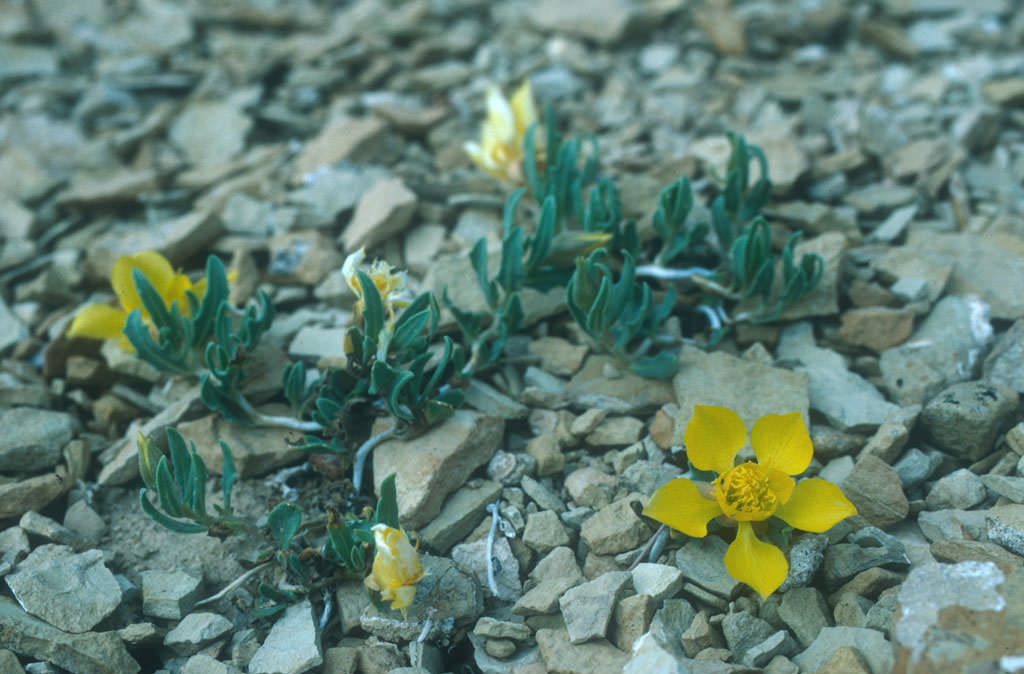
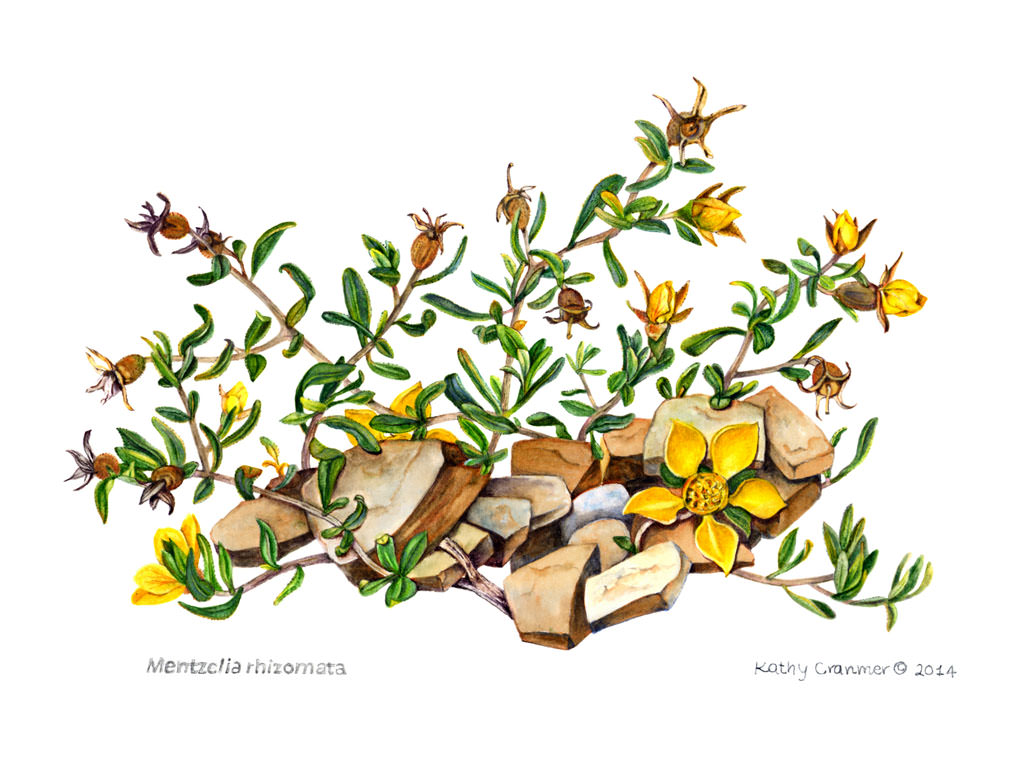
Plants are low, sprawling, rhizomatous, long-lived herbaceous perennials forming discrete clumps 1-2.5 × 1-3.5 dm with numerous, twisted and often tangled, exceedingly fragile and easily detached caudex branches (0.5-)0.8-3 dm long arising at irregular points along a horizontally spreading, elongate, infrequently branched, woody, deeply seated underground, entirely smooth rhizome up to 1 m or more in length. Stems are widely spreading and becoming curved-ascending, flexuous, but often erect in early anthesis, slender, flexuous, freely branched, the epidermis white and papery, scabrous-puberulent with a mixture of pointed scabrid hairs and pagodiform, glochidiate hairs, the larger and longer hairs tapering to a slightly expanded base, the shaft of the scabrid hairs smooth or minutely rugose with the glochidiate ones finely retrorse, the pubescence becoming more dense and the hairs somewhat longer on the upper branches. Leaves are all cauline and well distributed along the stems, alternate, sessile, light green, narrowly lanceolate, lanceolate, narrowly elliptic or obovate, entire or shallowly undulate-dentate with 2-4 rounded to obtuse lobes on each side, 1.5-4(-4.5) × (0.2-)0.3-1.2(-1.5) cm, scabrous-puberulent on both surfaces with longer and more dense hairs near the base, acute to obtuse apically, tapering basally, the margins often minutely ciliated with glochidiate hairs; inflorescences with 1-few flowers atop each side branch. Flowers are perfect, golden-yellow to yellow, the pedicel 1-3 mm long, subtended by two opposite, linear to narrowly lanceolate, foliaceous bracts, (8-)10-17(-20) × (0.8-)1-2.5 mm, these gradually deciduous in fruit; sepals 5, lanceolate, persistent, erect in bud, becoming strongly reflexed at anthesis but spreading in fruit, (4-)5-8(-11) mm long, scabrous abaxially with upwardly curved hairs, finely so with numerous, long, slender, appressed hairs adaxially; petals 5, glabrous, (9-)10-15 × 6-10 mm, broadly spatulate to broadly obovate and slightly clawed, obtuse to rounded apically; filaments yellow, numerous, glabrous, the two whorls of five petaloid filaments each typically cuspidate and frequently bearing an anther, slightly shorter and narrower than the petals, those of the first whorl rhombic and distinctly clawed, 7-9 × 5-6 mm, those of the second whorl oblanceolate to narrowly oblanceolate, 6-8 × (1.5-)3-4 mm, the remaining whorls of 35-60 or more filaments linear, (1.8-)2-4(-4.5) mm long; anthers anthers pale yellow, (1-)1.2-1.7(-2) mm long, oblong; style early deciduous, erect, slender, 5.5-7 mm long, the stigma minutely 3-lobed. Fruit is a dried capsule, (5-)8-10(-13) × (5-)6-8(-10) mm, urceolate, scabrous-puberulent, rounded basally, opening as an ever-widening apical pore where the stigma was positioned; seeds 15-20 per capsule, oblong, flat, 2-3 × 1.6-2.2 mm, brownish-green, smooth and somewhat shiny, slightly winged, the surface cells with 8 to several papillae (Reveal 2002).
Look Alikes:
Mentzelia rhizomata is a long-lived perennial (rather than a biennial) and is unique among all members of the genus in having a rhizome (Reveal 2002).
Phenology:
The plants flower in June and August and set fruit from mid August until late September. Flowers are fully open only in the afternoon. Seeds are rapidly dispersed soon after reaching maturity (Reveal 2002). Plants have also been observed to flower in September during an unusually wet year (Colorado Natural Heritage Program 2013).
 |
Habitat
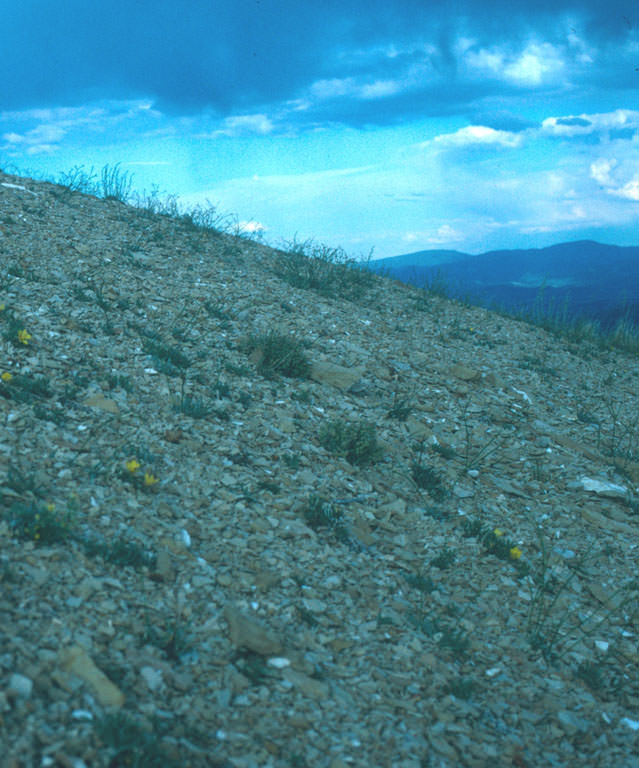
Known only from steep, shaley talus slopes derived from the Parachute Creek Member of the Green River Formation (Holmgren and Holmgren 2002, Reveal 2002). The plants are commonly associated with Gambel oak, western chokecherry, mountain mahogany and Utah juniper (Reveal 2002).
click on image to enlarge
 |
Elevation Range:
5,383 - 9,195 feet (1,641 - 2,803 meters)
Distribution
Colorado Endemic:
Yes
Range:
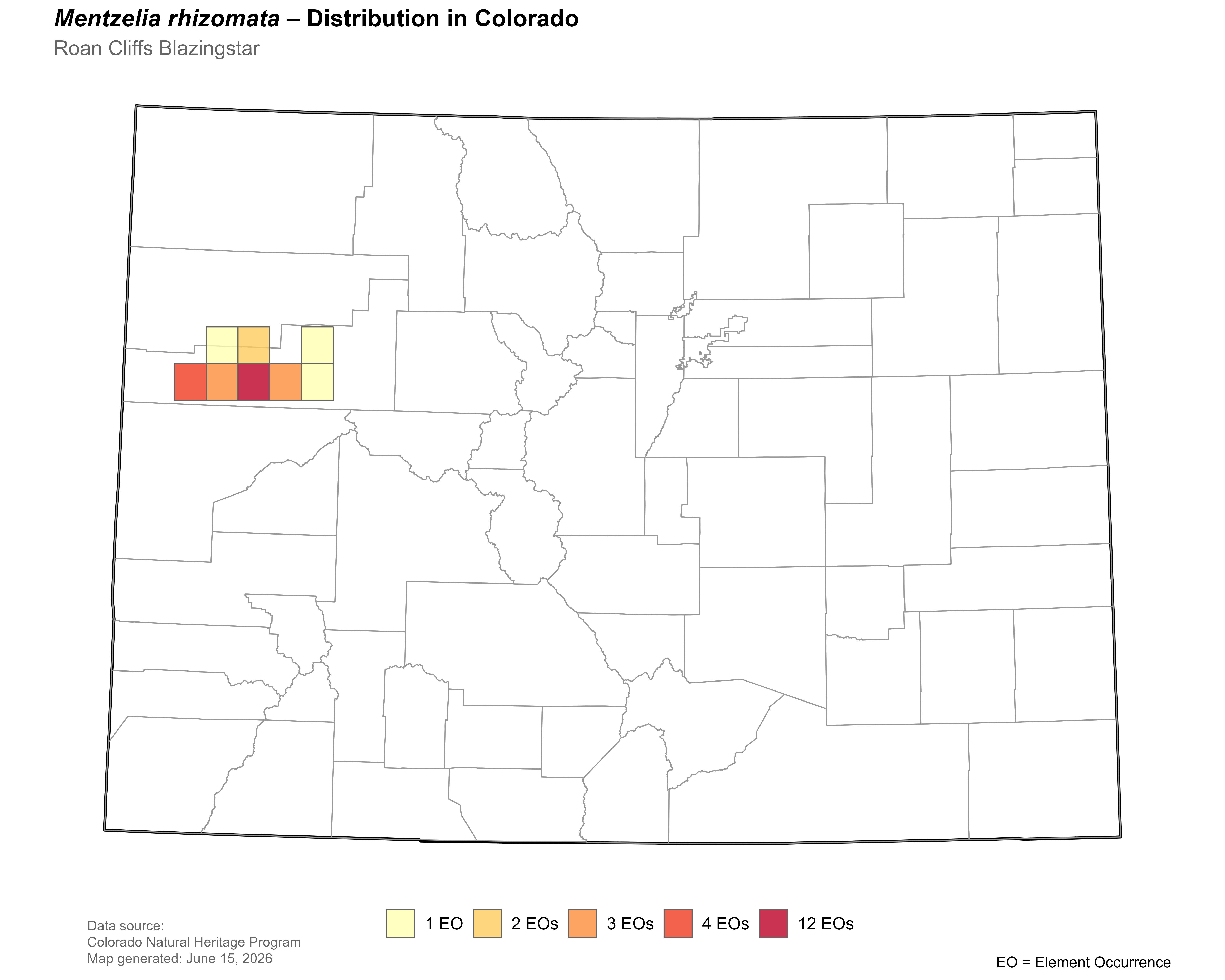
Mentzelia rhizomata occurs in the western United States, where it is endemic to Colorado on the Roan Plateau in Garfield County. The estimated range extent in Colorado of 1462 square kilometers was calculated in GeoCAT using occurrence data provided by the Colorado Natural Heritage Program (2022).
Click on map to enlarge |
Threats and Management Issues
Mentzelia rhizomata is threatened by energy development, competition from invasive plant species, livestock grazing, and road development and maintenance. Mentzelia rhizomata is found in areas where there is extensive oil and gas development and it has been reported as a potential threat for over half of the known occurrences (CNHP 2022). Potential oil shale mining is also a concern at many of these same locations. Creation of access roads for energy exploration and extraction activities has bisected some occurrences. Invasive plants species, including cheatgrass (Bromus tectorum) and yellow sweet clover (Melilotus officinale) have been reported from seven occurrences and may outcompete M. rhizomata (CNHP 2022). Livestock grazing has been reported as a concern at three locations although is it not generally a direct threat on the steep shale slopes where the M. rhizomata occurs. This species is considered to have low adaptive capacity and is expected to be extremely vulnerable to climate change under both RCP 4.5 and 8.5 scenarios, as assessed for the 2025 Colorado State Wildlife Action Plan (CNHP 2025).
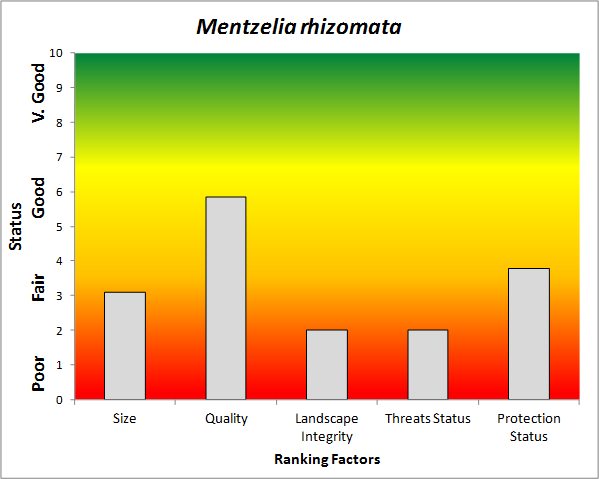
Summary results of an analysis of the status of Nuttallia rhizomata based on several ranking factors. This species was concluded to be weakly conserved. From Rondeau et al. 2011. |
References
- Ackerfield, J. 2015. Flora of Colorado. BRIT Press, Botanical Research Institute of Texas, Fort Worth, TX. 818 pp.
- Colorado Natural Heritage Program (CNHP). 2022. Biodiversity Tracking and Conservation System (Biotics 5). Colorado Natural Heritage Program, Colorado State University, Fort Collins.
- Colorado Natural Heritage Program (CNHP). 2025. Climate Change Vulnerability Assessment of Colorado Tier 1 and Tier 2 Plant Species of Greatest Conservation Need (SCGN) for the 2025 Colorado State Wildlife Action Plan. Colorado Natural Heritage Program, Colorado State University, Fort Collins.
- Elliott, B. A., S. Spackman Panjabi, B. Kurzel, B. Neely, R. Rondeau, M. Ewing. 2009. Recommended Best Management Practices for Plants of Concern. Practices developed to reduce the impacts of oil and gas development activities to plants of concern. Unpublished report prepared by the Rare Plant Conservation Initiative for the National Fish and Wildlife Foundation.
- Handwerk, J., L. Grunau, and S. Panjabi. 2015. Colorado Wildlife Action Plan: 2015 Rare Plant Addendum. Colorado Natural Heritage Program, Colorado State University, Fort Collins, Colorado, USA.
- Holmgren., N. H. and P. K. Holmgren. 2002. New Mentzelias (Loasaceae) from the Intermountain region of western United States. Systematic Botany 27(4): 747-762.
- Neely, B., S. Panjabi, E. Lane, P. Lewis, C. Dawson, A. Kratz, B. Kurzel, T. Hogan, J. Handwerk, S. Krishnan, J. Neale, and N. Ripley. 2009. Colorado Rare Plant Conservation Strategy, Developed by the Colorado Rare Plant conservation Initiative. The Nature Conservancy, Boulder, Colorado, 117 pp.
- O'Kane, S. L. 1988. Colorado's Rare Flora. Great Basin Naturalist. 48(4):434-484.
- Panjabi, S.S. and G. Smith, 2017. Recommended best management practices for Roan Cliffs blazing star (Nuttallia rhizomata): practices to reduce the impacts of road maintenance activities to plants of concern. Colorado Natural Heritage Program, Colorado State University, Fort Collins, Colorado.
- Reveal, J.L. 2002. Mentzelia rhizomata (Loasaceae: Mentzelioideae), a new species from western Colorado. Systematic Botany 27(4):763-767.
- Rondeau, R., K. Decker, J. Handwerk, J. Siemers, L. Grunau, and C. Pague. 2011. The state of Colorado's biodiversity 2011. Prepared for The Nature Conservancy. Colorado Natural Heritage Program, Colorado State University, Fort Collins, Colorado.
- USDA, NRCS. 2022. The PLANTS Database. National Plant Data Team, Greensboro, NC 27401-4901 USA.
- Weber, W.A., and R.C. Wittmann. 2012b. Colorado Flora, Western Slope, a field guide to the vascular plants, fourth edition. Boulder, Colorado. 532 pp.
- Welsh, S.L. 1979. Status report for Mentzelia argillosa. Unpublished report prepared for the Colorado Natural Areas Program, Denver, CO.