

Scientific Name : Draba graminea
Author : Greene NatureServe Explorer
Common Name : San Juan Draba
 Current Research Activities


☰ Click link below for details.
Taxonomy
Brassicaceae (mustard family)
Ranks and Status
State Rank : S3
State Rank Reason : Draba graminea is a Colorado (USA) endemic found only in the San Juan Mountains. As of 2023, there are about 40 occurrences known, about one third are of good viability, one third are historical, and the remainder have fair or undocumented viability. Occurrences are fairly isolated, so threats are not well known. Off road vehicles, reported at some occurrences, are the primary threat. Climate change or extreme weather are potential threats.
U.S. Endangered Species Act : none
Colorado Threatened and Endangered List : none
Other Statuses : SWAP Tier 2, USFS GMUG, USFS RGNF
Description and Phenology
General Description:
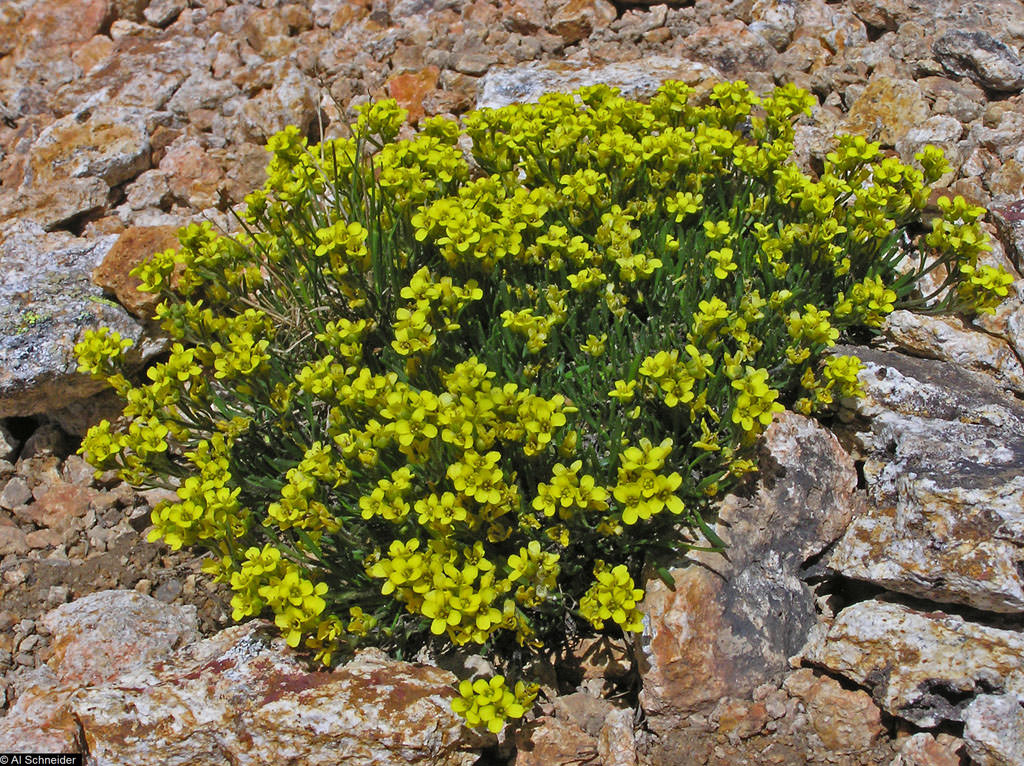
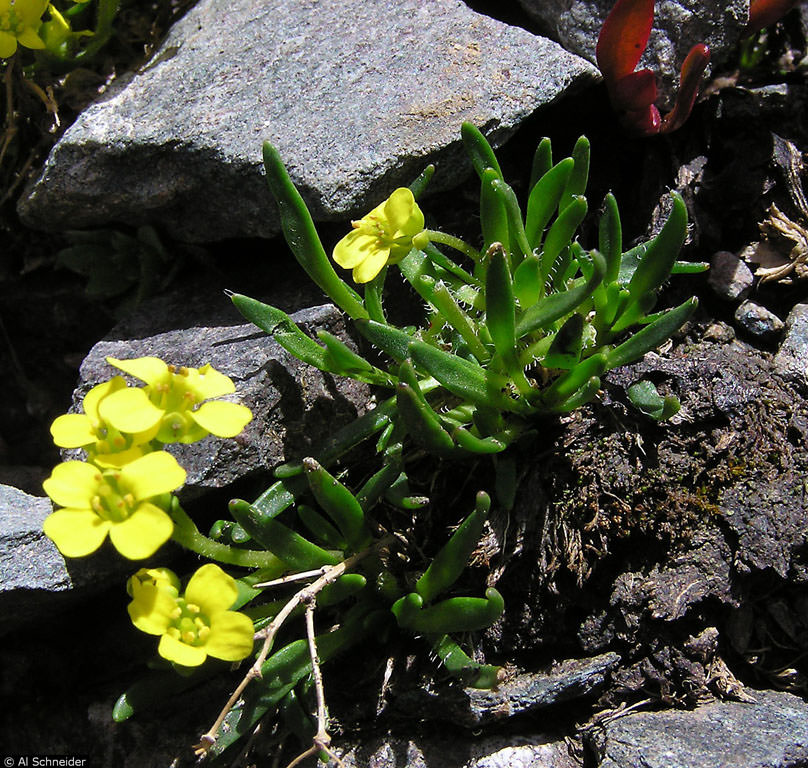
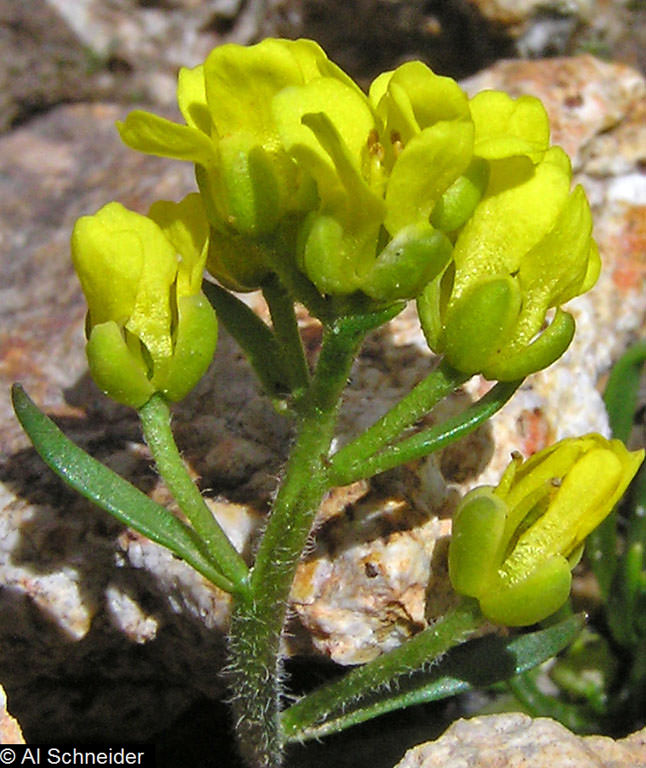
Draba graminea is a caespitose perennial herb, 1 to 5 cm tall. Stems are caulescent with slender unbranched hairs. Leaves are linear to linear-oblanceolate, glabrous except for long ciliate hairs on the lower half. These hairs are simple or sometimes forked. Cauline leaves are mostly absent; if present they number between one and six, and are reduced. The inflorescence is a raceme with three to 15 flowers subtended by leaf-like bracts. The petals are yellow and 4 to 5 mm long. The siliques are 5 to 10 mm long and 2 to 4 mm wide, elliptic-ovate, thick, and glabrous (Moore and Friedley 2004, Hitchcock 1941, Harrington 1954, Rollins 1993).Hitchcock 1941, Harrington 1954, Rollins 1993).
Look Alikes:
There are morphological similarities in some Rocky Mountain members of Draba. Look-alike species include D. crassifolia , D. spectabilis, and D. exunguiculata. Draba graminea can be distinguished from the others by the ciliate, linear, basal leaves, the lack of cauline leaves, the leaf-like bracts subtending the flowers, and glabrous fruits (Flora of North America 2010, Moore and Friedley 2004).
Phenology:
Flowers July-August (Colorado Natural Heritage Program 2012).
Habitat
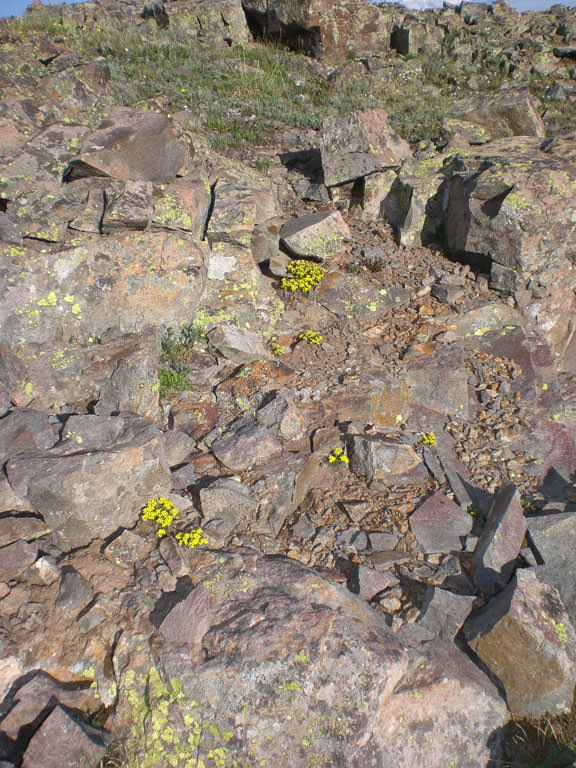
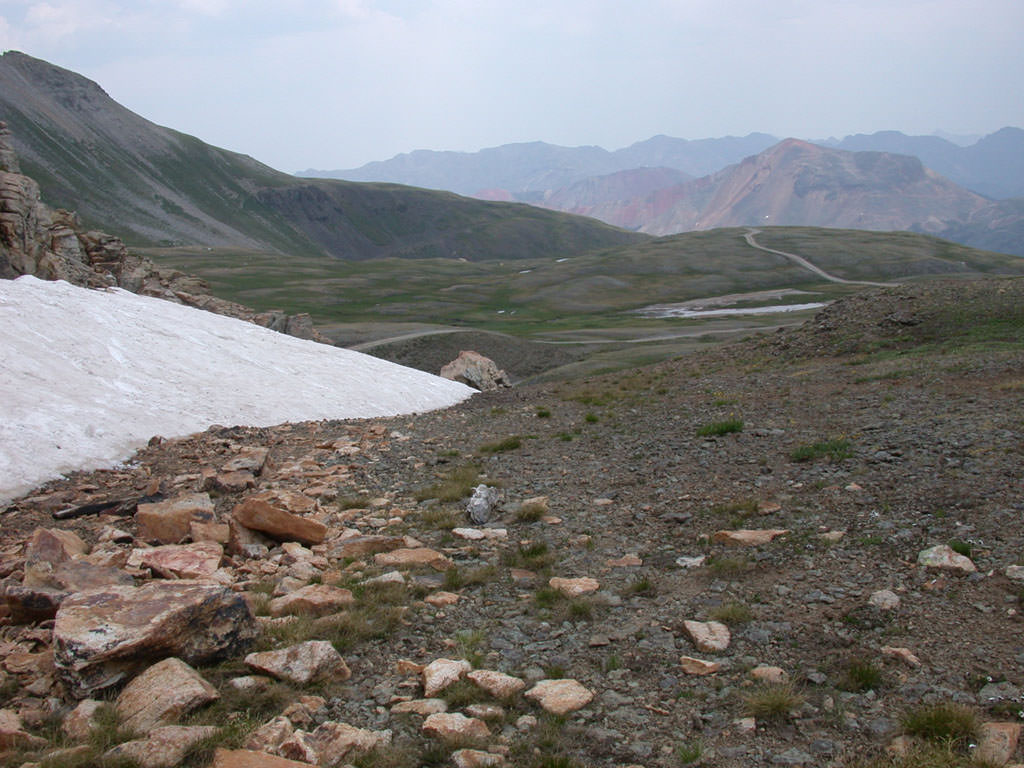
Draba graminea is a plant of the high mountains of southwestern Colorado. It is typically located in the alpine, and less often in subalpine areas. It occupies the crevices of rock outcrops, talus slopes, late snowmelt areas, and alpine tundra along the Continental Divide and the greater San Juan Mountains area (Moore and Friedley 2004). Associated species include Pseudocymopterus montanus, Silene acaulis, Parnassia fimbriata, Salix reticulata, Cilaria austromontana, Lidia obtusiloba, Luzula spicata, Geum rossii, Claytonia megarhiza, Artemisia scopulorum, Potentilla diversifolia, Draba streptobrachia, Draba aurea, Draba crassifolia, Oreobrama pygmaea, Micranthes rhomboidea, Erigeron simplex, Rydbergii grandiflora, Artemisia scopulorum, Podistera eastwoodiae (Colorado Natural Heritage Program 2012).
click on image to enlarge
 |
 |
Elevation Range:
9,598 - 14,316 feet (2,926 - 4,364 meters)
Distribution
Colorado Endemic:
Yes
Range:
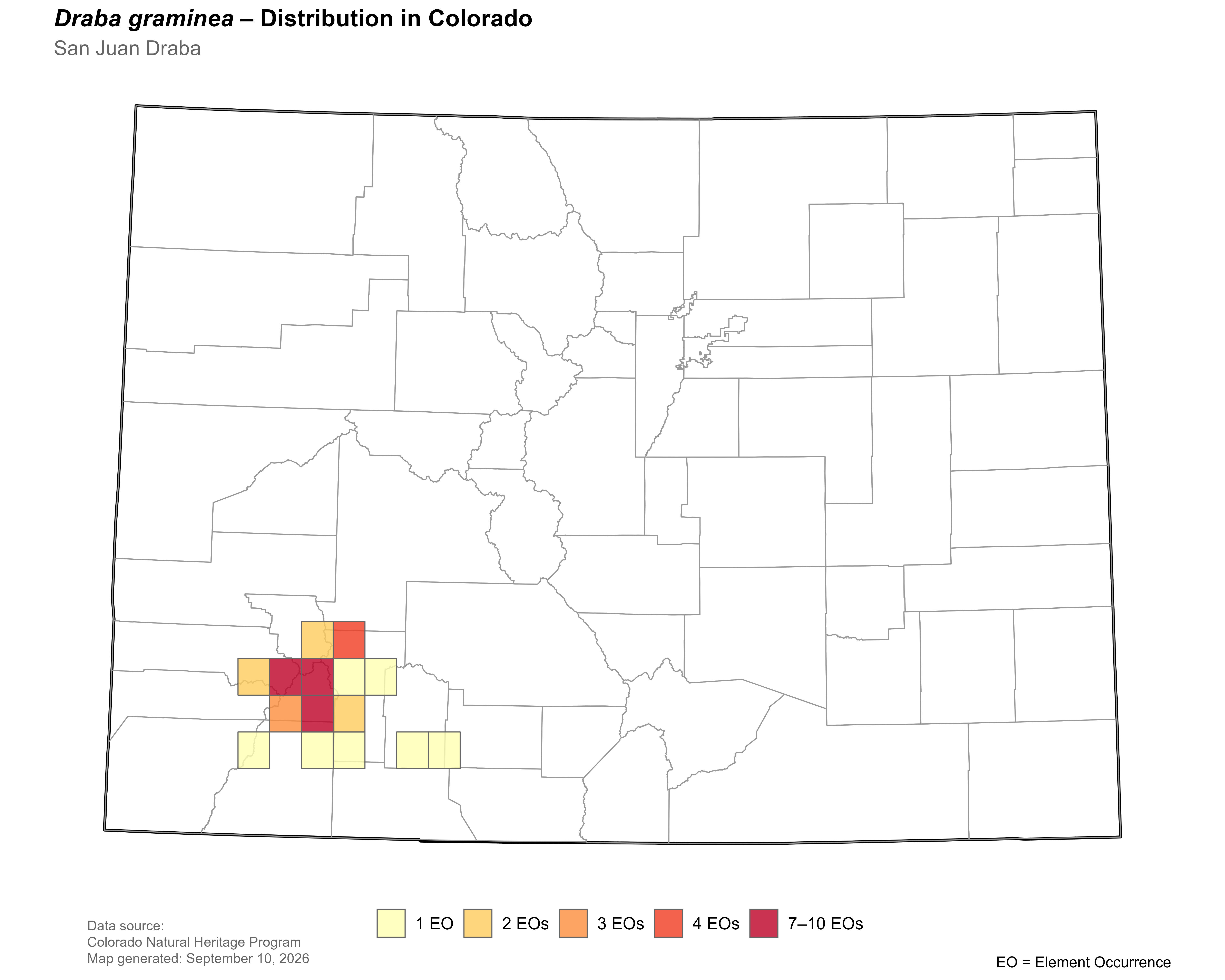
Draba graminea is endemic to Colorado, USA where it occurs in Dolores, Gunnison, Hinsdale, La Plata, Mineral, Montezuma, Ouray, Rio Grande, San Juan, and San Miguel counties. Estimated range extent in Colorado of 6387 square kilometers was calculated in GeoCAT using occurrence data provided by the Colorado Natural Heritage Program (2023).
Click on map to enlarge |
Threats and Management Issues
Non-motorized recreation is considered to be the primary threat to the species at this time (Rondeau et al. 2011). Two occurrences list a heavily used jeep trail as a potential threat, however, current threats to Draba graminea are difficult to discern due to the remoteness of the occurrences. The concern for the viability of the species is based on its limited abundance and restricted global distribution. Recreation, livestock grazing, and mining are likely to be the most influential activities with regards to D. graminea occurrences. Past threats that have been observed include erosion from nearby jeep trails and sheep grazing. Other potential threats to the species include extreme weather conditions, global warming, herbivory by native fauna (e.g. deer, elk, rodents, insects), competition from invasive species, and air pollution (Moore and Friedley 2004). This species is considered to have moderate adaptive capacity and is expected to be slightly to moderately vulnerable to climate change under both RCP 4.5 and 8.5 scenarios, as assessed for the 2025 Colorado State Wildlife Action Plan (CNHP 2025).
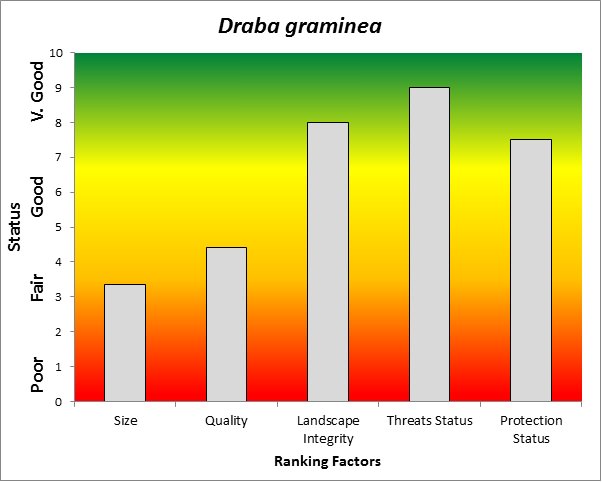
Summary results of an analysis of the status of Draba graminea based on several ranking factors. This species was concluded to be “Effectively Conserved”. From Rondeau et al. 2011. |
References
- Ackerfield, J. 2015. Flora of Colorado. BRIT Press, Botanical Research Institute of Texas, Fort Worth, TX. 818 pp.
- Al-Shehbaz, I.A., and M. D. Windham. 2007. New or noteworthy North American Draba (Brassicaceae). Harvard Papers in Botany 12(2): 409-419.
- Colorado Natural Heritage Program (CNHP). 2023. Biodiversity Tracking and Conservation System (Biotics 5). Colorado Natural Heritage Program, Colorado State University, Fort Collins.
- Colorado Natural Heritage Program (CNHP). 2025. Climate Change Vulnerability Assessment of Colorado Tier 1 and Tier 2 Plant Species of Greatest Conservation Need (SCGN) for the 2025 Colorado State Wildlife Action Plan. Colorado Natural Heritage Program, Colorado State University, Fort Collins.
- Colorado Natural Heritage Program. 2012. Biodiversity Tracking and Conservation System. Colorado State University, Fort Collins, CO.
- Flora of North America Editorial Committee. 2010. Flora of North America North of Mexico, Vol. 7, Magnoliophyta: Salicaceae to Brassicaceae. Oxford University Press, New York.
- Handwerk, J., L. Grunau, and S. Panjabi. 2015. Colorado Wildlife Action Plan: 2015 Rare Plant Addendum. Colorado Natural Heritage Program, Colorado State University, Fort Collins, Colorado, USA.
- Harrington, H.D. 1954. Manual of the plants of Colorado. Sage Press, Chicago. 666 pp.
- Heil, K.D., S.L. O'Kane Jr., L.M. Reeves, and A. Clifford, 2013. Flora of the Four Corners Region, Vascular Plants of the San Juan River Drainage; Arizona, Colorado, New Mexico, and Utah. Missouri Botanical Garden Press, St. Louis, Missouri. 1098 pp.
- Lavender, A.E., M.M. Fink, S.E. Linn, D.M. Theobald. 2011. Colorado Ownership, Management, and Protection v9 Database. Colorado Natural Heritage Program and Geospatial Centroid, Colorado State University, Fort Collins, CO. (30 September).
- Moore, L. and S. Friedley. (2004, September 30). Draba graminea Green (Rocky Mountain draba): a technical conservation assessment. [Online]. USDA Forest Service, Rocky Mountain Region. Available: http://www.fs.fed.us/r2/projects/scp/assessments/drabagraminea.pdf [March 2006].
- Neely, B., S. Panjabi, E. Lane, P. Lewis, C. Dawson, A. Kratz, B. Kurzel, T. Hogan, J. Handwerk, S. Krishnan, J. Neale, and N. Ripley. 2009. Colorado Rare Plant Conservation Strategy, Developed by the Colorado Rare Plant conservation Initiative. The Nature Conservancy, Boulder, Colorado, 117 pp.
- Rollins, R.C. 1993a. The Cruciferae of continental North America: Systematics of the mustard family from the Arctic to Panama. Stanford Univ. Press, Stanford, California. 976 pp.
- Rondeau, R., K. Decker, J. Handwerk, J. Siemers, L. Grunau, and C. Pague. 2011. The state of Colorado's biodiversity 2011. Prepared for The Nature Conservancy. Colorado Natural Heritage Program, Colorado State University, Fort Collins, Colorado.
- Schneider, A. 2013. Wildflowers, Ferns, and Trees of the Four Corners Regions of Colorado, New Mexico, Arizona, and Utah. Accessed on-line at http://www.swcoloradowildflowers.com.
- USDA, NRCS. 2022. The PLANTS Database. National Plant Data Team, Greensboro, NC 27401-4901 USA.
- Weber, W. A. and R. C. Wittmann. 2012. Colorado Flora, Eastern Slope, A Field Guide to the Vascular Plants, Fourth Edition. Boulder, Colorado. 555 pp.
- Weber, W. A. and R. C. Wittmann. 2012. Colorado Flora, Western Slope, A Field Guide to the Vascular Plants, Fourth Edition. Boulder, Colorado. 532 pp.