

Scientific Name : Penstemon albifluvis
Author : England NatureServe Explorer
Common Name : White River Penstemon
 Current Research Activities
 1997 profile


☰ Click link below for details.
Taxonomy
Plantaginaceae (plantain family)
This taxon is listed as Penstemon albifluvis in Ackerfield (2022) and Penstemon scariosus var. albifluvis in Ackerfield (2015). Micro satellite studies indicate that Penstemon albifluvis should be considered as a distinct species, not a variety of P. scariosus (Anderson 2016). Ackerfield (2015, 2022) places this genus in the Plantaginaceae family.
Ranks and Status
State Rank : S1
State Rank Reason : Penstemon albifluvis is known from a limited range in western Colorado, USA. There are five occurrences, only one of which is of good viability. The species occurs within an area of developed and expanding oil and gas fields with several wells and access roads; additional potential threats include off-road vehicle use, inappropriate livestock grazing and competition from invasive nonnative plant species. Penstemon albifluvis is considered to be moderately to extremely vulnerable to the effects of climate change.
U.S. Endangered Species Act : none
Colorado Threatened and Endangered List : none
Other Statuses : BLM, SWAP Tier 1
Description and Phenology
General Description:
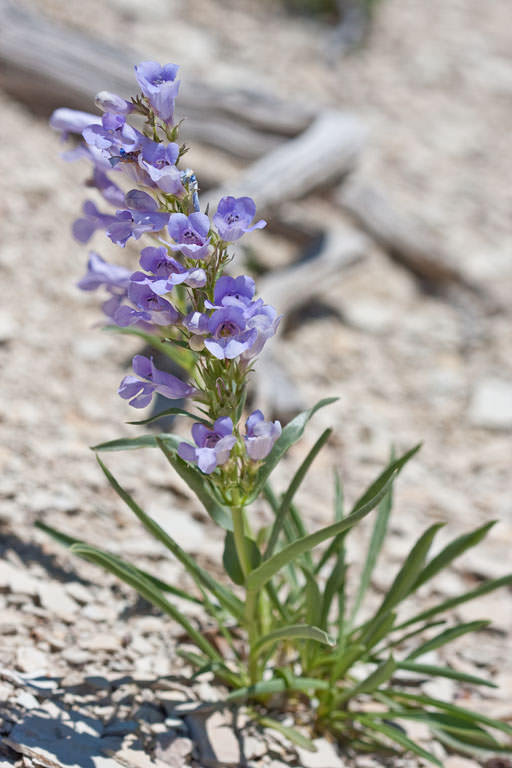
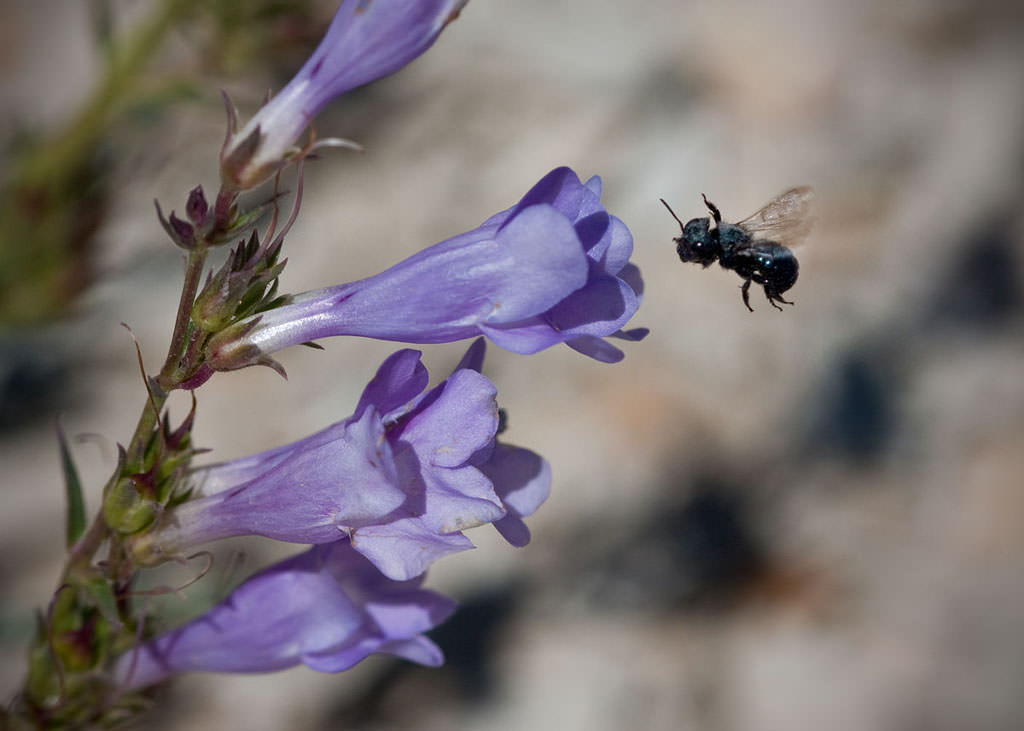
Herbaceous perennial to 5 dm in height with multiple stems from a woody caudex. The leaves are linear to linear-lanceolate and are typically less than 7 mm wide. The pale-blue to lavender corolla is prominently bilabiate, the lower lip larger than the upper. Corolla lobes are thin membranous-margined; the stamens exserted; the anthers white-bearded. Inflorescence a cyme of 2 to 5 flowers.
Look Alikes:
Clearly a close relative to Penstemon scariosus. This variety differs from typical P. scariosus as the corolla and anther hairs tend to be shorter, and the basal leaf rosette is reduced; habitat also differs. Also closely related to Penstemon strictus and other members of the complex by a series of small morphological features: P. scariosus var. albifluvis has basal leaves that are lacking or poorly developed contrasting well-developed basal leaves of relatives; anther hairs are longer than widths in relatives; corolla lenth is 20-22 mm in P. scariosus var. albifluvis, 24-30 mm in relatives (Galatowitsch 1985).
Phenology:
Flowers from mid May through June (Spackman et al. 1997), with seeds produced in late June (Colorado Natural Heritage Program 2012).
Habitat
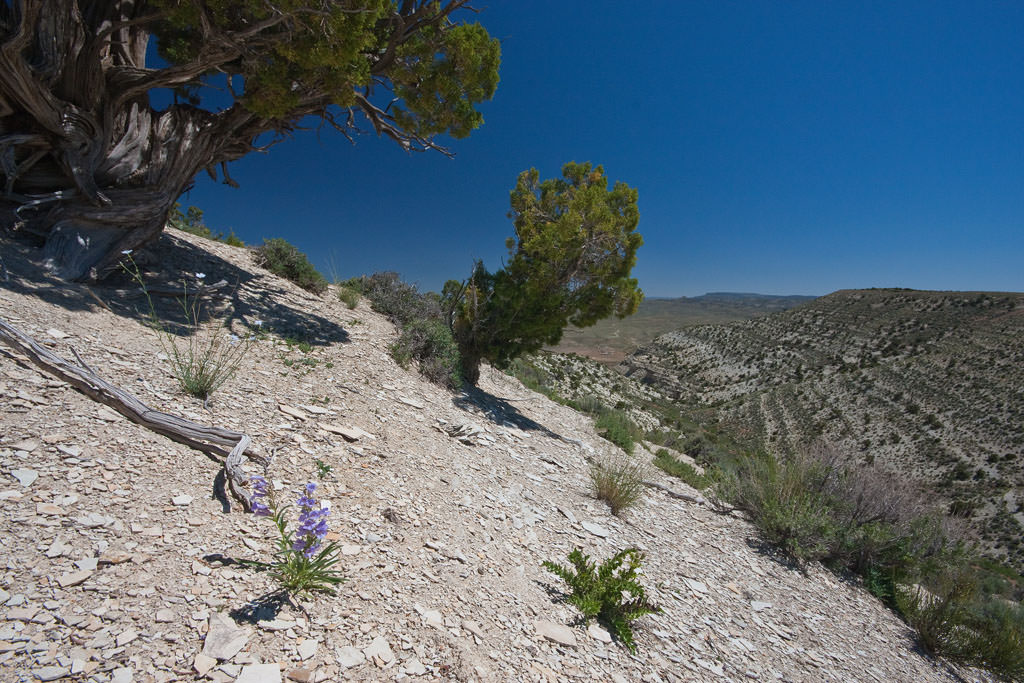
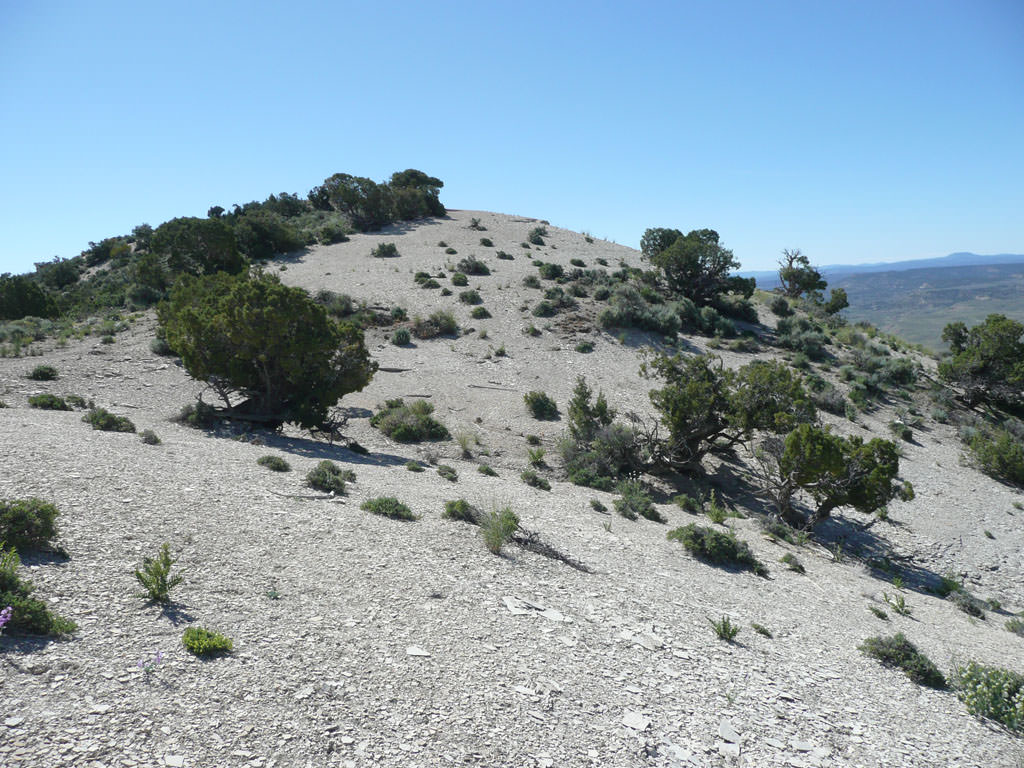
Found in mixed desert shrub and pinyon-juniper communities on sparsely vegetated white shale slopes. Occurs on fine-textured calcareous soils that are shallow, and usually mixed with fragmented shale. These soils are derived from oil shale barrens of the Parachute Creek Member, Green River Formation (Spackman et al. 1997).
click on image to enlarge
 |  |
Elevation Range:
5,495 - 6,713 feet (1,675 - 2,046 meters)
Distribution
Colorado Endemic:
No
Range:
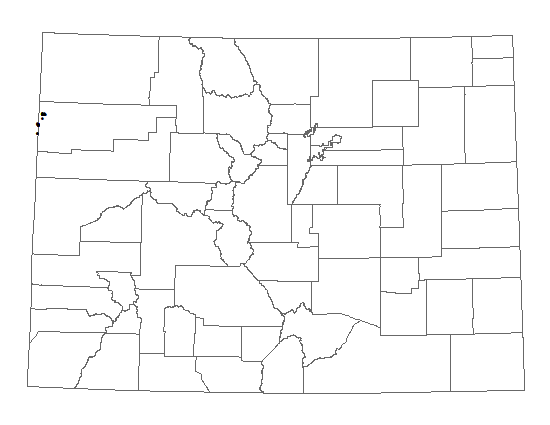
Penstemon albifluvis is known from Rio Blanco County in Colorado, USA. The estimated range extent in Colorado of 87 square kilometers was calculated in GeoCAT using occurrence data provided by the Colorado Natural Heritage Program (2023). This species can also be found in Uintah County, Utah, USA.
 Click on map to enlarge |
Threats and Management Issues
The primary threats to this species arise from oil and gas development and inappropriate livestock grazing (CNHP 2023, Rondeau et al. 2011) which can lead to potential elimination of occurrences/subpopulations, habitat degradation and fragmentation. Four of the occurrences report evidence of livestock use in occupied habitat (CNHP 2023). Penstemon albifluvis occurs within an area of developed and expanding oil and gas fields with several wells pipelines and access roads in the immediate area. Other potential threats include off-road vehicle use and competition from noxious weeds. Long term drought is widespread throughout the species range. This species is considered to have low adaptive capacity and is expected to be moderately to extremely vulnerable to climate change under both RCP 4.5 and 8.5 scenarios, as assessed for the 2025 Colorado State Wildlife Action Plan (CNHP 2025).
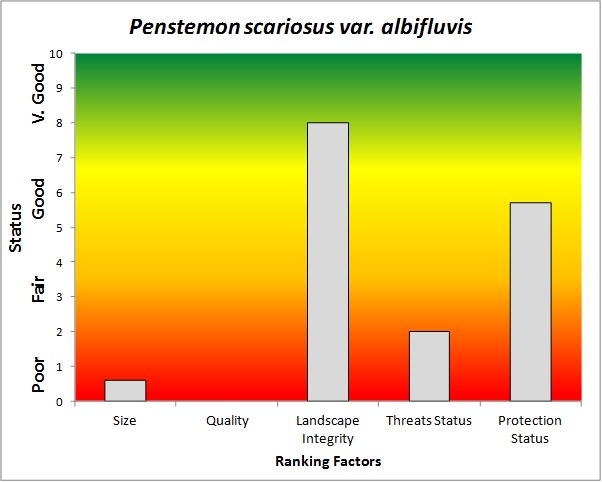 Summary results of an analysis of the status of Penstemon scariosus var. albifluvus based on several ranking factors. This species was concluded to be “under conserved”. From Rondeau et al. 2011. |
References
- Ackerfield, J. 2015. Flora of Colorado. BRIT Press, Botanical Research Institute of Texas, Fort Worth, TX. 818 pp.
- Ackerfield, J. 2022. Flora of Colorado. Second Edition. Bot. Misc. 60. BRIT Press, Fort Worth Botanic Garden/Botanical Research Institute of Texas, U.S.A. 861 pp.
- C. D. Anderson, N. J. Ricks, K. M. Farley, P. J. Maughan, and Mikel R. Stevens. 2016. Identification and Characterization of Microsatellite Markers in Penstemon scariosus (Plantaginaceae). Applications in Plant Sciences 2016 4 (3).
- Colorado Natural Heritage Program (CNHP). 2025. Climate Change Vulnerability Assessment of Colorado Tier 1 and Tier 2 Plant Species of Greatest Conservation Need (SCGN) for the 2025 Colorado State Wildlife Action Plan. Colorado Natural Heritage Program, Colorado State University, Fort Collins.
- Cronquist, A., A.H. Holmgren, N.H. Holmgren, J.L. Reveal, and P.K. Holmgren. 1984. Intermountain Flora: Vascular Plants of the Intermountain West, U.S.A. Vol. 4, Subclass Asteridae (except Asteraceae). New York Botanical Garden, Bronx. 573 pp.
- Elliott, B. A., S. Spackman Panjabi, B. Kurzel, B. Neely, R. Rondeau, M. Ewing. 2009. Recommended Best Management Practices for Plants of Concern. Practices developed to reduce the impacts of oil and gas development activities to plants of concern. Unpublished report prepared by the Rare Plant Conservation Initiative for the National Fish and Wildlife Foundation.
- England, J.L. 1982. A new species of Penstemon (Scrophulariaceae) from the Uinta basin of Utah and Colorado. Great Basin Naturalist. 42(3): 367-368.
- Flora of North America Editorial Committee (FNA). 2019. Flora of North America north of Mexico. Vol. 17: Magnoliophyta: Tetrachondraceae to Orobanchaceae. Oxford Univ. Press, New York. xxiv + 737 pp.
- Franklin, M. A. 1995. Field inventory of Penstemon scariosus var. albifluvis (R.L. England) N. Holmgren in the Book Cliffs Resource Area, Uinta Basin, Utah. Final report for 1994 Challenge Cost Share Project. UDNR Utah Natural Heritage Program and BLM Vernal District. Unpublished report on file Utah Natural Heritage Program, Salt Lake City, Utah. Pp. 1-9 + appendices.
- Handwerk, J., L. Grunau, and S. Panjabi. 2015. Colorado Wildlife Action Plan: 2015 Rare Plant Addendum. Colorado Natural Heritage Program, Colorado State University, Fort Collins, Colorado, USA.
- Kartesz, J.T. 1994. A synonymized checklist of the vascular flora of the United States, Canada, and Greenland. 2nd edition. 2 vols. Timber Press, Portland, OR.
- Krening, P. and J. Hope Hornbeck. 2021. Graham’s Beardtongue (Penstemon grahamii) and White River Beardtongue (Penstemon scariosus var. albifluvis) 2021 Population Monitoring Report. Prepared for The Penstemon Conservation Team: State of Utah School and Institutional Trust Lands Administration; Uintah County, Utah; Utah Public Lands Policy Coordination Office; Utah Division of Wildlife Resources; Rio Blanco County, Colorado; Bureau of Land Management; U.S. Fish and Wildlife Service. March 31, 2021.
- Neely, B., S. Panjabi, E. Lane, P. Lewis, C. Dawson, A. Kratz, B. Kurzel, T. Hogan, J. Handwerk, S. Krishnan, J. Neale, and N. Ripley. 2009. Colorado Rare Plant Conservation Strategy, Developed by the Colorado Rare Plant conservation Initiative. The Nature Conservancy, Boulder, Colorado, 117 pp.
- Neese, E., and F. Smith. 1982. Final Report: Threatened and endangered plant inventory for the Oil Shale RMP, Bookcliffs Resource Area, Utah Bureau of Land Management, Vernal District. Volume 1 - Text. Pp 1-88 + appendices.
- Rocky Mountain Society of Botanical Artists. 2009. RARE Imperiled Plants of Colorado, a traveling art exhibition. Exhibition catalogue developed by the Denver Botanic Gardens and Steamboat Art Museum.
- Rondeau, R., K. Decker, J. Handwerk, J. Siemers, L. Grunau, and C. Pague. 2011. The state of Colorado's biodiversity 2011. Prepared for The Nature Conservancy. Colorado Natural Heritage Program, Colorado State University, Fort Collins, Colorado.
- Spackman, S., B. Jennings, J. Coles, C. Dawson, M. Minton, A. Kratz, and C. Spurrier. 1997. Colorado rare plant field guide. Prepared for Bureau of Land Management, U.S. Forest Service and U.S. Fish and Wildlife Service by Colorado Natural Heritage Program.
- Stevens, M.R. and R.L. Johnson. 2016. Annual APS Summer Meeting Rewards: Taxonomic clarification of two Penstemon species of the Uinta Basin of Colorado and Utah. Bulletin of the American Penstemon Society. 2016 Apr;75:8-20.
- U.S. Fish and Wildlife Service (USFWS). 2013. Threatened Species Status for Graham's Beardtongue (Penstemon grahamii) and White River Beardtongue (Penstemon scariosus var. albifluvis). Federal Register 78(151): 47590-47611.
- U.S. Fish and Wildlife Service (USFWS). 2014. Withdrawal of the Proposed Rules To List Graham’s Beardtongue (Penstemon grahamii) and White River Beardtongue (Penstemon scariosus var. albifluvis) and Designate Critical Habitat. Federal Register 79(151): 46042-46087.
- U.S. Fish and Wildlife Service (USFWS). 2021. February 4 last update. Draft Graham’s beardtongue (Penstemon grahamii) and White River beardtongue (P. scariosus var. albifluvis): Biological Status Report of Future Condition. Utah Field Office, Ecological Services, U.S. Fish and Wildlife Service, West Valley City, 74 pages + Appendix.
- USDA, NRCS. 2022. The PLANTS Database. National Plant Data Team, Greensboro, NC 27401-4901 USA.
- Weber, W. A. and R. C. Wittmann. 2012. Colorado Flora, Western Slope, A Field Guide to the Vascular Plants, Fourth Edition. Boulder, Colorado. 532 pp.