

Scientific Name : Chylismia eastwoodiae
Author : (Munz) W.L. Wagner & Hoch NatureServe Explorer
Common Name : Eastwood Evening- primrose
 Current Research Activities


☰ Click link below for details.
Taxonomy
Onagraceae (evening primrose family)
Weber and Wittmann (2012) list this as Camissonia eastwoodiae.
Ranks and Status
State Rank : S2
State Rank Reason : Chylismia eastwoodiae is known from 15 occurrences in Delta and Mesa counties, Colorado, USA. Threats to the species include surface disturbance from road maintenance and construction, off-road vehicle (ORV) use, livestock grazing, and competition from invasive non-native plant species. Prolonged drought and habitat alteration due to climate change are also a concern for this species.
U.S. Endangered Species Act : none
Colorado Threatened and Endangered List : none
Other Statuses : BLM, SWAP Tier 2
Description and Phenology
General Description:
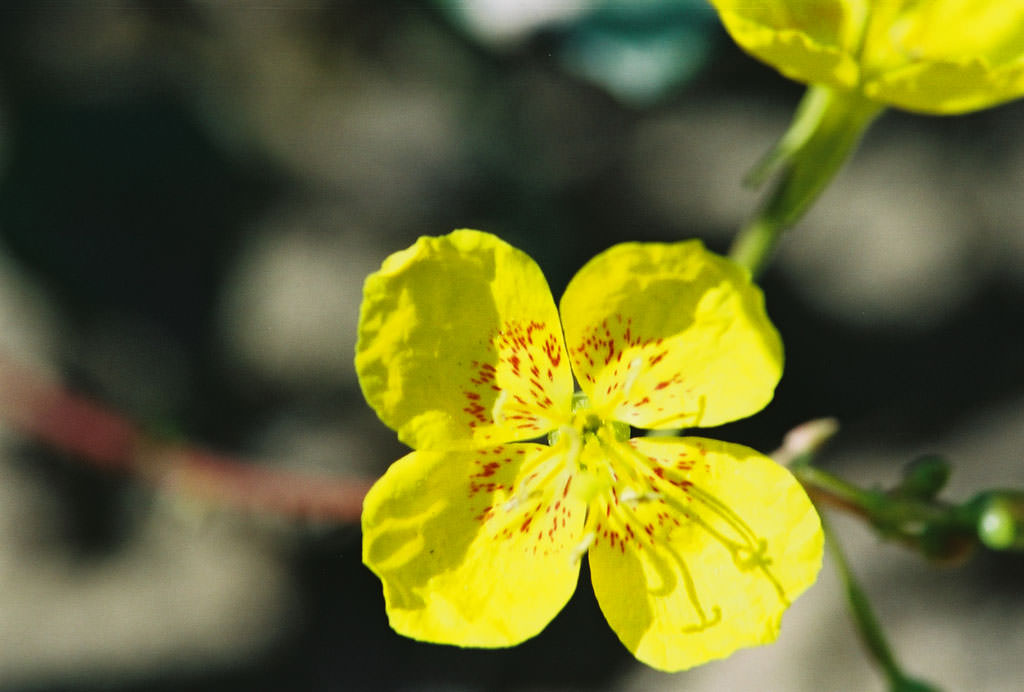
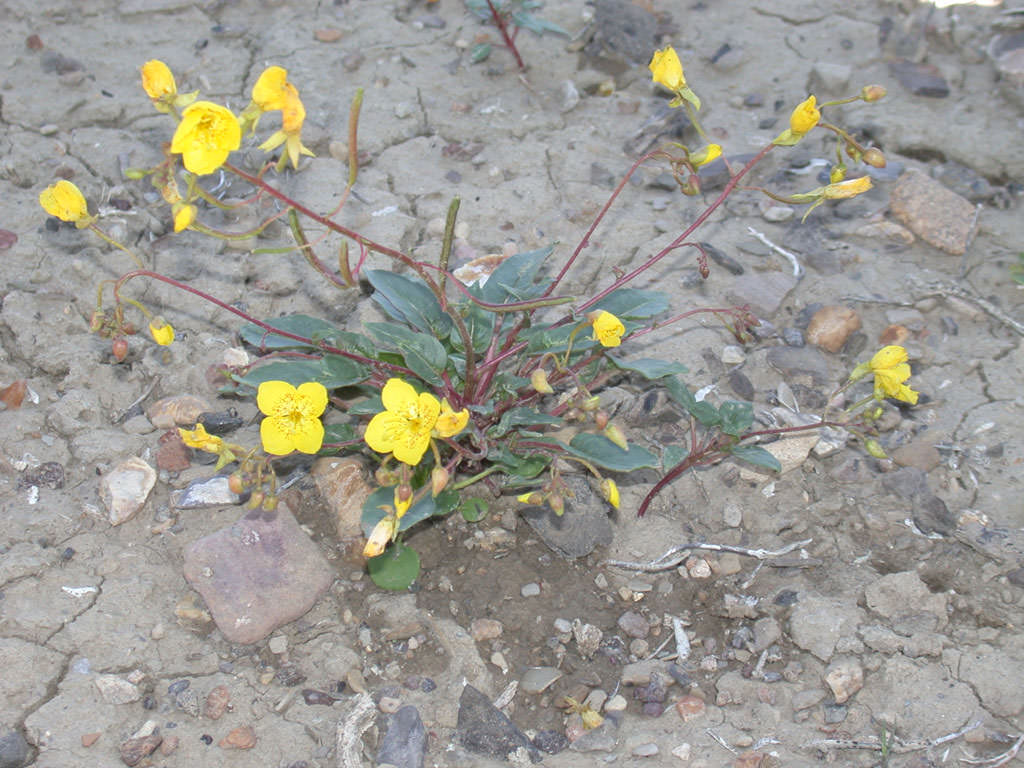
Annual herbs from taproots. Stems simple or branched near the base, 40-60 cm tall (Welsh al. 1993). Flowers are bright yellow with reddish streaks. Plants have reddish stems, and dark green leaves. Petals are usually more than 6 mm long, and capsules are on well-defined pedicles (Weber and Wittmann 2012).
Look Alikes:
At maturity, Camissonia eastwoodiae stigma are held well above the anthers, and the petals are more than 6 mm long. In contrast, Camissonia scapoidea stigma are surrounded by the anthers at maturity, and petals are less than 5.5. mm long (Weber and Wittmann 2012).
Phenology:
Flowers May-June (Ackerfield 2012, Colorado Natural Heritage Program 2012).
Habitat
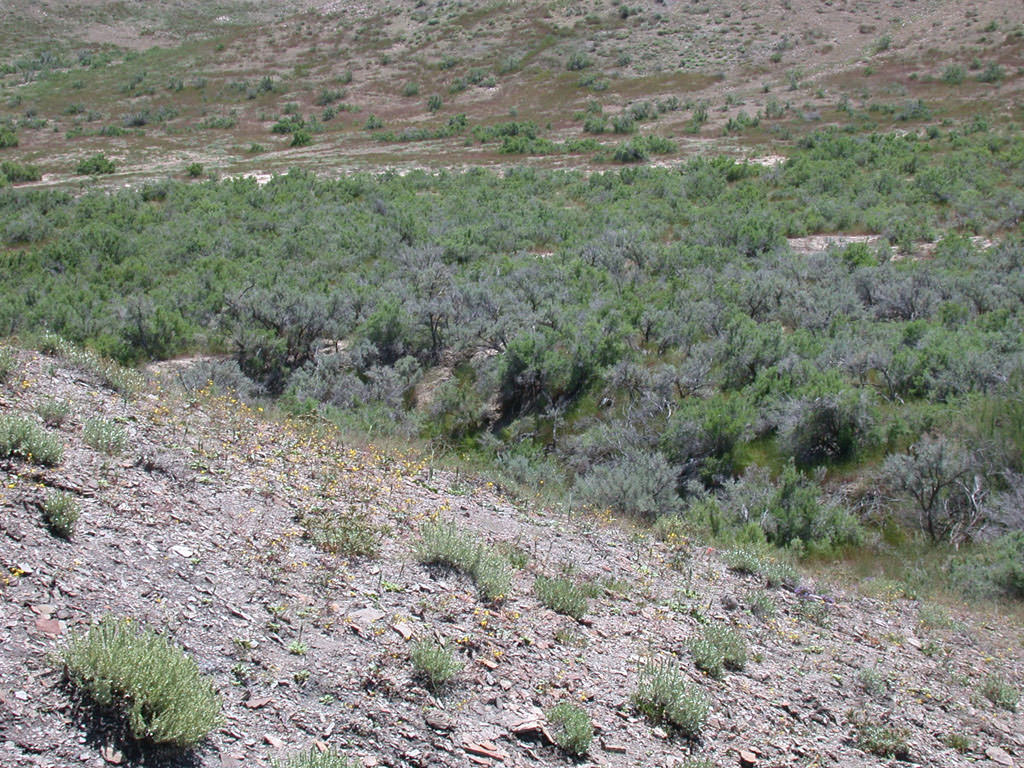
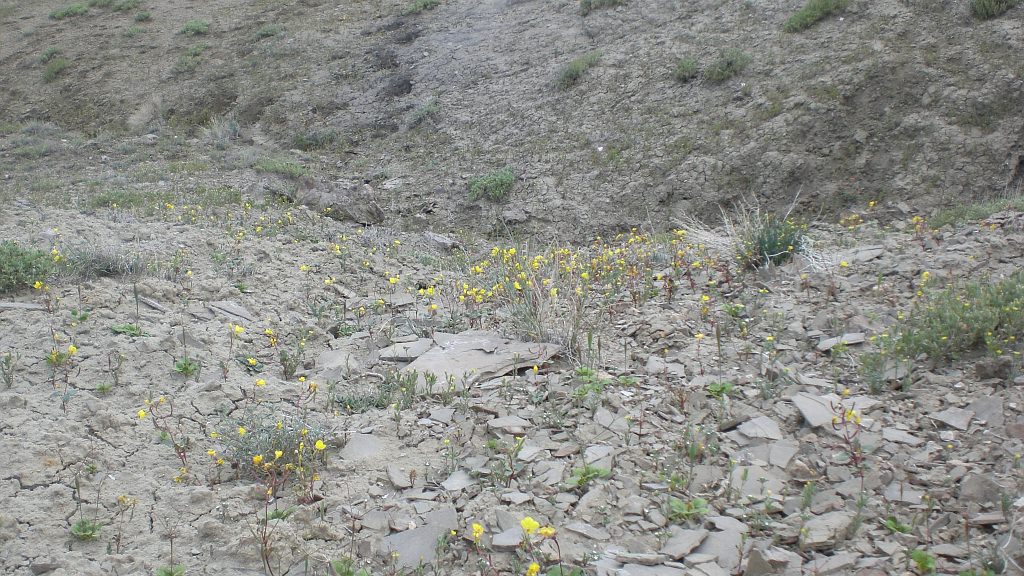
In Colorado this species is found on clay soils derived from Mancos shale with Atriplex gardneri a dominant associate. Other associated species include Eriogonum inflatum, Phacelia crenulata, Acrolasia albicaulis, Tetradymia spinosa, Cymopterus bulbosa, Calochortus nuttallii, Sphaeralcea parvifolia, Oenothera caespitosa ssp. marginata, Corispora tenella, Eriastrum diffusum, Opuntia polyacantha, Atriplex corrugata, Xylorhiza venusta, Hilaria jamesii, and Oryzopsis hymenoides (Colorado Natural Heritage Program 2012).
click on image to enlarge
 |
 |
Elevation Range:
4,566 - 6,275 feet (1,392 - 1,913 meters)
Distribution
Colorado Endemic:
No
Range:
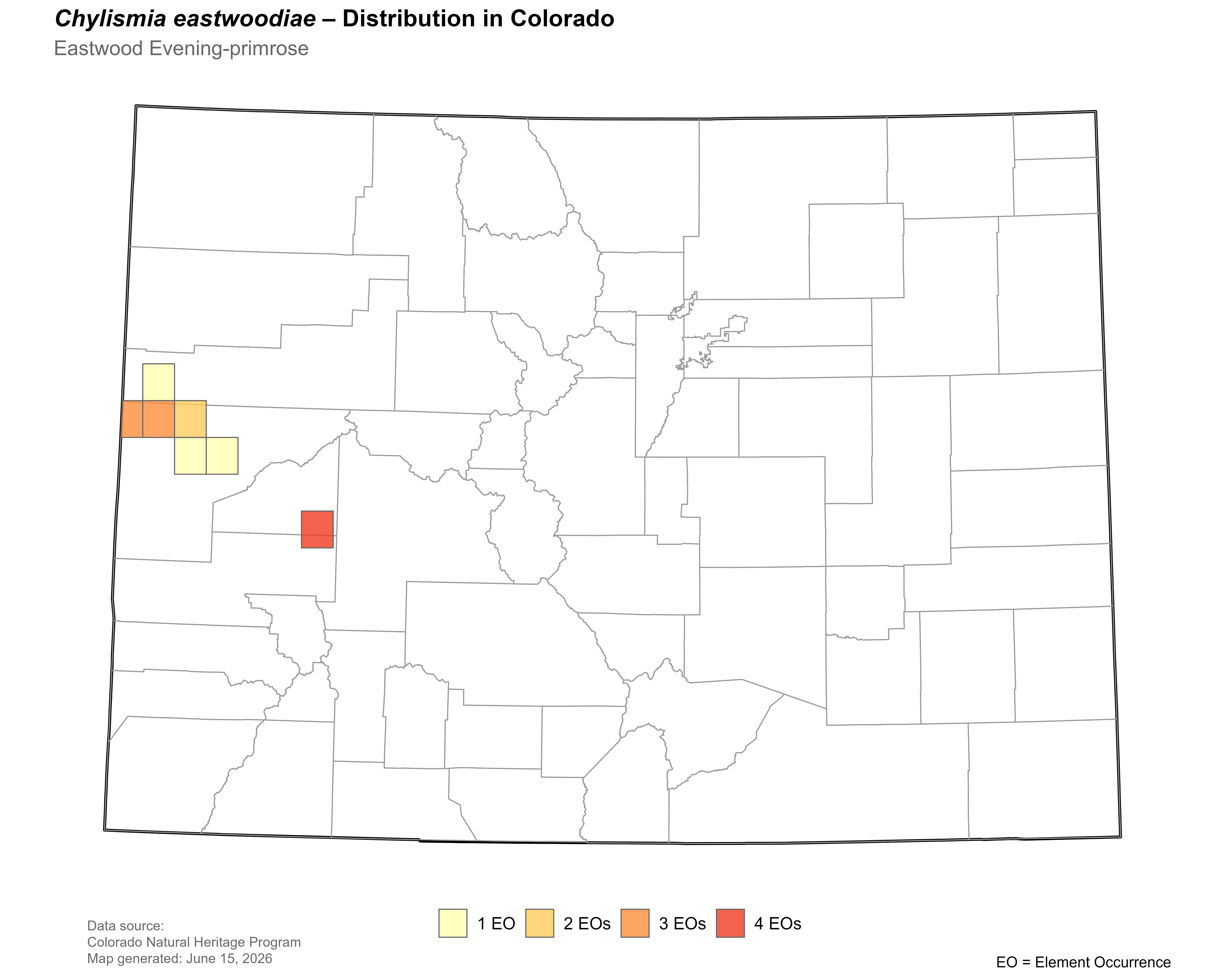
Chylismia eastwoodiae is known from Delta and Mesa counties in Colorado, and is endemic to the Colorado Plateau. It has also been recorded in Arizona and Utah, USA. The estimated range extent in Colorado of 2033 square kilometers was calculated in GeoCAT using occurrence data provided by the Colorado Natural Heritage Program (2023).
Click on map to enlarge |
Threats and Management Issues
As of 2023, 67% of the occurrences are found in habitat with minimal to low levels of landscape disturbance, the remainder are in areas with moderate to high levels of landscape disturbance (CNHP 2021, 2023). At the local level the primary threats are considered to be disturbance from roads maintenance and off road vehicle (ORV) activity (Rondeau et al. 2011). It is not known if all of the occurrences are threatened by these activities. At least one occurrence is within the BLM Colorado Canyons National Conservation Area with a management plan in progress. There are some oil and gas wells nearby the area as well as roads, grazing, and weedy areas. Long term drought is also a concern for this species. Its low numbers make it important to continue inventory efforts and determine the possible threats and appropriate management issues. This species is considered to have moderate adaptive capacity and is expected to be moderately vulnerable to climate change under both RCP 4.5 and 8.5 scenarios, as assessed for the 2025 Colorado State Wildlife Action Plan (CNHP 2025).
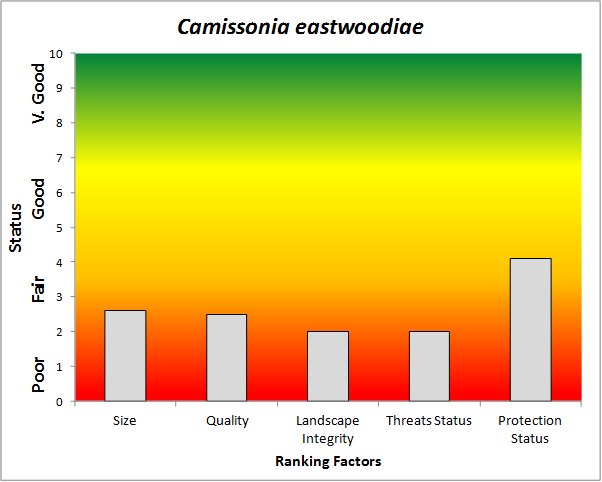
Summary results of an analysis of the status of Camissonia eastwoodiae based on several ranking factors. This species was concluded to be Weakly Conserved. From Rondeau et al. 2011. |
References
- Ackerfield, J. 2012. The Flora of Colorado. Colorado State University Herbarium. 433 pp.
- Colorado Natural Heritage Program (CNHP). 2025. Climate Change Vulnerability Assessment of Colorado Tier 1 and Tier 2 Plant Species of Greatest Conservation Need (SCGN) for the 2025 Colorado State Wildlife Action Plan. Colorado Natural Heritage Program, Colorado State University, Fort Collins.
- Flora of North America Editorial Committee, ed. (FNA). 1993+. Flora of North America North of Mexico. Oxford Univ. Press, New York, Oxford.
- Handwerk, J., L. Grunau, and S. Panjabi. 2015. Colorado Wildlife Action Plan: 2015 Rare Plant Addendum. Colorado Natural Heritage Program, Colorado State University, Fort Collins, Colorado, USA.
- Harris, J.G. 1983. A vascular flora of the San Rafael Swell, Utah. Great Basin Naturalist 43(1): 79-87. Online. Available: https://scholarsarchive.byu.edu/gbn/vol43/iss1/6/
- Heil, K.D., S.L. O'Kane Jr., L.M. Reeves, and A. Clifford, 2013. Flora of the Four Corners Region, Vascular Plants of the San Juan River Drainage; Arizona, Colorado, New Mexico, and Utah. Missouri Botanical Garden Press, St. Louis, Missouri. 1098 pp.
- Kartesz, J.T. 1996. Species distribution data at state and province level for vascular plant taxa of the United States, Canada, and Greenland (accepted records), from unpublished data files at the North Carolina Botanical Garden, December, 1996.
- Lavender, A.E., M.M. Fink, S.E. Linn, D.M. Theobald. 2011. Colorado Ownership, Management, and Protection v9 Database. Colorado Natural Heritage Program and Geospatial Centroid, Colorado State University, Fort Collins, CO. (30 September).
- Neely, B., S. Panjabi, E. Lane, P. Lewis, C. Dawson, A. Kratz, B. Kurzel, T. Hogan, J. Handwerk, S. Krishnan, J. Neale, and N. Ripley. 2009. Colorado Rare Plant Conservation Strategy, Developed by the Colorado Rare Plant conservation Initiative. The Nature Conservancy, Boulder, Colorado, 117 pp.
- Rondeau, R., K. Decker, J. Handwerk, J. Siemers, L. Grunau, and C. Pague. 2011. The state of Colorado's biodiversity 2011. Prepared for The Nature Conservancy. Colorado Natural Heritage Program, Colorado State University, Fort Collins, Colorado.
- Southwest Environmental Information Network (SEINet). 2022. Collections Databases. Online. Available: https://swbiodiversity.org/seinet/collections/index.php (accessed 2022).
- Weber, W. A. and R. C. Wittmann. 2012. Colorado Flora, Western Slope, A Field Guide to the Vascular Plants, Fourth Edition. Boulder, Colorado. 532 pp.
- Welsh, S.L., N.D. Atwood, S. Goodrich, and L.C. Higgins. (Eds). 2015. A Utah flora, fifth edition, revised 2015. Monte L. Bean Life Science Museum, Provo, Utah. 987 pp.