

Scientific Name : Mentzelia densa
Author : Greene NatureServe Explorer
Common Name : Royal Gorge blazingstar
 Current Research Activities
 1997 profile


☰ Click link below for details.
Taxonomy
Loasaceae (blazingstar family)
=Nuttallia densa
Ranks and Status
State Rank : S2
State Rank Reason : Mentzelia densa is endemic to the Arkansas River Valley in central Colorado, USA, where it can be locally common. It is threatened by livestock grazing, road and railroad construction and maintenance, competition from invasive weedy species, and motorized and non-motorized recreation. Prolonged drought is prevalent throughout this species range and it is considered moderately vulnerable to climate change effects.
U.S. Endangered Species Act : none
Colorado Threatened and Endangered List : none
Other Statuses : BLM, SWAP Tier 1
Description and Phenology
General Description:
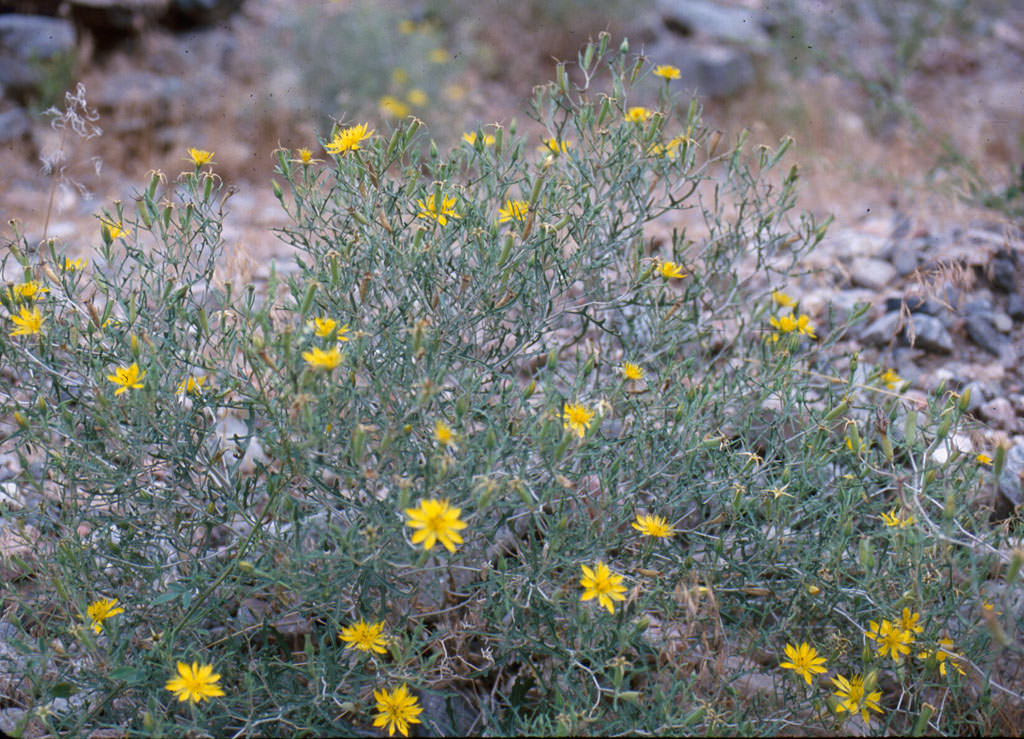
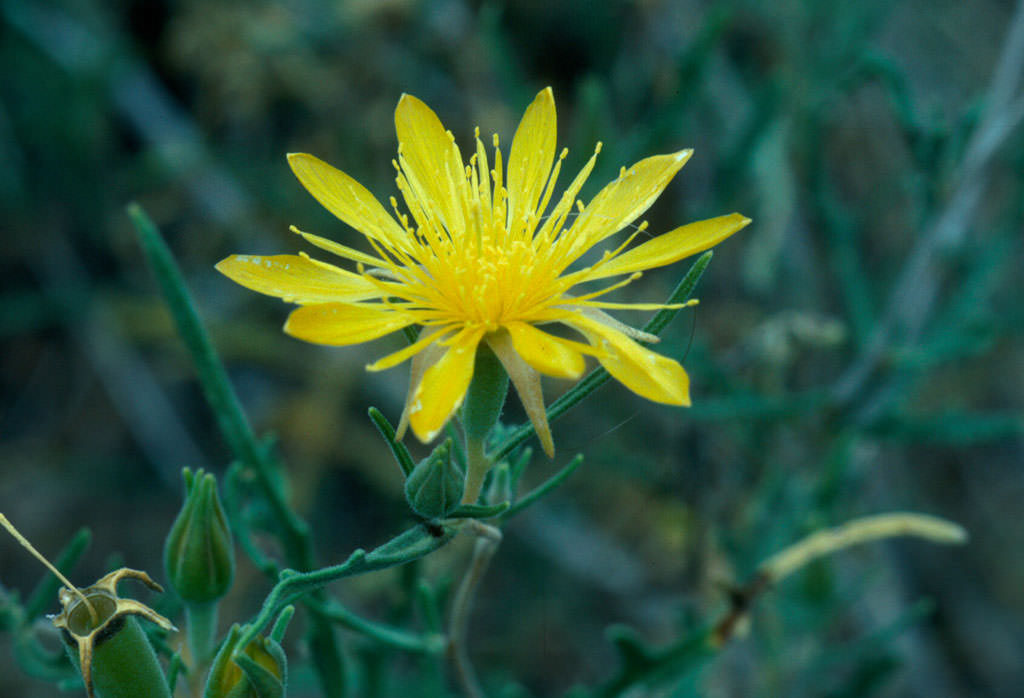
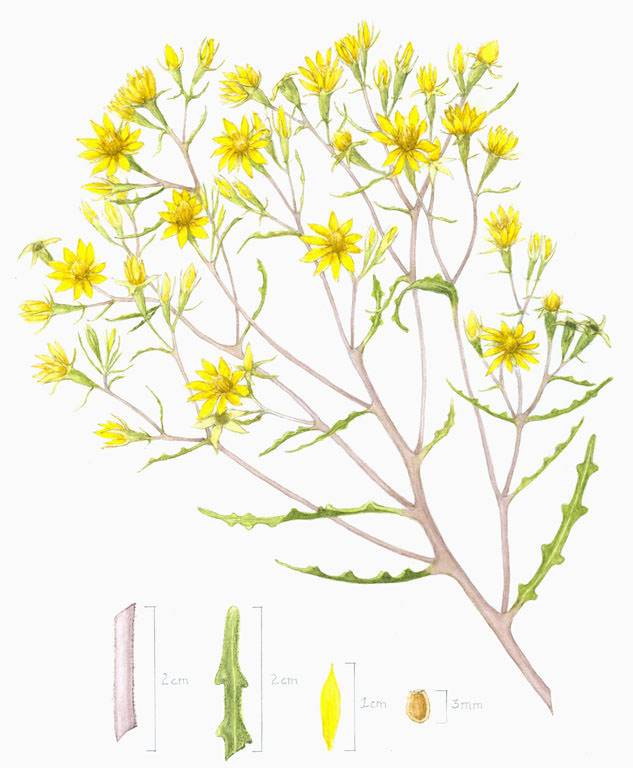
Mentzelia densa is a small perennial subshrub, usually less than 3 dm. tall. The stems branch from the base, giving the plant a hemispherical shape. The branches are white, curve upward and are covered with stiff hairs. The narrow leaves are also covered with stiff hairs. Bright yellow flowers occur singly or in threes at the ends of the branches, and open in the late afternoon. Flowers are about 2 cm. wide. The petals are narrow, widest at the middle, and pointed at the end. The fruit is oblong, 1.3 to 2 cm. long, 1 cm. in diameter and bears teeth that are about half as long as the fruit. Seeds are flattened and are surrounded by a thin, winglike membrane (Coles 1990).
Look Alikes:
Distinguished from other Mentzelia species by its growth form and the presence of the previous years dried stems (Spackman et al. 1997).
Phenology:
Flowering occurs in July through early August; fruit are produced in September (Spackman et al. 1997). The flowers are only open from late afternoon (around 6 p.m.) until dark.
 |
Habitat
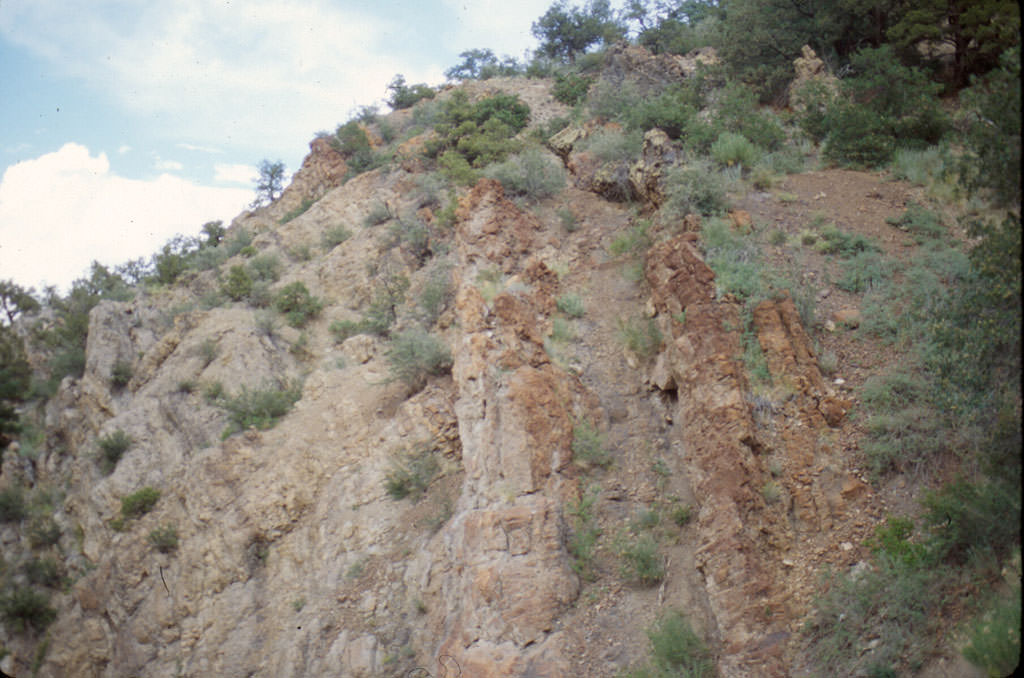
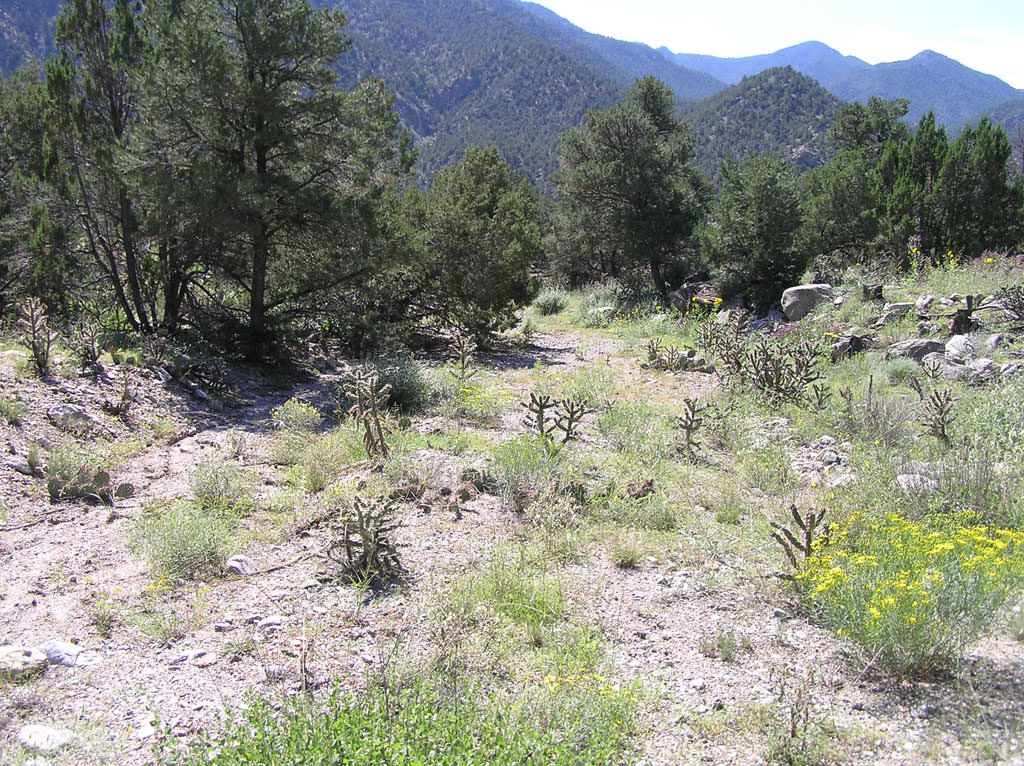
Mentzelia densa occupies dry open areas in washes, roadsides, naturally disturbed sites, and steep rocky slopes. Plants grow in gravel, scree, or on cliffs formed from Precambrian granodiorite and gneiss. The species occurs in pinyon-juniper woodland and lower montane shrubland communities with a poorly developed understory and an open canopy. It may dominate in very open, disturbed sites such as sandy washes. It occurs as scattered individuals generally occupying 5% or less of the total vegetative canopy. The associated species are Pinus edulis, Juniperus monosperma, Juniperus scopulorum, Symphoricarpos oreophilus, Cercocarpus montanus, Artemisia tridentata, Eriogonum jamesii, Oryzopsis humenoides, Oryzopsis micrantha, Mentzelia multiflora var. leucopetala, Bouteloua gracilis, Rhus trilobata, Heterotheca villosa, Cylindropuntia inbricata, and Opuntia phaeacantha (Coles 1990).
click on image to enlarge
 |
 |
Elevation Range:
5,404 - 7,823 feet (1,647 - 2,385 meters)
Distribution
Colorado Endemic:
Yes
Range:
Mentzelia densa is endemic to south central Colorado, USA, where it is known from Fremont and Chaffee counties. The estimated range extent in Colorado of 2396 square kilometers was calculated in GeoCAT using occurrence data provided by the Colorado Natural Heritage Program (2022).
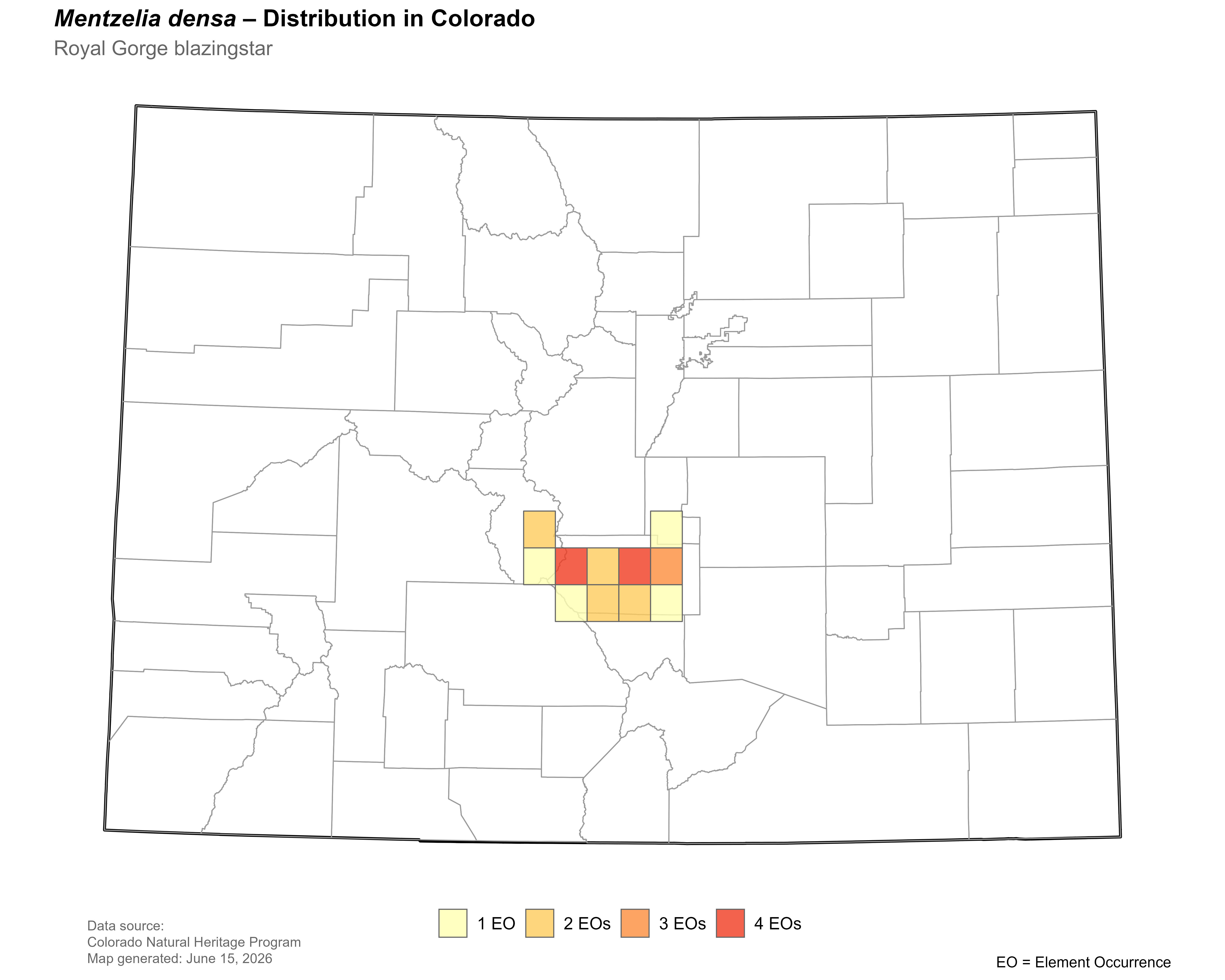
Click on map to enlarge |
Threats and Management Issues
Mentzelia densa is threatened by livestock grazing, road and railroad construction and maintenance, competition from invasive weedy species, and motorized and non-motorized recreation. At least five occurrences report impacts from off-highway vehicle use or trampling by hikers and fisherman (CNHP 2022). Nearly half of the occurrences document invasive plants species as a management concern for the species (CNHP 2022). Several occurrences are found along roads and/or railroad tracks where they may be damaged by maintenance activities. Livestock grazing has also been reported within several occurrences where direct damage by trampling may occur. This species is considered to have moderate adaptive capacity and is expected to be moderately vulnerable to climate change under both RCP 4.5 and 8.5 scenarios, as assessed for the 2025 Colorado State Wildlife Action Plan (CNHP 2025).
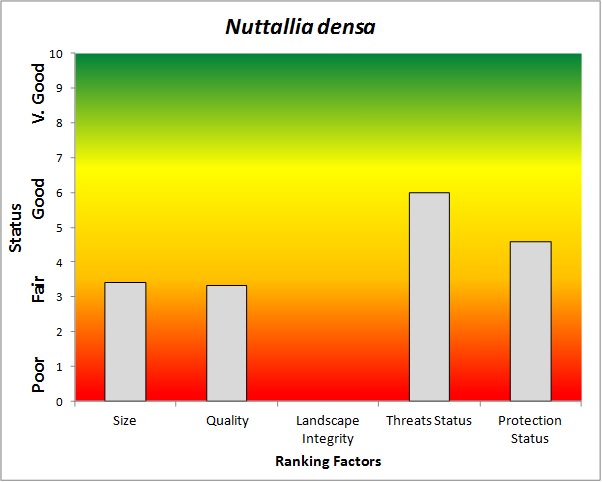
Summary results of an analysis of the status of Nuttallia densa based on several ranking factors. This species was concluded to be moderately conserved. From Rondeau et al. 2011. |
References
- Ackerfield, J. 2012. The Flora of Colorado. Colorado State University Herbarium. 433 pp.
- Coles, J. 1990. Status report for Mentzalia densa. Unpublished report prepared for the Colorado Natural Areas Program, Denver, CO.
- Colorado Native Plant Society. 1989. Rare plants of Colorado. Rocky Mountain Nature Association, Colorado Native Plant Society, Estes Park, Colorado. 73 pp.
- Colorado Natural Heritage Program (CNHP). 2022. Biodiversity Tracking and Conservation System (Biotics 5). Colorado Natural Heritage Program, Colorado State University, Fort Collins.
- Colorado Natural Heritage Program (CNHP). 2025. Climate Change Vulnerability Assessment of Colorado Tier 1 and Tier 2 Plant Species of Greatest Conservation Need (SCGN) for the 2025 Colorado State Wildlife Action Plan. Colorado Natural Heritage Program, Colorado State University, Fort Collins.
- Handwerk, J., L. Grunau, and S. Panjabi. 2015. Colorado Wildlife Action Plan: 2015 Rare Plant Addendum. Colorado Natural Heritage Program, Colorado State University, Fort Collins, Colorado, USA.
- Neely, B., S. Panjabi, E. Lane, P. Lewis, C. Dawson, A. Kratz, B. Kurzel, T. Hogan, J. Handwerk, S. Krishnan, J. Neale, and N. Ripley. 2009. Colorado Rare Plant Conservation Strategy, Developed by the Colorado Rare Plant conservation Initiative. The Nature Conservancy, Boulder, Colorado, 117 pp.
- O'Kane, S. L. 1988. Colorado's Rare Flora. Great Basin Naturalist. 48(4):434-484.
- Rondeau, R., K. Decker, J. Handwerk, J. Siemers, L. Grunau, and C. Pague. 2011. The state of Colorado's biodiversity 2011. Prepared for The Nature Conservancy. Colorado Natural Heritage Program, Colorado State University, Fort Collins, Colorado.
- Spackman, S., B. Jennings, J. Coles, C. Dawson, M. Minton, A. Kratz, and C. Spurrier. 1997. Colorado Rare Plant Field Guide. Prepared for the Bureau of Land Management, the U.S. Forest Service and the U.S. Fish and Wildlife Service by the Colorado Natural Heritage Program.
- USDA, NRCS. 2022. The PLANTS Database. National Plant Data Team, Greensboro, NC 27401-4901 USA.
- Weber, W. A. and R. C. Wittmann. 2012. Colorado Flora, Eastern Slope, A Field Guide to the Vascular Plants, Fourth Edition. Boulder, Colorado. 555 pp.